
Compare Car Insurance Rates in Ohio
See if you qualify for a lower rate in less than 2 minutes



Why Vehicle Weight Is Reshaping Car Insurance in 2026
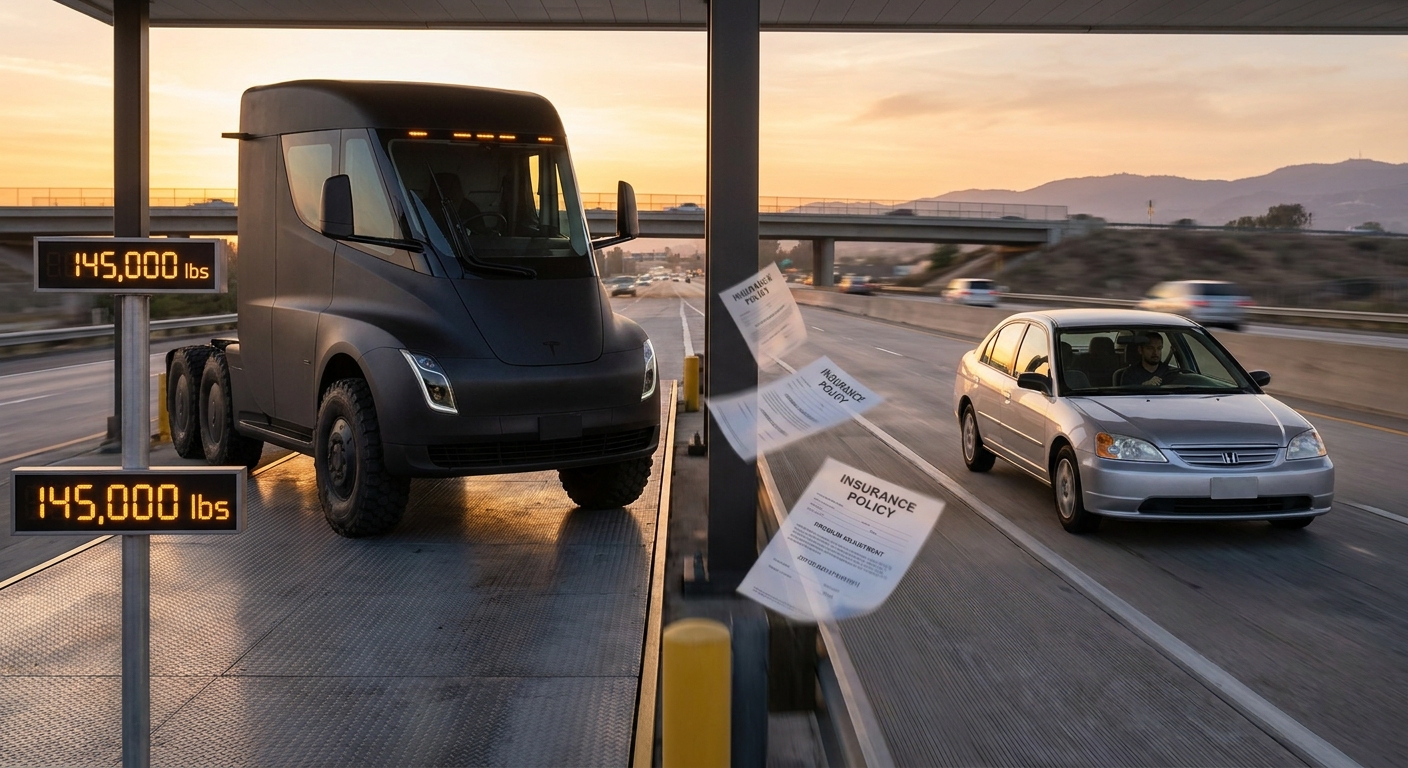
The average new vehicle sold in the United States now tips the scales at approximately 4,400–4,450 pounds — a dramatic climb from the 3,200-lb average of the early 1980s. That weight gain isn't just an engineering footnote. It's becoming one of the most consequential factors shaping what Americans pay for auto insurance in 2026, driven by the explosive growth of full-size SUVs, heavy-duty pickups, and battery-heavy electric vehicles.
While insurers rarely print "vehicle weight surcharge" as a separate line item on your declarations page, the financial impact of driving a heavier vehicle is very real — and it's being priced into your premium in ways most drivers never see. Understanding how and why this works can help you make smarter vehicle and coverage decisions.
The Four Core Reasons Heavier Vehicles Cost More to Insure
Weight doesn't raise your insurance premium arbitrarily. Insurers follow the money — and heavier vehicles generate larger, more frequent, and more expensive claims across the board.
1. Greater Collision Damage to Other Vehicles and Property
Physics drives claims. A heavier vehicle carries significantly more kinetic energy at any given speed, which translates directly into greater destructive force on impact. When a 5,500-lb full-size pickup rear-ends a compact sedan, the energy transferred is exponentially higher than in a collision between two similarly sized cars. The result: higher property damage liability payouts, more frequent total losses for the struck vehicle, and steeper overall claim costs that insurers pass back to policyholders.
2. Higher Bodily Injury Severity for Others
Heavy vehicles don't just damage property — they inflict more serious injuries on the occupants of smaller vehicles, pedestrians, cyclists, and motorcyclists. Insurers price bodily injury liability based on expected payouts per accident, and heavier vehicles consistently produce higher medical costs, longer recovery periods, and larger legal settlements when they are at fault. This creates a direct upward pressure on liability premiums.
3. More Expensive Physical Damage Repairs
Modern trucks and SUVs are loaded with technology: advanced driver assistance systems (ADAS), radar sensors, cameras, large infotainment displays, and aluminum structural components. Repairing these systems after even a minor collision is significantly more expensive than repairing a basic sedan. Couple this with larger body panels, heavier suspension components, and specialized labor requirements, and the collision and comprehensive portions of your premium rise accordingly. Learn more about how repair cost inflation is directly impacting what all drivers pay.
4. Increased Road Wear and Usage Patterns
Heavier vehicles cause disproportionately more wear on road surfaces — a cost that, while not directly billed through your premium, correlates with the types of use patterns that raise insurer risk. Trucks and heavy SUVs are more frequently used for hauling, towing, job-site work, and long highway trips. Higher usage intensity translates into more miles, more exposure, and statistically more claims.

Compare Car Insurance Rates in Ohio
See if you qualify for a lower rate in less than 2 minutes
The Safety vs. Damage Paradox: Safer for You, Costlier for Everyone Else
One of the most counterintuitive dynamics in auto insurance is what experts call the safety paradox of heavy vehicles. In a two-vehicle crash, the heavier, taller vehicle almost always protects its own occupants better — transferring more force to the smaller car, riding up over its lower structure, and insulating its passengers from the worst of the impact.
This is genuinely good news for drivers of trucks and large SUVs. Occupant injury severity is often lower in heavier vehicles, which can modestly reduce medical payments and personal injury protection (PIP) claim costs for those vehicles.
But the paradox is this: the very thing that makes a heavy vehicle safer for you makes it more dangerous for everyone else on the road. Insurers price both sides of this equation.
The net effect for most truck and large SUV owners is higher overall premiums, because the increased liability and physical damage costs far outweigh the small savings on occupant-injury coverage. Insurers analyze historical loss data by vehicle symbol — every make, model, and trim gets its own risk rating — and heavy vehicles consistently show higher bodily injury and property damage payouts when they are at fault.
This paradox is also shaping regulatory conversations. Safety advocates, including state-level transportation agencies, are increasingly studying how fleet weight trends affect pedestrian and cyclist fatalities — a dynamic that could eventually influence how states regulate vehicle classifications and the liability minimums required for larger vehicles. Understanding what affects car insurance rates beyond just vehicle weight can help you see the full pricing picture.

Protect your car with Farmers
Average Rate:
Find coverage options that fit your budget.

The insurance savings you expect.
Average Rate:
Enjoy personalized policies, comprehensive coverage & more.

See how much you could save today!
Average Rate:
Drivers who switch their auto insurance and save with State Farm save $764 on average!

Safe Drivers Save with Allstate®
Average Rate:
Get rewarded with savings for having a clean driving record.
EV Battery Weight: A New Insurance Cost Tier
Electric vehicles have introduced a new dimension to the vehicle weight conversation — and it's one with serious insurance implications. The average EV weighs 20–30% more than a comparable gas-powered vehicle, almost entirely due to the traction battery pack. And that battery isn't just heavy — it's extraordinarily expensive to repair or replace.
What EV Weight Means in Practice
| Vehicle | Approximate Weight | Gas Equivalent | Weight Difference |
|---|---|---|---|
| Tesla Model 3 | ~4,000 lbs | BMW 3 Series (~3,500 lbs) | +500 lbs (+14%) |
| Ford F-150 Lightning | ~6,000+ lbs | Ford F-150 Gas (~4,500 lbs) | +1,500 lbs (+33%) |
| Rivian R1T | ~7,000+ lbs | Ford F-150 Gas (~4,500 lbs) | +2,500 lbs (+56%) |
| Chevy Bolt EUV | ~3,500 lbs | Chevy Trax (~3,000 lbs) | +500 lbs (+17%) |
The battery pack alone can account for up to one-third of an EV's total weight, according to insurance industry data cited by the American Property Casualty Insurance Association (APCIA). That concentrated mass, positioned low in the chassis, changes crash dynamics significantly.
The Total-Loss Problem
Here's the insurance-critical issue: a minor low-speed collision that would be a $3,000 repair on a gas-powered vehicle can become a $25,000 total loss on an EV if the underfloor battery pack is compromised. Battery inspection, module replacement, and pack replacement costs range from $10,000 to $25,000 or more — and because battery packs can represent 30–40% of a vehicle's value, damage near the pack area frequently triggers total-loss decisions.
The result is a measurable premium gap. EVs currently cost 20–50% more to insure than comparable gas vehicles, with many EV owners paying $3,500–$4,100 per year compared to roughly $2,150–$2,500 for gas-powered equivalents. See our full breakdown of EV insurance rates and why the cost gap persists in 2026.
Weight-Based Insurance Pricing: How It Actually Works in 2026
Despite the growing discussion around vehicle weight and insurance costs, no major U.S. personal auto insurer currently applies an explicit, line-item "vehicle weight surcharge" to private passenger policies. However, weight's financial impact is deeply embedded in the way insurers price specific vehicles.
How Weight Gets Priced In
Every vehicle sold in the US receives an insurance symbol — a proprietary rating assigned by insurers based on detailed loss data for that specific make, model, and trim. This symbol directly influences collision, comprehensive, and liability premiums. Vehicles that are heavier, more expensive to repair, and more likely to cause severe damage to others receive higher symbols, which translate to higher base premiums.
| Vehicle Class | Typical Full Coverage Premium Range | Weight Range |
|---|---|---|
| Compact Sedan | $1,400–$1,900/yr | 2,800–3,200 lbs |
| Midsize Sedan | $1,700–$2,200/yr | 3,200–3,800 lbs |
| Midsize SUV/Crossover | $1,900–$2,400/yr | 3,800–4,500 lbs |
| Full-Size Pickup Truck | $1,850–$2,600/yr | 4,500–5,500 lbs |
| Heavy-Duty Truck/Large SUV | $2,000–$3,000+/yr | 5,500–7,000+ lbs |
| Electric Vehicle (avg) | $3,281–$4,058/yr | 3,500–7,000+ lbs |
The Commercial Threshold
When vehicles exceed approximately 10,000 lbs Gross Vehicle Weight Rating (GVWR) — think commercial work trucks, large vans, or dually pickups used for business — they typically cross into commercial auto insurance territory, where weight is explicitly factored into rating tiers. Commercial truck policies can run $3,500–$20,000+ per year depending on vehicle class, cargo, and usage.
For personal vehicles, regulators in several states are actively studying the relationship between fleet weight trends, pedestrian fatalities, and liability minimums — a policy area that could eventually formalize weight considerations into rating rules. Stay informed about car insurance industry trends that may affect pricing in your state. You can also review how car insurance premiums are calculated to better understand the vehicle-symbol pricing system behind your rate.
How Truck and SUV Owners Can Reduce Insurance Costs
Driving a heavy vehicle doesn't mean accepting a higher premium without a fight. There are meaningful strategies that can offset the weight-related cost burden — sometimes by 20–30% or more.
1. Enroll in a Telematics Program
Usage-based insurance (UBI) programs — like State Farm's Drive Safe & Save, Progressive's Snapshot, and Nationwide's SmartRide — track your actual driving behavior and reward smooth, safe driving with discounts of 10–30% (up to 40% with some carriers). If you drive your truck or SUV at moderate speeds, brake gently, and avoid high-risk hours, telematics can significantly offset the base premium penalty for vehicle weight.
2. Stack Multi-Vehicle and Bundling Discounts
If your household has multiple vehicles, insuring them all on a single policy can save 7–25% per vehicle. Bundling auto with homeowners insurance adds another 7–25% off. Together, these two moves alone can counteract much of the weight-related premium increase.
3. Maximize Safety-Feature Discounts
Modern trucks and SUVs are equipped with advanced safety technology — automatic emergency braking, blind-spot monitoring, lane-keep assist, and anti-theft systems. Make sure your insurer has documented every factory safety feature. Anti-theft discounts can reach ~23%, and passive restraint discounts can go as high as 30–40% with some carriers.
4. Adjust Your Deductibles Strategically
Raising your collision and comprehensive deductible from $500 to $1,000 can reduce those coverage costs by 10–20%. For older trucks and SUVs that are fully paid off, evaluate whether maintaining full collision coverage makes financial sense given the vehicle's current market value.
5. Shop and Compare at Every Renewal
Different insurers use different vehicle symbols and loss data, which means premiums for the same truck can vary by $400–$800+ per year across carriers. Comparison shopping at each renewal — or using an independent broker — is the single most reliable way to find the best rate for a heavy vehicle. Learn more about how car insurance rates in 2026 are trending so you can time your shopping effectively.
Frequently Asked Questions
Does vehicle weight directly affect car insurance rates?
Not as an explicit line item, but yes — vehicle weight has a significant indirect effect on your premium. Heavier vehicles generate larger claim payouts when they cause accidents, require more expensive repairs, and carry a higher risk of total loss. Insurers embed all of these weight-related risk factors into each vehicle's insurance symbol, which directly determines your base rate. The heavier and more expensive a vehicle is, the higher its symbol tends to be.
Why do electric vehicles cost more to insure if they're considered safer?
EVs may have advanced safety technology, but their heavy battery packs create a unique insurance problem. A battery pack can weigh up to one-third of the vehicle's total mass and cost $10,000–$25,000 to replace. Even minor undercarriage damage can trigger a total loss. Additionally, EVs cost 25–30% more per claim to repair than comparable gas vehicles due to specialized parts and limited repair shop availability. These factors push EV premiums 20–50% higher than gas equivalents despite their safety features.
What is the average weight of a vehicle in the US in 2026?
The average new vehicle sold in the United States currently weighs approximately 4,400–4,450 pounds, up from about 3,200 pounds in the early 1980s. This increase is driven almost entirely by the shift in consumer preference toward SUVs, crossovers, and full-size pickups, which now make up the majority of new vehicle sales. Electric vehicles are adding additional weight to the fleet, as their battery packs add hundreds to thousands of pounds compared to gas equivalents.
Are any insurance companies explicitly charging a weight surcharge in 2026?
No major U.S. personal auto insurer currently applies an explicit "vehicle weight surcharge" as a visible line item on private passenger policies. However, the weight-related premium impact is real — it's built into each vehicle's insurance symbol and base rate. Commercial auto policies for vehicles above certain GVWR thresholds do use weight-based rating tiers explicitly. Regulatory conversations around fleet weight and pedestrian safety could eventually bring more formal weight-based rating rules to personal auto markets.
Can I lower my truck or SUV insurance even though my vehicle is heavy?
Absolutely. Enrolling in a telematics program (saving up to 30–40%), stacking multi-vehicle and bundling discounts (saving 15–50% combined), ensuring all factory safety features are documented, raising deductibles strategically, and comparison shopping at every renewal are all proven strategies. Heavy vehicle owners who take a proactive approach to discounts and carrier comparison can often offset 20–30% of the weight-related premium premium penalty. Understanding how car insurance premiums are calculated can help you identify exactly where you have leverage.