
Compare Car Insurance Rates in Ohio
See if you qualify for a lower rate in less than 2 minutes



Why Insurance Companies Pull Out of State Markets
When an insurance company exits your state entirely, it's rarely a snap decision. It almost always comes down to one thing: the math no longer works. Here are the primary reasons insurers walk away from state markets — and what's changed heading into 2026.
Catastrophic Losses Are Breaking the Model
Climate-driven disasters are fundamentally changing the risk calculus for insurers. Wildfires, hurricanes, and severe storms have driven insured losses to record levels in recent years. California's January 2025 Los Angeles wildfires alone triggered over $40 billion in insured losses, and the state's FAIR Plan enrollment has surged to approximately 684,000+ policies — up roughly 152% since 2022. As long as climate-related disasters intensify, this trend won't reverse on its own. Learn more about how severe weather is pushing car insurance rates higher across the country.
Regulatory Rate Suppression
In states like California, regulations make it extremely difficult for insurers to price risk accurately. California's Proposition 103 — a decades-old law — restricts how quickly and easily insurers can raise rates to match real-world losses, inflation, and reinsurance costs. The result? More than 34 insurers have paused or exited California's property market, including State Farm, Farmers, Allstate, and Nationwide. California's Sustainable Insurance Strategy (SIS), which has been rolling out since 2023 and was actively advancing through 2025–2026, now allows insurers to use catastrophe modeling in rate filings and to recover reinsurance costs — in exchange for committing to write at least 85% of their statewide market share in high wildfire-risk areas. Legislative oversight hearings as recently as February 2026 confirm the strategy is still being actively monitored and refined. Understanding how state insurance regulation affects your rates is key to knowing why your state's rules matter so much.
Reinsurance Costs and Profitability Crunches
Reinsurance — the insurance that insurers buy to protect themselves — has become dramatically more expensive in high-risk states. When reinsurance costs spike, an insurer's entire book of business in a region can become unprofitable overnight, even if they're collecting what seem like healthy premiums from individual customers. Combined with regulatory restrictions on rate increases, many carriers simply have no viable path to profitability.
State-by-State Snapshot
| State | Main Risk Factor | Market Status (2026) |
|---|---|---|
| California | Wildfire | 34+ insurers paused or exited; FAIR Plan up ~152% since 2022; SIS reforms actively rolling out through 2026 |
| Florida | Hurricane | Market stabilizing; 17 new insurers entered post-reforms; top 5 auto insurers filed ~8% average rate decreases for 2026 |
| Louisiana | Hurricane & Litigation | Auto premiums fell 5.8% in 2025 following tort reforms; 20+ carriers filed rate decreases; 60-day notice requirement effective July 1, 2026 |
| Texas | Convective storms | Elevated premiums; new 2026 law requires written reasons for all non-renewals |
| Nevada | Urban density & accidents | Among the highest average full-coverage rates nationally at ~$335/month |

Compare Car Insurance Rates in Ohio
See if you qualify for a lower rate in less than 2 minutes
Understanding Your Non-Renewal Notice and Your Rights
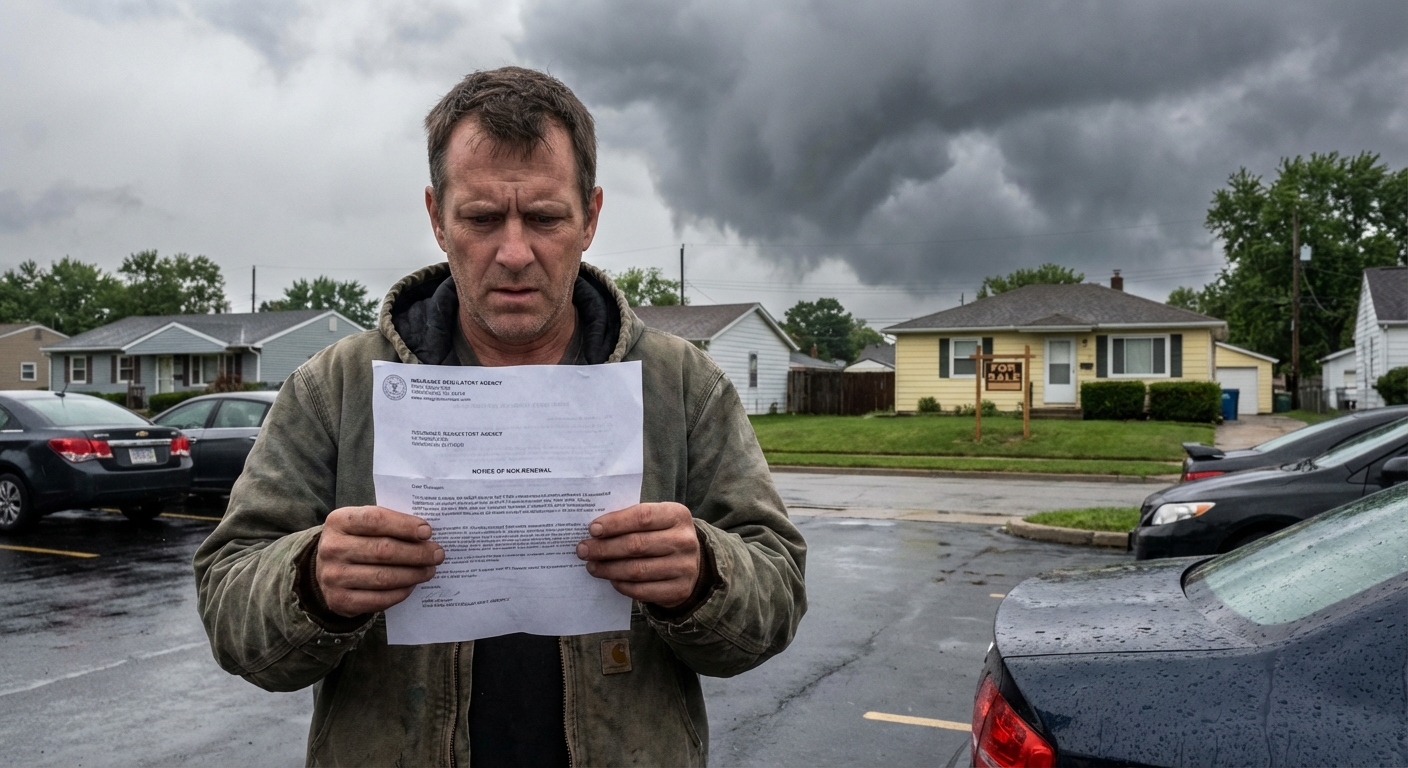
Receiving a non-renewal notice can be alarming, but understanding what it means — and what you're legally entitled to — puts you back in control.
What a Non-Renewal Actually Means
A non-renewal means your insurer will not continue your policy when it expires at its natural end date. This is different from a mid-term cancellation, which ends coverage early (usually for serious reasons like non-payment or fraud). Non-renewals are generally less drastic — your coverage remains fully active until the stated expiration date, giving you time to act.
When an insurer withdraws from an entire state, they must non-renew all policyholders in that market. The trigger is a business-level decision, not a reflection of your individual driving record. Learn more about the difference between policy cancellation and non-renewal so you know exactly which situation you're dealing with.
How Much Notice Are You Required to Receive?
State laws vary widely, but most require insurers to provide 30 to 60 days' written notice before a policy expires without renewal. Some notable examples include:
| State | Non-Renewal Notice Period | Notes |
|---|---|---|
| Kentucky | 75 days | Among the longest required |
| Texas | 60 days | + Written reason now required as of Jan 1, 2026 |
| Louisiana | 60 days | Extended from 30 days; effective July 1, 2026 |
| Nebraska / New Jersey | 60 days | Standard for these states |
| Florida / Maryland / NC | 45 days | Standard for these states |
| Illinois / Delaware | 30 days | Shorter window — act fast |
The notice must be mailed to your last known address and must clearly state the specific reason for non-renewal. A noteworthy 2026 update: Texas now requires insurers to provide written reasons for non-renewals, effective January 1, 2026, giving consumers greater transparency.
Your Rights as a Policyholder
- Right to a written explanation: Insurers must provide a specific reason for non-renewal, not vague language. Texas now legally mandates this as of 2026.
- Right to a reasonable notice period: You are legally entitled to adequate time to secure new coverage. If a notice is untimely, many states force the policy to auto-extend.
- Right to appeal: In many states, you can file a complaint with the State Department of Insurance if you believe a non-renewal was improper.
- Protection from discrimination: Insurers cannot non-renew based on protected characteristics like age, race, gender, or marital status.
- Right to a premium refund: If you've paid beyond the cancellation date, any unused portion of your premium must be returned.
If you believe your non-renewal was handled improperly, contact your State Insurance Commissioner — they can investigate complaints, mediate disputes, and in some cases compel insurers to reinstate or extend coverage.

Protect your car with Farmers
Average Rate:
Find coverage options that fit your budget.

The insurance savings you expect.
Average Rate:
Enjoy personalized policies, comprehensive coverage & more.

See how much you could save today!
Average Rate:
Drivers who switch their auto insurance and save with State Farm save $764 on average!

Safe Drivers Save with Allstate®
Average Rate:
Get rewarded with savings for having a clean driving record.
How to Find Replacement Car Insurance in a Tight Market
Finding new coverage when insurers are pulling back from your state requires a more strategic approach than a normal insurance switch. Here's how to navigate the process effectively.
Step-by-Step Replacement Coverage Checklist
| Step | Action | Timeline |
|---|---|---|
| 1 | Read your non-renewal notice carefully; note the exact expiration date | Day 1 |
| 2 | Contact your current insurer — ask if they offer any bridge options | Days 1–3 |
| 3 | Confirm your state's minimum coverage requirements | Days 1–3 |
| 4 | Get quotes from at least 3–5 insurers, using both direct and agent channels | Days 4–14 |
| 5 | Bind new coverage with a start date before your old policy expires | 7+ days before expiration |
| 6 | Cancel old policy and request any premium refund | After new coverage is active |
Work With an Independent Insurance Agent
In a restricted market, an independent agent can be your most valuable asset. Unlike captive agents who represent one company, independent agents have access to multiple carriers — including specialty and surplus lines insurers that don't advertise directly to consumers. They know which carriers are actively writing policies in your state and can often negotiate better terms. Brokers can provide access to 50 or more carriers at once, dramatically improving your odds of finding affordable coverage in a restricted market.
Don't Automatically Take the First Quote
Even in a tight market, premiums vary significantly between carriers. Get at least 3–5 comparable quotes. When comparing, make sure you're matching coverage levels — identical liability limits, deductibles, and add-ons — so you're doing an apples-to-apples comparison. A market-wide non-renewal is a business decision, not a personal one, so your driving record and claims history remain the primary factors other insurers will use to rate you. If you're worried about being flagged, review our guide on how to get reconsideration after a denial for additional strategies.
Carriers That Are More Tolerant of Non-Renewals
If you've received a non-renewal — even for reasons tied to your driving record — certain carriers are known to be more flexible when offering replacement coverage:
| Company | Notes on Non-Renewal / Lapse Tolerance |
|---|---|
| USAA | Best post-lapse rates; military/veterans and their families only |
| Progressive | Does not heavily penalize lapses; starting around $75/month; high-risk friendly |
| GEICO | Minimal lapse penalties; competitive rates across most states |
| Travelers | Among the lowest post-lapse rates for standard drivers |
| State Farm | Widely available; good for rebuilding coverage history |
If you cannot secure coverage through any standard or specialty carrier, explore non-standard auto insurance options for a bridge solution while rebuilding your profile.
The Assigned Risk Pool: Your Coverage of Last Resort
If you've exhausted every standard and specialty market option and still can't find coverage, your state's assigned risk pool (also called a residual market plan) guarantees you access to at least the minimum legal coverage required in your state. Learn more about how the assigned risk pool works and what to expect when you're placed in one.
The assigned risk pool is mandatory — all licensed insurers in your state must participate, and the state assigns you to one of them. It fulfills your legal obligation to carry insurance, but it comes at a real cost. Rates are typically much higher than comparable standard market coverage. Use this as a bridge, not a long-term solution.
What to Expect for Rates in 2026
The national average annual full-coverage car insurance premium sits between approximately $2,144 and $2,697 as of 2026, depending on the source and driver profile. The picture varies widely at the state level:
| State | Estimated Monthly Full Coverage | Notes |
|---|---|---|
| Nevada | ~$280–$335/month | Consistently among the highest nationally |
| Louisiana | ~$210–$277/month | Improving; 5.8% avg. drop in 2025 |
| Florida | ~$229–$264/month | Stabilizing; new carriers entering |
| California | ~$182–$197/month | Rising; market still strained |
| Vermont / Wyoming | ~$91–$128/month | Among the cheapest nationally |
If you're in a climate-exposed state where an insurer is actively withdrawing, budget for a potential premium increase when securing replacement coverage. For a full breakdown, see our guide on car insurance rates by state and our deep dive into the 2026 car insurance affordability crisis. That said, in states like Florida and Louisiana where tort reforms are taking hold, meaningful rate relief is already underway.
Frequently Asked Questions
What should I do first when I receive a non-renewal notice from my car insurer?
Read the notice carefully to find the exact expiration date and the reason given for non-renewal. Do not wait to take action — begin shopping for replacement coverage immediately, ideally within the first few days of receiving the notice. Contact your current insurer to ask if any options exist and confirm whether they offer coverage through a different product or subsidiary. Your goal is to have a new policy bound before your current one expires to avoid any gap in coverage.
Can I be left completely without car insurance options if my insurer leaves my state?
No. Every state in the U.S. maintains an assigned risk pool (or residual market plan) that legally guarantees access to minimum liability coverage for any driver who cannot obtain insurance through the standard private market. It is more expensive than standard coverage and typically limited in scope, but it ensures you can legally drive while you continue searching for better options through specialty or non-standard insurers. Being non-renewed by one insurer does not make you uninsurable — many drivers secure standard policies elsewhere after a market-wide exit event. Learn more about what happens after a car insurance lapse if you do hit a coverage gap.
Will a non-renewal because my insurer left the state count against me when shopping for new coverage?
Generally, no. A market-wide withdrawal is a business decision made at the company level, not a reflection of your individual risk profile. When shopping for new coverage, other insurers should treat you the same as any other customer — your driving record, claims history, and credit score (where applicable) will be the primary rating factors. However, if you also have a poor driving record or prior claims, that can compound your difficulty in a tight market. Review the difference between cancellation and non-renewal to understand what each means for your coverage history.
How can I prevent being caught off guard by an insurer market exit in the future?
Stay informed about your state's insurance market through your State Department of Insurance website, which publishes insurer withdrawals and complaints. Maintain a strong driving record and continuous coverage history — both make you more attractive to a wider range of carriers. Set a calendar reminder 60–90 days before each policy renewal to compare rates proactively, regardless of whether you plan to switch. It's also worth understanding how car insurance requirements and costs differ by state so you're never caught off guard by local rules.
Are Florida and Louisiana insurance markets still in crisis?
Both markets have seen meaningful improvement in recent years. Florida's market has stabilized significantly — 17 new insurers entered following tort reforms passed in 2022–2023, and the state's top auto carriers filed for average rate decreases of approximately 8% for 2026. Louisiana similarly passed sweeping tort reforms, resulting in a statewide average auto premium drop of 5.8% in 2025, with more than 20 insurers filing rate reductions. The worst of the crisis appears to be easing in both states as private insurers regain confidence — though homeowners insurance can still be costly. See our full breakdown of the 2026 car insurance affordability crisis for context on where costs still hurt the most.