
Compare Car Insurance Rates in Ohio
See if you qualify for a lower rate in less than 2 minutes



Who Verifies Your Car Insurance and Why
Car insurance verification isn't just a one-time box to check at the DMV. Multiple parties have the authority, and in many cases the legal obligation, to confirm that your vehicle is covered by an active, compliant insurance policy.
The DMV / State Motor Vehicle Agency
Your state's Department of Motor Vehicles (or equivalent agency) is the primary enforcer of insurance verification. Most states require proof of insurance before they'll issue or renew your vehicle registration. But it doesn't stop there. Many states run periodic electronic checks after registration to make sure coverage hasn't lapsed. If a gap is detected, you'll typically receive a notice giving you 15 to 45 days to provide proof before your registration is suspended. Learn how car insurance and vehicle registration requirements are legally tied together in your state.
Law Enforcement During Traffic Stops
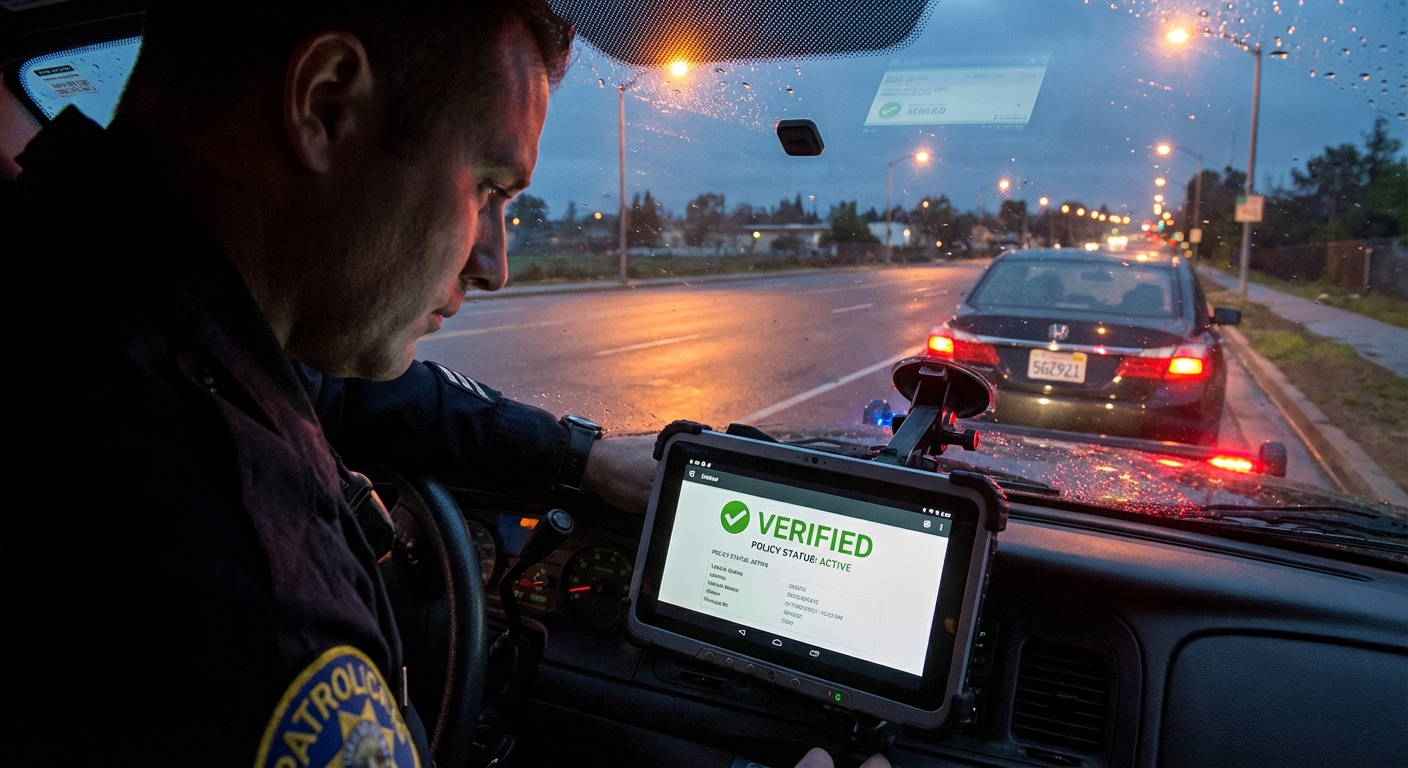
Police officers can verify insurance in real time during a traffic stop. In states with active electronic verification systems, officers can run your license plate or VIN through a database and see your coverage status within seconds, no paper card required. That said, most states still allow you to show a physical or digital insurance card on your smartphone.
Lenders and Auto Dealerships
If you're financing or leasing a vehicle, your lender has a direct financial interest in making sure that car is insured. Lenders typically verify coverage through automated APIs, manual checks with insurers, or customer-submitted proof like insurance cards or declarations pages. They require comprehensive and collision coverage in addition to state minimums. If your insurance lapses, your lender may purchase "force-placed" insurance on your behalf at a 2026 cost of roughly $350 per month (about three times the standard full-coverage average), and add it to your loan balance. Learn more about lienholder requirements and what happens when a lender is on your policy. Under federal rules (12 C.F.R. § 1024.37), lenders must send two written notices before force-placing coverage and refund any overlapping premiums within 15 days if you provide proof of insurance.
After an Accident
When a claim is filed, insurance companies will verify coverage for all parties involved. This includes confirming policy status, coverage limits, and whether the accident occurred within the active policy period. Law enforcement reports and third-party verification tools are often used to cross-check information. Learn more about how to verify another driver's coverage after a crash.

Compare Car Insurance Rates in Ohio
See if you qualify for a lower rate in less than 2 minutes
How Electronic Insurance Verification Works
Gone are the days of purely paper-based insurance checks. Today, roughly 34 states use some form of real-time electronic insurance verification (EIV) to confirm vehicle coverage at scale, up from about 27 in 2020, and the systems are rapidly becoming more sophisticated.
The Role of IICMVA Standards
Most state systems are built around standards set by the Insurance Industry Committee on Motor Vehicle Administration (IICMVA). These standards define how states and insurers exchange data, using secure web services and standardized data fields like:
- NAIC Code (identifies the insurance company)
- Vehicle Identification Number (VIN)
- Policy Number
- Coverage effective and expiration dates
When a verification request is triggered, the state's system sends a standardized electronic query directly to the insurer's database and receives a response, typically "verified" or "not verified," within seconds. IICMVA's Online Insurance Verification Model Legislation Version 1.2 was created on January 27, 2026 and last updated March 23, 2026, and new state laws increasingly reference this model for uniformity. The related Model User Guide for Implementing Web Services (Version 7.0) remains the baseline technical specification.
No Single National Database
It's a common misconception that there's one giant national insurance database. There isn't. Each state operates its own verification system and queries individual insurers' databases directly. Insurers are required to participate in these systems and keep their policy data current. In Maryland, for example, since January 1, 2025 all insurers must submit weekly book-of-business files listing their active policies with Maryland-registered vehicles, which the MVA then processes for real-time coverage checks.
State System Updates: 2025 to 2026
The push for real-time online verification is accelerating nationwide. Each new system has historically cut the share of uninsured drivers by two to four percentage points within two years. Here's where things stand as of mid-2026:
- Pennsylvania enacted Act 3 of 2026 (House Bill 710), signed by Governor Josh Shapiro on February 12, 2026. The law directs PennDOT to establish an Online Liability Verification (OLV) system to electronically confirm insurance status directly with insurers, and gives PennDOT roughly 18 months to build or contract the system, targeting late 2027 for full operation. The law also gives law enforcement a way to spot counterfeit insurance cards during traffic stops.
- New Jersey introduced Assembly Bill A4360 (with companion Senate Bill S1805) on February 19, 2026 for the 222nd Legislature. The proposed "Motor Vehicle Insurance Verification Act" would require the Motor Vehicle Commission to establish an IICMVA-compliant online verification system. As of mid-2026, the bill remains pending.
- Kentucky amended KRS 186A.040 through House Bill 390 (2025 session), requiring an accessible online insurance verification system interfaced with AVIS to be operational and available to insurers no later than October 1, 2026, with requestor access by January 1, 2027. Insurers must follow IICMVA standards under the KentuckyIVS Implementation Guide issued in late 2025.
- Kansas signed SB 42 (the Kansas Real Time Motor Vehicle Insurance Verification Act) on April 4, 2025. The law took effect July 1, 2025, and the verification system must be fully operational no later than July 1, 2026, following a testing period of not less than nine months.
- Missouri activated the Missouri Insurance Verification System (MOIVS) following the Department of Commerce and Insurance's Bulletin 25-09 issued in September 2025, with insurer system activation on March 16, 2026. 2026 registration renewals now use real-time policy checks.
- Maryland launched its new Online Verification (OLV) process in January 2025, with weekly insurer book-of-business submissions powering real-time checks during registration.
- New York Governor Hochul signed S.5331-A into law on November 12, 2025, replacing the old batch-update process with a real-time system that allows the DMV, law enforcement, and other agencies to verify coverage instantly. Full implementation is set for December 31, 2028.
- Mississippi continues to operate its DRIVe system, which has enabled real-time roadside insurance checks by license plate or VIN since 2017.
- Ohio and other states have proposed similar legislation for the 2026 to 2027 sessions. Ohio has operated an electronic random-sample verification program for years and continues to consider a fully real-time upgrade.
What Triggers a Verification Check?
| Trigger | Who Initiates It |
|---|---|
| Vehicle registration or renewal | State DMV |
| Periodic automated scan (often 2x/year) | State DMV |
| Traffic stop | Law enforcement |
| After an accident | Insurer / law enforcement |
| Loan origination or lapse | Auto lender |
Learn more about how vehicle registration requirements differ across all 50 states.

Protect your car with Farmers
Average Rate:
Find coverage options that fit your budget.

The insurance savings you expect.
Average Rate:
Enjoy personalized policies, comprehensive coverage & more.

See how much you could save today!
Average Rate:
Drivers who switch their auto insurance and save with State Farm save $764 on average!

Safe Drivers Save with Allstate®
Average Rate:
Get rewarded with savings for having a clean driving record.
What Gets Checked and How to Provide Proof
Information Verified During a Coverage Check
When any authorized party verifies your car insurance, here's what they're typically looking at:
- Policy active status: Is the policy currently in force?
- Coverage type: Does it meet the state's minimum requirements (liability, PIP, etc.)?
- Coverage limits: Are the limits adequate for legal or lender requirements?
- Effective and expiration dates: Is the coverage valid for the time period in question?
- Policyholder and vehicle details: Do the name, VIN, and plate number match records on file?
- Endorsements or exclusions: Are there any changes or limitations on the standard policy?
How to Provide Proof of Insurance
Most states accept the following as valid proof of insurance:
- Physical insurance ID card issued by your insurer
- Digital insurance card displayed on your smartphone (accepted in 49 states plus D.C. as of 2026)
- Certificate of Insurance (COI), more common in commercial or fleet situations
- Insurance declarations page, used when contesting a verification failure or working with a lender
- SR-22 or FR-44 filing, required after certain violations and filed directly by your insurer with the state
Common Reasons Verification Fails
Even if you're insured, your verification can come back as "not verified." The most frequent culprits are:
- VIN or data mismatches between your policy and DMV records, one of the most common triggers. Learn how to fix a VIN mismatch before it derails a claim.
- Reporting delays where insurers haven't submitted updated data to the state system yet
- System communication errors, especially in states still running batch-update processes rather than real-time systems
- Brief policy lapses where even a gap of a few days can trigger an automated flag
- Outdated or expired policy documents if your insurer hasn't refreshed data since renewal
What Happens If Verification Fails
Failing an insurance verification check, whether because you're actually uninsured or due to a reporting error, carries serious consequences. According to the Insurance Research Council's most recent study, 15.4% of U.S. drivers were uninsured in 2023, up from 12.6% in 2017, with combined uninsured and underinsured motorists reaching 33.4% nationally. Mississippi (28.2%), New Mexico (24.1%), and Washington D.C. (23.1%) have the highest uninsured rates, while Maine has the lowest at just 5.7%. Eight states plus D.C. now have uninsured rates above 20%. These figures are driving states to expand and modernize their verification systems rapidly. Read our full breakdown of the uninsured motorist crisis for state-by-state details, and see how penalties for driving uninsured vary from modest fines to jail time for repeat offenders.
Immediate Consequences
- Vehicle registration suspension: Your plates become invalid and it's illegal to drive.
- Notice from the DMV: Most states give you 15 to 45 days to respond with proof of coverage.
- Reinstatement fees: Illinois charges a $100 to $500 reinstatement fee to restore suspended plates, Nevada charges up to $1,000 for repeat offenses, and South Carolina charges a $700 uninsured reinstatement fee.
- Vehicle impoundment if you're caught driving with a suspended registration.
Long-Term Financial Impact
A coverage lapse doesn't just create legal problems, it hits your wallet for months afterward. Short lapses of 30 days or less typically raise premiums by an average of 8 to 11%, while lapses of more than 30 days can push increases to 35% or higher, potentially adding hundreds of dollars to your annual premium. Some insurers punish longer gaps far more aggressively, with some carriers raising rates 45 to 60% for lapses of 45 to 60 days, and 40 to 50% or more for 90-day gaps. With Insurify's 2026 Mid-Year Auto Report placing the national full-coverage average at $2,237 per year (up 1% since the end of 2025), and other trackers such as The Zebra reporting $2,256 (up 3% year over year) and Experian at $2,266, a lapse-driven 35% surcharge could tack on more than $780 per year. Rate impacts typically last 3 to 5 years. If your policy has already lapsed, read our step-by-step guide on what to do after a car insurance lapse.
State-Specific Penalties Snapshot
| State | Penalty for Failed Verification / Driving Uninsured |
|---|---|
| New York | $150 to $1,500 fine; up to 15 days jail; 1-year license revocation |
| Massachusetts | $500 to $5,000 fine and/or up to 1 year jail; $500 RMV reinstatement fee |
| Kentucky | $500 to $1,000 fine; registration revoked; up to 90 days jail |
| Kansas | Misdemeanor; $300 to $2,500 fine; license suspension |
| Illinois | $500 to $1,000 fine plus registration suspension |
| Pennsylvania | $300 minimum fine; 3-month license and registration suspension (or $500 civil penalty once per 12 months) |
| Nevada | $250 to $1,000 fine; escalating reinstatement fees |
| Texas | $175 to $350 base fine (first offense); $350 to $1,000 for repeat offenses under Tex. Transp. Code §601.191 |
| Tennessee | $300 fine (Class C misdemeanor); up to $2,500 with injury accident |
| Missouri | Registration suspension through MOIVS system |
| Florida | $150 to $500 (first offense); up to 3-year suspension |
| Virginia | $600 fee; 180-day suspension; SR-22 required for 3 years |
| Mississippi | $300 (1st), $400 (2nd), $500 (3rd+); criminal misdemeanor |
| North Carolina | $50 to $150 fine; 30-day suspension |
| Michigan | $200 to $500 fine; suspension; up to 1 year jail |
| New Jersey | $300 to $1,000 fine; suspension; up to 14 days jail |
| South Carolina | $100 to $200 fine; $700 reinstatement fee; suspension until proof provided |
| California | $100 minimum (1st, ~$450 with assessments); $200 to $500 (2nd within 3 years, up to ~$2,500 with assessments) |
After certain violations, you may also be required to file an SR-22 certificate with your state, a form that your insurer submits to prove you're carrying at least the minimum required coverage. Also be aware that lying on your policy to avoid a surcharge can trigger material misrepresentation penalties that are far worse than the original lapse. Before your next renewal, it's smart to run through a policy review checklist to make sure your data is current on file with the state.
Frequently Asked Questions
What is car insurance verification?
Car insurance verification is the process of confirming that a vehicle is covered by an active, compliant auto insurance policy. It can be performed by state DMVs, law enforcement, lenders, or insurance companies themselves. Modern verification typically uses electronic systems that query insurer databases in real time using data like your VIN and policy number. The goal is to enforce state minimum insurance requirements and protect all drivers on the road.
How does electronic insurance verification work?
Electronic insurance verification works by sending a standardized data request, typically containing your VIN, NAIC insurer code, and policy number, from an authorized party (like the DMV) to your insurer's database. The insurer's system responds in real time with a "verified" or "not verified" status. These systems follow IICMVA standards, with Model Legislation Version 1.2 created January 27, 2026 and last updated March 23, 2026. No single national database exists; each state queries insurers directly, and roughly 34 states now run some form of real-time verification as of 2026.
What happens if my car insurance can't be verified?
If your car insurance cannot be verified, you'll typically receive a notice from your state DMV giving you 15 to 45 days to provide proof of coverage. If you fail to respond, your vehicle registration can be suspended, making it illegal to drive. Even if you're actually insured, you can fail verification due to reporting delays or VIN mismatches, in which case you should contact your insurer and request a letter confirming continuous coverage. Additional consequences can include fines, reinstatement fees, and higher insurance premiums upon renewal.
Can a coverage lapse significantly raise my car insurance rates?
Yes. Even a short lapse of 30 days or less can raise your premiums by an average of 8 to 11%, while a lapse longer than 30 days can push rates up by 35% or more. Some insurers raise rates 45 to 60% for lapses of 45 to 60 days and 40 to 50% or more for 90-day gaps, and the surcharge can stay on your record for 3 to 5 years. You may also lose continuous coverage discounts you had previously earned, so reinstate your policy as quickly as possible during any waiting period or grace period.
Which states are rolling out new electronic insurance verification systems?
The trend toward real-time online verification is growing fast. Pennsylvania enacted Act 3 of 2026 (HB 710) on February 12, 2026, with PennDOT given roughly 18 months to build the OLV system. New Jersey introduced A4360/S1805 on February 19, 2026, Kentucky's system must be operational for insurers by October 1, 2026 under HB 390, Kansas' SB 42 requires full operation by July 1, 2026, Missouri activated MOIVS on March 16, 2026, and New York signed its real-time law on November 12, 2025 with full implementation by December 31, 2028. See our guide on vehicle registration requirements for the latest details by state.