
Compare Car Insurance Rates in Ohio
See if you qualify for a lower rate in less than 2 minutes



Method 1: Check Your Own Policy Through Insurer Apps & Online Portals
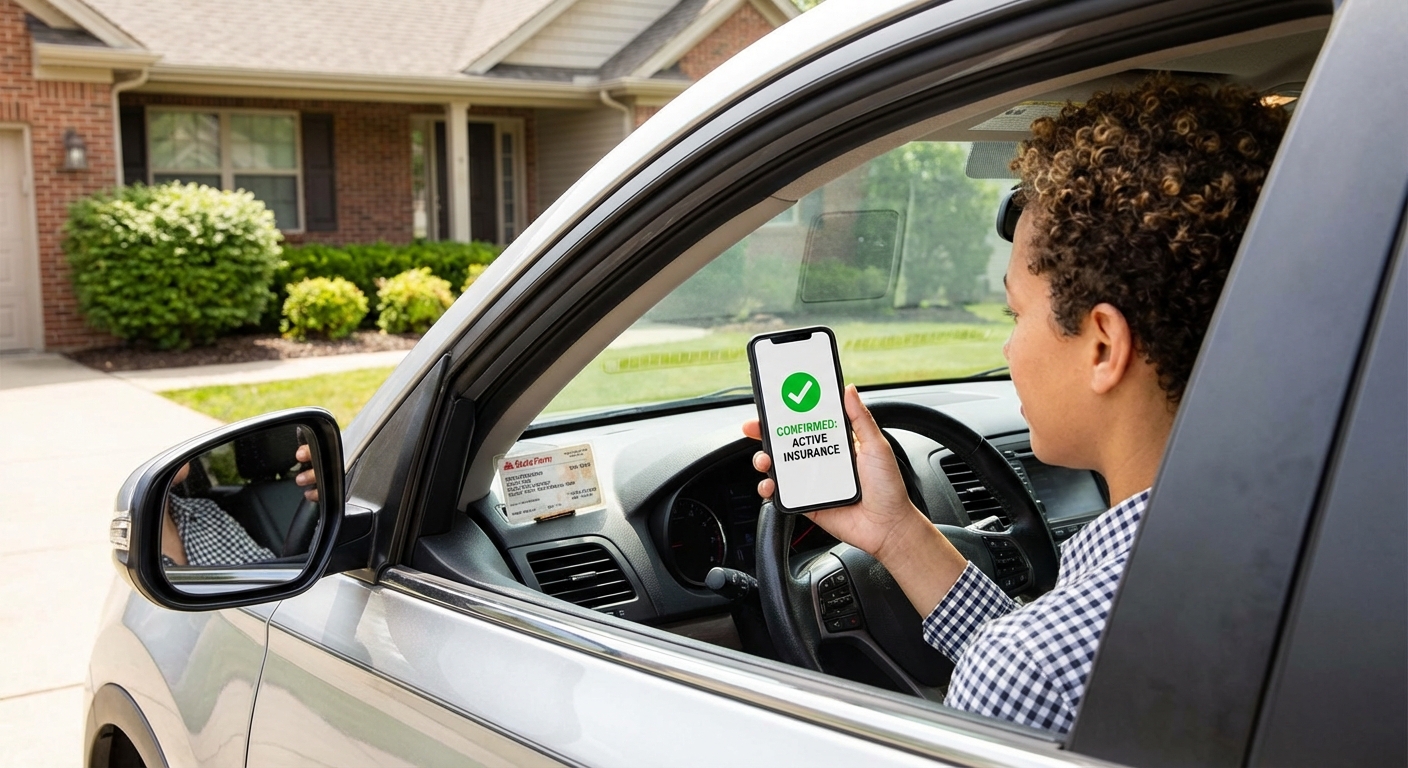
The fastest and most reliable way to confirm your own car is insured is through your insurer's digital tools. Every major insurance company, including GEICO, State Farm, Progressive, and Allstate, offers a mobile app and a secure online account portal where you can view your active policy status in real time. Our roundup of the best car insurance apps breaks down which carriers do this best.
What You Can Verify
| Information Available | Where to Find It |
|---|---|
| Policy effective & expiration dates | Insurer app / online account |
| Coverage types (liability, comp, collision) | Declarations page in your portal |
| Premium payment status | Billing section of app |
| Digital insurance ID card | App or email download |
| Named drivers on policy | Policy documents section |
Log in using your policy number or registered email, navigate to your active policy, and look for the effective and expiration dates. If your payment lapsed, the portal will typically flag the policy as "inactive" or "cancelled." You can also download a digital insurance ID card directly from the app for immediate proof of coverage. As of 2026, digital ID cards are accepted in 49 states plus D.C., with New Mexico remaining the sole holdout. A few insurers note additional carrier-specific limits (for example, GEICO's digital ID is not accepted in Massachusetts or New Hampshire). Massachusetts also handles proof through the vehicle registration rather than a separate insurance card.
Heading into late 2026, the four largest insurers all lean heavily on AI and telematics inside their apps. GEICO Mobile offers an AI Virtual Assistant that answers policy and billing questions in-app, plus DriveEasy, a smartphone-based telematics program now available in 47 states plus D.C. that tracks braking, cornering, phone use, and mileage. GEICO's own discount page lists DriveEasy savings between 5% and 15%, though third-party 2026 reviews report some drivers achieving up to 25% based on their driving score. State Farm's Drive Safe & Save advertises up to 30% savings with a 10% enrollment discount, and Progressive's Snapshot and Allstate's Drivewise offer competitive telematics discounts that vary by state. These tools do not just verify coverage; they can also earn you meaningful discounts. It is also smart to do a full car insurance policy review periodically to make sure your coverage limits are still appropriate and that you're not paying for coverage you no longer need.

Compare Car Insurance Rates in Ohio
See if you qualify for a lower rate in less than 2 minutes
Method 2: State DMV Electronic Insurance Verification Systems
As of mid-2026, roughly 34 states operate some form of real-time or near-real-time electronic insurance verification, up from about 27 in 2020, and 19 of those have formal online-verification statutes on the books. These systems are built on standards from the Insurance Industry Committee on Motor Vehicle Administration (IICMVA), with the current Model Legislation Version 1.2 finalized in early 2026, and they query insurer databases electronically. Detailed car insurance verification rules vary by state.
How DMV Verification Works
State DMV systems submit a verification request using key vehicle identifiers, such as a license plate number, VIN, or policy number, and receive a response from the insurer confirming whether coverage is active, lapsed, or cancelled. Traditional systems used delayed batch reporting (ALIR); newer IICMVA-style web-service systems respond in seconds.
States with active or advancing electronic verification systems include:
| State | System / Legislation | 2026 Status |
|---|---|---|
| Texas | TexasSure | Active |
| Georgia | GEICS | Active |
| Arkansas | AOIVS | Active |
| Illinois | ILIVS | Active |
| Missouri | MOIVS | Active (launched March 16, 2026) |
| Kansas | KSIVS / SB 42 | Live (launched July 1, 2026) |
| Kentucky | HB 390 | Must be operational by October 1, 2026 |
| Maryland | OLV Process | Active (weekly insurer submissions) |
| Florida | FLHSMV Online | Active |
| Pennsylvania | Act 3 of 2026 (HB 710) | Enacted Feb 12, 2026; rollout targeted 2027 |
| New York | S.5331-A real-time verification law | Signed Nov 2025; full rollout by Dec 31, 2028 |
| New Jersey | S1805 (MVC online system) | Introduced in 2026 session |
| Ohio | HB 678 | In House Transportation Committee hearings (March 2026) |
You can typically access your state's DMV verification portal by entering your vehicle registration number or VIN. These tools are designed primarily to verify your own vehicle's insurance status; they are not intended for checking another person's car without a valid legal reason. Understanding vehicle registration requirements by state can also help you stay on top of what your state expects and avoid registration suspension due to a lapsed policy.

Protect your car with Farmers
Average Rate:
Find coverage options that fit your budget.

The insurance savings you expect.
Average Rate:
Enjoy personalized policies, comprehensive coverage & more.

See how much you could save today!
Average Rate:
Drivers who switch their auto insurance and save with State Farm save $764 on average!

Safe Drivers Save with Allstate®
Average Rate:
Get rewarded with savings for having a clean driving record.
Method 3: VIN-Based Verification & Proof of Insurance Documents
Checking Insurance by VIN for a Used Car Purchase
When buying a used car, confirming the vehicle has active insurance, and that coverage will transfer or be replaced before you drive off, is critical. The VIN (Vehicle Identification Number) is your most powerful verification tool.
Here's how VIN-based insurance verification works:
- State DMV portals: Enter the 17-character VIN into your state's DMV verification tool (e.g., TexasSure in Texas, GEICS in Georgia, or ILIVS in Illinois). The system checks whether an insurer has reported an active policy tied to that VIN.
- Request the seller's insurance card: A valid proof-of-insurance document includes the VIN, the insured vehicle's year/make/model, the policy number, and effective/expiration dates. Cross-reference these details carefully. Watch out for a VIN mismatch on the policy, which can invalidate coverage.
- Contact the insurer directly: Call the insurer listed on the seller's policy card and provide the VIN to confirm the policy is current and has not been cancelled.
- Use NICB VINCheck: The National Insurance Crime Bureau offers a free tool (limited to 5 lookups per 24 hours per IP address) that checks if a vehicle has been reported as unrecovered stolen or declared a salvage loss by a participating insurer. NICB reported nearly 3 million VINCheck lookups processed by July 31, 2026, and the tool has delivered more than 5.5 million VIN searches over its lifetime. VINCheck also supports photo-based VIN entry.
- Use NMVTIS-based tools: Services like EpicVIN query the National Motor Vehicle Title Information System (NMVTIS) for title history, junk/salvage designations, and odometer issues. NICB itself directs consumers to NMVTIS for broader historical information beyond what VINCheck provides.
| Tool | Focus | Cost | Key Limitation |
|---|---|---|---|
| NICB VINCheck | Theft/salvage claims | Free (5/day per IP) | Participating insurers only |
| NMVTIS (e.g., EpicVIN) | Title history, fraud protection | Free basic / $2-$25 full | No accident detail |
| CARFAX | Full history, accidents, owners | $44.99/report (2026) | Paid; proprietary data |
| AutoCheck | History, auction records | $29.99/report (2026) | Similar to CARFAX |
Before signing anything, make sure you understand how to apply for car insurance on the vehicle so your new policy is bound before you drive it home.
Method 4: Verifying Another Driver's Coverage After an Accident
This is where insurance verification gets more legally complex, and where it matters most. With 15.4% of U.S. drivers uninsured as of the latest IRC data (based on 2023 claims from the 2025 IRC study), and 33.4% of all drivers either uninsured or underinsured (a 10 percentage-point jump since 2017), the odds of encountering an inadequately covered driver are significant. Eight states plus D.C. now have uninsured rates above 20%, double the count from 2022. If you want to understand the full scope of the problem, the uninsured motorist crisis has only deepened since 2019. Knowing your rights and the proper steps could save you thousands.
What You're Legally Entitled To
After an accident, every driver is legally required in most U.S. states to exchange:
- Full name and contact information
- Driver's license number
- Vehicle registration
- Insurance company name and policy number
Refusing to provide this information is illegal in most states and can result in fines, license suspension, or even misdemeanor charges. Only New Hampshire does not mandate that all drivers carry insurance, though financial responsibility is still required. Learn more about the penalties for driving without insurance to understand what the other driver was legally obligated to carry.
Step-by-Step: Verifying Insurance After an Accident
Step 1: Exchange information at the scene. Approach the other driver calmly and request their insurer name and policy number. Document everything with your phone's camera.
Step 2: Call the police. An official police report compels all parties to provide insurance details and creates a legal record. This is especially critical if the other driver refuses to cooperate.
Step 3: Contact your own insurer. Provide the other vehicle's license plate, make, model, and any policy info you received. Your insurer can investigate and retrieve additional details through proper DPPA-permissible channels (insurance activities and claims investigation are recognized permissible uses).
Step 4: Request the police report. Once filed, the police report will contain the other driver's insurance information and can be used to initiate a claim. Our step-by-step claims guide walks through what happens next.
Step 5: Contact your state's DMV. With proof of your involvement (such as the police report), your state's DMV can release insurance information to parties involved in an accident.
If the Other Driver Refuses to Share Insurance Information
If another driver will not cooperate after an accident:
- Do not escalate. Prioritize your safety
- Call 911 immediately and wait for police
- Document the vehicle's license plate, color, make, and model
- Get contact info from any witnesses
- File a claim under your uninsured motorist coverage if the other driver is uninsured or flees
- Consider consulting a personal injury attorney if there are injuries or significant damage
Having solid uninsured motorist coverage on your own policy is your best financial backstop in these situations. Review what car insurance actually covers to identify any gaps in your own protection before you need to file a claim.
Uninsured Motorist Rates by State (IRC 2025 Study, 2023 Data)
| State | Uninsured Driver Rate |
|---|---|
| Mississippi | 28.2% |
| New Mexico | 24.1% |
| Washington, D.C. | 23.1% |
| Michigan | 22.3% |
| Missouri | 20.7% |
| Florida | 20.6% |
| California | 20.4% |
| Maine | 5.7% (lowest) |
National Average: 15.4%, or roughly 1 in 7 drivers on U.S. roads is uninsured. Mississippi saw the largest single-year jump (roughly 6 percentage points from 2022 to 2023), and eight states plus D.C. exceeded the 20% threshold in 2023.
Frequently Asked Questions
Can I look up if a car has insurance by license plate number?
In most states, you cannot freely search a license plate to find out if a car is insured. DMV verification systems are generally restricted to vehicle owners, law enforcement, and authorized entities under the Driver's Privacy Protection Act (DPPA), and 2025-2026 court rulings continue to narrow how commercial actors can use DMV-sourced data. After a car accident, you may be able to request insurance information tied to a license plate through your state's DMV with proof of involvement, but random public lookups are prohibited. Insurers themselves are permitted to access plate data for claims processing and fraud prevention, but this access does not extend to private individuals.
How do I check if my own car insurance is still active?
The easiest way is to log in to your insurer's mobile app or website and check your policy's effective and expiration dates. You can also review your most recent payment to confirm your premium has not lapsed. Most apps will clearly flag an "inactive" or "cancelled" status. If you're unsure, calling your insurer's customer service line with your policy number will get you an immediate answer. Your state's DMV electronic verification portal, now real-time in roughly 34 states as of 2026, is another option for confirming whether insurance has been reported for your vehicle.
Can I check car insurance status by VIN number?
Yes, in many states you can use the DMV's electronic verification system to check whether an active policy has been reported for a specific VIN. For used car purchases, free tools like NICB VINCheck (up to 5 lookups per 24 hours per IP) and NMVTIS-based providers such as EpicVIN can reveal whether a vehicle was declared a total loss or flagged as salvage by an insurer. However, these lookups are typically limited to the vehicle's owner or authorized parties and may not show historical coverage, only whether a policy is currently active. Always combine multiple tools for a complete picture before finalizing any used car purchase.
What should I do if someone refuses to give me their insurance information after an accident?
Call the police immediately. Officers can legally compel the other driver to provide their information and will include it in the official accident report. While waiting, document the other car's license plate, make, model, and any visible damage with photos, and gather witness contact information. Contact your own insurer to report the incident and, if necessary, file a claim under your uninsured motorist coverage. Consulting a car accident attorney is advisable if there are injuries or significant property damage involved.
Is it legal to check someone else's car insurance without their knowledge?
Generally, no. Checking another person's insurance without their consent and without a legally permissible reason is restricted under the Driver's Privacy Protection Act (DPPA) and similar state laws. Law enforcement, licensed insurers, lenders, and courts have authorized access to insurance verification systems, but private individuals do not have the right to randomly check another person's coverage status. If you were involved in an accident, use official channels such as a police report or a DMV request to access the other party's insurance information legally.