
Compare Car Insurance Rates in Ohio
See if you qualify for a lower rate in less than 2 minutes



What Is a Car Insurance ID Card?
A car insurance ID card — sometimes called a proof of insurance card or insurance identification card — is a compact, wallet-sized document issued by your auto insurance company. It serves as official verification that you carry active car insurance coverage that meets your state's legal requirements.
Unlike your full policy documents, the insurance ID card is designed to be carried with you at all times. Most are the size of a credit card or a standard business card, making them easy to keep in your glove compartment or wallet. In today's digital world, many insurers also offer electronic versions accessible through their mobile apps — and in all 50 states, a digital card on your phone is just as valid as a physical one.
What Information Appears on a Car Insurance ID Card?
Every insurer formats their cards slightly differently, but all standard car insurance ID cards include the same core information required for legal proof of coverage. Here's a breakdown of what you'll find on yours:
| Field | What It Means |
|---|---|
| Policyholder Name | The name of the primary insured driver on the policy |
| Policy Number | A unique identifier for your specific policy |
| Effective Date | The date your current coverage period began |
| Expiration Date | The date your current coverage period ends |
| Vehicle Year, Make & Model | The specific car(s) covered under this policy |
| VIN (Vehicle Identification Number) | A 17-character code unique to your vehicle |
| Insurance Company Name | Your insurer's official business name |
| Insurer Contact Info | Phone number and/or website for claims or emergencies |
Some cards may also display your agent's contact information or a brief note about the types of coverage included. However, specific coverage limits and deductibles are not shown on the ID card — those details live on your declarations page.
Some states have additional formatting rules. For example, New York requires a bar-coded card with the customer name formatted in a specific "Last, First, Middle" structure matching the driver's license. New Jersey cards must include a specific heading — "State of New Jersey Insurance Identification Card" — along with the insurer's address for medical treatment notifications on the reverse side. Pennsylvania requires the card to be labeled "Financial Responsibility Identification Card" and include the insurer's NAIC number. Connecticut requires the name on the policy to match the driver's license exactly, along with the insurance company's NAIC number.
Insurance ID Card vs. Declarations Page: What's the Difference?
These two documents are often confused, but they serve very different purposes. Your insurance ID card vs. declaration page comparison comes down to simplicity vs. detail:
The insurance ID card is what you show a police officer, at the DMV, or after an accident. The declarations page is what your bank requires when financing a car, and what you review to understand your coverage in detail. It's also worth noting that several states — including California, North Carolina, Utah, and Virginia — increased their minimum liability coverage requirements in 2025, while Hawaii and New Jersey raised theirs effective January 1, 2026. Your ID card won't reflect these limit changes, but your declarations page will.

Compare Car Insurance Rates in Ohio
See if you qualify for a lower rate in less than 2 minutes
When Do You Need to Show Your Car Insurance ID Card?
There are several key situations where having your ID card on hand is legally required or strongly recommended:
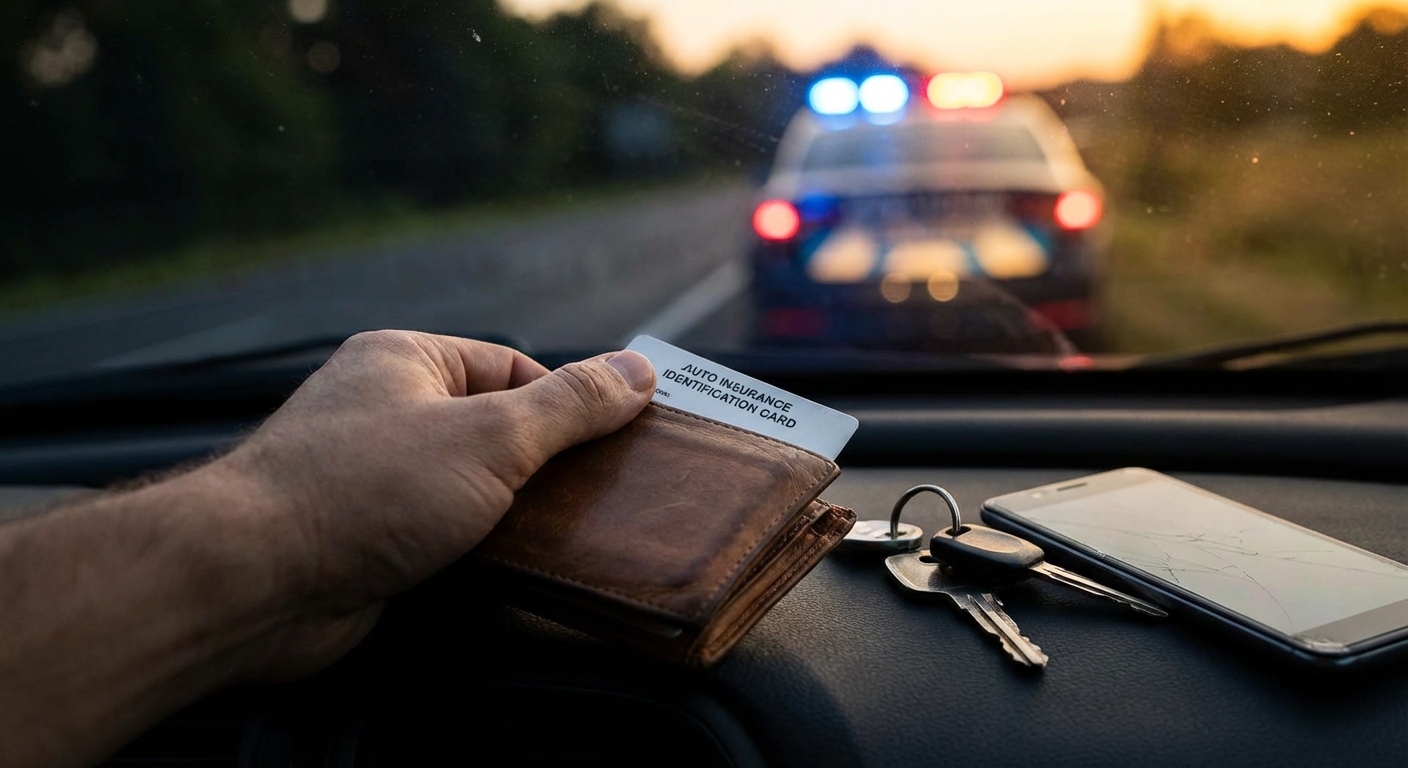
- Traffic stops — A police officer can request proof of insurance at any time. Failure to provide it can result in fines, a citation, or even suspension of your registration.
- Vehicle registration at the DMV — Most states require proof of insurance to register or renew registration for your vehicle.
- After an accident — You'll need to exchange insurance information with other drivers and provide it to responding officers and your own insurer.
- Purchasing or leasing a car — Dealerships typically require proof of current coverage before you drive off the lot.
- Parking violations or impoundment — Some jurisdictions require insurance proof to reclaim an impounded vehicle.
What Happens If You Can't Show Your Card?
Penalties for failing to produce proof of insurance at a traffic stop vary significantly by state. In most cases, there's an important distinction between simply not having your card on you (while actually being insured) versus truly driving without coverage:
| Situation | Typical Outcome |
|---|---|
| No card, but insured | Minor citation (often $25–$100); many states dismiss it if you later provide proof |
| No insurance at all | Fines ranging from $100 to $5,000+, possible license/registration suspension, SR-22 requirement |
| Repeat offense | Higher fines, longer suspensions, potential jail time depending on the state |
Here's how some states stack up for first-offense fines when caught driving without any coverage at all:
| State | First-Offense Fine | Additional Penalties |
|---|---|---|
| New York | Up to $1,500 | Up to 15 days jail, 1-year license loss |
| West Virginia | $200–$5,000 | Possible jail time for repeat offenses, SR-22 required |
| Illinois | $500–$1,000 | 3-month suspension, $100 reinstatement fee |
| Arizona | $500 | License suspension possible |
| Washington | $550 | SR-22 possible for repeat offenses |
| North Carolina | $100 civil | Higher fines for repeat offenses |
Even if you're insured, always having your ID card accessible — physical or digital — keeps you from dealing with unnecessary citations and court appearances.

Protect your car with Farmers
Average Rate:
Find coverage options that fit your budget.

The insurance savings you expect.
Average Rate:
Enjoy personalized policies, comprehensive coverage & more.

See how much you could save today!
Average Rate:
Drivers who switch their auto insurance and save with State Farm save $764 on average!

Safe Drivers Save with Allstate®
Average Rate:
Get rewarded with savings for having a clean driving record.
Digital vs. Physical Insurance ID Cards
As of 2026, all 50 states legally accept electronic proof of insurance in some form, making digital cards a widely valid and convenient option for most drivers. Learn more about digital proof of car insurance acceptance rules and how to use them in various situations.
How Major Insurers Provide Digital Cards
All four of the largest auto insurers — GEICO, State Farm, Progressive, and Allstate — offer digital ID cards through dedicated mobile apps and online account portals. GEICO allows users to log into the app, select "View ID Cards," and save their cards to the device for 24/7 access — online or offline — with options to email, print, download as a PDF, or add to Apple Wallet. State Farm, Progressive, and Allstate follow similar models through their own apps and online portals.
| Insurer | Digital Access Method |
|---|---|
| GEICO | GEICO mobile app; downloadable from online account; supports Apple Wallet |
| State Farm | State Farm app; "My Accounts" online portal; email delivery upon request |
| Progressive | Online account ("Get your ID card"); view, save, print, or email instantly |
| Allstate | Allstate app and My Account portal; 24/7 access; printable |
Digital cards are automatically updated when your policy information changes — eliminating the risk of carrying an outdated paper card. You can also typically access your saved card even without an active internet connection through your insurer's app. For a deeper look at which apps and features work best by state, see our guide to digital car insurance card acceptance.
Digital vs. Physical: Pros and Cons
How to Get or Replace Your Car Insurance ID Card
Whether you're getting your card for the first time or need a replacement, here are your options:
| Method | How to Do It | How Fast? |
|---|---|---|
| Mobile App | Open your insurer's app and navigate to ID cards | Instant |
| Online Portal | Log in to your account and download/print | Instant |
| Some insurers email a digital card upon purchase or request | Within minutes | |
| Fax | Available with some insurers like Progressive | Within minutes |
| Phone Call | Call your insurer's customer service line | Mailed in 7–10 business days |
| By Mail | Request through your online account or agent | 7–14 days via USPS |
If you need proof immediately — say, for a DMV appointment or a dealership visit — a printed card from your online account is universally accepted. For states that allow digital proof, pulling it up on your insurer's app takes seconds. If you need a physical card mailed to you, most providers deliver within 7 to 14 days via standard mail.
Common Mistakes People Make With Insurance ID Cards
Even careful drivers slip up when it comes to their insurance card. Here are the most frequent — and costly — errors to avoid:
- Carrying an expired card — Your insurer sends new cards at each renewal. Make it a habit to swap the old one out immediately, or rely on your insurer's app for always-current access.
- Not updating the card after buying a new car — Your current policy may temporarily cover a new vehicle, but your ID card won't reflect the correct info. Request a new card right away — most insurers allow you to generate one instantly through their app.
- Not having any card at all — Whether digital or physical, always have access to your proof of insurance. Getting caught without it at a traffic stop can result in fines — even if your policy is active.
- Assuming a declarations page works — In most states, a dec page does not fulfill a roadside proof-of-insurance request. Know the difference.
- Printing an unofficial copy — In some states, cards must come directly from your insurer (by mail or official app). Always use the official ID card download from your insurer's portal or app rather than a screenshot of a policy document page.
- Ignoring minimum coverage updates — Several states raised their required minimums in 2025 and 2026. While your insurer will adjust your policy automatically, confirm your card and coverage are still current after these changes.
Learn more about digital proof of insurance rules by state to make sure you're always prepared, wherever you drive.
Frequently Asked Questions
What is a car insurance ID card used for?
A car insurance ID card is used as legal proof that you carry active auto insurance coverage. You'll need to present it during traffic stops, vehicle registration at the DMV, after an accident, and in some cases when purchasing or picking up a vehicle from a dealership. It confirms your policy is active and provides key contact information for your insurer. It is not a substitute for your full policy documents or declarations page.
Is a digital insurance card the same as a physical one?
In most situations, yes — a digital insurance ID card displayed on your smartphone holds the same legal weight as a physical card. As of 2026, all 50 states accept some form of electronic proof of insurance, though the specific rules can vary. Washington D.C. is a notable exception, still requiring a physical card. Always keep a backup option available — such as a downloaded card in Apple Wallet or Google Wallet — in case your phone isn't accessible. You can explore how digital insurance cards are accepted in more detail by state and situation.
How do I get a replacement car insurance ID card if I lose mine?
If you've lost your insurance card, you can get an instant replacement by logging into your insurer's website or mobile app, where you can download and print a new one immediately. Major insurers like GEICO, State Farm, Progressive, and Allstate all offer this through their apps or online account portals. If you need a physical card mailed to you, contact your insurer directly — most providers deliver within 7 to 14 days via standard mail.
What is the difference between an insurance ID card and a declarations page?
An insurance ID card is a compact document used as quick proof of coverage — it's what you show at traffic stops or the DMV. A declarations page is a detailed policy summary that lists your coverage types, limits, deductibles, and premiums. In most states, the declarations page is not an acceptable substitute for the ID card in roadside situations, and lenders typically require the declarations page — not the ID card — when financing a vehicle.
Can I be fined for not having my insurance card?
Yes. If you are stopped by law enforcement and cannot provide proof of insurance — whether physical or digital — you may face fines or a citation, even if your policy is actually active. Fines for simply not having the card on you (when you are insured) are often minor ($25–$100) and may be dismissed if you later provide proof. The safest approach is always having your insurance ID card accessible, either on your phone through your insurer's app or in your glove compartment.