
Compare Car Insurance Rates in Ohio
See if you qualify for a lower rate in less than 2 minutes



The Golden Rule: Insurance Covers Future Damage, Not Old Damage
Every auto policy in the U.S. works the same way on this point. Coverage applies to losses that happen after your effective date, not to dents, scratches, or hail dings that were already there when you signed up. Even GEICO puts it plainly in its own policy language: scratches and dents that existed prior to an active insurance policy are not eligible for coverage.
That does not mean you cannot get a policy. You almost always can. It just means the insurer will either:
- Write the policy with a prior damage exclusion noted on the declarations page, or
- Refuse comprehensive and collision on the vehicle but still offer liability, or
- Require a pre-inspection (photos or in-person) before binding physical damage coverage.
Liability coverage is rarely a problem because it protects other drivers, not your car. Physical damage coverage is where things get complicated. For a deeper look at how the pieces of a policy fit together, see our breakdown of what car insurance actually covers.

Compare Car Insurance Rates in Ohio
See if you qualify for a lower rate in less than 2 minutes
Pre-Inspection Requirements: What Insurers Look For
When you buy comprehensive or collision on a used vehicle, most carriers will either require a pre-inspection or a set of dated photos. It is a fraud-prevention step. Without it, a driver could buy a policy on Monday and file a claim Tuesday for damage that happened Sunday.
A typical pre-inspection asks for:
- Four corner shots at roughly a 45-degree angle showing two sides of the vehicle in each
- VIN plate photo (usually visible through the lower windshield on the driver's side)
- Odometer reading
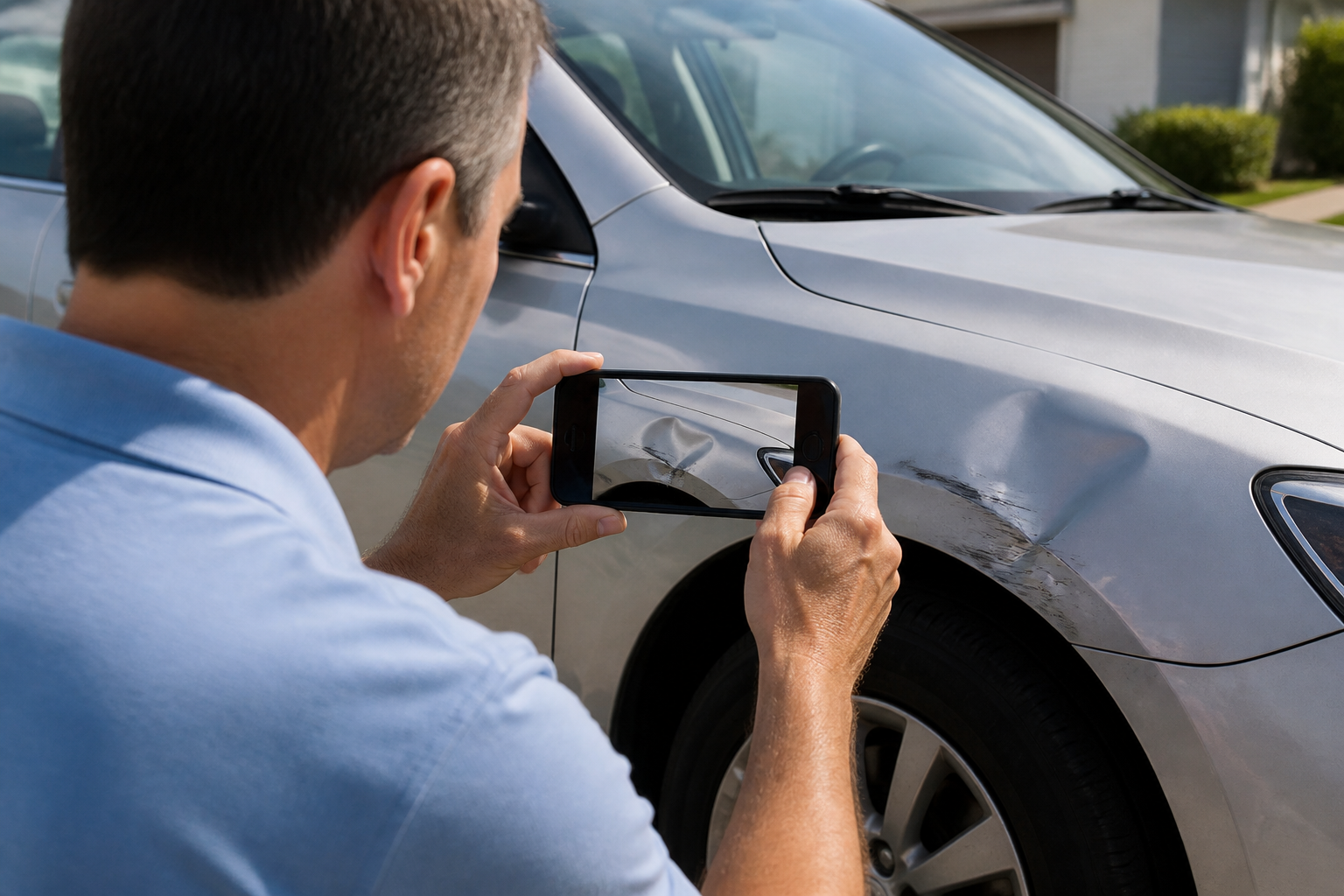
- Close-ups of any existing damage: scratches, dents, cracked glass, rust, or missing trim
- Interior/dashboard shots showing warning lights (some carriers only)
If the inspector or the photo review flags damage, that damage will be listed as excluded on your policy. Some carriers will still write full coverage on a car with light cosmetic damage as long as it is documented and the policyholder understands they cannot claim it.

Protect your car with Farmers
Average Rate:
Find coverage options that fit your budget.

The insurance savings you expect.
Average Rate:
Enjoy personalized policies, comprehensive coverage & more.

See how much you could save today!
Average Rate:
Drivers who switch their auto insurance and save with State Farm save $764 on average!

Safe Drivers Save with Allstate®
Average Rate:
Get rewarded with savings for having a clean driving record.
The Prior Damage Exclusion on Your Declarations Page
The declarations page (often called the "dec page") is the one-to-two-page summary of your policy showing limits, deductibles, and any endorsements or exclusions. When an insurer accepts a car with pre-existing damage, it will usually attach a prior damage exclusion, which spells out that specific damage the policy will not pay to repair.
Here is what typically appears:
| Item on Dec Page | What It Means |
|---|---|
| "Prior damage exclusion – right rear quarter panel" | The insurer will not pay for that panel unless clearly new damage is shown |
| "Physical damage excluded" | No comp or collision at all, liability only |
| "Photo inspection required within 14 days" | Coverage is conditional on submitting photos |
| No exclusion listed | Standard coverage applies (but insurer still won't pay for old damage found during claim) |
Even without a written exclusion, adjusters are trained to detect prior damage during claims. If the same dent, crack, or broken part shows up in photos of an incident you filed, the insurer can reduce or deny the payout for that portion. Our article on how insurers assess damage after an accident explains the adjuster process in more depth.
How to Document Pre-Existing Damage the Right Way
Good documentation protects you in two directions. First, it prevents the insurer from claiming new damage is really old damage during a future claim. Second, it prevents you from being accused of fraud if you file a claim for something that overlaps an old scratch.
Here is a photo checklist that mirrors what a professional inspector would do:
Additional tips:
- Take wide context shots first, then close-ups. A close-up of a dent with no context is easy to challenge.
- Include a scale reference (a coin or ruler) in close-ups so the size of the damage is unambiguous.
- Keep prior repair invoices, body-shop estimates, and maintenance records. These serve as proof the damage was not there earlier.
- If the insurer offers a mobile app inspection, use it. The photos are stored on their servers and timestamped by their system, which is harder to dispute later.
- Never edit, filter, or crop the images. Insurers can tell.
Store everything in a cloud folder tied to the vehicle's VIN so you can pull it up years later if a claim comes up.
Will Comprehensive or Collision Cover Related Future Damage?
This is the most misunderstood part of insuring a damaged car. The short answer: yes, for new damage; no, for old damage; and it gets messy when they overlap.
Three common scenarios:
Scenario 1: Old damage, new unrelated area. Your rear bumper has a scrape from last year. A tree limb falls on your hood during a storm. Comprehensive pays for the hood. The bumper stays as-is.
Scenario 2: Old damage, new damage same area. Your bumper had a crack. A parking lot hit-and-run breaks it further. Collision may pay for the additional damage but not the original crack. Expect the payout to be reduced.
Scenario 3: Total loss with existing damage. If the car is totaled, insurers use actual cash value (ACV) and deduct for any pre-existing damage that lowered the vehicle's market value. Reddit adjusters routinely confirm the insurer will "deduct some amount from the value to account for unrelated prior damage."
For a full explanation of comprehensive protections and exclusions, our comprehensive coverage guide is worth a read, especially before adding it to a damaged vehicle.
Cosmetic vs. Structural Damage: A Huge Underwriting Difference
Not all pre-existing damage is treated the same. Insurers draw a sharp line between damage that affects only appearance and damage that could compromise safety or make repair costs unpredictable.
| Damage Type | Example | Underwriting Impact |
|---|---|---|
| Cosmetic | Door dings, light scratches, faded paint, small dents | Most carriers write full coverage with documentation |
| Glass | Chipped windshield, cracked side window | Usually covered going forward; existing crack excluded |
| Mechanical | Worn suspension, oil leak | Not covered anyway (wear and tear exclusion) |
| Structural | Frame damage, unibody bends, prior salvage title | Comp/collision often refused entirely |
| Airbag/Safety | Deployed airbags, cut seat belts | Most standard carriers refuse; specialty market only |
If the car has a salvage or rebuilt title, expect a much smaller pool of insurers, and often only liability. Structural damage is treated as a red flag because insurers cannot predict how the vehicle will behave in a future crash, and repair costs are hard to estimate.
Which Insurers Are Most Willing to Write Damaged Vehicles
Not every carrier will take a car with visible damage. Standard-market insurers like State Farm, Allstate, and Farmers often decline physical damage on cars with more than minor cosmetic issues. But several carriers are known to be more flexible, especially in the non-standard or high-risk market.
- Progressive – Regularly writes vehicles with prior cosmetic damage after a photo inspection.
- GEICO – Will bind liability quickly; comp/collision requires clean inspection results.
- The General – Specializes in nonstandard drivers and vehicles, often the easiest path for a car with dents or a prior accident on record.
- Direct Auto – Similar nonstandard focus; strong in southern states.
- Dairyland – Motorcycle roots but writes many auto policies on rougher vehicles.
- Bristol West (a Farmers subsidiary) – Non-standard market for damaged and higher-risk vehicles.
For drivers with a rough record on top of a rough car, our guide to high-risk driver insurance options has more context on carriers that specialize in tough underwriting cases.
Buying a Used Car With Damage: What to Do Before You Drive Off
If you are shopping for a used car that already has visible damage, take these steps before you sign:
- Run a vehicle history report (Carfax or AutoCheck) to see if damage was ever reported to insurance or DMV.
- Check the title status. Salvage, rebuilt, or flood titles limit your insurance options dramatically.
- Get a pre-purchase inspection from an independent mechanic. Ask specifically about frame and unibody condition.
- Photograph everything before the vehicle leaves the lot. Time-stamped photos before your policy starts are gold.
- Call your insurer with the VIN before purchase. Ask if they will write comprehensive and collision on the vehicle as-is.
- Get repair estimates for any cosmetic damage you plan to fix. Sometimes it is cheaper to repair before insuring so you avoid the exclusion.
If the damage is minor, you may also want to compare a pay-per-mile car insurance option if the car will be a secondary vehicle driven infrequently.
Frequently Asked Questions
Is it insurance fraud to buy a policy on a car with pre-existing damage?
No, buying a policy on a damaged car is not fraud as long as you disclose the damage honestly. Fraud only happens if you try to claim old damage as new damage after coverage begins. Insurers expect used cars to have some wear, and they have systems to document what was there at the start of the policy.
Will my insurance company drop me if they find out my car had damage before the policy started?
Usually not, as long as you were truthful on the application. What they will do is add a prior damage exclusion, exclude physical damage coverage on the affected panels, or reduce your claim payout if you try to file for that damage later. Non-disclosure that is later discovered can lead to policy rescission, so honesty upfront matters.
Can I repair pre-existing damage on my own and then add full coverage?
Yes, and this is often the best route. Once the damage is repaired and documented with receipts, most insurers will drop the exclusion at your next renewal or after a re-inspection. Keep the body-shop invoice as proof of repair.
How do adjusters actually tell the difference between old and new damage?
Adjusters look for rust inside dents, weathered paint edges, oxidation on exposed metal, and matched debris patterns. They also cross-reference photo databases, prior claim records, and even publicly available images. If the same damage appears in a photo dated before your policy started, they will call it pre-existing.
Does pre-existing damage on my car raise my insurance rates?
Not by itself. Premiums are based on driving record, location, coverage limits, credit (in most states), and vehicle value, not the current condition of your paint. However, if your car has a salvage or rebuilt title, that can raise rates or eliminate certain carriers entirely because the vehicle is treated as higher risk.