
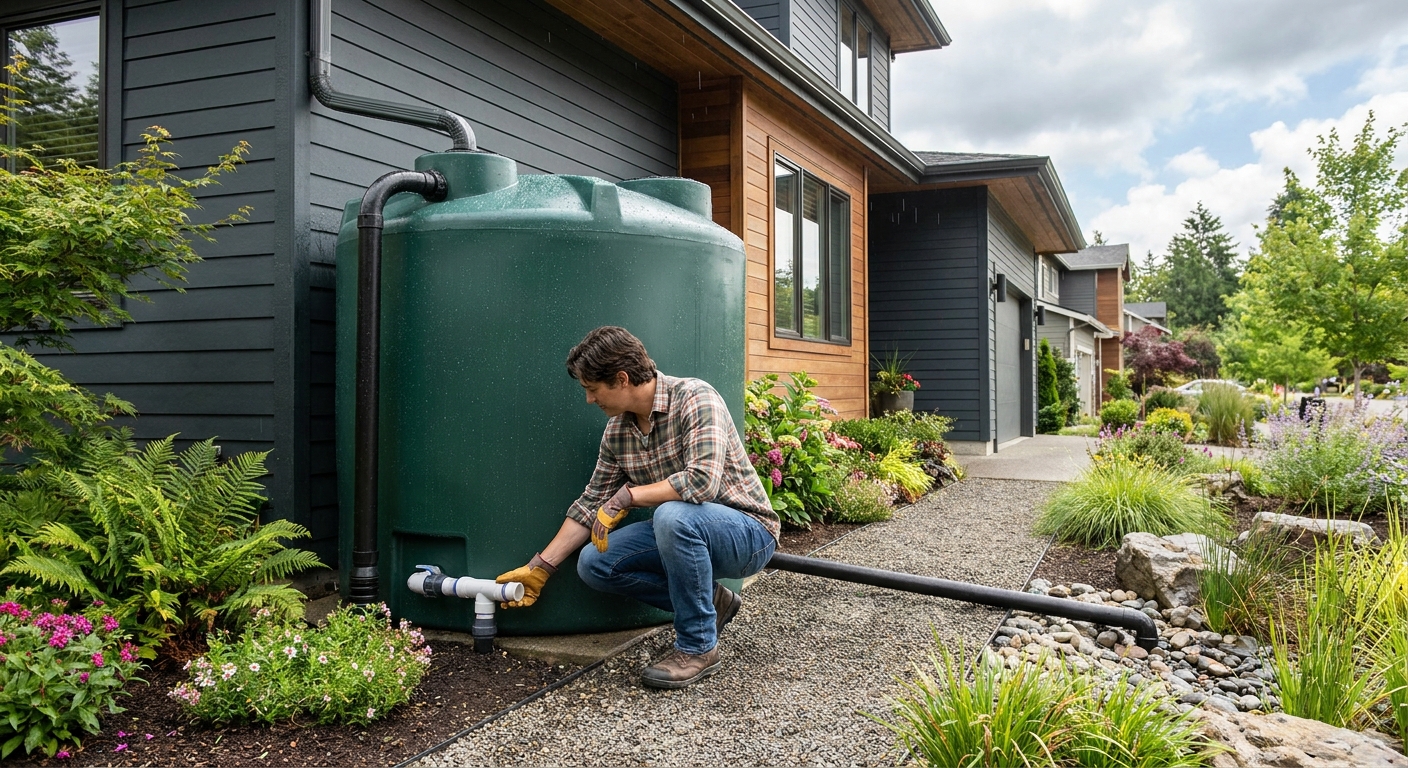
How a Rainwater Harvesting System Works
A residential rainwater harvesting system captures precipitation from your roof, filters it, stores it in a cistern or tank, and distributes it wherever you need it, all without tapping your municipal supply. The process follows a logical five-step flow:
- Collection: Rain lands on your roof (the catchment area) and runs toward the edges.
- Conveyance: Gutters and downspouts channel that water toward storage, using UV-resistant PVC piping to connect everything.
- Pre-filtration: Leaf guards (typically ¼-inch mesh screens), rain heads, and strainer baskets strip out leaves, insects, and large debris before water enters the tank.
- First Flush Diversion: A standpipe diverter (sized at roughly 1-2 gallons per 100 sq ft of roof) discards the first, dirtiest portion of runoff, the water that carries dust, bird droppings, and atmospheric pollutants.
- Storage & Distribution: Filtered water enters the cistern calmly through a calming inlet to avoid stirring sediment. A floating pickup outlet, screened vent, and overflow pipe complete the tank setup. From there, a submersible or external pump (typically rated at 30 psi for irrigation) delivers water on demand.
Core System Components at a Glance
| Component | Purpose | Typical Spec |
|---|---|---|
| Gutters & Downspouts | Convey rooftop runoff | Aluminum or vinyl, 4-6 inch |
| Leaf Guards / Screens | Remove debris pre-tank | ¼-inch mesh |
| First Flush Diverter | Discard contaminated first flow | 1-2 gal per 100 sq ft of roof |
| Storage Tank / Cistern | Hold harvested water | 200-10,000+ gallons, opaque |
| Filtration Unit | Remove sediment, bacteria (if potable) | Sediment + carbon + UV (for potable) |
| Pump | Pressurize delivery | 30-60 psi, submersible or inline |
| Backflow Preventer | Protect potable supply | Air gap or RPZ device |
Potable vs. Non-Potable Uses
For irrigation and outdoor use, a basic sediment screen and first flush diverter are usually sufficient. For indoor non-potable use (toilet flushing, laundry), you'll add sediment filtration plus disinfection. For drinking water, a multi-stage system with sediment filter, activated carbon filter, UV sterilizer, and often reverse osmosis is required. Most residential systems in 2026 target irrigation and outdoor use first, then expand as budgets allow. If you're planning broader upgrades, our water conservation plumbing guide covers complementary fixture and appliance changes.

Find Trusted & Licensed Plumbers in Ohio
Get matched with companies for your specific needs
Plumbing Requirements & Code Compliance
There is no single national standard governing rainwater harvesting plumbing in the US. Requirements depend on your state, county, and whether your system connects to your home's interior plumbing. As of 2026, most jurisdictions rely on the 2021 International Plumbing Code (IPC) Chapter 13 for non-potable water systems, with CSA B805/ICC 805-2018 serving as an accepted alternative standard for rainwater-specific design. The ICC's onsite water reuse workgroup submitted proposed updates for the 2026 code cycle in late 2023, but no finalized replacement of IPC Chapter 13 or new edition of ICC 805 has been published, so the 2021 IPC and 2018 ICC 805 remain the controlling references.
What Most Jurisdictions Require
- Backflow prevention: Any system connected to a potable supply line must include an air gap or Reduced Pressure Zone (RPZ) device to prevent contaminated rainwater from entering drinking water.
- Dual piping & non-potable labeling: Indoor non-potable pipes are typically required to be purple (or similarly color-coded) and clearly stenciled "NON-POTABLE, DO NOT DRINK" at set intervals.
- Approved collection surfaces: Rainwater must be collected from above-ground impervious roofing constructed from approved materials. Runoff from parking lots or ground-level surfaces is generally treated as graywater, not rainwater.
- Overflow routing: Tank overflow must route to a storm drain, not a sanitary sewer or neighbor's property.
- Engineering review: Tanks over 5,000 gallons commonly trigger a permit and engineering sign-off.
- Licensed installation: States like Arkansas require a licensed plumber and appropriate cross-connection safeguards under Arkansas Code § 17-38-201 for any residential rainwater system.
For simple outdoor-only systems, many jurisdictions impose no permit requirement at all. Check with your local building and plumbing department before you break ground. If you're also considering a greywater reuse system, note that dual water reuse systems may require a combined permit review.
Is Rainwater Harvesting Legal in Your State?
Good news: rainwater harvesting is legal in all 50 US states as of 2026, and no state outright bans collection. However, a small group of states regulate it in some form, imposing volume caps, use restrictions, registration requirements, or design standards. Colorado and Utah remain the two most restrictive for residential storage volume, while Arkansas ties systems to plumbing-code compliance and licensed installation.
State-by-State Regulation Snapshot
| State | Key Restriction | Volume Limit |
|---|---|---|
| Colorado | Rooftop, outdoor non-potable use only; two-barrel limit under HB 16-1005 | 110 gallons combined |
| Utah | Free registration required above 100 gal or 2 containers; same-property use | 2,500 gallons |
| Arkansas | Licensed plumber, plumbing-code compliant, non-potable use only | No cap; must meet plumbing code |
| Georgia | Outdoor use only; Dept. of Natural Resources oversight | No cap stated |
| Oregon | Rooftop allowed; surface runoff needs water right/permit | Varies by permit |
| Nevada | Non-potable domestic use only | No cap stated |
| Kansas | Some systems require Division of Water Resources permit | Varies by permit |
| Texas | HOA prohibitions banned (Property Code § 202.007); tax exemption on equipment | No cap; encourages use |
Pro tip: Even in permissive states, your HOA or county may impose additional restrictions. Colorado's HB 16-1005 has not been amended since 2016 (though a 2025 proposal, HB 25-1106, has been introduced to eliminate volume and use limits), and Utah's 2,500-gallon framework has remained unchanged. Always verify at the local level before purchasing equipment.
If you're unsure about dual water reuse options in your state, our guide on greywater system installation covers state-by-state permitting rules for a closely related system type.
Rainwater Harvesting Costs, ROI & 2026 Rebates
What Does a System Cost?
System costs scale dramatically with complexity and storage capacity. Here's a realistic 2026 breakdown based on current national installation data:
| System Type | Capacity | Installed Cost Range | Best For |
|---|---|---|---|
| DIY Rain Barrel | 50-80 gallons | $99-$200 | Small gardens, starter systems |
| Premium Rain Barrel | 50-200 gallons | $200-$800 | Medium gardens, supplemental irrigation |
| Above-Ground Cistern | 500-2,000 gallons | $2,000-$5,000 | Full irrigation coverage |
| Large Above-Ground Cistern | 2,000-5,000+ gallons | $2,500-$12,000 | Whole-yard + partial indoor |
| Underground Cistern | 1,000-10,000+ gallons | $3,000-$24,000 | Whole-home non-potable + irrigation |
| Whole-Home Potable System | 5,000-10,000+ gallons | $8,000-$21,000+ | Off-grid or rural properties |
The average rainwater collection system in 2026 runs around $4,000 for a typical suburban installation, with most homeowners landing between $3,000 and $5,000 for a mid-range 1,000 to 2,000 gallon setup with standard components. Cost per gallon of storage ranges from about $1.25 to $1.50 installed for a turnkey residential system, up to several dollars per gallon for welded steel. Excavation for underground systems typically adds around $1,000 depending on soil conditions and site access. Expect professional labor rates of $50-$130 per hour for above-ground work, higher for underground. Ongoing DIY filter and UV light maintenance runs approximately $400 per year for potable systems.
2026 Rebates & Incentives: State and Local Programs
There is still no dedicated federal tax credit for residential rainwater harvesting in 2026. A proposed federal bill, the Advancing Water Reuse Act, would create a 30% investment tax credit for qualifying water reuse projects, but it targets manufacturers and industrial entities rather than homeowners. In the meantime, local and state incentives can meaningfully offset your costs:
| Location | Program | Maximum Rebate |
|---|---|---|
| Montgomery County, MD | RainScapes Rewards (residential) | ~$7,500 |
| Prince George's County, MD | Rain Check Rebate | $6,000 |
| Austin, TX | Austin Water Rebate ($1/gal pressurized, $0.50/gal non-pressurized) | $5,000 lifetime |
| Austin, TX | WaterWise Rainscape ($0.50/sq ft converted) | $1,500 |
| Seattle, WA | RainWise Program (per sq ft of roof managed) | ~$3,000-$5,000 avg. |
| Tucson, AZ | Rainwater Harvesting Rebate (workshop required) | ~$2,000 |
| Santa Monica, CA | Rain Harvest cistern rebate | $2,000-$4,000 |
| SoCal WaterSmart (MWD) | Rain barrel + cistern rebate | $35/barrel; $2,000-$3,000/cistern |
| Gaithersburg, MD | Rainwater System Rebate | $250 |
Rebate budgets are allocated annually and can run out mid-year. Always verify current program status with your local utility before purchasing equipment, and remember that Rhode Island, Texas, and Virginia offer state tax credits or sales-tax exemptions for rainwater equipment.
How to Size Your Rainwater Harvesting System
The Three-Variable Formula
Sizing your system correctly prevents you from over-spending on a tank you'll never fill, or under-building and running dry in August. Three factors drive the math:
1. Roof Catchment Area Measure the flat footprint of your roof in square feet (add garage, sheds, and covered porches if connected). This is your total collection surface.
2. Water Collection Potential The standard 2026 formula used across the industry is:
Gallons collected = Roof area (ft²) × Rainfall (inches) × 0.623 × Efficiency
The 0.623 factor converts one inch of rain over one square foot into gallons. Efficiency (runoff coefficient) depends on your roof material: about 0.9-0.95 for metal, 0.8-0.85 for shingle, and 0.75-0.8 for tile. As a shortcut, every 1,000 sq ft of roof produces roughly 623 gallons per inch of rainfall.
3. Water Demand Match your tank size to your actual usage needs:
| Household Size | Recommended Tank Capacity |
|---|---|
| 1-2 people | 2,500-3,000 gallons |
| 3-5 people | ~5,500 gallons |
| 6+ people | 8,000-11,000 gallons |
Apply the Two-Limit Rule: Modern sizing tools (including BS 8515-style calculators) size the tank as the smaller of (a) your peak-month harvest or (b) your daily demand multiplied by 15-21 days of storage. This balances storage capacity against cost and available space. For off-grid or very dry climates, extend storage to 30-90 days of demand. In extreme drylands like Tucson, industry guides recommend up to 21,000 gallons of storage to bridge dry spells of 140 days or more.
If you're also considering outdoor plumbing upgrades like irrigation hookups or hose bibs, coordinate them with your rainwater install to save on labor.
Frequently Asked Questions
Can I drink harvested rainwater?
Technically yes, but only with a properly designed potable-grade filtration system that includes sediment filtration, activated carbon, UV sterilization, and often reverse osmosis. Most states require this level of treatment and a licensed professional installation if rainwater is used for any drinking or cooking application. Without appropriate treatment, rainwater can carry bacteria, heavy metals, and atmospheric contaminants. Start with irrigation use and upgrade your filtration if you later want potable capacity.
How much money can I save with a rainwater harvesting system?
Savings depend on your local water rates, rainfall totals, system size, and how much water you currently use outdoors. In drought-prone regions with higher water rates, a well-sized rooftop system can offset irrigation costs that might otherwise run hundreds of dollars per season. Cities with generous rebates (like Seattle's RainWise or Austin's $5,000 lifetime cap) can dramatically shorten your payback period. Track your pre- and post-installation water bills for at least a full year to calculate your personal ROI.
Do I need a permit to install a rainwater harvesting system?
For simple outdoor rain barrels, most jurisdictions require no permit. For any system that connects to interior plumbing (toilet flushing, laundry, or indoor use), a building or plumbing permit is almost always required. States like Arkansas additionally require licensed plumber installation and cross-connection safeguards under state code. Always check with your local building department before installation to avoid fines or forced removal.
What size storage tank do I need for a typical home?
A household of 3-5 people using harvested rainwater primarily for irrigation typically needs around 5,500 gallons of storage capacity. Use the standard formula: Gallons = Roof area (ft²) × Rainfall (in) × 0.623 × Efficiency. Then size your tank as the smaller of your peak-month harvest or 15-21 days of daily demand. Free calculators from Texas A&M and Aquascape can generate a localized estimate in minutes.
Is rainwater harvesting worth it in a low-rainfall state like Colorado?
Colorado's HB 16-1005 currently caps residential collection at just 110 gallons across two rain barrels, which limits financial returns. A pending 2025 bill (HB 25-1106) proposes removing volume limits and allowing indoor use, but until it passes, those two barrels still provide free water for container gardens and spot irrigation. In states with higher rainfall and more permissive laws (like Texas or Washington), the economics are much stronger. Regardless of state, the environmental benefits (reduced stormwater runoff, lower municipal demand, and drought resilience) add value beyond the water bill alone.