
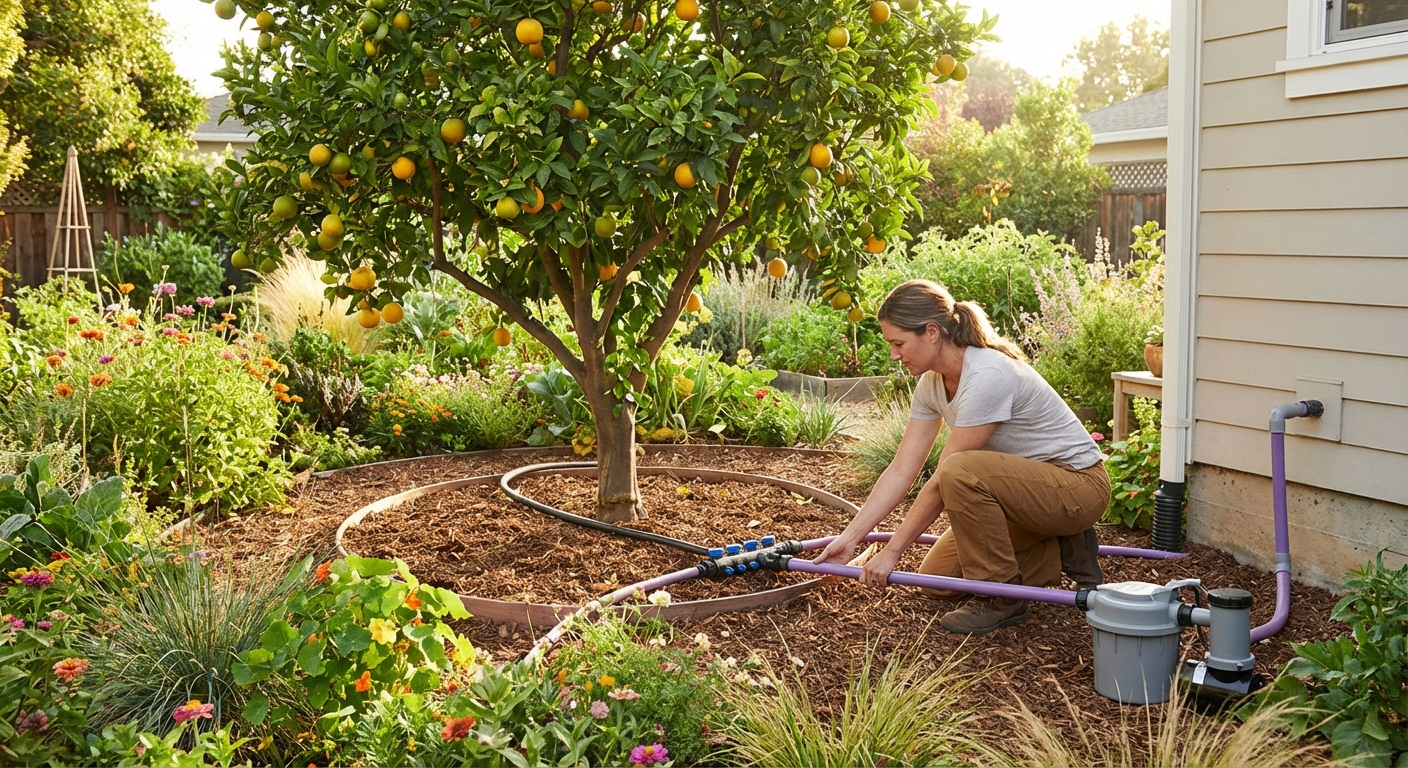
What Is a Greywater System and How Does It Work?
Greywater refers to the lightly used wastewater generated from showers, bathtubs, bathroom sinks, and washing machines (everything except toilet water, which is called blackwater). Rather than letting this water flow straight into the sewer, a greywater recycling system captures it, filters it to varying degrees, and routes it for a second use, most commonly subsurface garden irrigation or toilet flushing.
A typical system involves three core components:
- Collection pipes: Dedicated plumbing routes water away from fixtures before it hits the main drain line. Per modern codes, these pipes must be purple and labeled "CAUTION: NON-POTABLE WATER."
- Filtration/treatment unit: Ranges from a simple diversion valve to multi-stage biological processors with UV disinfection.
- Distribution system: Moves treated greywater to drip irrigation, mulch basins, or toilet fill tanks via gravity or a pump.
A critical safety feature in all compliant systems is an automatic overflow valve. If the storage tank fills up or the system malfunctions, water is automatically diverted back to the municipal sewer, keeping your home protected. New 2026 systems increasingly include smart sensors and IoT-enabled monitoring that flag flow issues, water-quality drift, and maintenance needs in real time, reducing the chance of an unnoticed failure.

Find Trusted & Licensed Plumbers in Ohio
Get matched with companies for your specific needs
Types of Greywater Systems: Simple to Complex
There are four main types of residential greywater systems, progressing from no-frills diversion setups to sophisticated whole-home treatment units. Choosing the right one depends on your water goals, budget, and local regulations. You can also pair a greywater setup with broader water conservation plumbing upgrades to maximize savings.
Tier 1: Laundry-to-Landscape (L2L)
The simplest and most popular entry point. A 3-way valve diverts your washing machine's drain hose directly outdoors to a mulch basin or subsurface trench. No storage tank, no pump, no treatment. Many states require no permit for this setup.
- Best for: Single-level homes with downhill gardens
- Typical cost (2026): $150 to $400 DIY, $700 to $2,000 professional
- Water handled: 50 to 100 gallons/day
Tier 2: Branched Drain / Multi-Source Gravity System
Collects from multiple low-risk sources (showers, sinks, laundry) via gravity-fed branched pipes to mulch basins or a subsurface irrigation field. A permit is typically required.
- Best for: Homes with multiple bathrooms and garden areas
- Typical cost (2026): $800 to $3,500
- Water handled: Up to 250 gallons/day
Tier 3: Pumped & Filtered System
Adds a surge tank, debris filter, and pump to move greywater uphill or to areas far from the source. Self-cleaning filters reduce maintenance burden. Suitable for homes where gravity flow isn't an option.
- Best for: Flat or uphill irrigation zones
- Typical cost (2026): $2,000 to $6,000
- Water handled: 100 to 300 gallons/day
Tier 4: Advanced Treatment System (Whole-Home)
Full biological processing systems like membrane bioreactors (MBRs) treat greywater to near-potable quality through multi-stage filtration, aeration, and UV disinfection. Many jurisdictions require NSF/ANSI 350 certification for these units when used for toilet flushing or indoor reuse.
- Best for: Whole-home water reuse, water-scarce regions
- Typical cost (2026): $8,000 to $20,000+
- Water handled: 300+ gallons/day
Greywater System Permits, State Laws & Costs
Which States Allow Greywater Systems?
Greywater regulations are primarily a western and southwestern phenomenon in the US, where water scarcity drives policy. Here's a snapshot of the current legal landscape as of 2026:
| State | Permit Required? | Key Rules |
|---|---|---|
| California | No (for L2L under 400 gpd) | Purple pipes, auto-overflow to sewer required |
| Arizona | No (<400 gpd) | Water table must be >5 ft below surface; design rules apply |
| Texas | No (<400 gpd) | Subsurface or non-spray distribution required; overflow to sewer |
| New Mexico | No (<250 gpd) | Gardening, composting, or landscape irrigation only |
| Colorado | Varies by city | HB24-1362 effective Jan. 1, 2026 (statewide opt-out model) |
| Nevada | Yes (all systems) | Surge tank required even for gravity systems |
| Oregon | Yes (all tiers) | DEQ permit + annual compliance reports |
| Washington | Tier 1 simplified | Tier 1 max 60 gal/day for single-family residence |
| Georgia | No (<250 gpd) | Subsurface irrigation; use within 24 hours |
| Florida | Indoor reuse only | Outdoor greywater banned; NSF/ANSI 350 required |
| Montana | Yes (>6,500 gpd) | Rule 17.36.319 governs subsurface reuse |
| West Virginia / Massachusetts | Restricted | Only allowed with composting toilet |
Note: Even in permissive states, local municipalities can impose stricter rules. Always verify with your city or county before installing any system.
Installation Cost Breakdown
| System Type | DIY Cost | Professional Install |
|---|---|---|
| Laundry-to-Landscape | $150 to $400 | $700 to $2,000 |
| Branched Drain | $400 to $1,000 | $800 to $3,500 |
| Pumped System | $1,000 to $2,500 | $2,000 to $6,000 |
| Advanced Treatment (MBR) | Not recommended DIY | $8,000 to $20,000+ |
Industry cost guides put the average installed cost around $4,000, with most homeowners landing between $2,200 and $5,500. Permit fees typically range from $150 to $500 depending on state and jurisdiction.
2026 Rebates and Incentives
Rebates are largely local utility programs, not statewide tax credits. Current 2026 examples include:
- Santa Clara Valley Water District (CA): $200 to $400 for L2L systems
- Soquel Creek Water District (CA): $400 for L2L, up to $1,000 for permitted systems
- City of Glendale, CA: Up to $500 for L2L installs
- San Lorenzo Valley Water District (CA): Up to $150 per fixture
- Monterey Peninsula / Cal-American: $100 per fixture
Arizona and Texas offer rebates at the city or water-district level rather than statewide. Always check your local water utility's conservation page first.
Environmental Benefits, Water Savings & Home Value
How Much Water Can You Actually Save?
A household using a greywater system can save 18,000 to 40,000 gallons per year, depending on household size and system type. Here's a realistic breakdown based on 2026 case studies:
| Household Size | Est. Greywater Generated | Estimated Annual Savings |
|---|---|---|
| 2 to 3 people | ~30,000 gal/yr | 5,000 to 19,000 gal/yr |
| 4 people | ~50,000 gal/yr | 10,500 to 18,500 gal/yr (basic) up to 35,000 (full) |
| 6 people | ~75,000 gal/yr | 30,000 to 50,000+ gal/yr |
Research from Colorado State University found that using greywater for toilet flushing alone can reduce indoor water use by about 24%, and combining toilet and laundry reuse can push that to roughly 36%. In arid Southern California, household-scale greywater reuse can offset up to 13% of total household water use (more than twice the savings of rooftop rainwater capture in the same climate).
Environmental Impact
Beyond the water bill, greywater recycling delivers meaningful environmental benefits:
- Reduces strain on municipal water systems: less demand on reservoirs, aquifers, and treatment plants
- Lowers wastewater output: less greywater entering the sewer means less energy-intensive treatment
- Cuts your carbon footprint: reduced water processing equals lower energy use at the utility level
- Nourishes your landscape: greywater contains trace nutrients like phosphorus and nitrogen that support plant growth naturally
Best Plants for Greywater Irrigation
Larger, established plants with deep root systems handle greywater best. Avoid using greywater on root vegetables, leafy greens, or any crop where the edible portion touches the soil or water directly. Drought-tolerant and xeriscape-friendly plants are the most efficient pairing.
For 2026 best practices, install a diverter valve so you can send water back to the sewer when running loads with bleach or harsh cleaners, and use greywater-rated drip emitters (standard drip tubing clogs quickly).
Does a Greywater System Add Home Value?
In water-scarce markets, yes. Greywater systems are increasingly seen as a desirable feature, similar to solar panels or energy-efficient HVAC. Properties with water-efficient infrastructure stand out to sustainability-focused buyers, and ongoing utility savings make them objectively more cost-efficient to own. In high water-cost areas like California, Arizona, and Texas, a well-installed system can meaningfully contribute to resale appeal. That said, value impact depends heavily on local demand and how mainstream greywater has become in your area.
Pair your greywater system with low-flow plumbing fixtures and a rainwater harvesting setup to maximize both savings and buyer appeal.
Frequently Asked Questions About Greywater Systems
Is a greywater system worth it?
For most homeowners in water-scarce states like California, Arizona, or Texas, yes. Simple laundry-to-landscape systems cost as little as $700 to $2,000 professionally installed and can pay for themselves within 1 to 2 years in areas with high water rates. More complex systems have payback periods of 4 to 7 years but offer greater water reuse and potential home value benefits in drought-prone regions.
What maintenance does a greywater system require?
Maintenance needs depend on system complexity. Basic laundry-to-landscape systems require little more than occasionally checking the diversion valve and clearing any debris. More advanced systems require monthly filter cleaning, quarterly bioreactor checks, and annual UV lamp replacement. Advanced membrane-based systems typically need professional servicing every 6 to 12 months, with annual operating costs of $100 to $300 for filters and UV lamps.
Can greywater be used to flush toilets?
Yes, but only with Tier 3 or Tier 4 systems that include proper filtration and disinfection like UV treatment or biological processing. Simple laundry-to-landscape or branched drain systems are only approved for subsurface outdoor irrigation in most states. Many jurisdictions require NSF/ANSI 350 certified treatment equipment for indoor reuse, so always confirm your local code first.
What soaps and detergents are safe to use with greywater irrigation?
Choose plant-safe, biodegradable, low-sodium, low-boron, phosphate-free liquid detergents. Avoid products with bleach, sodium lauryl sulfate in high concentrations, powdered detergents, or strong disinfectants, all of which can harm plants and soil over time. Popular safe choices include liquid castile soap, Oasis Biocompatible, and many eco-certified detergents. When you must use bleach or harsh cleaners, flip your diverter valve to send that load to the sewer instead.
Do I need a permit to install a greywater system?
It depends on your state and system type. In California, Arizona, and Texas, simple systems under 400 gallons per day generally require no permit, and New Mexico and Georgia use a 250 gpd threshold. More complex systems almost always require a permit regardless of location. Colorado now defaults to allowing greywater in new construction statewide as of January 2026, though individual municipalities can opt out. Always check with your local building or health department first.