
Compare Home Insurance Plans in Ohio
Find your best options in less than 2 minutes



The 3 Types of Tiny Homes and Why It Matters for Insurance
The biggest mistake tiny home buyers make is assuming one insurance policy fits all. In reality, the type of tiny home you own (and how you use it) determines which insurance category it falls into, what it costs, and which companies will even write you a policy. How the unit is built, certified, titled, and used determines insurability: foundation-built, code-compliant tiny homes often fit homeowners or dwelling policies, while movable units are usually insured as RVs or Park Model RVs when certified to NFPA 1192/ANSI A119.5 standards. Here's how the three main categories break down:
Tiny Homes on Wheels (THOWs)
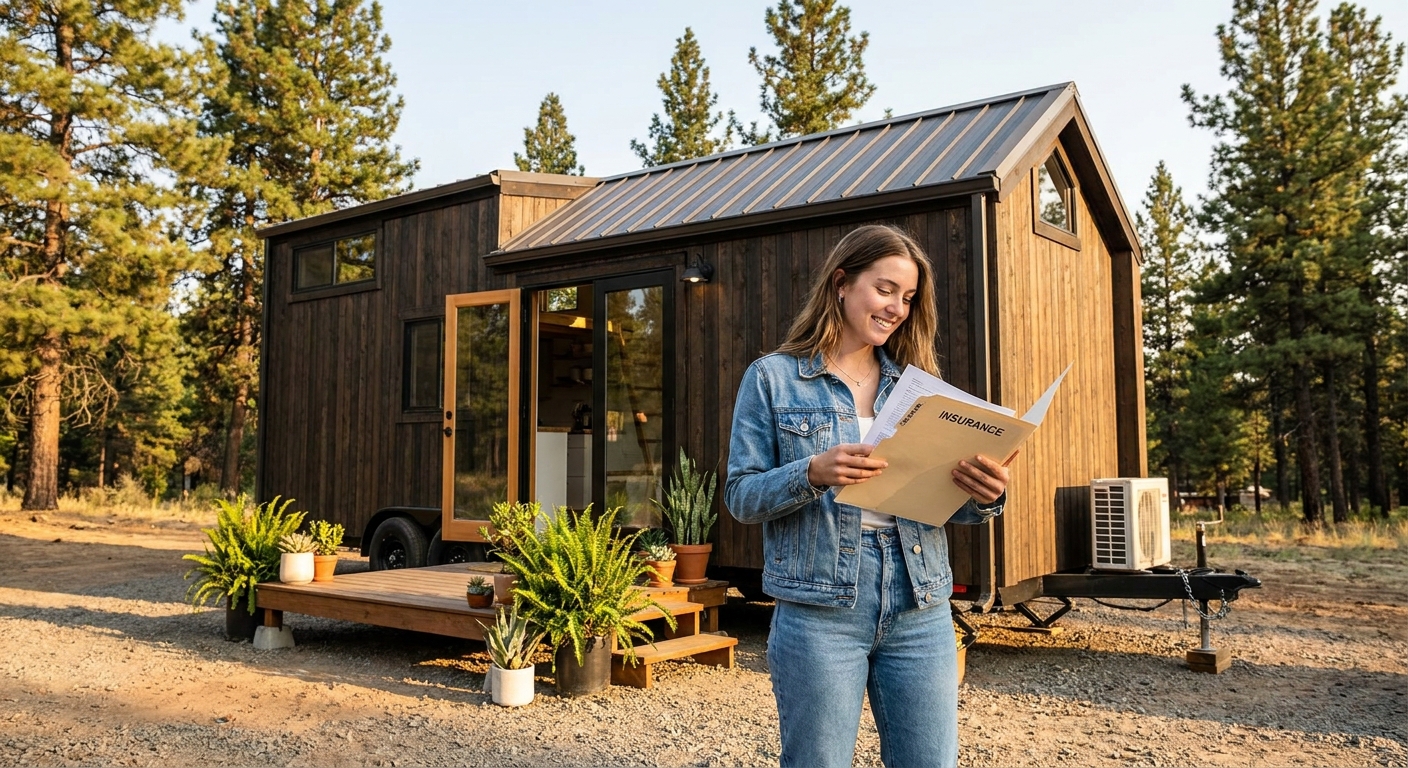
Tiny homes built on trailer chassis are generally not eligible for standard homeowners insurance. As Progressive confirms, you won't be able to cover a tiny home with a standard home insurance policy, but coverage may be available through RV or mobile home insurance.
Key coverages under an RV-style policy for a THOW include:
- Collision coverage for damage while being towed
- Comprehensive coverage for theft, fire, storm damage
- Liability for injuries or property damage to others
- Personal property for your belongings inside
- Full-timer endorsement if the THOW is your primary residence, since standard RV policies are designed for recreational use only
Tiny Homes on Permanent Foundations
A tiny home that is site-built or permanently affixed to land has a much cleaner path to insurance. These structures can qualify for a manufactured/mobile home insurance policy (HO-7) or, in some cases, a standard homeowners policy if they meet local building codes.
Learn more about mobile home insurance and how it applies to small permanent structures, including what an HO-7 policy covers for factory-built and modular homes.
Tiny Homes as ADUs (Accessory Dwelling Units)
A tiny home placed on the same lot as your primary residence may qualify as an Accessory Dwelling Unit (ADU). If it's a detached backyard tiny home, it typically falls under Coverage B (Other Structures), but only up to its limits, which most standard HO-3 policies cap Coverage B at 10% of the Coverage A limit.
For example, if your primary home is insured for $400,000, Coverage B would provide up to $40,000 for a detached tiny home ADU. That may not be enough, especially with 2026 ADU construction costs running $150,000 to $400,000 in most markets. If your tiny home ADU is attached or an interior conversion, it's usually treated as part of the main dwelling under Coverage A instead. If you build or add an ADU, you're required to notify your insurer of the material change to the property, and failure to disclose can result in coverage denial or policy cancellation. If you rent out the ADU, you'll likely need a separate landlord policy since many insurers exclude rented ADUs from Coverage B entirely.
Read our full guide on guest house insurance and granny flat coverage to understand ADU coverage limits and when a separate policy is required.

Compare Home Insurance Plans in Ohio
Find your best options in less than 2 minutes
What Tiny Home Insurance Costs in 2026
Tiny home insurance is generally more affordable than traditional homeowners insurance, but costs vary significantly based on your home type, location, and usage. In 2026, tiny home insurance runs roughly $500 to $1,650 per year, with most owners paying between $600 and $1,500 annually depending on the home type, coverage path, and certification status.
One notable 2026 shift: certified tiny houses on wheels can now cost more than foundation-placed units, reversing the older assumption that wheeled units were always cheaper, because coverage often bundles transit and RV-style protection.
| Tiny Home Type | Typical Annual Cost (2026) | Policy Type |
|---|---|---|
| Tiny home on wheels (certified) | $1,050 – $1,650 | RV / Travel Trailer |
| Permanent foundation | $700 – $1,500 | Mobile Home (HO-7) / Homeowners |
| ADU (other structures) | Included in main policy | Coverage B |
| DIY / self-built | $375 – $1,200 | Specialty / Builder's Risk |
| Renter of tiny home | $180 – $240 | Renters Insurance |
Community and specialty insurer data confirms these ranges, with NOAH reporting an average tiny home insurance cost of about $850 per year, though some insurers offer RV-based coverage for less than $1,000.
Key Cost Factors
Several variables drive your premium up or down:
- Foundation vs. wheels since stationary homes carry lower transport risk
- Location and weather risk, with wildfire zones, flood plains, and high-wind areas costing more
- Construction materials where non-standard materials may increase replacement cost estimates
- Certification status since RVIA, ANSI A119.5, or NOAH-certified homes are easier and cheaper to insure
- Primary vs. recreational use because full-time residents pay more than part-time users
- Coverage limits and deductible where higher deductibles lower your premium

Protect your home with State Farm
Average Rate:
Homeowners who bundle and save with State Farm save an average of $1,000 per year!

You're in Good Hands® with Allstate
Average Rate:
Get comprehensive home coverage with flexible policy options.

Customize your home coverage
Average Rate:
Only pay for the coverage you need with personalized home insurance.

Smart coverage for your home
Average Rate:
Protect what matters most with award-winning home insurance.
Best Tiny Home Insurance Companies in 2026
Finding the right insurer is one of the hardest parts of tiny home ownership. Many major carriers simply won't write tiny home policies. As of 2026, the most active names writing tiny home coverage are Foremost, Strategic Insurance Agency, Progressive, American Family, and American Modern, with a handful of specialty options like MAC Insurance filling gaps.
Company Highlights
- Strategic Insurance Agency is one of the few providers to cover off-grid and DIY tiny homes, and is frequently cited as the go-to specialist for non-traditional builds.
- MAC Insurance runs a nationwide tiny home program through Lloyd's of London available in over 40 states, and is popular for non-traditional and off-grid builds.
- Progressive covers tiny houses on wheels as RVs and HUD-code manufactured homes, but self-constructed units are generally ineligible and NOAH certification is preferred.
- Foremost is a strong option for both stationary and mobile tiny homes. Personal-use tiny homes, on wheels or on a foundation, are eligible for coverage through Foremost, and it's currently one of the only major carriers that specifically requires certification.
- American Modern offers specialized coverage for stationary tiny homes and is a good fit for vacation, seasonal, and park-model tiny homes. Learn more in our American Modern reviews.
- Proper Insurance is the best choice if you rent out your tiny home through platforms like Airbnb.
- State Farm is the largest home insurer in the US and offers several paths for tiny homes on a case-by-case basis, though it doesn't have a dedicated tiny home product.
- USAA (via Foremost) partners with Foremost for personal-use tiny homes on wheels or foundations, available to eligible military members and families.
Proving Insurability: Certifications, Permits & Requirements
Getting coverage isn't just about finding the right company. It's about proving your home qualifies. Your tiny home's certification status and how it's titled often determine whether you'll need a homeowners, RV, or specialty policy.
Key Certifications
| Certification | Who Needs It | What It Means |
|---|---|---|
| RVIA (Recreational Vehicle Industry Association) | Factory-built THOWs seeking RV insurance | Built to NFPA 1192 RV safety standards; comes with a VIN |
| NOAH (National Organization of Alternative Housing) | THOWs or custom/DIY builds seeking specialty coverage | Certified for residential construction quality via multi-stage inspections |
| ANSI A119.5 | Park model RVs and some THOWs | Accepted by many mainstream RV insurers alongside RVIA |
| Local Building Permits | Permanent foundation tiny homes & ADUs | Demonstrates code compliance; required by most insurers |
| HUD/HCD Label | Manufactured homes | Federally mandated for factory-built homes |
In practice, RVIA or ANSI A119.5 certified THOWs qualify for standard RV policies from multiple mainstream carriers, while NOAH-certified builds qualify for a smaller but still meaningful pool of specialty carriers. Uncertified DIY or small-shop builds often qualify only for liability-limited specialty policies at higher rates.
Steps to Get Insured
- Identify your tiny home's type (on wheels, on foundation, or ADU)
- Gather documentation including build specs, certifications, VIN if applicable, permits, and photos of construction
- Check local zoning since your home must be legally placed where it sits
- Work with a specialist since general agents often can't place tiny home policies
- Request agreed value coverage so your payout isn't reduced by depreciation
RV Insurance vs. Tiny Home Insurance: The Key Differences
While tiny homes on wheels are often insured under RV policies, they are not the same as recreational vehicles in the eyes of insurers:
| Feature | RV Insurance | Tiny Home Insurance |
|---|---|---|
| Designed for | Frequent road travel | Occasional moves or permanent placement |
| Full-time living | Requires endorsement (6+ months/year) | Built-in for stationary types |
| Agreed value option | Rare | More common in specialty policies |
| Construction standards | RV safety codes (RVIA/NFPA 1192) | Residential building codes (NOAH, HUD, ANSI A119.5) |
| Coverage while parked | Yes, with limits | Yes, full-time |
| Liability while moving | Yes | Only if towed under RV policy |
If your tiny home spends 90% of its time parked in one spot, an RV policy may leave critical gaps. A specialty tiny home policy or mobile home policy is often a better long-term fit. For a broader look at how policy forms differ, review our guide on types of home insurance policies.
Non-traditional builds face similar challenges. Learn more about log home insurance and how specialty housing insurance works for unusual construction, or how seasonal home insurance applies if your tiny home is a vacation property.
Frequently Asked Questions About Tiny Home Insurance
Q: Can I use a regular homeowners insurance policy for my tiny home?
Standard homeowners insurance policies are designed for traditional site-built homes and rarely apply to tiny homes. If your tiny home is on wheels, it's ineligible for a homeowners policy and needs RV or specialty coverage instead. If it's on a permanent foundation, meets local building codes, and is your primary residence, you may qualify for a mobile home (HO-7) policy or, in some cases, a standard homeowners policy. Always verify eligibility with the insurer directly.
Q: What is NOAH certification and why does it matter for insurance?
NOAH stands for the National Organization of Alternative Housing, and it certifies that a tiny home is built to residential construction standards through multi-stage inspections during the build (including a remote inspection option for DIY builds). Foremost is one of the few major carriers that specifically requires certification, and NOAH-certified homes open the door to a pool of specialty carriers. Having this certification significantly increases your chances of getting insured and may lower your premium.
Q: Do I need a separate policy if my tiny home is an ADU on my property?
Not always. If the ADU is detached, your homeowners policy's Coverage B (Other Structures) typically covers it up to about 10% of your dwelling coverage limit. If it's attached or an interior conversion, it usually falls under your main Coverage A dwelling limit. However, if you rent out the ADU, many insurers exclude it from Coverage B entirely and a separate landlord or short-term rental policy is required. See our guide on guest house insurance for more detail.
Q: What does "agreed value" coverage mean and why is it important for tiny homes?
Agreed value coverage means your insurer and you agree on the home's total insured value upfront, and that's exactly what you receive in a total loss with no depreciation deducted. This is especially important for tiny homes, which can be difficult to value accurately since they don't have traditional comps. Without it, an "actual cash value" policy could leave you with a payout far less than what it would cost to replace your home.
Q: What happens to my tiny home insurance when I move it to a new location?
For tiny homes on wheels covered under an RV or THOW policy, coverage typically follows the home during transit, including collision and liability while being towed. Some specialty insurers offer trip endorsements that cover the structure during moves for a small flat fee for the policy term regardless of number of trips. Your new parking location may affect your premium, so always notify your insurer before relocating to avoid coverage lapses.