
Compare Home Insurance Plans in Ohio
Find your best options in less than 2 minutes



How a Pool Affects Your Home Insurance Premiums in 2026
Adding a swimming pool to your home is a major upgrade, but it's also a significant change to your insurance risk profile. Insurers view pools as high-liability features that raise both the cost to replace your property and the chance of a serious injury claim. The result is almost always a higher premium, and in 2026 that impact is amplified by an already elevated baseline. The average annual premium is projected to increase 4% to about $3,057 this year, after jumping 12% in 2025, according to Insurify, and pools sit near the top of the list of features that push individual policies well above that mark.
Inground Pools vs. Above Ground: The Cost Difference
The type of pool you own directly determines how much your rates increase. Inground pools are treated as permanent structures, which means higher replacement costs and greater liability exposure. Inground pools typically add $50 to $300 per year to your premium, while above-ground pools cost less to insure, usually $25 to $75 a year. In higher-risk markets or homes with diving boards and slides, the annual bump can push closer to 10% to 25% of the base premium, and in some cases add $150 to $500+ per year.
Above ground pools carry a lower risk profile. They're generally less expensive to replace, and some are classified as personal property rather than permanent structures. That said, they still carry meaningful liability risk and will likely push your premiums upward, just by a smaller margin.
| Pool Type | Coverage Classification | Typical 2026 Premium Impact |
|---|---|---|
| Inground | Other Structures (Coverage B) | $50 to $300 per year (up to 25% in high-risk states) |
| Above Ground (permanent) | Other Structures (Coverage B) | $25 to $150 per year |
| Above Ground (non-permanent) | Personal Property (Coverage C) | Minimal; may be excluded |
How Pool Structure and Equipment Are Covered
Inground pools and permanently installed above ground pools typically fall under Other Structures coverage (Coverage B) in a standard homeowners policy. This coverage pays to repair or replace your pool if it's damaged by a covered peril such as fire, vandalism, falling objects, or certain storms. Learn more about how other structures coverage protects detached features on your property.
The standard limit for Other Structures coverage is 10% of your dwelling coverage limit. So if your home is insured for $400,000, you'd have up to $40,000 to cover your pool, deck, and any other detached structures on your property.
Keep in mind:
- Flood damage to a pool is typically not covered under a standard policy
- Earthquake damage is also excluded in most standard policies
- Wear and tear or gradual deterioration is never covered
- If your pool is connected directly to your home, it may fall under dwelling coverage (Coverage A) instead
If the standard 10% limit isn't enough to replace your pool, ask your insurer about increasing your Coverage B limit or adding an endorsement for broader protection. With construction costs and tariffs still pushing building materials higher in 2026, many owners find their default limit falls short of true rebuild cost.

Compare Home Insurance Plans in Ohio
Find your best options in less than 2 minutes
Liability: The Biggest Insurance Risk of Pool Ownership
Of all the ways a pool affects your homeowners insurance, liability is the most significant. A pool accident, especially one involving a child, can result in a lawsuit worth hundreds of thousands of dollars or more. Drowning is the leading cause of death for children ages one to four, according to a U.S. Consumer Product Safety Commission (CPSC) report. An average of 376 children under the age of 15 fatally drowned in pool- or spa-related incidents each year from 2021 to 2023. Nearly 80 percent of those fatal drownings involved children under five. There were, on average, an estimated 5,900 pool- or spa-related, hospital emergency department (ED)-treated, nonfatal drowning injuries each year for 2023 through 2025, and social inflation is pushing jury verdicts higher, so insurers are steering pool owners toward larger liability limits than ever before.
The Attractive Nuisance Doctrine Explained
Pools are one of the most cited examples of what the law calls an "attractive nuisance." Under this legal doctrine, a property owner can be held liable for injuries to a child trespasser if a dangerous feature on the property drew the child in, even if that child had no legal right to be there.
To be held liable under attractive nuisance, a court generally looks at whether:
- The pool had the potential to cause serious harm
- The homeowner knew or should have known children might wander onto the property
- The children were too young to understand the danger
- The homeowner failed to take reasonable steps to prevent access
Importantly, simple "No Trespassing" signs are not sufficient protection. Young children cannot read or meaningfully understand such warnings. Physical barriers and supervision are what courts, and insurers, require.
Common Pool Accident Claim Scenarios
Understanding the types of claims that arise from pool ownership can help you make sure you're properly covered:
- Drowning or near-drowning: The most catastrophic scenario, often involving children. These claims can reach or exceed policy limits quickly.
- Slip-and-fall injuries: Wet surfaces around pools create hazardous conditions for guests of all ages.
- Diving board injuries: Head, neck, and spinal injuries from diving are among the most severe, and most expensive, injury claims.
- Unauthorized access injuries: A neighbor's child enters through a broken gate and is injured. You may be liable even though no one invited them.
Your homeowners policy's personal liability coverage (Coverage E) is your first line of defense. Most standard policies come with $100,000 in liability coverage, but for pool owners, that is rarely sufficient in today's legal environment.
How Much Liability Coverage Do You Actually Need?
Experts and insurers alike recommend $300,000 to $500,000 in personal liability coverage as a minimum for pool owners. For additional protection, a personal umbrella insurance policy is strongly recommended. A $1 million umbrella policy typically costs $250 to $550 per year nationally in 2026, but pricing runs sharply higher in catastrophe-exposed states. Current pricing data shows Washington state often comes in lowest at around $450 to $550, while Florida frequently runs highest at $875 to $975 for $1 million in coverage.
Learn more about how much liability coverage you should carry as a homeowner with higher-risk features like a pool.

Protect your home with State Farm
Average Rate:
Homeowners who bundle and save with State Farm save an average of $1,000 per year!

You're in Good Hands® with Allstate
Average Rate:
Get comprehensive home coverage with flexible policy options.

Customize your home coverage
Average Rate:
Only pay for the coverage you need with personalized home insurance.

Smart coverage for your home
Average Rate:
Protect what matters most with award-winning home insurance.
Insurer Requirements: What You Must Have to Stay Covered
Most insurers impose specific safety requirements on pool owners. In 2026, carriers are treating these as pass/fail underwriting conditions rather than suggestions. Failing to meet them can result in claim denials, policy cancellation, or refusal to renew. Here's what's commonly required:
Standard Pool Safety Requirements
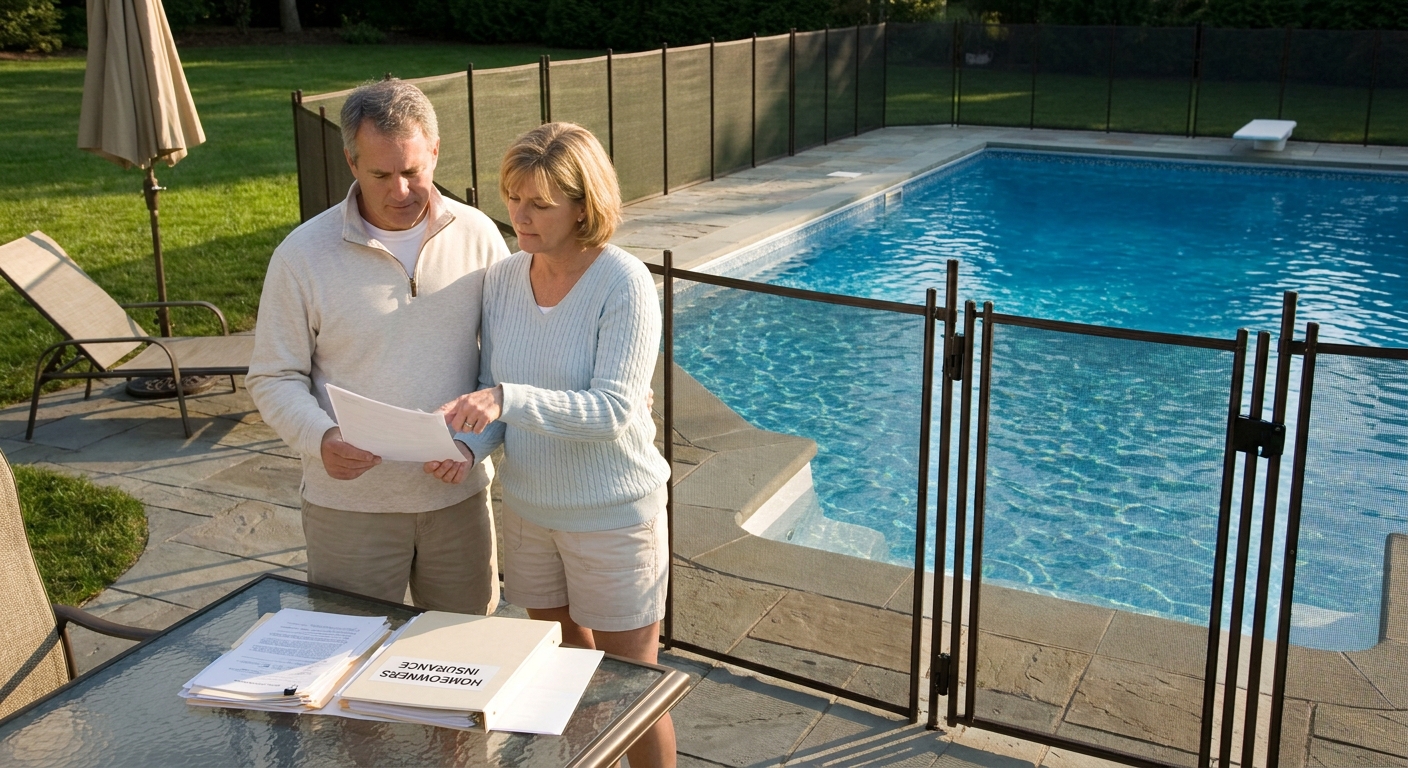
Fencing A fence around the pool is the most universally required safety feature. Most insurers require a fence that is at least 4 to 5 feet high, with requirements varying by state:
- California: 60 inches (5 feet) with no more than 2 inches of ground clearance
- Texas, Florida, and New York: 48 inches minimum (local codes may require more)
- Arizona: 4 to 5 feet depending on jurisdiction
The gate must be self-closing, self-latching, and open outward (away from the pool), with the latch positioned on the interior side to prevent children from reaching it. Pool fence requirements state that pool fences must have a minimum height of 48 inches and require gates which close and latch automatically to open away from the pool area. All openings must be small enough that a 4-inch sphere cannot pass through.
Pool Covers Many insurers require or strongly recommend a safety cover that meets ASTM F1346 standards, a designation that certifies the cover can prevent drowning. Automatic and lockable covers are often accepted as risk-reduction features but are usually not a substitute for a fence.
Alarms Door/exit alarms, underwater motion alarms, or perimeter alarms are commonly required, particularly in states like California and Florida, which mandate multiple safety features for newer or remodeled pools.
Diving Boards and Slides In 2026, a growing number of insurers now exclude liability coverage entirely for any incident involving a diving board or slide, rather than just charging higher premiums. Some carriers require their removal as a condition of writing or renewing coverage. Providing documented proof of a properly fenced enclosure before an insurer will bind a home policy is becoming standard practice, and Insurify has flagged this as one of the biggest shifts in pool underwriting this year.
State-Specific Safety Requirements at a Glance
| State | Fence Height Requirement | Additional Requirements |
|---|---|---|
| California | 60 inches | 2 of 7 approved drowning-prevention features required for pools built or remodeled after 2018 (Swimming Pool Safety Act, HSC 115920 to 115929) |
| Florida | 48 inches (varies by local code) | HB 117 (effective July 1, 2026) requires at least one approved safety feature for any pool on property sold or transferred on or after October 1, 2026; home inspectors must report violations |
| Texas | 48 inches (local codes) | Self-latching gate required; hail/storm deductibles common; TDI confirms fencing and locking gates typically mandatory |
| Arizona | 48 to 60 inches | Self-latching gate; interior barriers often required if house doors open to pool |
| New York | 48 inches | Door alarms; secondary barriers often required when dwelling forms part of the barrier |
A new Florida law requires residential properties with pools to have at least one safety feature when sold or transferred after October 1, 2026. The measure mandates that properties have a barrier, cover, or alarm as safety measures. Home inspectors are responsible for noting any violations to local enforcement agencies.
How to Notify Your Insurer and What Happens If You Don't
Steps to Add Your Pool to Your Home Insurance Policy
- Contact your insurer before or immediately after installation, don't wait until the pool is finished
- Provide key details including pool type (inground or above ground), size, materials, and any special features like a diving board or slide
- Review your liability limits and ask your agent whether your current coverage is sufficient
- Ask about required safety features so you're compliant from day one
- Get everything in writing by confirming the policy changes in your updated declarations page
What Happens If You Don't Disclose Your Pool?
Failing to tell your insurer about your pool is a serious risk. If a claim arises, especially a liability claim from a pool accident, your insurer could:
- Deny the claim entirely, leaving you personally responsible for all costs
- Cancel your policy for material misrepresentation
- Void your liability protection for any pool-related injuries
This applies whether the pool existed when you first took out the policy or was added later. Review your home insurance liability obligations to make sure you're fully protected. Homeowners with other attractive nuisances should also read our guide on trampoline home insurance, since the same disclosure rules apply.
Frequently Asked Questions
Does adding a pool automatically increase my home insurance?
Yes, in virtually every case. A pool increases both your property replacement value and your liability exposure, both of which are factors insurers use to calculate premiums. The amount of the increase depends on the type of pool, your location, the insurer, and which safety features you have in place. In 2026, inground pools typically add $50 to $300 per year, while above ground pools add $25 to $75.
Is my above ground pool covered by my homeowners insurance?
It depends on how your insurer classifies it. Permanently installed above ground pools are often covered under Other Structures (Coverage B). Non-permanent or inflatable pools may fall under personal property (Coverage C), with lower limits. Some policies may exclude portable pools entirely, so always confirm with your insurer how your specific pool is classified before assuming coverage.
Can my insurer require me to remove my diving board?
Yes. In 2026, many insurers view diving boards as a high-risk feature and will either exclude liability claims related to diving boards entirely, charge substantially higher premiums, or require removal as a condition of coverage. If your insurer won't cover your diving board, you may need to shop for a carrier that will, or weigh the cost of keeping it against the insurance implications. Learn more about liability coverage limits you'll need in either scenario.
What's the difference between pool liability coverage and an umbrella policy?
Your homeowners policy's personal liability coverage (Coverage E) is your first layer of protection, paying for legal defense and damages if someone is injured in or around your pool. An umbrella policy kicks in after those limits are exhausted, providing an additional $1 million or more in protection. For pool owners, both are important: max out your standard liability limit ($300K to $500K) and add an umbrella policy for full peace of mind.
Are there states where having a pool makes it harder to get home insurance?
Yes. In states like Florida, California, Texas, and Arizona, pools combined with disaster-prone environments (hurricanes, wildfires, hail) can make homeowners insurance harder to obtain or significantly more expensive. The average home insurance cost in the U.S. is $2,872 annually, or $230 monthly for $300,000 in dwelling coverage based on 2026 Insurance.com data, but rates vary, from the cheapest, in Hawaii at $738 a year, to Florida at $8,471 a year. Depopulation from Citizens Property Insurance in Florida is also pushing pool owners toward private carriers with stricter safety requirements, so compare pool insurance options before you buy.