
Compare Home Insurance Plans in Ohio
Find your best options in less than 2 minutes



Why Insurers Treat Trampolines as High Risk
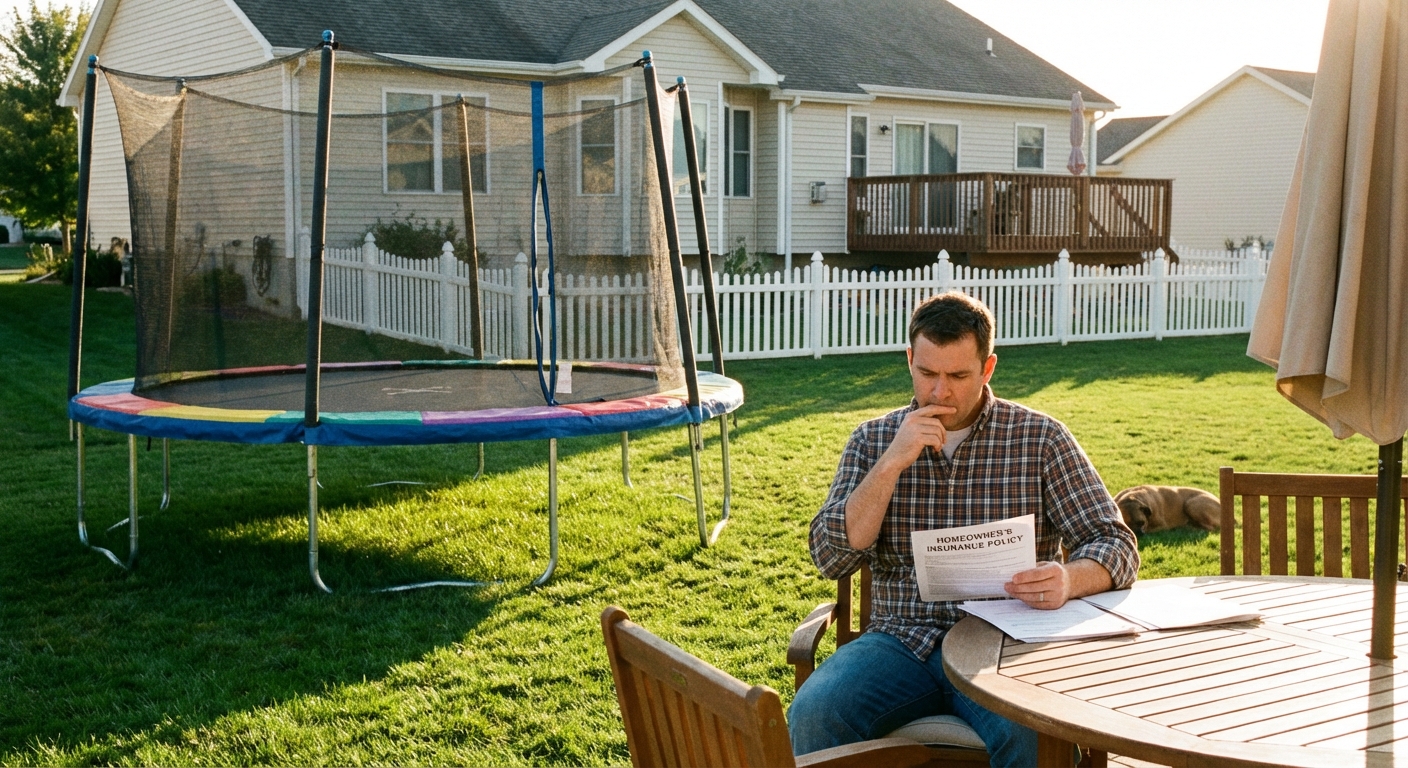
Homeowners insurance companies classify trampolines as "attractive nuisances," a legal term for features that draw in curious children who may be injured, exposing you to significant liability. The data backs up that concern. According to CPSC NEISS data (product code 1233, latest 2024 data year), trampolines generate an estimated 108,631 emergency-room-treated injuries per year in the U.S., a figure that has been roughly flat over the last five years, with about 4.1% of those ER visits ending in hospital admission or transfer. Older CPSC estimates put the number of medically treated trampoline injuries above 300,000 in a single year when urgent care and doctor visits are included.
More than 90% of trampoline injuries are sustained by children, mostly between the ages of 5 and 14, and roughly three out of four occur when two or more jumpers collide on the same mat. The injury breakdown paints a clear picture of why insurers are wary:
| Injury Type | Share of All Trampoline Injuries |
|---|---|
| Soft tissue injuries (sprains, strains) | ~52% |
| Fractures | ~35% |
| Lacerations | ~12% |
| Injuries from multiple jumpers | ~75% of all incidents |
| Falls off the trampoline | ~22% of all incidents |
Beyond the raw numbers, trampolines carry unique liability exposure. Under the attractive nuisance doctrine, a property owner can be held liable if a child is injured by a dangerous condition that entices them onto the property, even if that child is trespassing. Most states follow the Restatement (Second) of Torts §339 test, which weighs whether the owner should have known children were likely to trespass, whether the condition poses an unreasonable risk, and whether the burden of eliminating the danger is slight compared to the risk. That is the kind of open-ended liability that makes insurers nervous and prompts many to either raise your premium, add exclusions, or decline coverage altogether.

Compare Home Insurance Plans in Ohio
Find your best options in less than 2 minutes
How Trampolines Affect Your Homeowners Insurance Premiums
The financial impact of owning a trampoline depends heavily on your insurer, your state, and the safety measures you have in place. Here is what you can generally expect in 2026:
Typical Premium Increases
Most homeowners see a premium increase in the range of 5% to 25% after disclosing a trampoline, which typically translates to roughly $100 to $500 per year added to their policy cost. Some carriers apply a modest flat surcharge of only $25 to $50 per year, while others build the added risk into a larger rate bump.
For context on today's home insurance market: the average U.S. homeowners insurance policy now costs about $2,490 per year (roughly $208 per month) for $400,000 in dwelling coverage, and Insurify projects the average annual premium will rise another 4% to $3,057 by the end of 2026 after jumping 12% in 2025. On a policy near $3,000, even a 10% trampoline surcharge means about $300 more per year. Because home insurance rates keep climbing, any added surcharge lands on top of an already inflated base.
Insurers typically respond to a trampoline in one of three ways: cover it under a standard policy (sometimes contingent on safety features), add a surcharge or embed higher costs into your rate, or exclude trampoline-related liability altogether via a "trampoline exclusion." Reviewing your home insurance liability coverage before adding a trampoline is one of the smartest moves you can make.
The Three Common Insurer Responses
A fourth response also exists: some insurers will require removal of the trampoline as a condition of maintaining coverage. In all cases, disclosing the trampoline immediately is critical.

Protect your home with State Farm
Average Rate:
Homeowners who bundle and save with State Farm save an average of $1,000 per year!

You're in Good Hands® with Allstate
Average Rate:
Get comprehensive home coverage with flexible policy options.

Customize your home coverage
Average Rate:
Only pay for the coverage you need with personalized home insurance.

Smart coverage for your home
Average Rate:
Protect what matters most with award-winning home insurance.
Disclosure Requirements & What Happens If You Don't Report It
Do You Have to Tell Your Insurance Company About a Trampoline?
Yes. You are contractually obligated to disclose a trampoline to your homeowners insurance provider. Most policies require you to notify your insurer of any change on your property that materially affects your risk profile, and a trampoline clearly qualifies. Progressive specifically states that because a trampoline increases the risk of someone filing a liability claim against you and adds to the amount of personal property covered by your insurer, your policy may not provide coverage or your premium may increase when you notify your insurer of a trampoline on your property.
The best time to disclose is before you purchase the trampoline, so you can understand the terms, any added cost, and whether your insurer covers it at all.
What Happens If You Don't Disclose?
Failing to report a trampoline is considered material misrepresentation, and the consequences can be severe:
- Claim denial: If someone is injured on your trampoline and you never told your insurer it existed, the claim can be denied outright. You would be personally on the hook for medical bills and legal settlements.
- Policy cancellation: Some insurance companies do not allow trampolines and will exclude coverage for them. If you obtain one, your insurer may not offer coverage for trampoline-related injuries and damages, and they may cancel or non-renew your policy.
- Non-renewal: Even if they do not cancel mid-term, your insurer may refuse to renew your policy. Understanding your rights around home insurance non-renewal is essential if this happens.
- Retroactive void: In some cases, coverage could be retroactively voided, leaving past claims exposed as well.
Trampolines are also among the common home insurance exclusions that can quietly leave you uncovered, so read your policy carefully.
Which Insurance Companies Allow Trampolines?
Insurer policies on trampolines vary widely and can differ by state and even by individual agent. Below is a general breakdown of how major carriers approach trampoline coverage in 2026.
Major Insurer Trampoline Policies
| Insurer | Trampoline Policy |
|---|---|
| State Farm | Publishes trampoline safety guidance and encourages homeowners to disclose trampolines proactively so they can verify coverage or adjust it if needed. Many State Farm policies do not have a blanket trampoline exclusion, though this varies by state and policy form. |
| Allstate | Says a homeowners policy may provide coverage (up to the limits and terms of your policy) for a trampoline if you follow safety guidelines. However, if your policy contains a trampoline exclusion, it will not provide any protection for trampoline-related claims. |
| Progressive | Liability coverage may extend to trampoline injuries up to policy limits, but Progressive warns that when you notify your insurer of a trampoline, your policy may not provide coverage or your premium may increase. |
| Lemonade | Generally removes liability coverage as it pertains to trampolines because of the inherent danger and high risk involved, though the trampoline itself may still be covered as personal property. |
| American Family | Notes most insurance companies do not automatically cover trampolines due to liability risks; some will insure trampolines only if the right safety equipment and precautions are in place. |
| Farmers | Widely reported to deny or cancel coverage on homes with trampolines. Confirm with a local agent before purchasing. |
| Nationwide | Mixed approach. Some policies allow with safety conditions or a surcharge; others exclude trampoline liability. |
Important: These policies can change and vary by state. Always contact your insurer directly to confirm current trampoline coverage terms before purchasing.
Safety Measures That Can Help You Qualify for Coverage
Many insurers that do allow trampolines will require, or strongly recommend, the following safety features as a condition of coverage:
- ✅ Safety net enclosure (required by many insurers and ASTM safety standards)
- ✅ Locked or fenced yard to prevent unauthorized access
- ✅ Secure anchoring to the ground to prevent wind displacement
- ✅ Padded frame covers over springs and hard edges
- ✅ Adult supervision for all use
- ✅ One jumper at a time policy (about 75% of injuries involve multiple jumpers)
- ✅ Regular inspections for wear and damage
- ✅ Ground-level installation where possible (some insurers view in-ground trampolines as lower risk)
Installing these features demonstrates to your insurer that you are actively managing the risk, which can help keep premium increases toward the lower end of the range or help you qualify for coverage when you otherwise might not.
Recommended Liability Coverage Limits
A standard homeowners policy typically provides personal liability coverage between $100,000 and $500,000 per incident. For trampoline owners, the $100,000 default is generally considered insufficient. Most insurance professionals recommend:
- Minimum: $300,000 in personal liability coverage
- Preferred: $500,000 in personal liability coverage
- Best protection: $500,000 in homeowners liability plus a personal umbrella policy of $1 million or more
Learn more about umbrella insurance for homeowners and why it is particularly valuable for high-risk features like trampolines. If you are not sure whether your current limits are enough, our guide on how much liability coverage you need walks through the math.
What to Do If You're Denied Trampoline Coverage
If your current insurer excludes trampolines or cancels your policy, you still have options.
Option 1: Switch to a Trampoline-Friendly Insurer
Not all insurers treat trampolines the same way. Working with an independent insurance broker can help you compare multiple carriers to find one that allows trampolines, ideally with the safety measures you already have in place. Be upfront about the trampoline from the start. Homes that have trouble getting standard coverage may need to explore options for hard-to-insure homes or even the high-risk home insurance market.
Option 2: Add a Personal Umbrella Policy
If your homeowners policy covers the trampoline but with lower limits than you would like, a personal umbrella policy can extend your liability coverage by $1 million or more. A $1 million umbrella policy typically costs $150 to $300 per year according to the Insurance Information Institute, though real-world quotes from major carriers often land between $300 and $600 per year depending on your state and risk profile. Each additional $1 million commonly adds $75 to $150 per year. For a homeowner with a trampoline, that is an affordable safeguard given today's rising verdict environment. Note that if your base homeowners policy excludes trampoline claims, an umbrella cannot sit on top of an excluded loss, so confirm coverage on the underlying policy first. See our full umbrella insurance for homeowners guide for pricing details.
Option 3: Increase Your Base Liability Limits
Before pursuing an umbrella policy, check whether you can simply increase your homeowners liability limits from the standard $100,000 up to $300,000 or $500,000. This is often an inexpensive upgrade that addresses most trampoline liability scenarios. If you were recently denied coverage entirely, our guide on home insurance denials walks through your next steps.
Option 4: Remove or Relocate the Trampoline
If coverage truly is not available or the cost is prohibitive, some homeowners choose to remove the trampoline entirely, or replace it with an in-ground trampoline, which some insurers view as lower risk because it eliminates the fall-from-height concern. Because trampolines can also affect continuous home insurance coverage by triggering non-renewal, removal may open up better rates and prevent a coverage gap.
| Alternative | Best For | Estimated Cost |
|---|---|---|
| Switch insurers | Those denied coverage outright | Varies by carrier |
| Personal umbrella policy | Those with partial/limited coverage | $150-$600/yr for $1M |
| Increase liability limits | Those with existing coverage | Often $25-$75/yr more |
| Remove/replace trampoline | Those unable to find coverage | Cost of removal |
Backyard pools raise many of the same underwriting issues, so if you also have or plan to add one, review our guide on swimming pools and home insurance or the companion article on pool and home insurance costs to see how the two exposures stack up.
Frequently Asked Questions
Does a trampoline automatically increase homeowners insurance?
Not automatically, but it almost always does once disclosed. Most insurers that accept the risk will raise your premium by 5% to 25% annually after learning about a trampoline, though the exact amount depends on your insurer, your location, and the safety features you have installed. Some insurers skip the increase and instead exclude trampoline-related coverage or require removal as a condition of continued coverage.
Can you have a trampoline with homeowners insurance?
Yes, many insurers will cover homes with trampolines, but there are typically conditions. You will generally need to disclose the trampoline, meet specific safety requirements such as installing a net enclosure and a locked fence, and potentially accept a premium increase. Carriers like State Farm, Allstate, and American Family often offer conditional coverage, while Farmers and Lemonade typically exclude trampoline liability entirely.
What is a trampoline insurance exclusion?
A trampoline insurance exclusion is a policy clause that explicitly removes coverage for any claims arising from trampoline use. If your policy contains this exclusion, your insurer will deny claims for injuries, property damage, or liability that result from trampoline activity, even if your standard liability coverage would otherwise apply. Exclusions are most common when a policyholder fails to disclose the trampoline or when the insurer simply does not offer trampoline coverage at all.
How much does a trampoline add to homeowners insurance costs annually?
On average, expect to pay between $100 and $500 more per year after disclosing a trampoline, though this varies significantly. Homes in high-risk states or those with higher base premiums (the U.S. average is on track to reach $3,057 by the end of 2026) may see larger dollar increases even at the same percentage rate. The best way to get an accurate figure is to contact your current insurer and ask specifically how a trampoline would affect your rate before you buy one.
What trampoline safety features do insurance companies require?
The most commonly required safety features include a full safety net enclosure around the perimeter, secure anchoring to the ground, padded covers over springs and frames, and a locked or fenced yard to prevent unauthorized access. Some insurers also require written rules for use, such as adult supervision and a one-jumper-at-a-time policy. These requirements are assessed on a carrier-by-carrier basis, so always confirm with your specific insurer what is needed to maintain or qualify for coverage.