
Compare Home Insurance Plans in Ohio
Find your best options in less than 2 minutes



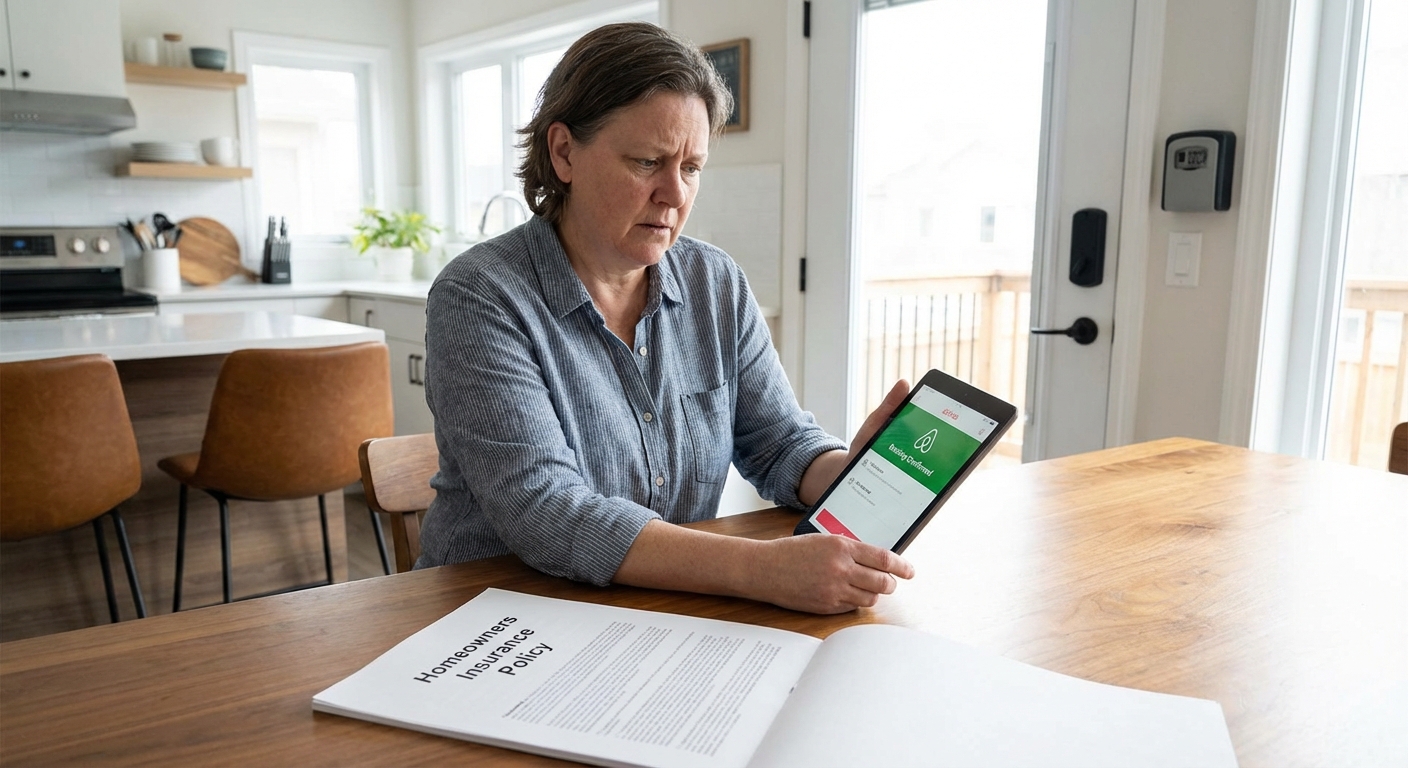
Why Your Homeowners Insurance Won't Cover Airbnb
Standard homeowners insurance is built around one core assumption: you live in the home full-time. The moment paying guests enter the picture, that assumption breaks down and so does your coverage.
Insurers classify short-term rental activity as a business pursuit. Most policies contain explicit exclusions for business-related liability and property damage, meaning a guest who slips on your stairs, breaks a window, or causes a fire could leave you fully on the hook with no insurance payout. The Insurance Information Institute confirmed in March 2026 that standard homeowner coverage does not apply to properties used for short-term rental income, and standard homeowner policies contain a business activity exclusion.
Here's what your homeowners policy typically excludes when you're hosting:
- Liability claims from guest injuries (slip-and-fall, accidents on the property)
- Guest-caused property damage to your home or belongings
- Theft by guests or during guest stays
- Loss of rental income while the property is being repaired
- Any claim where the insurer discovers undisclosed business use
One 2026 industry analysis found that roughly 60% of standard homeowners' policies automatically void when you start short-term renting, leaving a significant coverage gap. Your insurer can also cancel your policy outright or refuse to renew it. Understanding the broader limits of your policy (see what home insurance doesn't cover) is essential before your first booking, and reviewing the fundamentals of home insurance coverages A through F will help you spot exactly where your policy stops.
Bottom line: The instant you list your home for rent, you need to call your insurance company.

Compare Home Insurance Plans in Ohio
Find your best options in less than 2 minutes
What Airbnb's AirCover Actually Covers in 2026 (And What It Doesn't)
Airbnb provides every host with AirCover for Hosts at no extra cost. It includes guest identity verification, reservation screening, up to $3M in host damage protection, up to $1M in host liability insurance, and a 24-hour safety line.
| Protection | Coverage Limit | What It Covers |
|---|---|---|
| Host Damage Protection | Up to $3,000,000 | Guest-caused damage to your property, belongings, vandalism, pet damage, deep cleaning |
| Host Liability Insurance | Up to $1,000,000 | Legal liability for guest/third-party bodily injury or property damage during a stay |
| Experiences & Services Liability | Up to $1,000,000 | Certain third-party claims involving Airbnb Experiences and Services |
| Deep Cleaning Reimbursement | Included in damage protection | Extra cleaning services for stains, smoke odor, pet accidents |
A few important 2026 updates every host should know:
- Airbnb's April 20, 2026 Terms of Service update introduced a "Legitimate and Verifiable Evidence" standard, and it bans AI-generated, AI-enhanced, upscaled, or otherwise synthetic images and documents in AirCover claims. Submitting AI-processed images (even simple auto-fix or upscaling) can void an otherwise valid claim.
- The April 2026 update also introduces a formal "Consumables" definition covering toiletries, cleaning supplies, and kitchen staples, and those consumables are generally ineligible for damage claims under AirCover. Rules for smoke odor and household linen stains were also tightened.
- The updated Terms clarify a new host obligation to take "reasonable care to avoid loss," meaning Airbnb can reduce or deny payouts if it determines the host failed to act reasonably, even when a guest caused the damage.
- Airbnb's Host Damage Protection Terms now state that violations of house rules are relevant to determining eligibility for AirCover, so clearly written rules (no pets, no smoking, no parties) directly help support claims.
- AirCover is suspended after the 30th consecutive day of a guest's stay, so damage occurring on day 31 or later of the same reservation may fall outside AirCover.
- AirCover for Hosts applies only to stays booked through Airbnb, with no coverage for direct bookings, Vrbo, Booking.com, or other platforms.
- In June 2026, the Virginia Bureau of Insurance and State Corporation Commission alleged that Airbnb's Host Damage Protection is an unlicensed insurance product, giving Airbnb until July 31, 2026 to settle or defend the case, with a contested hearing scheduled to begin December 14, 2026.
- The current term of Airbnb's Host Liability Insurance program has been confirmed effective at least through June 30, 2027.

Protect your home with State Farm
Average Rate:
Homeowners who bundle and save with State Farm save an average of $1,000 per year!

You're in Good Hands® with Allstate
Average Rate:
Get comprehensive home coverage with flexible policy options.

Customize your home coverage
Average Rate:
Only pay for the coverage you need with personalized home insurance.

Smart coverage for your home
Average Rate:
Protect what matters most with award-winning home insurance.
Occasional vs. Frequent Hosting: Which Coverage Do You Need?
Not all Airbnb hosts have the same insurance needs. How often you rent, whether the property is your primary residence, and whether you're present during stays all affect what type of coverage is appropriate.
Coverage Options by Hosting Frequency
1. Home-Sharing Endorsement (Occasional Hosts) Some insurers, like Allstate's HostAdvantage and Erie Homeshare, allow you to add a short-term rental rider to your existing homeowners policy. This is best for hosts who rent infrequently from their primary residence and keep the property as their main home. Endorsement pricing typically ranges from $50 to $500 per year added onto your existing policy.
2. Landlord Insurance (Regular Hosts with Long-Stay Guests) Landlord policies cover the structure, liability, and loss of rental income, but they're designed for long-term tenants, not short-stay guests. Many landlord policies specifically exclude short-term rentals, so confirm coverage before assuming you're protected.
3. Short-Term Rental (STR) Insurance (Recommended for Most Hosts) Dedicated STR policies are purpose-built for Airbnb-style hosting. Proper Insurance is honored as the best insurance for short-term rental hosts, ranked by publications like Investopedia, Rental Recon, and Bob Vila, with independent analysis consistently highlighting Proper Insurance. It is underwritten by Lloyd's of London, exclusively endorsed by Vrbo, and available in all 50 U.S. states. Steadily is the go-to choice for short-term rental hosts who want purpose-built coverage at competitive rates, with the ability to get a quote and bind a policy online in minutes. Safely offers a per-booking model with guest screening baked in.
4. Commercial Dwelling Policy A DP-3 commercial dwelling policy covers the structure of a rental property on an open-perils basis. It's a good fit for investors with multiple properties but typically requires pairing with additional liability coverage and won't include STR-specific protections out of the box.
Typical 2026 Cost Ranges
| Insurance Type | Estimated Annual Cost |
|---|---|
| Home-sharing endorsement | $50 to $500/year added to existing policy |
| Landlord insurance | $1,300 to $1,500/year on average |
| STR-specific insurance (Proper, Safely, Steadily) | $1,500 to $3,500/year for typical single-family |
| Higher-risk or large properties | $2,000 to $5,000/year |
| Per-booking insurance (Safely) | Roughly $5 to $15 per booking |
Proper Insurance typically costs between $1,500 and $4,000 per year depending on property location, size, and coverage limits, while Safely insurance typically costs between $2,000 and $3,000 per year. In 2026, STR-specific policies from carriers like Proper Insurance, Steadily, and Safely run $1,500 to $3,500 per year for a typical single-family home. A practical budget guideline is to allocate 2 to 4% of gross rental income for STR insurance.
Learn more about your overall home insurance liability coverage needs when evaluating short-term rental policies.
Liability Concerns, Disclosure Rules & Properly Insuring Your Airbnb
Guest Liability: The Risk Most Hosts Underestimate
A guest injury on your property can quickly escalate into a six-figure lawsuit. Even if AirCover's $1M liability coverage applies, it excludes assault, battery, intentional acts, and incidents involving third-party services booked through Airbnb's platform. Undisclosed hosting also creates a massive liability coverage gap: if a guest slips and falls and files a lawsuit against you, your personal liability coverage won't respond, and without the right policy in place, you'd be defending that lawsuit with your own assets.
Additional liability risks include:
- Slip-and-fall accidents on stairs, in bathrooms, or around pools
- Guest property theft or damage to a guest's belongings
- Pet-related incidents if guests bring animals
- Mold, bed bug, and infectious-disease claims that AirCover specifically excludes
- Off-platform bookings that receive zero coverage from AirCover
- Airbnb Services bookings (chefs, massage therapists, etc.) where you may not even be notified before the service occurs at your property
For hosts with significant assets, consider pairing your STR policy with an umbrella insurance policy to extend your total liability protection beyond the standard $1M limit. That extra layer becomes especially important since serious injury claims can easily exceed $1M in the U.S.
Do You Need to Tell Your Insurance Company?
Yes, absolutely, and without delay. Failing to disclose short-term rental activity to your insurer is one of the most dangerous mistakes a host can make. Here's what can happen if you stay silent:
- Claim denial even for non-rental events like storm or water damage if rental use is discovered during the investigation
- Policy cancellation since your insurer can drop your coverage upon discovery
- Non-renewal even if they don't cancel mid-term, they may decline to renew
- Personal financial liability meaning you'd be fully responsible for all damages, legal fees, and settlements
A Step-by-Step Checklist for Properly Insuring Your Airbnb
- Call your current insurer and disclose your short-term rental plans
- Ask about endorsements since some carriers can add STR riders to existing policies
- Get quotes from STR-specific insurers like Proper, Safely, or Steadily
- Review AirCover terms so you understand what Airbnb provides and what it doesn't
- Evaluate your liability limits, considering $1M minimum and $2M+ if you have significant assets
- Confirm coverage for vacancy periods between bookings since some policies have vacancy clauses that limit coverage after 30 to 60 days of no occupancy
- Take authentic before-photos (not AI-enhanced) of your property with timestamps and location metadata intact, since AirCover's April 2026 rules ban synthetic images from damage claims
- Write clear house rules (no smoking, no parties, pet policies, quiet hours) since 2026 AirCover terms explicitly consider house rule violations when evaluating claims
- Update your coverage annually as your hosting income and property value change
If you own a condo that you rent on Airbnb, don't forget that your condo insurance HO-6 policy also likely excludes short-term rental activity and will need to be supplemented or replaced. If you rent out a detached unit, learn how guest house and ADU insurance coverage works as well. Hosts running any home-based rental operation should also review general home business insurance gaps to see where personal policies fall short, and vacation-rental owners should look at how seasonal home insurance applies to properties you don't occupy year-round.
Frequently Asked Questions About Airbnb Home Insurance
Does my homeowners insurance automatically cover Airbnb guests?
No. Standard homeowners insurance is designed for owner-occupied residences and typically excludes business-related activity, which includes short-term rental hosting. Most policies contain explicit exclusions for liability and property damage that occur during commercial or rental use. If you host guests without disclosing this to your insurer, you risk having any claim denied, even claims unrelated to your rental activity.
Is Airbnb's AirCover enough protection for hosts in 2026?
AirCover provides a useful baseline of $3M in damage protection and $1M in liability coverage, but it is not a substitute for real insurance. It only covers Airbnb-booked stays, excludes wear and tear, weather events, assault, mold, and infectious diseases, and as of April 2026 uses stricter evidence rules that ban AI-generated images, tighten definitions for consumables and smoke odor claims, and add a "reasonable care" host duty. AirCover is also suspended after the 30th consecutive day of a stay. Most insurance professionals recommend pairing AirCover with a dedicated short-term rental insurance policy.
What is the best insurance for Airbnb hosts in 2026?
For full-time or frequent hosts, Proper Insurance is consistently ranked as the top choice by Investopedia, Rental Recon, and Bob Vila in 2026. It's underwritten by Lloyd's of London and available in all 50 states. Steadily is a strong alternative for investor-style portfolios with online quoting, and Safely offers a per-booking model with guest screening. Occasional hosts may instead add a home-sharing endorsement (like Allstate HostAdvantage) to their existing homeowners policy.
How much does short-term rental insurance typically cost?
Costs vary widely based on your property's value, location, square footage, amenities, and how frequently you rent. In 2026, STR-specific policies typically run $1,500 to $3,500 per year for a standard single-family home, with higher-risk or larger homes running $2,000 to $5,000 annually. Home-sharing endorsements can cost as little as $50 to $500 per year added to an existing policy, and per-booking options through Safely typically run about $5 to $15 per reservation.
What happens if I have a claim and never told my insurer about Airbnb?
The consequences can be severe. Your insurer may deny the claim entirely on the basis of material misrepresentation, meaning you didn't disclose a fact that would have affected their decision to insure you. They may also cancel your policy or refuse to renew it. In the worst case, you'll be personally liable for all damages, medical bills, legal fees, and settlements, with no insurance protection whatsoever. Always disclose rental activity before your first booking.