
Compare Car Insurance Rates in Ohio
See if you qualify for a lower rate in less than 2 minutes



When Does Fleet Insurance Make Sense for Your Business?
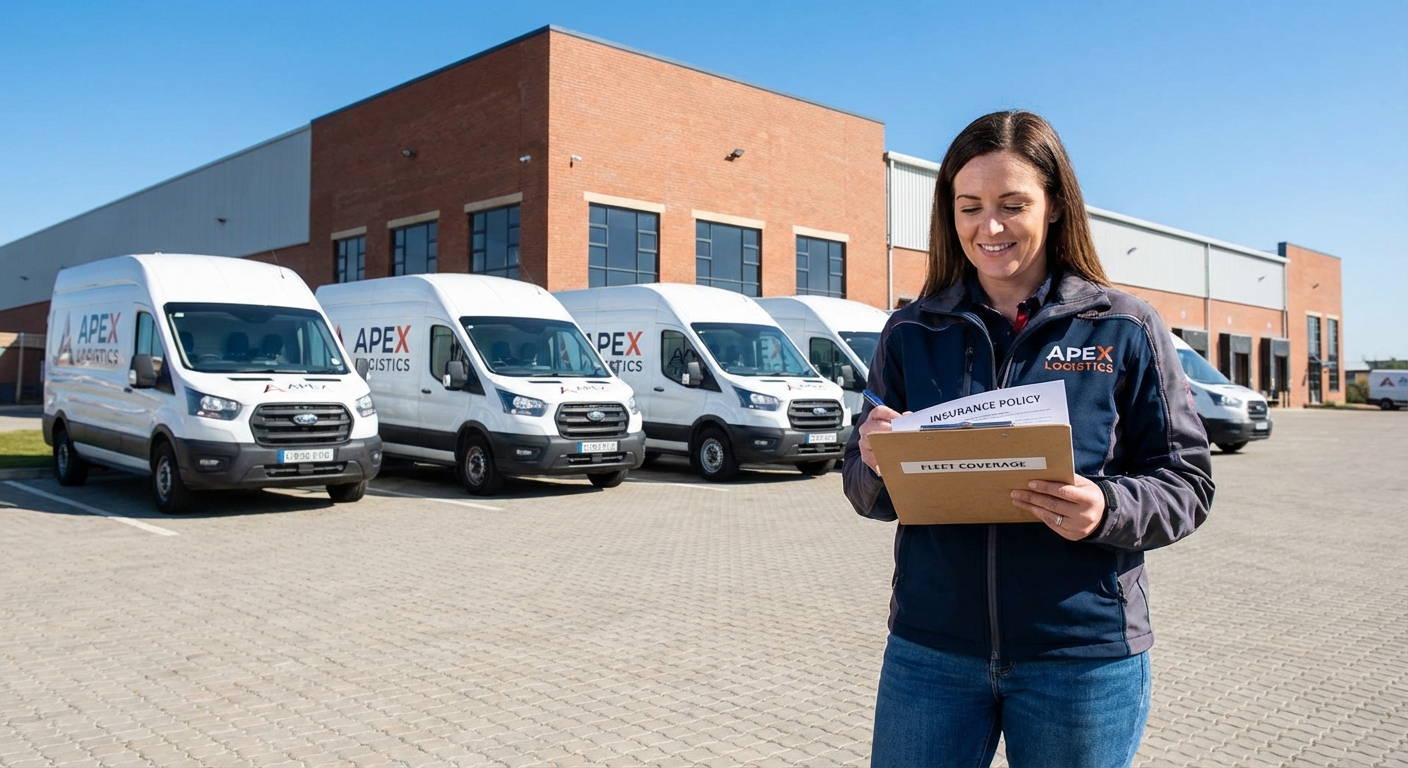
Fleet insurance is a single commercial auto policy that covers all of your business-owned vehicles under one umbrella. Instead of managing separate renewals, payments, and paperwork for each vehicle, everything is consolidated, and that simplicity often comes with real savings. But it's not always the right move for every business.
The 2-Vehicle Question
Most insurers will consider a fleet policy starting at 2 vehicles, though the clearest cost advantages typically emerge at 5 or more vehicles. Minimum requirements vary widely by carrier. Some will write policies for two vehicles, while others require at least five before offering fleet-level pricing and discounts. Here's a general rule of thumb:
| Fleet Size | Recommended Approach |
|---|---|
| 1 vehicle | Individual commercial auto policy |
| 2-4 vehicles | Either approach; compare quotes carefully |
| 5-10 vehicles | Fleet policy almost always wins on cost |
| 11+ vehicles | Fleet policy is the standard choice |
Businesses that frequently add and remove vehicles (contractors, delivery services, seasonal operations) benefit most from fleet policies because adding a new vehicle is often as simple as a phone call, rather than opening an entirely new policy.
Fleet vs. Individual Commercial Auto: Key Differences
For a broader view of how small business vehicle coverage works, see our full commercial auto insurance guide.

Compare Car Insurance Rates in Ohio
See if you qualify for a lower rate in less than 2 minutes
Fleet Insurance Coverage Types Explained
Understanding what's actually covered, and what's optional, helps you build the right policy for your business without overpaying for coverage you don't need.
Core Coverage Options
Commercial Liability is the foundation of any fleet policy. It covers bodily injury and property damage you or your drivers cause to third parties. State minimums vary significantly (Texas requires a 30/60/25 split limit, for example), while interstate trucking fleets subject to FMCSA federal minimums must carry at least $750,000 CSL for general freight and up to $5 million for certain hazmat operations. Many shippers and brokers contractually require $1M CSL regardless of statutory minimums.
Collision Coverage pays to repair or replace your vehicle if it's damaged in an accident, regardless of fault.
Comprehensive Coverage covers non-collision damage like theft, vandalism, weather events, and fire. Especially valuable if your fleet includes expensive specialty vehicles.
Medical Payments / PIP covers medical costs for drivers and passengers in your vehicles, regardless of fault.
Hired & Non-Owned Auto Coverage
This is one of the most overlooked, and most important, add-ons for small business fleets.
- Hired Auto Coverage protects vehicles your business rents or leases temporarily, filling the gap between your owned fleet policy and short-term rentals. Standard fleet limits of $1M CSL are recommended for hired vehicles.
- Non-Owned Auto Coverage covers liability when employees use their personal vehicles for business tasks, like picking up supplies or making a client delivery.
For a deeper look at how commercial auto coverage works for different vehicle types, see our guide on box truck insurance requirements.
Driver Requirements & CDL Compliance in 2026
Fleet policies offer two approaches to driver management:
- Any Authorized Driver means any licensed employee can operate any covered vehicle. This is ideal for large fleets with rotating drivers and reduces administrative burden.
- Named/Assigned Drivers are specific drivers listed on the policy, often resulting in lower premiums because insurers can assess each driver's risk individually.
Most insurers require that all listed drivers hold a valid license and will review driving history. Drivers with serious violations like DUIs or reckless driving convictions can significantly raise your premium or may need to be excluded from coverage.
In late 2026, underwriters are scrutinizing Drug and Alcohol Clearinghouse records more closely than ever under fully enforced Clearinghouse II rules. FMCSA regulations require State Driver Licensing Agencies to query the Clearinghouse before issuing, renewing, upgrading, or transferring a CDL/CLP, and any driver in "prohibited" status must be denied or have their credentials downgraded until they complete the return-to-duty process. As of January 2, 2026, the Clearinghouse shows 328,431 total CDL and CLP holders with at least one violation on record, with 202,345 currently in prohibited status, meaning they cannot legally drive a commercial vehicle. Notably, 159,226 of those prohibited drivers had not started the return-to-duty process, according to the 2026 reporting, keeping capacity tight across the trucking and delivery labor pool. The FMCSA also confirmed for 2026 that the minimum random drug testing rate for CDL drivers remains at 50%, with alcohol testing holding steady at 10%. Insurers now evaluate your company's overall compliance culture, not just individual driving records. Maintaining complete Driver Qualification Files and conducting mandatory annual Clearinghouse queries are key underwriting metrics that directly affect your premium.

Protect your car with Farmers
Average Rate:
Find coverage options that fit your budget.

The insurance savings you expect.
Average Rate:
Enjoy personalized policies, comprehensive coverage & more.

See how much you could save today!
Average Rate:
Drivers who switch their auto insurance and save with State Farm save $764 on average!

Safe Drivers Save with Allstate®
Average Rate:
Get rewarded with savings for having a clean driving record.
Fleet Insurance Cost: What to Expect in Late 2026
Fleet insurance premiums remain at record highs in 2026, though the pace of rate increases is finally moderating for small and mid-size fleets. In 2026, fleet car insurance cost commonly runs about $90 to $350 per vehicle per month for many small-to-mid fleets, with higher totals in dense metro ZIP codes, delivery duty cycles, higher limits, or recent losses. Light-duty pickups and service vans typically run roughly $150 to $450 per month per vehicle, while heavier vans, box trucks, or local delivery exposure often runs $300 to $900+ per month per vehicle. For a broader benchmark, MoneyGeek's national data shows commercial auto insurance costs $163 per month ($1,959 per year) for minimum coverage, while at the top end, a 20-truck operation can potentially spend over $300,000 annually at record-high insurance rates.
Average Cost by Fleet Size
| Fleet Size | Estimated Annual Cost Per Vehicle |
|---|---|
| 2-5 vehicles | $1,800 - $3,600 |
| 6-20 vehicles | $1,400 - $2,800 |
| 21+ vehicles | $1,200 - $2,200 (custom pricing) |
Note: Heavier vehicles (box trucks, specialized equipment) push costs significantly higher. For context on how box truck coverage is priced, costs can range from $250 to $3,000+/month depending on operation type and compliance history. Specialty and high-value vehicles are typically priced individually.
What Drives Your Premium
- Vehicle type and weight: Heavier or high-value vehicles cost more to insure
- Driver records & CDL compliance: Clean records and Clearinghouse compliance are the biggest factors
- Location: Urban areas and high-traffic states carry higher risk ratings
- Coverage limits: Higher liability limits and lower deductibles raise premiums
- Claims history: A history of at-fault accidents will increase your rate significantly
- Annual mileage: More miles equals more exposure equals higher premium
- Nuclear verdicts: Jury awards exceeding $10 million continue to drive up liability severity, tightening capacity and pushing up excess and umbrella pricing. Umbrella rose 5.3% in Q2 2026 alone, the highest of any major line
- Repair cost inflation: Tariffs on imported auto parts, such as steel, aluminum, and electronics, mean businesses pay higher costs for vehicle repairs and maintenance, and insurers pass those higher claim costs through as higher commercial auto premiums. The American Property Casualty Insurance Association estimates that tariff-driven parts and vehicle price inflation will add $26 to $52 billion annually to claims costs across the U.S. P&C market
- Parts supply delays: Longer repair timelines from tariff-driven supply disruptions extend rental reimbursement costs and worsen insurer loss ratios
- EV adoption: Electric vehicles in your fleet may carry higher premiums due to battery repair costs and limited insurer claims data
For a broader look at how tariffs are driving up car insurance rates in 2026, our dedicated guide breaks down the mechanisms squeezing both personal and commercial auto policies.
Cutting Fleet Insurance Costs: Safety Programs & Management Tools
The most effective way to lower your fleet insurance premium is to show insurers you run a low-risk operation. In 2026, that means data, and there are more tools than ever to help you capture it. Usage-based insurance is no longer a niche approach. It's becoming the industry standard, and fleets without safety technology are increasingly facing surcharges at renewal. Learn more about how telematics tracking devices can lower your rates through real-time driving data.
The key is to start building your data record at least 90 days before your renewal date. The earlier you start, the stronger your negotiating position.
Fleet Safety Programs That Reduce Premiums
Telematics / Usage-Based Insurance (UBI) GPS and telematics devices track real-time driving behavior: speeding, hard braking, sharp cornering, and idle time. Insurers use this data to price your policy based on actual risk rather than estimates. Fleets deploying modern video telematics solutions are seeing insurance premium reductions of 5 to 20 percent, with some achieving significant crash rate reductions, while fleets without the technology face continued rate hikes.
| UBI Model | How It Works | Max Reported Discount |
|---|---|---|
| Pay-Per-Mile (PAYD) | Premium tied to actual miles driven | 20-40% |
| Pay-How-You-Drive (PHYD) | Based on driving behavior metrics | 15-30% |
| Manage-How-You-Drive (MHYD) | Ongoing coaching and improvement tracking | Up to 25% |
AI Dashcams & Driver Coaching AI-equipped dashcams automatically detect dangerous driving behaviors (distracted driving, hard braking, close following) and alert managers before an incident happens. Dashcam footage also helps exonerate your drivers in disputed claims, and fleets leveraging AI dashcam systems can realize meaningful reductions in annual premiums plus mitigate a significant share of not-at-fault claims. Learn more about how dashcam insurance discounts work for commercial fleets.
Key carrier telematics programs for late 2026:
| Insurer/Program | Discount Range | 2026 Update |
|---|---|---|
| Progressive Smart Haul (ELD) | 5-15%+ | Smart Haul gives eligible for-hire truckers using an ELD the opportunity to save on their Progressive commercial truck policy in exchange for driving data |
| Progressive + Motive Dashcam | Up to 10% (existing customers only) | Progressive ended new enrollments in its commercial trucking dashcam program with Motive effective July 1, 2026, while current customers continue receiving benefits |
| GEICO + Motive (Commercial) | Up to 10% | GEICO commercial fleet policyholders can qualify for up to 10% off for approved AI dashcam and telematics systems |
| HDVI (UBI-style Shift) | Up to 20% | HDVI's telematics-based fleet program can deliver monthly premium discounts up to 20% for sustained safety improvements |
| Geotab Smart Haul (Progressive) | Up to +20% add-on | Qualified Progressive Commercial Insurance customers can save up to an additional 20% with a GO Focus Plus or GO Focus Pro dash cam on top of existing Smart Haul savings |
Driver Training Programs Regular safety training and documented driver coaching sessions can unlock additional credits at renewal. Consistent driver coaching can reduce accident frequency significantly, and insurers often grant 5-15% discounts to fleets demonstrating sustained safety improvements. Importantly, underwriters prioritize improvement trends over perfection.
Preventive Maintenance Tracking Computerized maintenance management systems (CMMS) that automate inspection logs, work orders, and maintenance records are increasingly valued by underwriters. Fleets that document vehicle inspections and scheduled maintenance are often moved to "preferred risk" status, meaning lower base rates.
Top Fleet Management Tools in 2026
| Tool | Key Features | Savings Potential |
|---|---|---|
| Geotab | Collision tracking, safety ROI reporting, GPS | Up to 20% Smart Haul add-on with Progressive |
| Samsara | Real-time telematics, dashcams, compliance | 5-15% discount potential |
| Motive (KeepTruckin) | AI dashcams, driver scoring, ELD logs | Up to 10-20% via carrier partnerships |
| Oxmaint | CMMS, maintenance logging, insurer reporting | Documented fleets earn preferred risk status |
| Idelic | Predictive safety analytics, driver risk scoring | 12+ months of data yields strong renewal savings |
Best Fleet Insurance Companies for Small Businesses
Not every commercial insurer handles fleet policies the same way. Here are the top providers for small business fleets in the US as of late 2026:
Top Picks at a Glance
| Insurer | Best For | AM Best Rating | Standout Feature |
|---|---|---|---|
| Progressive Commercial | Overall value & digital tools | A+ | Largest US commercial auto insurer; Smart Haul telematics program; broadest small fleet eligibility |
| The Hartford | Customer service & fleet support | A+ | Frequently ranked "Best for Fleets" in 2026; strong risk control and claims support |
| Travelers | Mid-size fleets | A++ | Top financial stability; competitive fleet pricing starting around $250/month |
| Acuity | Midwest fleets; reliability | A+ | Up to 15% telematics discount with Samsara/Motive |
| Liberty Mutual | Specialty vehicles & small fleets | A | Covers construction, food trucks, and more |
| Nationwide | Flexible small fleet operators | A+ | Strong BOP bundling options for small businesses |
| biBERK | Micro-fleets & startups | A++ | Instant COIs, fully digital, direct-to-carrier savings |
Progressive Commercial remains the largest U.S. commercial auto insurer and is consistently ranked best for small-to-mid fleets thanks to its broad eligibility (often from 1 vehicle up), quick quote-and-bind process, and strong telematics discount programs. Progressive's Smart Haul ELD program provides an automatic starter discount at signup, with clean safety records unlocking materially higher savings tiers over time. The Hartford continues to be recognized as a top choice for fleets specifically, with strong risk control services and dedicated claims handling. Travelers brings exceptional financial stability as one of the largest commercial auto writers in the country and is a strong fit for growing fleets that value claims strength.
For a full comparison of top providers and coverage options, review our commercial auto insurance guide and our breakdown of car insurance industry trends shaping the market in 2026.
Frequently Asked Questions
How many vehicles do you need to qualify for fleet insurance?
Most US insurers define a fleet as 2 or more vehicles, but the most competitive pricing and clearest benefits typically start at 5 vehicles. Minimum requirements vary by carrier, with some writing policies for two vehicles and others requiring at least five before applying fleet-level discounts. Between 2 and 4 vehicles, it's worth comparing individual commercial auto policies against fleet quotes to see which comes out cheaper for your specific situation.
Is fleet insurance cheaper than individual commercial auto policies?
For most businesses with 5 or more vehicles, yes. Fleet insurance is typically 5-25% cheaper per vehicle than maintaining separate individual policies. The savings come from consolidated risk assessment, administrative efficiency for the insurer, and volume discounts. However, for 2 to 4 vehicles, the difference may be smaller, so comparing both options with real quotes is essential before committing to either approach.
Can employees drive their personal vehicles under my fleet policy?
Not automatically. Your standard fleet policy covers company-owned vehicles only. To protect your business when employees drive personal vehicles for work, you need hired and non-owned auto (HNOA) coverage, which is typically added as an endorsement to your fleet policy. Without it, your business could be exposed to significant liability if an employee is in an accident while running a work errand in their own car.
What discounts are available for fleet insurance in late 2026?
The biggest discounts come from telematics and UBI programs (5-20% direct credits depending on model and performance), carrier-specific partnerships like GEICO + Motive (up to 10%) and HDVI (up to 20%), documented driver safety training, bundling multiple coverage types with one insurer, and paying your annual premium in full upfront. Note that Progressive ended new enrollments in its commercial trucking dashcam program with Motive effective July 1, 2026, so new Progressive fleets will need to lean on Smart Haul ELD data and Geotab dashcam add-ons instead. Building a 90-day documented safety record before renewal is the most reliable path to meaningful savings.
How are tariffs and rising repair costs affecting fleet insurance in 2026?
The 25% tariff on imported auto parts is significantly increasing claim severity across commercial fleets. Tariffs on imported auto parts, such as steel, aluminum, and electronics, mean businesses pay higher costs for vehicle repairs and maintenance, and insurers pass those costs through as higher commercial auto premiums. Combined with nuclear verdicts and ongoing social inflation, commercial auto remains deeply unprofitable for insurers, though 2026 has seen CIAB-tracked rate increases moderate from 5.8% in Q1 to 4.5% in Q2, still extending a 59-plus quarter streak. The best defense is a documented safety program, since fleets with telematics, clean CDL compliance records, and AI dashcam data consistently secure better rates at renewal.