
Compare Car Insurance Rates in Ohio
See if you qualify for a lower rate in less than 2 minutes


Who Actually Needs Commercial Auto Insurance?
Not every business owner needs a commercial auto policy, but more do than you might think. If you're using a vehicle for anything beyond personal commuting, your personal auto insurance may not cover you when it counts most.
Here's a breakdown of the most common business types that require commercial auto coverage:
| Business Type | Why They Need It |
|---|---|
| Contractors & Tradespeople | Haul tools, equipment, or materials to job sites |
| Sales Representatives | Drive frequently between client locations for work |
| Delivery Drivers | Transport goods or packages as a primary job function |
| Landscapers & Lawn Care | Tow trailers, carry heavy equipment |
| Food Truck Operators | Vehicle is the business |
| Cleaning & Service Businesses | Drive between multiple customer locations daily |
| Real Estate Agents | Regularly drive clients or visit properties for business |
| Plumbers & Electricians | Carry tools and equipment to service calls |
You also need commercial auto if your vehicle is:
- Titled or registered in the business name
- Operated by employees for business tasks
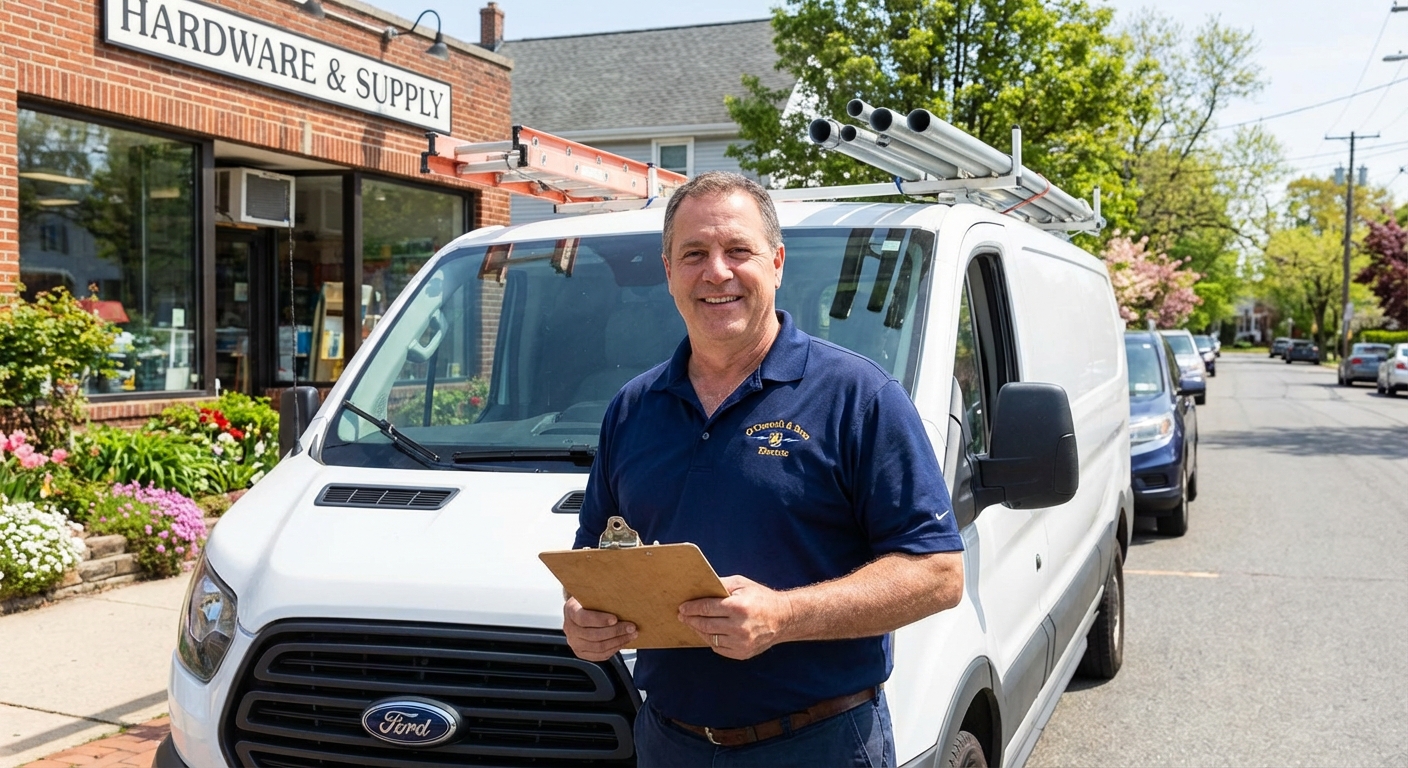
- A specialty or heavy-duty vehicle (van, truck, box truck) or has permanent modifications like ladder racks or branded signage
- Part of a fleet of two or more business vehicles
If you're a gig worker or independent contractor, be sure to also check out our beginner's auto insurance guide since the coverage gaps can be just as costly.

Compare Car Insurance Rates in Ohio
See if you qualify for a lower rate in less than 2 minutes
Types of Coverage in a Commercial Auto Policy
Commercial auto insurance is not a one-size-fits-all product. A solid policy for a small business typically combines several coverage types depending on your vehicle use and risk exposure.
Commercial Auto Liability
This is the foundation of any commercial policy and is often required by law. It pays for bodily injury and property damage you cause to others in an at-fault accident. Unlike personal policies, commercial liability limits are typically set much higher to protect business assets from lawsuits.
- Bodily Injury Liability: Covers medical expenses, lost wages, and legal costs for injured third parties
- Property Damage Liability: Pays for damage you cause to other vehicles or property
State minimums continue to shift. New Jersey became the only state with a statutory 2026 change, raising minimum limits to 35/70/25 effective January 1, 2026. Florida is scheduled to eliminate PIP and shift to 25/50/10 at-fault liability on July 1, 2026 under House Bill 1181. Recent 2025 increases still baked into 2026 minimums include California (30/60/15), Virginia (50/100/25), North Carolina (50/100/50 with UM/UIM required), and Utah (30/65/25). Most insurance professionals recommend carrying at least $1,000,000 in liability coverage, since state minimums rarely provide sufficient protection for business-related claims.
Physical Damage Coverage
Physical damage coverage protects your own vehicle. It's optional in most states but essential if your vehicle is financed or critical to daily operations.
- Collision: Pays for damage from crashes, regardless of fault
- Comprehensive: Covers theft, vandalism, fire, hail, floods, and animal collisions
- Specified Perils: A more limited version that only covers named events
Learn more about what full coverage car insurance includes and whether it's worth carrying on your business vehicle.
Hired & Non-Owned Auto (HNOA)
This is one of the most overlooked and most important add-ons for small businesses. HNOA is not legally required in most states, but it's strongly recommended for any business where employees use personal vehicles, rentals, or borrowed cars for work tasks. A common benchmark for HNOA limits is $1 million per occurrence / $2 million aggregate. HNOA endorsements typically cost small businesses just $100 to $300 annually.
HNOA is particularly valuable for businesses where employees drive their personal cars for work tasks, because their personal insurance may deny a work-related accident claim. It acts as secondary, excess liability coverage after the driver's own policy is exhausted, and is typically added as an endorsement to a general liability policy or Business Owner's Policy (BOP). Best practices include annual MVR (motor vehicle record) checks on all drivers, requiring proof of personal insurance, and reviewing HNOA limits annually as claim costs continue to rise.
Learn more about business car insurance coverage options and when you need them in our full guide.
Protect your car with Farmers
Average Rate:
Find coverage options that fit your budget.

The insurance savings you expect.
Average Rate:
Enjoy personalized policies, comprehensive coverage & more.

See how much you could save today!
Average Rate:
Drivers who switch their auto insurance and save with State Farm save $764 on average!

Safe Drivers Save with Allstate®
Average Rate:
Get rewarded with savings for having a clean driving record.
How Much Does Commercial Auto Insurance Cost in 2026?
Commercial auto insurance for a small business generally ranges from $150 to $300 per month per vehicle for standard policies, with Insureon reporting an average of $245 per month across its small business customers in 2026. MoneyGeek's 2026 national benchmark pegs minimum coverage at $163/month ($1,959/year), while Insurance.com cites an average of $147/month ($1,764/year). Progressive Commercial reports an average of $276/month across business auto customers, with contractors averaging $260/month and for-hire transport trucks reaching $926/month.
Average Monthly Costs by Business Type
| Industry | Avg. Monthly Premium |
|---|---|
| Automobile Services | ~$76 |
| Consulting | ~$146 |
| Real Estate | ~$160 |
| Retail | ~$171 |
| Construction / Contracting | ~$250 to $400 |
| Landscaping | ~$204 |
| Transportation / Trucking | $663 to $926+ |
Average Monthly Costs by Vehicle Type
| Vehicle Type | Avg. Monthly Premium |
|---|---|
| Passenger car / SUV | $180 to $300 |
| Light-duty truck or van | $140 to $240 |
| Cargo van | $230 to $320 |
| Pickup truck | $260 to $360 |
| Food truck | $317+ |
| Light box / straight truck | $380 to $700 |
| Tow truck or dump truck | $292 to $500+ |
Key Factors That Affect Your Rate
1. Industry & Vehicle Use Higher-risk industries like trucking and delivery pay significantly more than low-mileage businesses like consulting. High-cost states like New York, California, Texas, and Connecticut can push rates to extreme levels, and Texas commercial auto in particular has been hit hard as the state led all others with 23 nuclear verdicts in 2024 (roughly a third involving auto cases).
2. Vehicle Type & Value Specialty vehicles such as food trucks, tow trucks, or box trucks carry higher premiums. Learn about specific box truck insurance requirements, including FMCSA federal liability minimums, in our dedicated guide.
3. Driver History Clean driving records keep premiums low. Just one at-fault accident can raise premiums by 20% to 40%. Most insurers recommend annual MVR checks on all drivers.
4. Location Urban areas with heavy traffic see higher commercial auto premiums than rural or suburban regions.
5. Coverage Level Liability-only policies from some carriers average as little as $50 to $80/month versus $150 to $250/month for full coverage. Adding comprehensive, collision, and HNOA increases your premium and your protection.
6. Fleet Size & Claims History More vehicles and past claims mean higher risk in the eyes of insurers. Umbrella and excess liability rates rose 18% in Q1 2026, with some carriers capping per-account limits at $10 million due to nuclear verdicts and severity trends.
Best Commercial Auto Insurance Companies for Small Businesses
Not all insurers are created equal when it comes to small business coverage. Here are the top-rated providers based on cost, customer satisfaction, coverage options, and financial strength as of 2026.
Quick Comparison: Top Providers
| Company | AM Best Rating | Best For | Avg. Monthly Rate |
|---|---|---|---|
| Progressive | A+ | Overall value, wide availability, imperfect records | ~$207 to $276 |
| The Hartford | A+ | Small business bundles, BOP + auto | Varies |
| Erie Insurance | A+ | Customer satisfaction (#1 J.D. Power 2025) | Varies by region |
| Nationwide | A+ | Multi-policy discounts, coverage value | Varies |
| GEICO | A++ | Budget-conscious small businesses, affordability | ~$150 to $190 |
| State Farm | A+ | Agent support, local service | ~$109 to $175 |
| biBERK | A++ | Self-employed, micro-businesses | Lowest tier |
| Travelers | A++ | Specialized coverage, complex risks | Varies |
| Allstate | A+ | Heavy vehicles | Varies |
| NEXT | A- | Digital-first contractors | Varies |
Erie Insurance ranked #1 in J.D. Power's 2025 U.S. Small Commercial Insurance Study with a score of 723 out of 1,000, 25 points above the industry average of 698. Cincinnati Insurance and Philadelphia Insurance tied for second place at 714. J.D. Power has not yet published a 2026 study, so 2025 remains the most current data. Notably, The Hartford scored below average at 685 in 2025, and Liberty Mutual dropped 29 points to 696.
One important trend from the 2025 J.D. Power study: customer retention among small business policyholders dropped to 55% "definitely will renew," down 6 points year-over-year. This is good news for savvy buyers willing to compare quotes.
For businesses with larger fleets, check out our guide on fleet insurance for small businesses to see when consolidating coverage makes financial sense. If your drivers use their own vehicles for deliveries, our types of car insurance coverage guide also explains coverage options in detail.
Frequently Asked Questions
What is the difference between commercial auto insurance and personal auto insurance?
Personal auto insurance covers your vehicle for personal use, such as commuting, errands, and leisure driving. Commercial auto insurance is designed for vehicles used in business operations, covering higher liability limits, multiple drivers, and work-specific risks. If you use your personal vehicle for business and have a work-related accident, your personal insurer may deny the claim entirely. Most professionals recommend $1 million in liability coverage on a commercial policy to protect business assets from lawsuits. Learn more in our guide on business car insurance.
Do I need commercial auto insurance if I use my personal car for work?
It depends on how often and in what capacity you use it. Occasional commuting to one office location typically doesn't require commercial coverage. However, if you regularly drive to client sites, make deliveries, transport goods, or carry business equipment, you likely need at minimum a business-use endorsement or a full commercial policy. Review our guide on what car insurance actually covers to understand the key differences and confirm your situation is covered.
How much does commercial auto insurance cost for a one-vehicle small business in 2026?
Most small businesses with a single vehicle pay between $150 and $300 per month for a standard commercial auto policy, with a 2026 average around $245/month according to Insureon data. Low-risk businesses like consulting may pay around $146/month, while high-risk industries like transportation can pay $663 to $926/month or more per Progressive Commercial data. Commercial auto premiums rose 5.8% in Q2 2026, extending a 59-quarter streak of increases, so factor continued upward pressure into your renewal budget.
What does hired and non-owned auto insurance cover?
Hired auto coverage protects vehicles you rent, lease, or borrow for business use. Non-owned auto coverage protects your business when employees drive their personal vehicles for work-related tasks. Neither pays for repairs to the employee's personal car, they primarily cover your business's liability exposure when an accident occurs during work use. HNOA acts as secondary, excess coverage on top of the driver's own personal auto policy and is typically added as an affordable endorsement ($100 to $300/year) to your existing BOP or general liability policy, with recommended limits of $1 million per occurrence / $2 million aggregate.
Can I get commercial auto insurance if I have a bad driving record?
Yes, though your options may be more limited and premiums will be higher. Progressive, as the largest commercial auto insurer in the U.S., is specifically known for working with new ventures and drivers with imperfect records. Specialty carriers like Chubb and biBERK also handle higher-risk commercial drivers. Always compare quotes from multiple providers to find the best available rate for your situation. Our guide on finding cheap car insurance locally offers additional strategies for comparing carriers effectively.