
Compare Car Insurance Rates in Ohio
See if you qualify for a lower rate in less than 2 minutes



What Is an Inception Date vs. an Effective Date?
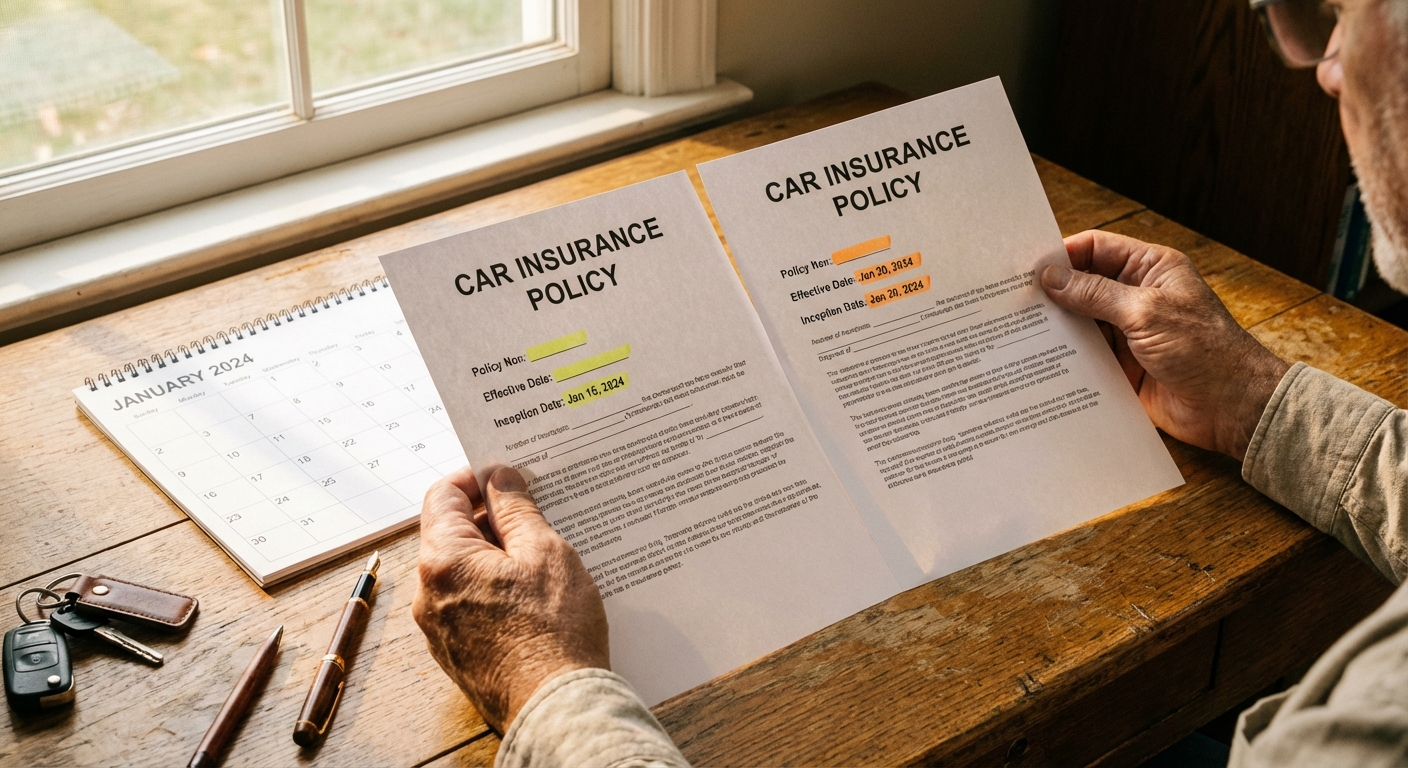
Most drivers have seen both "inception date" and "effective date" printed on their policy documents and assumed they mean the same thing. In many cases, they do. But there are important nuances that can affect your coverage, your claims, and your wallet. Knowing the difference could be what stands between a paid claim and a denied one.
Inception Date Defined
The inception date is the date on which your insurance policy first came into existence with a specific insurer. Think of it as the "birthday" of your policy. It is the original date you first contracted coverage, and critically, it can remain fixed across renewals with the same company. Insurers use this date to track how long you have been a customer and to calculate long-term loyalty benefits. Some carriers reward tenure directly. For example, State Farm offers a tenure-linked discount in New Jersey once your vehicle has been with State Farm for at least three continuous years without a chargeable accident.
Effective Date Defined
The effective date (also called the coverage start date or commencement date) is the exact date, and often the exact time, when your insurance protection becomes legally active. This is the moment the insurer becomes liable for covered losses. It is listed on your declarations page and your insurance ID card. Many auto policies still activate at 12:01 AM local time on the stated date, meaning protection kicks in at the very start of that calendar day, though some policies specify a different exact time, so always confirm what's printed on your declarations page.

Compare Car Insurance Rates in Ohio
See if you qualify for a lower rate in less than 2 minutes
Why These Dates Sometimes Differ and When It Matters
For most straightforward policies, the inception date and effective date are identical. However, the distinction becomes significant in three common scenarios:
1. Policy Renewals
When you renew with the same insurer, the inception date stays anchored to when you originally started your policy, while the effective date rolls forward to the new term's start. This matters because some insurers use your original inception date to calculate tenure-based perks. State Farm's Drive Safe & Save, for example, gives you an initial premium adjustment for enrolling and can then deliver up to 30% off at renewal based on driving behavior (New York is capped at 30%, and the program is not available in California, Massachusetts, or Rhode Island). The policy term you choose (6 or 12 months) also determines how frequently the effective date turns over and how often your rate can be re-evaluated. Learn more about how auto insurance works for beginners and why shopping around before renewal can save switchers hundreds of dollars per year.
2. Future-Dated Policies
You can purchase a policy today but set it to become active 30 to 60 days from now. In this case, the inception date (when the contract was formed) precedes the effective date (when coverage activates). This is commonly done to lock in a better rate or to time coverage with a vehicle purchase. Learn more about the car insurance waiting period and how future-dating a policy can work in your favor.
3. Administrative Processing Delays
Sometimes an insurer issues your policy documents a day or two before your coverage actually begins. The issue date (when paperwork is generated) is different from both the inception and effective dates. Always confirm which date officially starts your coverage.

Protect your car with Farmers
Average Rate:
Find coverage options that fit your budget.

The insurance savings you expect.
Average Rate:
Enjoy personalized policies, comprehensive coverage & more.

See how much you could save today!
Average Rate:
Drivers who switch their auto insurance and save with State Farm save $764 on average!

Safe Drivers Save with Allstate®
Average Rate:
Get rewarded with savings for having a clean driving record.
When Coverage Actually Begins: Boundary Dates & Claims
Understanding exactly when coverage starts is not just academic. It has real financial consequences.
The 12:01 AM Rule
Most car insurance policies activate at 12:01 AM local time on the effective date. This means if your policy effective date is March 20, your coverage begins at the very start of that day, not at noon and not when you wake up. This matters enormously if an incident occurs on the first or last day of your policy. The same rule generally applies at expiration. Most policies also end at 12:01 AM on the expiration date. Learn more about when policies expire to avoid an accidental gap.
Claims Filed on Boundary Dates
| Scenario | Covered? |
|---|---|
| Accident at 11:59 PM the day before effective date | ❌ Not covered, policy not yet active |
| Accident at 12:01 AM on effective date | ✅ Covered, policy is active |
| Accident at 11:59 PM on policy expiration date | ❌ Not covered, policy has typically already ended |
| Accident on the inception date during a grace period | Depends on insurer terms |
Because policies often expire at 12:01 AM, you can be technically uninsured for nearly an entire calendar day if your old policy ends and your new one hasn't started yet. Understanding this window is critical, since even a brief gap in coverage can have expensive consequences.
Backdating Insurance Policies: What's Allowed and What Isn't
One of the most misunderstood topics around inception dates is backdating. Here's the unambiguous truth:
Backdating Is Generally Illegal
Backdating an auto insurance policy to make coverage appear effective before it was actually purchased is treated as fraud in most cases, and no reputable insurer will do it. Major carriers including Geico, State Farm, Progressive, and Allstate operate under strict regulations that prevent issuing retroactive policies to cover past incidents. Attempting to do so can result in:
- Immediate policy cancellation
- Denial of all claims
- Criminal charges and fines
- License suspension
- Permanent rate increases or difficulty obtaining coverage in the future
Learn more about the car insurance application process and the serious consequences of misrepresentation on an application.
The One Narrow Exception: Reinstatement With a No-Loss Statement
There is a limited circumstance where a short administrative backdate may be permitted, specifically when a brief lapse occurred due to a paperwork or processing delay, and no losses occurred during that gap. In such cases, an insurer may ask you to sign a "no-loss statement" (also called a "no known loss" letter), a signed affidavit confirming that no accidents, claims, or losses occurred during the lapse. Insurers use this to confirm they are not retroactively covering a known loss. This option is rare, insurer-specific, and never applies if any claim or accident is involved. Signing a false no-loss statement is itself insurance fraud.
Planning ahead with a proper insurance binder is always the right way to avoid the temptation of backdating.
Continuous Coverage, Renewals & What to Verify When Buying
How Inception Dates Affect Continuous Coverage
Continuous coverage (having no lapse between policies) is critical for several reasons:
- State compliance: Most states require drivers to maintain active insurance. A lapse, even of one day, can trigger fines, registration suspension, or SR-22 requirements. Learn more about what happens after a lapse and how Louisiana's Act 476, effective January 1, 2026, prohibits insurers from raising rates or adding surcharges based solely on a driver's first lapse of 90 days or less, with the "first lapse" status resetting after 5 continuous years of coverage.
- Rate savings: Lapses are treated as a significant risk factor in 2026. According to ValuePenguin and MoneyGeek analyses of Allstate, State Farm, and USAA rate data, a lapse of 30 days or fewer raises rates by an average of about 8%, while lapses longer than 30 days average a 35% increase. Some data (Insurance.com, U.S. News) place 30 to 60-day lapses closer to 48% and 90-day-plus gaps at 50%+. Per Insurify's Mid-Year 2026 Auto Report, national average full-coverage premiums reached $2,237 per year by mid-2026 (up 1% from year-end 2025), with the year projected to finish at about $2,242 and 32 states expected to see rate increases by December. ValuePenguin's 2026 report puts the national full-coverage average closer to $2,496, so a lapse penalty easily dwarfs typical rate movement.
- Insurer loyalty benefits: Some insurers use your original inception date to reward long-term customers with vanishing deductibles, accident forgiveness, or tenure-based discounts.
When switching policies, time your new policy's effective date to the exact moment your old policy expires. A gap of even a few hours can create legal and financial exposure. Read more about coverage gaps and why they matter.
State Minimum Coverage Changes to Know (2025 to 2026)
Several states raised their minimum liability requirements recently, which can affect your declarations page and policy costs at renewal. Per Insurance.com's 2026 tracker, New Jersey is the only state with a new minimum-liability increase taking effect in 2026 on the mainland, while Hawaii's separately enacted increase (Senate Bill 2342) also went live January 1, 2026:
| State | Previous Minimum (BI/PD) | New Minimum | Effective |
|---|---|---|---|
| California | 15/30/5 | 30/60/15 | Jan. 1, 2025 |
| Utah | 25/65/15 | 30/65/25 | Jan. 1, 2025 |
| Virginia | 30/60/20 | 50/100/25 | Jan. 1, 2025 |
| North Carolina | 30/60/25 | 50/100/50 | July 1, 2025 |
| New Jersey | 25/50/25 | 35/70/25 | Jan. 1, 2026 |
| Hawaii | 20/40/10 | 40/80/20 (+ $10K PIP) | Jan. 1, 2026 |
If you live in one of these states, verify that your declarations page reflects the updated minimums at your next renewal. In New Jersey, the higher 35/70/25 limits apply to all new and renewal policies issued on or after January 1, 2026, so your first renewal in 2026 is when you'll see the change. Your insurer may auto-adjust, but it's still worth confirming. Florida is also scheduled to shift from PIP/no-fault to an at-fault liability system with 25/50/10 minimums, currently targeted for 2027 under HB 1181, so keep that on your radar if you drive in Florida.
Proof of Prior Coverage and Your Inception Date
When you switch insurers, your new carrier will often ask for proof of prior coverage to verify your insurance history. Your inception date with your previous insurer is a key part of this documentation. It demonstrates how long you maintained continuous coverage and can directly affect the rate you're offered. Longer gaps (over 60 days) can push premium surcharges to 40% to 50% or higher with some non-standard carriers.
Renewal Inception vs. Effective Date
At renewal, most insurers issue a new effective date, but your original inception date with that company remains on file. This is your "tenure" date, and it matters for loyalty perks. If you miss a payment and your policy is cancelled, you may lose this tenure entirely, resetting the clock on any loyalty benefits you've earned. If a lapse does occur, learn what to do immediately to minimize the damage.
What to Verify When Purchasing a New Policy
Before your new policy goes live, check your declarations page for these critical items:
| What to Verify | Why It Matters |
|---|---|
| Effective date and exact time | Ensures no gap between old and new coverage |
| Policy expiration date | Defines the end of your coverage window |
| Vehicle VIN and details | Prevents claim denials due to wrong vehicle on file |
| Listed drivers | All household drivers must be listed |
| Coverage types and limits | Confirm liability, comprehensive, and collision are correct |
| Deductibles | Know your out-of-pocket amount before a claim arises |
| Lienholder or lessor listed | Required if you're financing or leasing |
| State minimum compliance | Verify updated 2025 and 2026 minimums are reflected |
Confused by the jargon on your declarations page? Our insurance application guide breaks down each field you'll see and why it matters.
Frequently Asked Questions
Is the inception date the same as the effective date on my car insurance?
In most everyday contexts, yes. Insurers often use the terms interchangeably to mean the date your coverage begins. However, a technical distinction exists: the inception date may refer to the original date you first contracted with an insurer (remaining fixed across renewals), while the effective date updates with each new policy term. Always review your declarations page to confirm which date is controlling your coverage window.
What happens if I file a claim on my policy's effective date?
Coverage on the effective date depends on the time of the incident relative to your policy's activation time, typically 12:01 AM local time. If your policy became active at 12:01 AM on March 20 and your accident occurred at 8:00 AM that same day, you are covered. If the accident occurred at 11:59 PM on March 19 (before activation), the claim would be denied. Always confirm the exact activation time listed in your policy documents, since some insurers use a different stated effective time.
Can I backdate my car insurance policy to cover an accident that already happened?
No. Backdating a car insurance policy to cover a prior incident is insurance fraud and no reputable U.S. insurer will do it. Companies like Geico, State Farm, Progressive, and Allstate will not alter your effective date to cover past accidents. Attempting this can result in criminal charges, policy cancellation, and permanent difficulty obtaining affordable insurance in the future.
How does a lapse between my old and new policy affect my rates?
Even a short lapse in coverage can signal higher risk to insurers and trigger a premium increase. According to 2026 analyses from ValuePenguin and MoneyGeek, lapses of 30 days or fewer raise rates by an average of about 8%, while lapses longer than 30 days average a 35% jump. Insurance.com data and U.S. News reporting show 30 to 60-day lapses can approach 48%, and 90-day-plus gaps often push 50% or higher. At 2026 average full-coverage rates ranging from $2,237 (Insurify) to $2,496 (ValuePenguin) per year, a long lapse could cost you several hundred dollars annually. Louisiana's Act 476, effective January 1, 2026, protects drivers there from a rate increase or surcharge on a first lapse of 90 days or less, though state penalties like registration suspension or SR-22 filings can still apply elsewhere.
What is a "no-loss statement" and when would I need to sign one?
A no-loss statement (also called a "no known loss" letter) is a signed affidavit confirming that no accidents, losses, or claims occurred during a specific period, typically a brief coverage gap caused by an administrative or processing delay. Some insurers use this document when reinstating a lapsed policy to confirm they are not retroactively covering a known loss. It is only valid if genuinely no incidents occurred during the gap, and signing a false no-loss statement constitutes insurance fraud. This option is rare, insurer-specific, and should never be attempted to cover a prior accident.