
Compare Car Insurance Rates in Ohio
See if you qualify for a lower rate in less than 2 minutes



What Is Car Insurance Fraud?
Car insurance fraud is the deliberate act of deceiving an insurer to receive a financial benefit you're not entitled to — whether that's a larger payout, a lower premium, or coverage for a loss that didn't happen. It's not just a victimless crime. The Coalition Against Insurance Fraud estimates that insurance fraud costs the U.S. over $308.6 billion per year — roughly $933 per American or $3,800 per family of four. Property and casualty fraud alone is estimated at $90–$122 billion annually, growing at an estimated 10–15% per year. Auto insurance fraud accounts for approximately $7.4 billion in annual losses from claims fraud, plus another $35.1 billion annually in premium leakage from misrepresented policy details. Those losses translate directly to an estimated $400–$900 extra per year in elevated premiums for honest policyholders.
Fraud falls into two major categories: soft fraud and hard fraud. Understanding the difference matters — both in recognizing when you might unknowingly be committing it and in understanding how seriously insurers and prosecutors treat each type.
Soft Fraud vs. Hard Fraud: Know the Difference
Soft Fraud (Opportunity Fraud)
Soft fraud occurs when a real incident happens but the details are exaggerated or misrepresented to get a bigger benefit. It's sometimes called "opportunity fraud" because it typically involves a real policyholder taking advantage of an actual situation. Economic pressures have fueled a rise in soft fraud in recent years — and according to the Coalition Against Insurance Fraud, 22% of drivers admit to lying to their auto insurer, including misrepresenting mileage, pocketing repair funds, or falsifying their address.
Common examples of soft fraud include:
- Inflating the value of property damaged in an accident
- Claiming pre-existing vehicle damage was caused by a recent incident
- Exaggerating the severity of injuries to increase a settlement
- Omitting prior accidents, tickets, or DUIs on your insurance application
- Listing a lower-mileage estimate than you actually drive
- Using a relative's address to get cheaper rates (known as address fraud)
- Failing to disclose all household drivers on your policy
Soft fraud is more common than hard fraud — and many people who commit it don't even realize they're crossing a legal line. But make no mistake: misrepresenting information on your application is a form of material misrepresentation and can result in policy cancellation, claim denial, and criminal charges.
Hard Fraud (Premeditated Fraud)
Hard fraud involves deliberately creating or staging a loss from scratch. This is premeditated, organized, and treated far more harshly by prosecutors. Learn more about the differences between friendly and hard fraud and how each is penalized.
Common examples of hard fraud include:
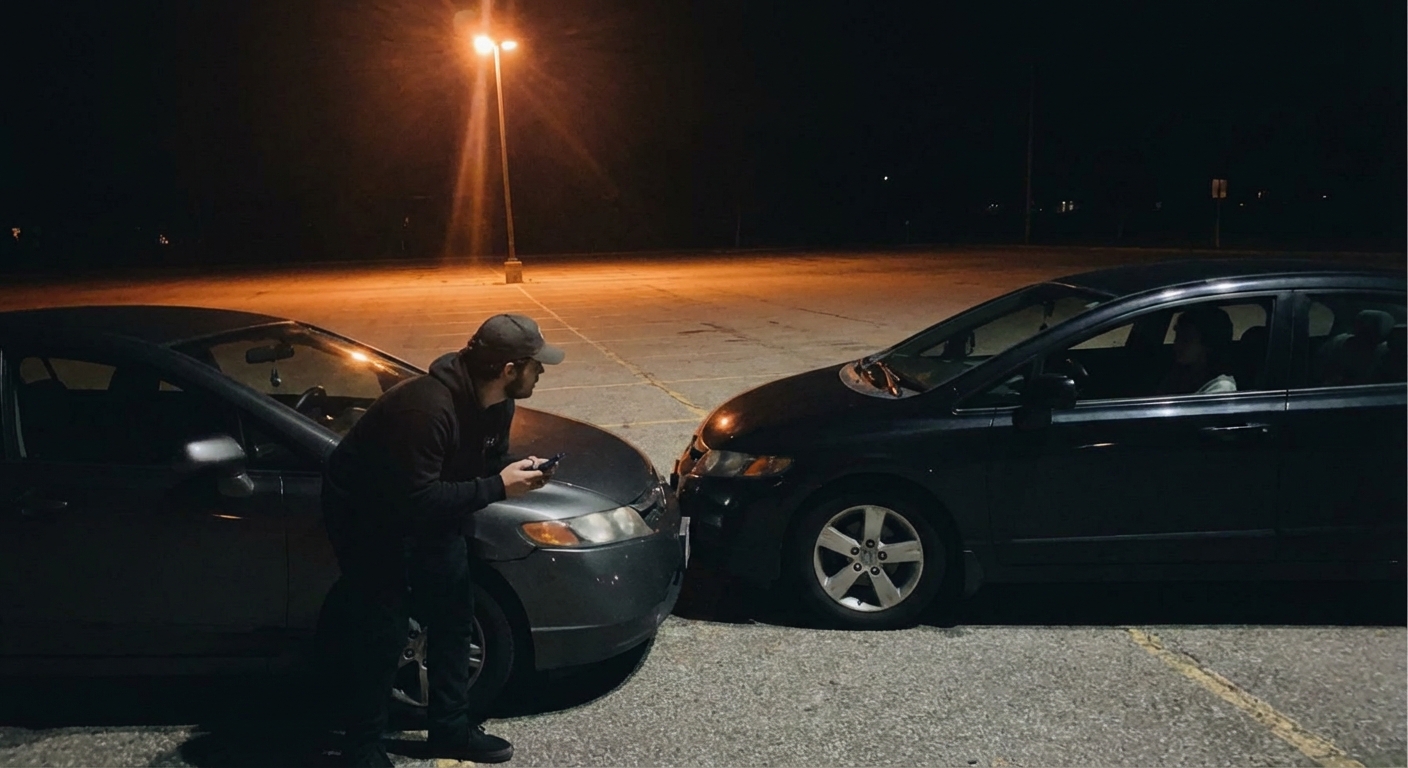
- Staging a car accident to file injury and damage claims
- Reporting a vehicle as stolen after selling, abandoning, or destroying it
- Setting fire to a vehicle and filing a theft or comprehensive claim
- Filing a claim for a crash that never happened ("paper accident")
- Adding passengers to a claim who were never in the vehicle
- Submitting AI-generated photos of fake vehicle damage
- Using synthetic identities (AI-generated names + real Social Security numbers) to purchase policies and file claims
- Ghost broker scams — fake agents selling fraudulent policies via social media, cold calls, or text, leaving drivers uninsured

Compare Car Insurance Rates in Ohio
See if you qualify for a lower rate in less than 2 minutes
Common Car Insurance Fraud Schemes
Fraud rings have developed highly organized tactics that target unsuspecting drivers and insurers alike. Knowing these schemes can protect you from unknowingly becoming a pawn — or a victim. The federal Staged Accident Fraud Prevention Act (H.R. 2662), introduced in April 2025 and still in the House Judiciary Committee as of May 2026, aims to make staging crashes involving commercial vehicles a federal crime carrying up to 20 years in prison — reflecting how seriously lawmakers now treat these schemes.
The Most Notorious Staged Accident Tactics
| Scheme | How It Works |
|---|---|
| Swoop and Squat | A car cuts in front of you and slams the brakes, forcing a rear-end collision you caused |
| Side Swipe | Fraudster drifts into your lane, then claims you hit them |
| Drive Down / Wave-In | A driver waves you into traffic, then purposely hits you and denies it |
| Phantom Passengers | Non-existent or uninvolved people are added to injury claims |
| Paper Accident | A crash is fabricated entirely using doctored police reports and old damage photos |
| AI-Generated Damage Claims | Fraudsters submit photorealistic fake damage photos created with generative AI tools |
| Vehicle-Hostage / Bandit Tow Scams | Fraudulent tow or repair shops seize vehicles and demand exorbitant fees for release |
| Synthetic Identity Fraud | AI-generated identities using real Social Security numbers are used to open policies and file claims |
| Ghost Broker Scams | Fake agents collect premiums without purchasing actual coverage, leaving drivers uninsured |
| Crash for Cash Rings | Organized criminal groups stage multi-vehicle collisions, earning tens of thousands per car |
Emerging Fraud: AI, Deepfakes & Synthetic Identities
One of the fastest-growing fraud trends involves AI-generated evidence. Major insurers reported a 300% increase in claims featuring AI-manipulated or fabricated images showing fake vehicle damage — dents, structural harm, or crashes that never happened. Industry estimates suggest that 25–30% of questionable claims now involve some form of altered images, forged medical reports, or fabricated documents, up sharply from prior years.
The scale of AI-driven fraud continues to grow. Voice fraud rose 19% in 2024 and continues accelerating into 2025–2026, with call centers reporting significant surges in synthetic voice attacks. Voice cloning allows fraudsters to impersonate policyholders and redirect claim payouts, while AI-generated accident reports, medical notes, and police statements further lower the barrier to large-scale fraud. A 2025 Deloitte survey found that 35% of insurance executives named fraud detection a top priority for generative AI investment — and the industry is projected to save $80 billion to $160 billion through AI-driven fraud prevention by 2032. For a deeper look at how auto insurance fraud affects your rates, see our full breakdown.
Vehicle Theft Fraud
Auto theft fraud — also called "owner give-up" or "vehicle dumping" — involves reporting a car stolen after the owner has sold it for parts, hidden it, or deliberately destroyed it. Staged arson cases are particularly common for high-value vehicles or those with loans exceeding the car's market value. Insurers investigate total-loss theft claims carefully, including checking odometer records, GPS history, telematics, and social media activity. Investigators now use sophisticated cross-state resources and digital forensics to track down fraudulently reported vehicles — and conviction rates are high when video or electronic evidence is present.

Protect your car with Farmers
Average Rate:
Find coverage options that fit your budget.

The insurance savings you expect.
Average Rate:
Enjoy personalized policies, comprehensive coverage & more.

See how much you could save today!
Average Rate:
Drivers who switch their auto insurance and save with State Farm save $764 on average!

Safe Drivers Save with Allstate®
Average Rate:
Get rewarded with savings for having a clean driving record.
How Insurance Companies Catch Fraud
Insurers have dramatically upgraded their fraud detection capabilities, and the days of slipping a false claim past a busy adjuster are largely over. 75% of insurers now use some form of AI in their fraud detection workflows, and by 2026, the majority of fraud analysts are actively using generative AI tools to counter the rising wave of synthetic fraud. The fraud detection technology market itself is projected to grow from $4 billion in 2023 to $32 billion by 2032.
Special Investigation Units (SIU)
Every major insurer maintains a Special Investigation Unit — a team of trained fraud investigators, often with law enforcement backgrounds. When a claim triggers red flags, the SIU takes over. They can:
- Conduct recorded interviews and field investigations
- Access national insurance databases (like NICB and ISO ClaimSearch)
- Review medical records, repair shop histories, and police reports
- Monitor social media for contradictory evidence
- Coordinate with law enforcement for criminal referrals
Modern SIU teams are now supported by AI "case management agents" that automatically open and populate case files when claims breach fraud-scoring thresholds — complete with entity network diagrams, image forensics results, and recommended next investigative steps.
AI & Machine Learning Detection
Modern insurers use sophisticated AI tools that score every single claim for fraud probability in real time — from the very first notice of loss. These systems combine multiple data sources simultaneously — including telematics, satellite imagery, biometric voice analysis, and network link analysis — to detect coordinated fraud rings. Studies show ML models can flag suspicious claims as early as two weeks after FNOL, closely matching human SIU referral accuracy. Learn more about how AI is reshaping insurance claims and what it means for your settlement.
Advanced forensic tools now include perceptual hashing to detect near-duplicate images across multiple carriers, audio and video analysis to flag metadata irregularities, and document authentication via OCR to identify forged invoices and fabricated repair estimates. Graph AI and network analysis detect complex fraud rings by visualizing connections between individuals using shared addresses, phone numbers, and emails — uncovering collusion that spans multiple insurers simultaneously. If your story doesn't match your vehicle's black box or telematics data, investigators will know.
Consequences of Car Insurance Fraud
Getting caught committing fraud — even soft fraud — carries consequences far worse than whatever financial benefit you were chasing.
What Happens to Your Policy
- Immediate policy cancellation — fraud voids your insurance contract
- Claim denial — any pending claims are denied in full
- Blacklisting — fraud convictions are shared between insurers via national databases, making it extremely difficult to get standard coverage again
- Higher premiums — even if you find a new insurer, you'll be classified as high-risk and pay significantly more
- Premium hike impact — 72% of fraud victims surveyed reported seeing premium increases after fraud affected their area
Criminal Penalties by Fraud Type
| Fraud Severity | Typical Classification | Potential Penalties |
|---|---|---|
| Minor soft fraud (small amounts) | Misdemeanor | Fines up to $1,000, probation, up to 1 year jail |
| Moderate fraud ($1K–$10K) | Misdemeanor/Felony | Fines up to $10K, up to 3 years jail |
| Serious fraud ($10K–$50K) | Felony | Fines up to $50K, up to 5 years prison |
| Major fraud ($50K+) | Felony | Fines up to $100K, up to 10 years prison |
| Staged accident (no injury) | Felony | Up to 10 years prison + heavy fines |
| Staged accident (with injury/death) | Aggravated Felony | Mandatory 2–30 years, no probation |
| Federal fraud (mail/wire/interstate) | Federal Felony | Up to 20–30 years + fines up to $1 million |
Penalties vary significantly by state. California treats fraudulent claims as a felony carrying 2, 3, or 5 years in county jail plus fines up to $50,000 or double the fraud amount — whichever is greater. Florida classifies fraud as a 1st-degree felony (up to 30 years) for amounts over $100,000. New York carries up to 7–25 years imprisonment for grand larceny via fraud. South Carolina's proposed Bill 4784 (2025–2026 session) would impose mandatory minimums of 2–10 years for staging crashes, escalating to mandatory 2–30 years with no possibility of suspension if a death results. Virginia allows up to 20 years and $100,000 in fines for felony-level auto fraud.
The pending federal H.R. 2662 (Staged Accident Fraud Prevention Act) would add up to 20 years in federal prison for staging collisions involving commercial motor vehicles — with enhanced penalties if bodily injury or death occurs. As of May 2026, the bill remains in the House Judiciary Committee.
Beyond criminal charges, a fraud conviction creates a permanent criminal record that can affect your employment, housing, and professional licenses. It's simply not worth it. If you want to understand the full scope of penalties, read more about friendly fraud vs. hard fraud and how insurers approach each type. You should also understand how material misrepresentation can lead to policy rescission even without criminal intent.
How to Report Car Insurance Fraud
If you suspect someone is committing car insurance fraud — whether it's a stranger, a contractor, or even someone you know — you can and should report it. Fraud drives up everyone's rates. Understanding how zip code and local fraud rates affect your premium is another reason why fighting fraud in your community directly impacts your wallet.
Where to Report
| Organization | How to Contact |
|---|---|
| National Insurance Crime Bureau (NICB) | Call 1-800-TEL-NICB (1-800-835-6422) or submit online at nicb.org |
| Your State's Dept. of Insurance | Most states have online fraud reporting portals |
| NAIC Fraud Reporting System | Submit at ofrs.naic.org |
| Local Law Enforcement | File a police report for criminal fraud |
| State Attorney General's Office | Handles organized fraud and criminal rings |
Reports can almost always be made anonymously. Provide as much detail as possible — dates, claim numbers, names, vehicle descriptions, and a description of the suspected fraud. Your state's insurance department will review and investigate, and in many cases, coordinate with law enforcement for prosecution.
Being honest isn't just the right thing to do — it's what protects you from a denied claim down the road, keeps your policy intact, and ensures you're never on the wrong side of a fraud investigation. If you're unsure whether information on your application is accurate, contact your insurer to correct it proactively before it becomes a legal problem.
Frequently Asked Questions
Is exaggerating a car insurance claim really considered fraud?
Yes. Exaggerating any part of a claim — including the value of damaged property, the severity of injuries, or the circumstances of an accident — is legally considered soft fraud. Even if the underlying incident was real, misrepresenting it to receive a higher payout is a form of insurance fraud and can result in claim denial, policy cancellation, and criminal charges. Insurers and prosecutors treat exaggeration seriously regardless of whether the policyholder intended it as a "victimless" act. The Coalition Against Insurance Fraud estimates that fraud in some form affects roughly 10% of all property and casualty losses annually.
What's the difference between a mistake and insurance fraud?
The key distinction is intent. If you accidentally provide incorrect information — such as forgetting to update your mileage estimate — that's generally treated as a mistake and can often be corrected without penalty. Fraud requires deliberate intent to deceive. However, the line can be blurry, and insurers may still deny a claim due to material misrepresentation even without criminal intent. It's always best to review your policy details carefully and update your insurer promptly when anything changes.
Can I go to jail for filing a fake insurance claim?
Absolutely. Filing a fake or fraudulent insurance claim is a criminal offense in every U.S. state. Depending on the dollar amount and circumstances, it can be charged as either a misdemeanor or felony. California, for example, treats fraudulent claims as a felony carrying 2 to 5 years in county jail plus fines up to $50,000 or double the fraud amount. Staging an accident that causes injury or death can carry mandatory minimum sentences with no option for probation. Federal charges may also apply if the fraud involves mail, wire communications, or crosses state lines, carrying up to 20 to 30 years in federal prison.
How do insurance companies detect fraud in 2025 and 2026?
Insurers now use a combination of AI-powered claim scoring, multimodal data fusion, image forensics, deepfake detection, and Special Investigation Units staffed by trained investigators. Machine learning models score every claim in real time from the first notice of loss, and graph AI maps connections between fraud ring members across multiple insurers. The fraud detection technology market is projected to grow from $4 billion in 2023 to $32 billion by 2032, reflecting the industry's massive investment in catching sophisticated schemes. SIU agents can cross-reference medical records, telematics data, GPS history, and social media to verify a claimant's story. Learn more about AI's role in claims processing.
Does reporting car insurance fraud protect me from higher premiums?
Reporting fraud doesn't directly lower your own rate, but it contributes to reducing industry-wide fraud losses that inflate everyone's premiums — costing honest drivers an estimated $400–$900 per year in auto insurance alone. On a personal level, if you witness a staged accident or a fraudulent scheme targeting you, reporting it promptly can protect you from being falsely implicated in a fraud ring's activities. Contact the NICB at 1-800-TEL-NICB or your state's Department of Insurance to file a report anonymously — most state portals accept tips with no identifying information required.