
Compare Car Insurance Rates in Ohio
See if you qualify for a lower rate in less than 2 minutes



When Car Insurance Does and Doesn't Cover Your Battery
Standard auto insurance is not designed to act as a maintenance plan. That means if your car battery simply dies from old age, you'll be paying out of pocket. However, there are specific situations where your car insurance will step in to cover battery-related damage. Understanding the difference can save you from a nasty surprise when you file a claim.
Here's a quick overview of the general rules:
The two most relevant types of coverage for battery-related incidents are comprehensive and collision. Liability-only policies do not cover damage to your own vehicle at all, including the battery. It helps to understand what car insurance actually covers before assuming your battery is protected, and reviewing the different types of coverage on the market can clarify which policy pieces matter most for battery risks.

Compare Car Insurance Rates in Ohio
See if you qualify for a lower rate in less than 2 minutes
Comprehensive Coverage: Theft, Fire, and Non-Collision Damage
Comprehensive car insurance covers non-collision damage to your vehicle, making it the broadest protection you can have for battery-related events that don't involve a crash. Here's what it typically covers:
Battery Theft and Vandalism
If your battery, including a high-voltage EV pack, is stolen or deliberately damaged, comprehensive insurance generally treats it like any other vehicle component. You'd receive a payout based on your car's actual cash value (ACV) minus your deductible. A police report is typically required for theft claims, and payout timing can be affected by parts availability for specialty EV packs. For a full walkthrough of the process, see our guide on filing a stolen vehicle claim.
Battery Fires (Including EV Thermal Runaway)
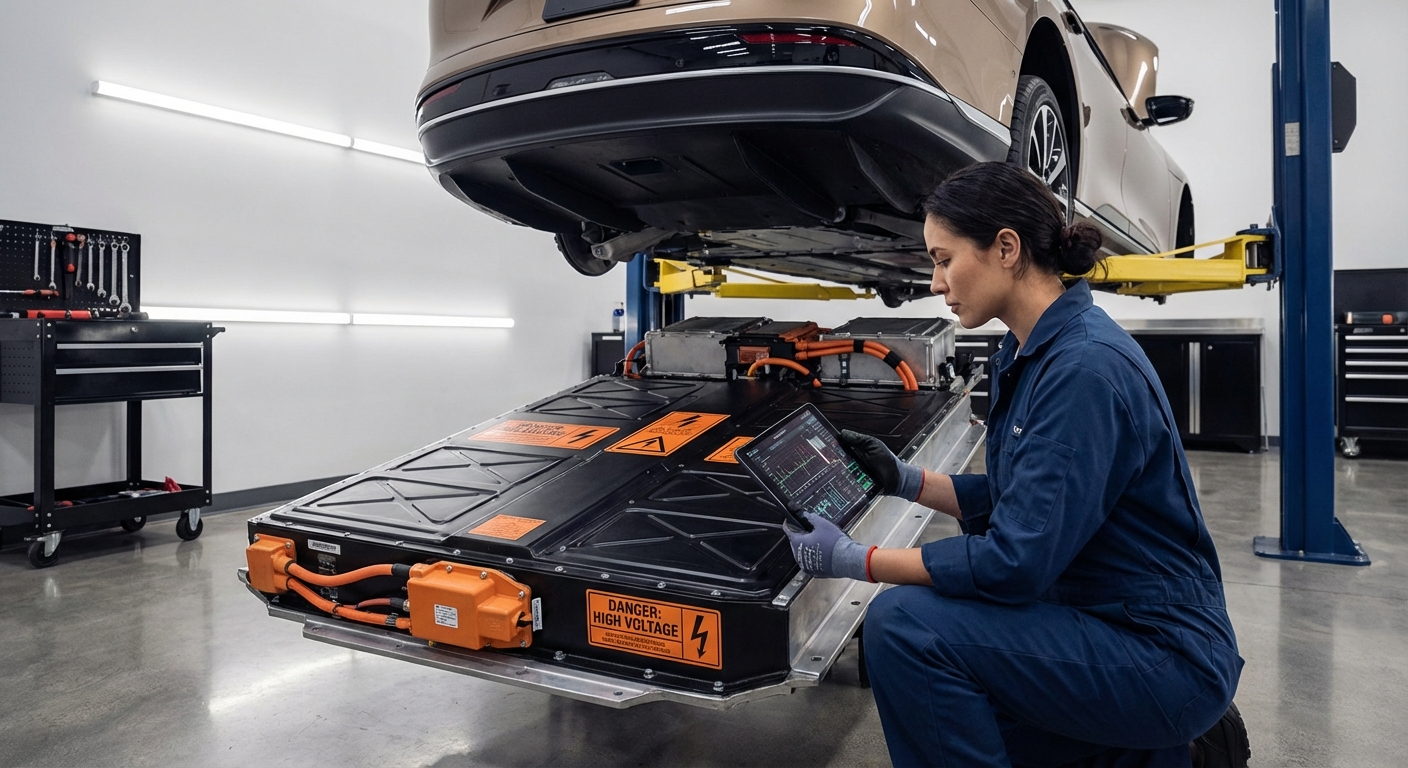
This is one of the more complex areas of car insurance battery coverage. EV batteries can experience thermal runaway, where a single cell short-circuits and heats uncontrollably, triggering a chain reaction across neighboring cells. Comprehensive coverage typically handles this since it's a non-collision fire event, and most 2026 insurer product documentation now explicitly lists EV battery fires and thermal runaway as a covered fire peril. Importantly, EVs remain far safer than the headlines suggest. Recent 2026 data pegs the EV fire rate at roughly 0.025% (about 25 per 100,000 vehicles sold), versus roughly 1.5% for petrol vehicles, a nearly 50x lower rate. The catch: when an EV battery does ignite, recent full-burn test research from 2026 confirms that once thermal runaway begins, no suppression technique fully stops the reaction, and packs can re-ignite hours or even days after the initial event.
| Fire Cause | Coverage Type | Covered? |
|---|---|---|
| EV battery thermal runaway | Comprehensive | ✅ Yes |
| Electrical/engine fire | Comprehensive | ✅ Yes |
| Crash-triggered fire | Collision | ✅ Yes |
| Arson by a third party | Comprehensive | ✅ Yes |
| Owner-intentional fire | None | ❌ No |
Other Comprehensive Events
Hail, flooding, falling objects, and wind damage that physically harm your battery pack are all covered under comprehensive. For EV owners, even charger-related damage from a covered peril, such as an electrical fire from a malfunctioning home charger, may be included under comprehensive. Note that the charging station hardware itself typically falls under homeowners insurance, not your auto policy.

Protect your car with Farmers
Average Rate:
Find coverage options that fit your budget.

The insurance savings you expect.
Average Rate:
Enjoy personalized policies, comprehensive coverage & more.

See how much you could save today!
Average Rate:
Drivers who switch their auto insurance and save with State Farm save $764 on average!

Safe Drivers Save with Allstate®
Average Rate:
Get rewarded with savings for having a clean driving record.
Collision Coverage and Battery Damage from Accidents
If your vehicle is involved in a crash and the battery pack is damaged as a result, collision coverage pays for the repair or replacement, minus your deductible. This applies equally to traditional 12-volt batteries, hybrid battery packs, and large EV battery systems.
One important nuance: insurers frequently prefer to total a vehicle rather than repair a severely damaged EV battery. Even minor impacts that compromise the battery casing can prompt a write-off, since battery replacement costs can easily exceed 50 to 60% of the vehicle's market value, making a total loss declaration more economical for the insurer. Battery packs still represent roughly 30 to 40% of a vehicle's total value in 2026, even as pack pricing continues to fall.
What Car Insurance Does NOT Cover: Wear, Tear & Warranty Issues
Understanding what your policy excludes is just as important as knowing what it covers. Here are the most common battery-related exclusions:
- Normal capacity loss. A battery that gradually loses range over years of use is treated as wear and tear, just like brake pads or tires.
- Age-related failure. If a battery simply stops holding a charge due to old age, no coverage applies.
- Manufacturing defects after warranty. Once the manufacturer's warranty expires, insurance doesn't pick up defect-related failures. A mechanical breakdown insurance policy or extended service agreement may be worth exploring.
- Improper use or modifications. DIY repairs, unapproved chargers, or aftermarket modifications that damage the battery are excluded.
Battery Warranty vs. Car Insurance: Key Differences
These two forms of protection serve very different purposes and should not be confused:
| Aspect | Manufacturer Warranty | Auto Insurance |
|---|---|---|
| Covers normal degradation | ✅ Yes (if below threshold) | ❌ No |
| Covers accident damage | ❌ No | ✅ Yes |
| Covers theft | ❌ No | ✅ Yes (comprehensive) |
| Federal minimum duration | 8 yrs / 100,000 miles | Ongoing (annual renewal) |
| California SOH warranty (2026 to 2030 MY) | 8 yrs / 100,000 miles (70% SOH) | Ongoing (annual renewal) |
| California SOH warranty (2031+ MY) | 8 yrs / 100,000 miles (75% SOH) | Ongoing (annual renewal) |
| California range durability (2026 to 2029 MY) | 10 yrs / 150,000 miles (70% range) | Ongoing (annual renewal) |
| California range durability (2030+ MY) | 10 yrs / 150,000 miles (80% range) | Ongoing (annual renewal) |
Most EV manufacturers guarantee their battery packs for 8 years or 100,000 miles, covering abnormal capacity loss (typically defined as the battery dropping below 70% of its original capacity). Notable exceptions include Hyundai, Kia, and VinFast, which offer 10-year battery warranties. California's Advanced Clean Cars II regulations add two separate battery protections that apply to 2026 and subsequent model year zero-emission vehicles and plug-in hybrids certified for sale in California. First, a battery warranty requires manufacturers to cover defects that cause state of health to fall below 70% for 8 years or 100,000 miles on 2026 to 2030 model years, rising to 75% for 2031+ models. Second, a fleet durability standard requires 2026 to 2029 BEVs to be designed so that at least 70% of a test group retains 70% or more of certified range for 10 years or 150,000 miles, tightening to 80% range retention for 2030+ models. Warranties address performance degradation; insurance addresses accidental damage.
EV Battery Replacement Costs and Specialty Coverage Options
How Much Does an EV Battery Replacement Cost?
Battery pack prices have continued to fall. According to BloombergNEF's 2025 Lithium-Ion Battery Price Survey, the global average pack price hit a record-low $108/kWh in 2025, an 8% year-over-year drop, with BEV-specific lithium-ion packs averaging $99/kWh (below the $100 parity line for the second consecutive year). BNEF forecasts the average pack price will fall a further 3% to approximately $105/kWh across all segments in 2026. However, retail replacement costs remain significantly higher than raw cell pricing due to labor, diagnostics, and OEM markup. A useful 2026 rule of thumb is roughly $130 to $200 per kWh installed for a full out-of-warranty replacement on mainstream EVs. Here's what out-of-warranty owners can typically expect to pay:
| Vehicle Category | Battery Size | Estimated Replacement Cost (Parts + Labor) |
|---|---|---|
| Compact EVs (Nissan Leaf, Chevy Bolt) | 24 to 65 kWh | $4,000 to $10,000 |
| Mid-Size EVs (Tesla Model 3/Y, Hyundai Ioniq 5) | 60 to 82 kWh | $11,000 to $18,000 |
| Luxury/Large EVs (Tesla Model S/X, BMW iX) | 90 to 110 kWh | $15,000 to $25,000 |
| Trucks & Large SUVs (F-150 Lightning, Rivian R1T) | 100 to 135+ kWh | $25,000 to $50,000 |
Refurbished or remanufactured battery packs can cost 30 to 50% less than new OEM units, making them an increasingly popular option for out-of-warranty repairs. Certified EV technicians commonly bill $175 to $250+ per hour in 2026, meaning labor alone typically adds $1,500 to $5,000 to the total bill depending on whether you go independent or dealer. These costs are a key reason EV insurance rates remain significantly higher than coverage for gas-powered cars.
Specialty EV Insurance Products
As EVs become more mainstream, the insurance industry is responding with tailored options. Per Insurify's 2026 report, EVs cost an average of $3,159 per year to insure with full coverage across all model years, while gas-powered cars cost $2,218 per year on average, meaning EVs are about 42% ($941 annually) more expensive to insure. Other sources place the gap as high as 49%. For a full breakdown, see our guide on the best EV insurance companies and how Tesla insurance rates by model compare with traditional carriers.
- Tesla Insurance. Per Tesla's own 2026 support documentation, the program is now available in 15 states: Arizona, California, Colorado, Florida, Illinois, Indiana, Maryland, Minnesota, Nevada, Ohio, Oregon, Tennessee, Texas, Utah, and Virginia. In every state except California, Safety Score-based real-time pricing determines your monthly premium (California uses a traditional rating model). Safe drivers with strong Safety Scores often see rates 20 to 40% below traditional insurers, and drivers who complete more than 50% of their miles on FSD (Supervised) can layer an additional discount of up to 10% on qualifying coverage.
- EV-Specific Endorsements. Some insurers now offer battery-specific add-ons or "battery protect" riders that extend protection beyond standard comprehensive and collision, covering scenarios like water ingress, internal thermal runaway without an external cause, and short circuits during charging.
- Extended Service Agreements. Tesla and many third-party providers offer extended warranty plans covering battery-related repairs after the factory warranty expires. This pairs well with mechanical breakdown coverage for comprehensive post-warranty protection.
- Gap Insurance. Essential for financed EVs, gap coverage pays the difference between what you owe and your car's ACV if the vehicle is totaled. Given that EVs can depreciate 45 to 57% within five years, this protection is especially valuable for new buyers, and most car loans require gap coverage or full coverage from day one. Leased EVs face similar rules under car insurance for leased vehicles.
Frequently Asked Questions
Does car insurance cover a dead car battery?
No. A battery that simply dies from age, cold weather, or normal use is considered a maintenance issue, not an insurable event. Standard auto insurance policies exclude wear-and-tear items like batteries from coverage. You may be able to get a jump-start through a roadside assistance add-on, but the cost of a new battery will be out of pocket. If you're concerned about mechanical failures beyond accidents, consider looking into mechanical breakdown insurance.
Will comprehensive insurance cover my EV battery if it's stolen?
Yes, in most cases. Comprehensive coverage treats the EV battery as part of the vehicle. If someone steals your battery pack, your insurer will typically pay out the actual cash value of the vehicle minus your deductible. A police report is generally required, and policy language can vary, so always confirm the specifics with your insurer directly.
Does insurance cover hybrid battery replacement?
Only if the hybrid battery is damaged by a covered peril such as a collision, fire, or theft. Normal hybrid battery degradation and age-related failure are not covered by insurance. Most hybrid manufacturers offer 8-year/100,000-mile warranties on their battery systems, which is your best protection against premature failure not caused by a covered accident.
What happens if an EV battery catches fire?
Comprehensive insurance typically covers EV battery fires, including thermal runaway events caused by a malfunction. If the fire results from a crash, collision coverage applies instead. EV battery fires are rarer than most people think, with 2026 data showing EVs are roughly 50 times less likely to catch fire than petrol vehicles. However, EV fire claims can take longer to settle due to specialized inspections and the risk of delayed re-ignition, and if a manufacturing defect is involved, you may also have grounds for a separate product liability claim against the automaker.
Is Tesla's battery covered by Tesla Insurance?
Tesla Insurance offers standard comprehensive and collision coverage, which means the battery is covered for accidents, theft, fire, and other covered perils, the same as any other auto policy. However, Tesla Insurance does not cover battery degradation or mechanical failure from normal use. For protection against those scenarios, Tesla's Extended Service Agreement is a better fit. Drivers with strong Safety Scores may qualify for meaningful premium discounts of 20 to 40% in Tesla Insurance's non-California states, with additional FSD-mileage discounts of up to 10% available in select states.