

Compare Home Warranty Options in Ohio
See what plans you qualify for in less than 2 minutes
Understanding Home Warranty Payout Limits
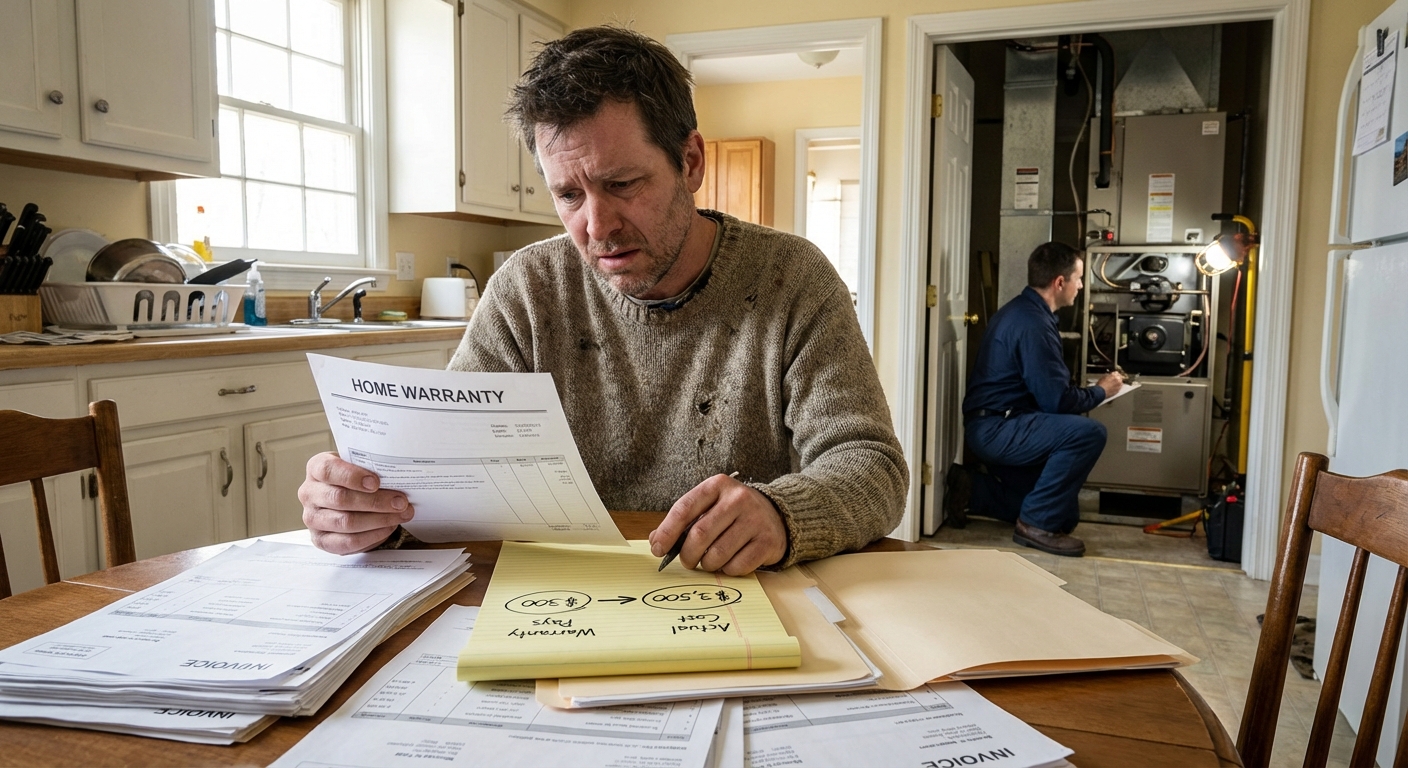
Home warranty payout limits are the single most important detail hiding inside your service contract. Most homeowners don't discover them until they're staring down a $13,000 HVAC replacement bill with a $2,000 cap. Every home warranty plan sets a maximum dollar amount it will pay per covered item, per repair incident, and per year in total. These figures directly determine whether your warranty is a financial safety net or a false sense of security.
There are two primary types of limits you need to understand:
- Per-item caps: The maximum the plan pays for a single covered system or appliance (e.g., $2,000 for your air conditioner)
- Annual aggregate limits: The total the plan will pay across all claims in a 12-month contract period (e.g., $50,000 total regardless of how many claims you file)
Once either limit is hit, you're responsible for 100% of remaining costs. Understanding what a home warranty actually covers before you buy is essential to making a smart purchase, and it's more important than ever in 2026 as many providers have quietly reduced coverage. Consumer research shows roughly 44% of policyholders have had a claim denied or only partially paid, largely because caps and exclusions catch homeowners off guard.
How Per-Item Caps Work in Practice
Every covered item in your home warranty plan carries its own individual dollar ceiling. These caps vary significantly by provider and plan tier. Here's a breakdown of typical 2026 per-item coverage limits across the industry:
| System or Appliance | Low-Tier Cap | Mid-Tier Cap | High-Tier Cap |
|---|---|---|---|
| HVAC (Heating & Cooling) | $1,500 to $3,000 | $3,000 to $5,000 | $5,000 to Unlimited |
| Plumbing System | $500 to $1,000 | $1,500 to $3,000 | $3,000 to Unlimited |
| Electrical System | $500 to $1,000 | $1,500 to $3,000 | $3,000 to Unlimited |
| Refrigerator | $500 to $1,000 | $1,500 to $2,500 | $3,500 to $7,000 |
| Washer / Dryer | $500 to $1,000 | $1,500 to $2,000 | $3,500 to $7,000 |
| Dishwasher | $500 to $800 | $1,000 to $1,500 | $2,500 to $3,500 |
| Water Heater | $500 to $1,000 | $1,500 to $2,000 | $3,000 to $5,000 |
| Built-in Microwave | $150 to $300 | $400 to $800 | $1,000 to $2,000 |
These caps represent the ceiling, not a guaranteed payout. Your actual claim reimbursement depends on the repair diagnosis, approved labor rates, and whether the failed component is specifically listed in your contract. Heading into mid-2026, several mid-tier plans have reduced plumbing and electrical caps from around $2,000 down to $1,000 or lower, and a growing number are paying actual cash value on older appliances rather than full "repair or replace" pricing. Contract review matters more than ever. Learn more about home warranty coverage limits and how they translate into real-world payouts.
What Happens When Repair Costs Exceed the Cap
When an approved repair or replacement exceeds your plan's coverage limit, the process is straightforward but painful: you pay the difference. There is no negotiation on the cap itself unless you've selected a higher-tier plan.
Here's how common over-cap scenarios play out in 2026:
Scenario 1: HVAC Replacement
Your central air conditioner fails completely. The technician quotes a full system replacement at $13,000. Your plan has a $3,000 HVAC cap.
- Warranty pays: $3,000
- You pay: $10,000
- Service fee: $100 to $125 (still owed even on a capped claim)
Scenario 2: Refrigerator Compressor Failure
Your refrigerator's compressor fails on a high-end unit. Repair cost: $2,200. Your plan caps refrigerators at $1,500.
- Warranty pays: $1,500
- You pay: $700
- Service fee: $100
Scenario 3: Annual Aggregate Limit Hit
You have a $15,000 annual aggregate cap. Earlier in the year, a plumbing repair used $8,000 and an electrical repair used $5,000, leaving $2,000 remaining in your aggregate. Your HVAC then fails and needs $6,000 in repairs.
- Warranty pays: $2,000 (remaining aggregate balance)
- You pay: $4,000
Some providers will notify you before work begins if a repair is projected to exceed your coverage cap, giving you a chance to authorize the overage or explore alternatives. This is more common with higher-tier plans from established companies. Understanding how companies decide to repair or replace an item is also key, because a replacement decision at a low cap can leave you with a much larger bill than a repair would have.
Providers With the Highest Payout Limits
Not all home warranty companies treat caps the same way. Premium providers offer significantly higher and in some cases unlimited coverage on major systems. Here's how the top companies compare:
Top Providers by Payout Generosity (2026)
American Home Shield (AHS) has set the industry benchmark in 2026 with a $50,000 total limit per agreement term across all three of its plans (ShieldSilver, ShieldGold, and ShieldPlatinum). All AHS plans pay up to $5,000 per covered HVAC system per term, with a lower $1,500 sub-limit on geothermal A/C systems. ShieldSilver covers systems only (no appliance coverage). ShieldGold adds a $2,000 per appliance cap, while ShieldPlatinum increases that to $4,000 per appliance and adds $1,000 in roof leak repair coverage plus $250 for permits and code violations, along with unlimited plumbing and electrical on some plan configurations.
First American Home Warranty stands out for offering no total dollar limit on most covered repairs, including plumbing, electrical, and HVAC systems. Appliance caps run $3,500 per item on the Starter and Essential plans and rise to $7,000 per item on the Premium plan, one of the highest appliance ceilings in the industry. Note that a few sub-items like water heaters and roof leaks still carry their own dollar limits on the lower plans.
Old Republic Home Protection consistently ranks on the high end for both HVAC and appliances, with HVAC caps reaching $6,500 each for heating and cooling on higher tiers (a combined $13,000 in HVAC coverage). Appliance limits typically run $3,000 to $7,000 per item on the more comprehensive plans.
2-10 Home Buyers Warranty offers up to $5,000 each for air conditioning, heating, and ductwork (a combined $15,000 in HVAC coverage), with a $25,000 to $50,000 annual aggregate across all covered systems and appliances depending on plan. This puts it firmly in the upper tier for payout generosity in 2026.
For a full cost-to-value breakdown, see our guide on home warranty options for 2026, which compares premium pricing against payout potential across major providers. If you want a side-by-side of plan tiers, our home warranty plans comparison for 2026 shows how caps stack up across the top companies.
Coverage Caps vs. Actual Replacement Cost
There's a critical distinction every homeowner must understand: your home warranty's coverage cap is not the same as the item's actual replacement cost. The gap between the two is where most financial surprises happen.
Coverage cap = The fixed maximum your warranty will pay, as defined in your contract. Actual replacement cost = The real current market cost to repair or replace the item with a new equivalent.
Does Home Warranty Depreciation Apply?
Unlike homeowners insurance, which often pays on an actual cash value (ACV) basis by subtracting depreciation from the item's age and useful life, most home warranties do not formally depreciate items. Your HVAC is not paid out at 60 cents on the dollar because it's 10 years old. The warranty simply pays up to its cap and stops. That said, more providers in 2026 are applying actual cash value logic to cash-out settlements on older appliances, which can materially reduce the payout compared to the retail replacement quote.
Even without formal depreciation, if your plan's cap is already lower than a new replacement cost, the age of your system has essentially the same financial impact. You're still paying a large portion out of pocket.
| Item | 2026 Replacement Cost | Typical Cap | Your Out-of-Pocket Gap |
|---|---|---|---|
| Central HVAC System | $7,000 to $16,000 | $2,000 to $5,000 | $2,000 to $14,000 |
| High-Efficiency HVAC | $15,000 to $20,000 | $2,000 to $5,000 | $10,000 to $18,000 |
| Refrigerator (mid-tier) | $900 to $2,600 | $1,500 to $4,000 | $0 to $1,100 |
| Washer + Dryer Set | $1,100 to $2,600 | $1,500 to $2,000 each | $0 to $600 |
| Water Heater (standard tank) | $1,100 to $2,800 | $1,000 to $2,000 | $0 to $1,800 |
| Water Heater (tankless) | $3,000 to $5,000 | $1,000 to $2,000 | $1,000 to $4,000 |
| Electrical Panel | $2,500 to $5,000 | $1,500 to $3,000 | $0 to $3,500 |
For a deeper look at how the total cost stacks up against real repair gaps, read our home warranty total cost analysis.
Is a Home Warranty Worth Buying Given Payout Limits?
Here's the honest framework for evaluating whether a home warranty's payout limits make it financially worthwhile for your situation. The average plan runs about $73 per month (roughly $876 per year) with a service fee averaging $108.45 per visit, so any evaluation needs to weigh those hard costs against realistic claim outcomes. With about 44% of policyholders reporting a claim that was denied or only partially paid, the math has to include the possibility that you won't get full value even when you file.
Step 1: List Your High-Risk Items
Write down the age and condition of your HVAC, water heater, major appliances, and home systems. Older items (10+ years) carry higher replacement risk. Review what HVAC coverage your warranty plan includes to understand how your biggest expense is treated.
Step 2: Compare Caps to Real Local Costs
Look up current replacement costs in your market. Standard central AC replacement in 2026 averages $5,500 to $9,500 installed, while full HVAC replacements typically run $7,000 to $16,000, and high-efficiency or complex installs can hit $15,000 to $20,000. If a plan's HVAC cap is $2,000 in a $13,000 market, the warranty provides limited protection on your biggest risk. Learn more about air conditioner coverage rules that specifically affect AC claims.
Step 3: Run the Math
Add up: Annual premium + estimated service fees vs. probability of a claim x (real repair cost minus cap)
If your expected out-of-pocket after the cap is consistently higher than your annual premium, a higher-tier plan or a dedicated repair savings account may serve you better. You can also explore whether reimbursement for out-of-pocket repairs is available if you use your own contractor.
Step 4: Prioritize Plans With Higher Caps on Your Biggest Risks
If you can't afford the highest-tier plan, at minimum target the highest cap available for your most expensive at-risk system, typically HVAC. You may also want to evaluate options like dedicated repair savings, equipment breakdown insurance riders, or HVAC service agreements if caps remain too low for your area.
Understanding how companies decide to repair or replace an item can also help you avoid surprises when it's time to actually use your coverage. And if you're worried about filing several claims in one year, our guide to multiple home warranty claims explains how aggregate limits can be exhausted faster than you'd expect. If you want a full pre-signing walkthrough, our home warranty contract review guide shows exactly where limits are defined.
Frequently Asked Questions
What is the average home warranty payout limit per item?
Per-item caps range widely, but most mid-tier plans set limits between $1,500 and $3,000 for appliances and $2,000 to $5,000 for major systems like HVAC. Low-cost plans can be as low as $500 to $1,000 per item, while premium plans from First American can pay up to $7,000 per appliance and American Home Shield pays up to $5,000 per HVAC system. Always check the "Limit of Liability" section in your specific contract, as limits vary even within the same company's plan lineup.
What happens if my repair cost is more than my home warranty will pay?
You are responsible for paying the difference between the warranty's coverage cap and the actual repair or replacement cost. This applies even on fully approved claims, since the cap is not a negotiating point once set in your contract. Some providers may offer a cash-out settlement as an alternative to a repair that exceeds the cap, but the amount offered is typically based on the company's internal wholesale rates, not retail pricing.
Do home warranty companies apply depreciation to payouts?
Most home warranty plans do not apply formal depreciation to their scheduled repair-or-replace payouts. They pay up to the coverage cap without reducing the amount based on the item's age. This differs from homeowners insurance, which may use actual cash value (ACV) and subtract depreciation. However, a growing number of providers in 2026 use ACV logic on cash-out settlements for older appliances, and since caps are often already lower than full replacement cost, older systems can still leave homeowners with significant out-of-pocket expenses regardless.
Which home warranty companies offer the highest payout limits?
American Home Shield, First American Home Warranty, Old Republic Home Protection, and 2-10 Home Buyers Warranty are the top-tier providers for payout limits in 2026. AHS offers a $50,000 annual aggregate, $5,000 per HVAC system, and up to $4,000 per appliance on ShieldPlatinum. First American's Premium plan reaches $7,000 per appliance with no total dollar cap on most systems, while Old Republic delivers up to $6,500 each for heating and cooling on its higher-tier plans and 2-10 offers a $25,000 to $50,000 aggregate with $5,000 each for heating, AC, and ductwork.
How do annual aggregate home warranty limits work?
An annual aggregate limit is the maximum dollar amount your warranty will pay across all claims combined during a 12-month contract period. For example, if your plan has a $15,000 aggregate cap and you file claims totaling $14,000 before December, only $1,000 remains for additional claims that year regardless of how large the next repair is. Annual aggregate limits range from roughly $10,000 to $25,000 on most mid-tier plans, with American Home Shield's $50,000 cap and First American's uncapped system coverage representing the top of the market in 2026.