

Compare Home Warranty Options in Ohio
See what plans you qualify for in less than 2 minutes
What Standard Home Warranties Actually Cover
If you've invested in a smart home setup, you might assume your home warranty has you covered when things break. The reality is more nuanced. A standard home warranty is a service contract that covers the repair or replacement of major home systems and appliances when they fail due to normal wear and tear. Understanding what a home warranty covers is the first step to figuring out where smart devices fit in.
In 2026, home warranty premiums average around $73 per month according to NerdWallet, with plans ranging from roughly $28 up to $191 per month. Forbes pegs the average closer to $60 per month, This Old House at $56, and First American Home Warranty at about $55. Service fees average $108 per claim visit, though most providers charge somewhere between $75 and $150. Standard plans typically cover the following core systems and appliances:
| Category | Covered Components |
|---|---|
| HVAC | Furnaces, central air units, ductwork, thermostats (mechanical function only) |
| Plumbing | Pipes, water heaters, faucets, shut-off valves |
| Electrical | Wiring, circuit breakers, outlets, electrical panels |
| Kitchen Appliances | Refrigerator compressor & cooling, oven/range burners, dishwasher motor |
| Laundry | Washer and dryer motors, drums, pumps, heating elements |
The critical phrase here is mechanical and electrical. Home warranties were designed long before smart home technology existed, and most policy language still reflects that legacy. Covered breakdowns are those that cause a device to stop performing its core function, not those that affect app connectivity, digital displays, or voice assistant integration. For a deeper look at how warranty coverage is structured, see our appliance coverage guide.
Smart Features vs. Mechanical Components: The Key Distinction
This is the most important concept for any smart home owner to understand: a covered appliance and a covered smart feature are not the same thing. Home warranty companies draw a firm line between the appliance itself and the technology layered on top of it.
Embedded Smart Features in Covered Appliances
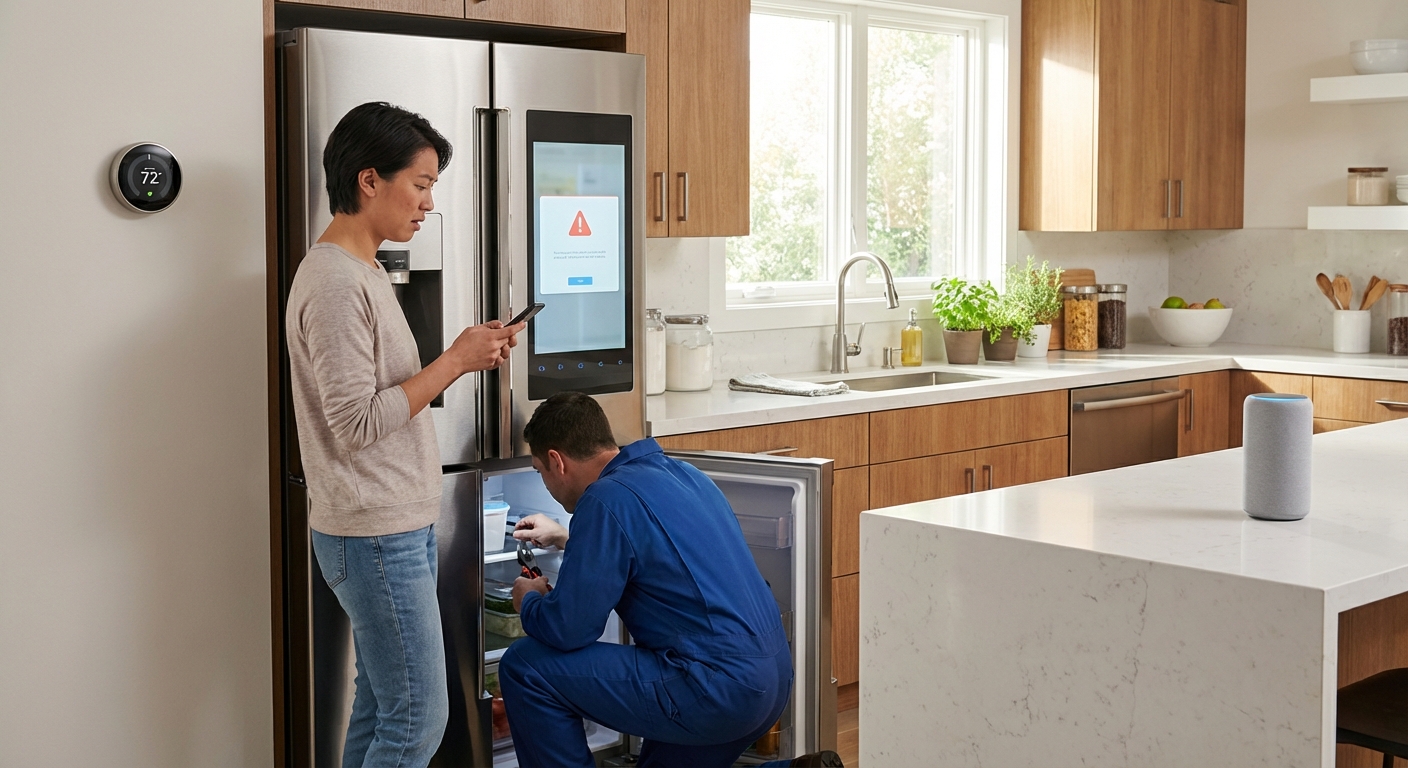
Many modern appliances come with smart features built directly into them, like a refrigerator with a touchscreen panel, a washer with a Wi-Fi-enabled app, or an oven you can control from your phone. These are considered embedded smart features, and they receive mixed treatment under home warranty policies.
- What's covered: The mechanical and electrical components responsible for the appliance's primary function. For a refrigerator, that means the compressor, evaporator fan, condenser coils, and cooling system. For a washer, that means the motor, drum, pump, and heating element.
- What's excluded: The Wi-Fi module, embedded display screen, smart sensors, app integration, firmware, and any cloud-based functionality.
So if your smart refrigerator stops cooling, that's a mechanical failure and likely covered. If the touchscreen panel freezes up or your app loses connectivity to the appliance, those are smart feature failures, and most standard warranties won't touch them.
Standalone Smart Devices
Standalone smart devices are gadgets that aren't integral to a home system but connect to your home's network to provide added functionality. Examples include:
- Smart doorbells (Ring, Google Nest Doorbell)
- Smart locks and deadbolts
- Smart speakers (Amazon Echo, Google Nest Hub)
- Wireless security cameras
- Smart plugs and light switches
These devices are almost universally excluded from standard home warranty coverage. They are not considered essential home systems or appliances, and no mechanical failure coverage applies to them under a traditional plan. American Home Shield explicitly states that its standard plans do not cover smart technology breakdowns. If a Ring doorbell's motion sensor stops working or your smart lock's Bluetooth module fails, a standard home warranty will not help.
This distinction matters a lot when reviewing electrical coverage rules and other system-level protections. Knowing the common appliance exclusions in advance can save you the frustration of a denied claim.
Smart Device Coverage Scenarios: Thermostat, Fridge & Doorbell
Let's break down the three most commonly asked-about smart devices and exactly when coverage would be approved or denied in 2026.
Smart Thermostat (Nest, Ecobee, Honeywell Home)
A smart thermostat sits at the crossroads of appliance and smart device. Because it's directly connected to your HVAC system, which is almost always covered, it occupies a unique position. You can learn more about HVAC coverage rules to understand how this system-level coverage applies. Old Republic Home Protection is one of the few major providers that will consider Wi-Fi-enabled thermostats as part of the covered HVAC system, provided the failure meets the terms of the plan and involves a covered component (not just the smart features).
| Scenario | Covered? | Reason |
|---|---|---|
| Thermostat fails to send signal to furnace | ✅ Likely Yes | Mechanical failure of a covered HVAC component |
| Thermostat wiring shorts out | ✅ Likely Yes | Electrical failure within covered system |
| App loses connection to thermostat | ❌ No | Software/connectivity issue, not mechanical |
| Touchscreen display stops responding | ❌ No | Smart feature, excluded from coverage |
| Thermostat firmware corrupts | ❌ No | Software issue, not covered |
Bottom line: If the thermostat fails in a way that prevents your heating or cooling from functioning, your HVAC coverage may apply. If the smart features stop working but the heating and cooling still operate, you're on your own. Nest devices also carry a manufacturer warranty (2 years standard on the Learning Thermostat 4th gen, up to 5 years when installed by a Nest Pro) that may cover defects separately from your home warranty.
Smart Refrigerator
Smart refrigerators are now commonplace, with models featuring internal cameras, voice-control panels, and grocery tracking apps. But home warranties still evaluate them primarily as cooling appliances. See our refrigerator coverage guide for a deeper breakdown of covered components.
| Scenario | Covered? | Reason |
|---|---|---|
| Compressor fails, fridge stops cooling | ✅ Yes | Core mechanical failure |
| Ice maker motor breaks | ✅ Usually | Mechanical component, most plans cover |
| Internal camera stops working | ❌ No | Smart feature |
| Wi-Fi module fails | ❌ No | Connectivity component |
| Built-in screen freezes | ❌ No | Smart feature, not mechanical |
Per-appliance coverage caps also affect how much you can recover on a high-end smart model. American Home Shield ShieldGold covers up to $2,000 per appliance, ShieldPlatinum lifts that to $4,000, Choice Home Warranty caps at $3,000, and First American's top-tier plan can go as high as $7,000 per appliance. AHS also carries a $50,000 total agreement-term limit across all plan tiers. This is worth understanding when comparing warranty options for a kitchen full of expensive connected appliances.
Smart Doorbell (Ring, Nest Doorbell)
Smart doorbells are standalone devices and are not part of any covered home system. As a result, they receive virtually no coverage under standard home warranty plans.
| Scenario | Covered? | Reason |
|---|---|---|
| Doorbell wiring at breaker fails | ⚠️ Maybe | If tied to covered electrical wiring |
| Video feed stops working | ❌ No | Smart feature on standalone device |
| Motion detection fails | ❌ No | Smart/tech feature, not a home system |
| Device stops turning on entirely | ❌ No | Standalone smart gadget, excluded |
Electronics Protection Add-Ons and Standalone Smart Home Plans
The good news: the industry is responding to the smart home boom, and protection options are expanding in 2026. Many providers are broadening coverage to include smart and energy-efficient appliances, and dedicated electronics riders are now widely available. Our guide to energy-efficient appliance coverage covers how these connected systems intersect with green appliance protection.
Home Warranty Electronics Add-Ons
American Home Shield (AHS) remains the most notable example with its Whole Home Electronics Protection Plan (EPP), provided by Allstate Protection Plans. The plan covers failures due to normal use, power surges, and defects in workmanship and materials, and can be added to any AHS home warranty plan. There is no limit to the number of electronics covered, and eligible items include:
- Televisions and home theater systems
- Desktop and laptop computers, tablets
- Gaming systems and external hard drives
- Home routers
- Select smart home products
- Wearables, digital cameras, and printers
The 2026 plan carries a $2,000 per-claim limit and a $5,000 total claims limit per contract term. The electronics add-on must be added within the first 60 days of AHS membership. AHS's own coverage overview lists ShieldGold at $2,000 per appliance and ShieldPlatinum at $4,000 per appliance, with a $5,000 HVAC cap and a $50,000 aggregate cap across all tiers. AFC Home Warranty and ARW Home also offer electronics riders that cover TVs, computers, and other consumer devices. You can review broader home warranty add-on options to see how electronics protection stacks up against other available riders.
Standalone Smart Home Protection Plans
If your home is heavily loaded with smart devices, a dedicated tech protection service may be the smarter move. Asurion Home+ remains the leading direct-to-consumer option in 2026:
| Plan Detail | Asurion Home+ (2026) |
|---|---|
| Monthly cost | $34.99 + tax |
| Per-claim limit | $2,000 |
| Annual aggregate limit | $5,000 per 12-month period |
| Service fee per claim | Varies by device (about $49 for smart home devices) |
| Coverage start | Day 31 of enrollment |
| Devices covered | Unlimited eligible devices per household |
Covered devices include smart TVs, gaming systems, laptops, tablets, routers, smart speakers, smart thermostats, smart smoke and CO detectors, smart door locks, smart video doorbells, smart home security cameras, smart light dimmers, and wearables like smart watches and fitness bands. Coverage applies to mechanical/electrical breakdowns plus wear and tear, and select portable devices also get accidental damage protection. Mobile phones are not covered under Home+, and pre-existing failures before enrollment are excluded.
AT&T HomeTech Protection offers a lower-cost alternative at $25/month plus applicable taxes, though it requires an active AT&T wireless or internet subscription and is limited to one plan per account. It covers TVs, gaming consoles, laptops, tablets, printers, routers/modems, and smart home devices like thermostats, doorbells, locks, cameras, and smart smoke/CO detectors. Service fees run $0 for routers, modems, and keyboards, $49 for Wi-Fi-only wearables and audio headsets, and $99 for TVs, laptops, tablets, desktops, and portable gaming devices. Coverage starts on day 31 after enrollment, and mobile phones, loss, and theft are excluded. Claims are capped at $2,000 per claim and $5,000 per rolling 12 months.
These plans do not cover theft, loss, or cyber/hacking incidents. For those risks, a homeowners insurance rider may be more appropriate. Understanding the difference between warranty and home insurance protection can help you decide which gaps need to be filled.
Is Smart Home Coverage Worth Pursuing Separately?
A dedicated smart home protection plan is worth it if you own multiple high-value connected devices (smart TVs, laptops, routers, hubs) and a single repair would cost more than your annual premium. A typical device repair runs $200 to $500 or more, and one successful claim on a $34.99/month Asurion plan pays for nearly a year of coverage. It's less worthwhile if your smart home setup is limited or if most devices are still under manufacturer warranty.
For a broader look at how protection contracts compare, see our guide on home warranty vs extended warranty differences. You can also explore how a full plan comparison stacks smart-capable HVAC and appliance coverage across major providers.
Frequently Asked Questions
Does a home warranty cover a Nest or Ecobee thermostat?
A home warranty may cover a smart thermostat if it fails in a way that affects the mechanical operation of your HVAC system, such as faulty wiring causing the furnace or AC to stop responding. However, the smart features of the thermostat (app connectivity, touchscreen, remote access) are not covered under standard warranty terms. Old Republic Home Protection will consider Wi-Fi thermostats when the failure is treated as part of the HVAC system, but many other providers exclude smart thermostats entirely. Always confirm with your specific provider before assuming coverage.
Will my home warranty cover my smart refrigerator if the touchscreen breaks?
No. Most home warranty plans in 2026 will not cover a broken touchscreen, failed Wi-Fi module, or any other smart-specific component of your refrigerator. Home warranty coverage for refrigerators is limited to mechanical and electrical failures, such as a compressor breakdown or a faulty evaporator fan, that prevent the appliance from cooling. The smart features are treated as separate technology components that fall outside the scope of standard coverage.
Are smart doorbells covered by any home warranty plan?
Standard home warranty plans do not cover smart doorbells. They are classified as standalone smart devices rather than covered home systems or built-in appliances. The one exception may be if the underlying doorbell wiring at the electrical panel level fails, which might qualify under electrical system coverage. For full protection of devices like Ring or Nest Doorbell, a standalone electronics protection plan like Asurion Home+ or AT&T HomeTech Protection is your best option in 2026.
What is the best home warranty for smart home owners in 2026?
American Home Shield remains the most notable provider offering an electronics protection add-on that explicitly includes select smart home products through its Allstate-backed Whole Home Electronics Protection Plan. AFC Home Warranty and ARW Home also offer electronics riders worth comparing. For homeowners with a large inventory of smart devices, pairing a comprehensive home warranty with a dedicated tech protection service like Asurion Home+ ($34.99/month) or AT&T HomeTech Protection ($25/month) provides the most complete layered coverage.
Can I get separate insurance for my smart home devices?
Yes. Standalone tech protection services like Asurion Home+ and AT&T HomeTech Protection are specifically designed to cover home technology devices beyond what a standard home warranty offers. These plans cover breakdowns, wear and tear, and power surges for devices like smart TVs, routers, laptops, gaming consoles, smart thermostats, and video doorbells. For theft, loss, or cyber threats, a homeowners insurance policy add-on or a specialized cyber insurance rider would be the appropriate coverage to pursue instead.