

Compare Home Warranty Options in Ohio
See what plans you qualify for in less than 2 minutes
Does a Home Warranty Cover Energy-Efficient Appliances?
The short answer is: yes, but with important caveats. Home warranties are designed to cover major appliances and home systems when they break down due to normal wear and tear, and an Energy Star label or high-efficiency rating doesn't disqualify a product from coverage. What matters is whether the item falls into a covered category (such as a refrigerator, HVAC system, or water heater), not its efficiency rating.
That said, the way warranties handle energy-efficient equipment can differ significantly from how they handle standard gear. Most policies cover the mechanical and electrical components of these systems but may not account for the higher cost of replacing a high-efficiency unit with its equivalent. Coverage limits, upgrade options, and add-on availability vary widely by provider, and 2026 has cemented a clear trend: more companies are using depreciated actual cash value to calculate payouts for older appliances rather than paying full replacement cost.
Coverage for Specific Energy-Efficient Systems
Understanding how your warranty treats individual high-efficiency systems is critical before you file a claim or choose a plan.
Tankless Water Heaters
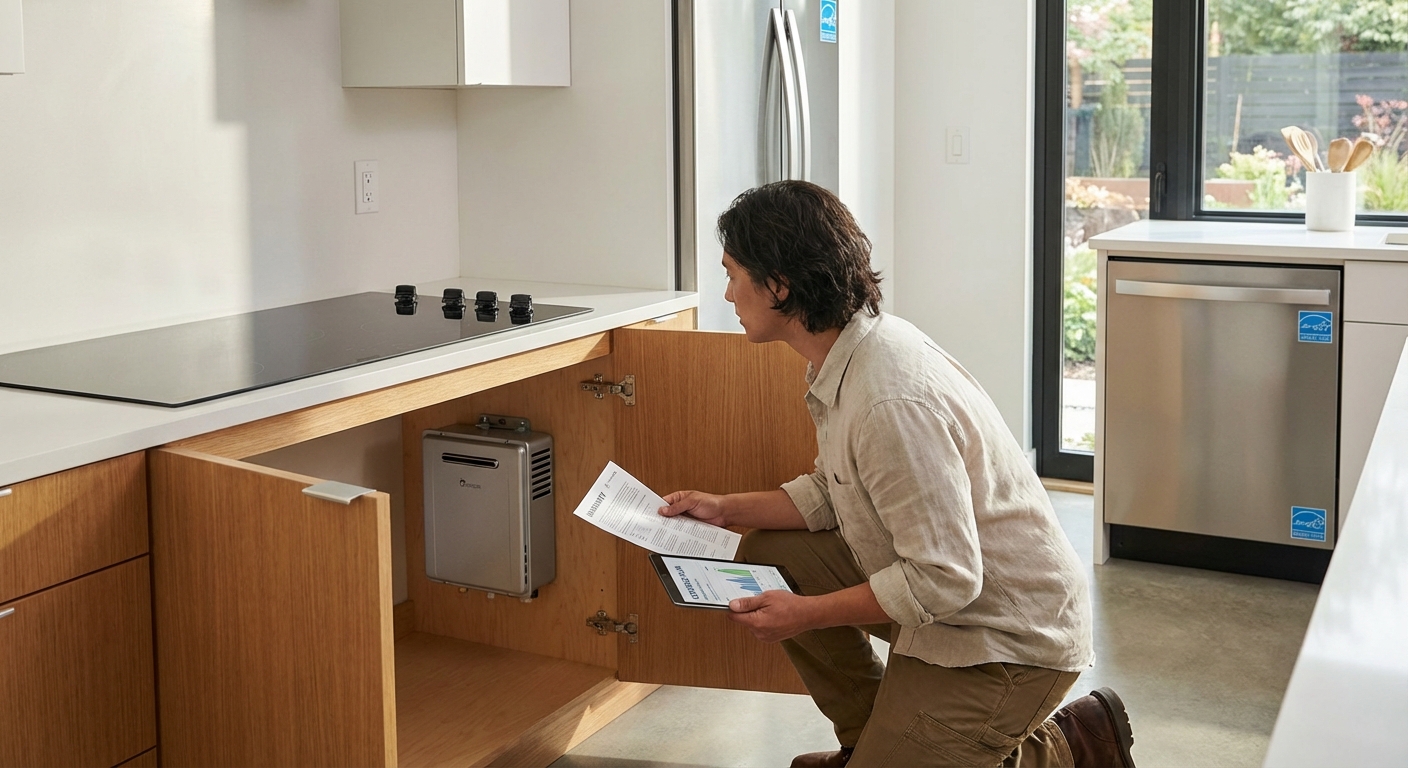
Tankless (on-demand) water heaters are covered by most major home warranty providers today. All three American Home Shield plans (ShieldSilver, ShieldGold, and ShieldPlatinum) include water heater coverage, including tankless models and circulating pumps. Auxiliary holding tanks, storage tanks, and fuel storage tanks are excluded. Home Warranty Inc., Liberty Home Guard, and First American also cover tankless models under plumbing or systems coverage.
However, the more complex electronics and flow sensors unique to tankless units can fall into gray areas. Providers are much more aggressive in 2026 about demanding proof of professional installation and documented maintenance before approving claims, and tankless units (which need descaling, flushing, and correct venting) are especially subject to those requirements. Always verify that your plan explicitly says "tankless" rather than just "water heater."
Learn more about tankless water heater coverage and what to expect from your plan.
Heat Pumps & High-Efficiency HVAC
Heat pumps are covered as part of HVAC systems under most combination plans. Coverage typically extends to compressors, refrigerant lines, fan motors, and thermostats. However, standard exclusions apply, with humidifiers, dehumidifiers, and radiant heating systems commonly left out.
HVAC coverage limits vary significantly by provider. American Home Shield's plans include a $5,000 per HVAC system limit across ShieldSilver, ShieldGold, and ShieldPlatinum, backed by a $50,000 aggregate per contract term. Geothermal and water-source heat pumps carry a lower sub-limit on AHS plans. First American offers higher caps on its Premium tier, up to $7,000 per appliance with no overall dollar cap on most items. High-efficiency heat pump systems often cost more to replace, which means a standard coverage cap may leave you paying the difference out of pocket. For a deeper look, see our home warranty HVAC coverage guide.
Induction Cooktops
Induction cooktops are generally covered under the "ranges, ovens, and cooktops" category found in most appliance plans. Since they function as a standard kitchen appliance from a claims standpoint, failure due to normal wear qualifies for repair or replacement. The caveat is that 2026 contracts increasingly narrow coverage for "non-essential" parts like digital display panels, touch controls, and knobs, and cosmetic glass damage is almost universally excluded.
Energy Star Appliances
Energy Star-rated refrigerators, dishwashers, washing machines, and dryers are covered under standard appliance plans just like conventional models. The efficiency rating itself is not a factor in eligibility. What matters is whether the appliance qualifies as a major built-in unit and whether the failure resulted from normal wear and tear.
An important 2026 note: about 82% of home warranty providers now offer some form of smart home device coverage or add-on, but standalone connected features are still commonly excluded. Efficiency certification doesn't affect base eligibility, but the electronics and smart controls that come with newer Energy Star models often do. For a full breakdown of what qualifies, see our guide on appliance coverage exclusions.
Solar Water Heaters
Solar water heaters are a bit of a wild card. Some providers include the standard storage tank under water heater coverage, while others exclude solar thermal components entirely. The solar collection panels and associated equipment are rarely covered under a standard home warranty and may require a separate protection plan or the manufacturer's warranty.
Green Upgrade Options & Replacement Policies
Will Your Warranty Replace Standard Equipment with an Efficient Equivalent?
When a covered appliance or system can't be repaired, most home warranty companies replace it with a functional equivalent, meaning similar features and capacity, not necessarily the same brand or efficiency tier. There is, however, one meaningful exception in 2026.
Home Warranty of America's GreenPlus add-on is the only major program that actually guarantees an Energy Star replacement. When a covered failure occurs and the item can't be repaired, GreenPlus requires the replacement to be an Energy Star-certified model for dishwashers, refrigerators, and washing machines, a 90% efficiency model for heating systems, and a tankless replacement for water heaters. As of mid-2026, the GreenPlus add-on runs about $5.77 per month, and HWA still describes it as the industry's first green home warranty option (originally introduced in 2008). One important limitation: HWA's contract caps the tankless water heater upgrade replacement at $1,500, and payment is issued only after proof of replacement. No major provider is advertising a 125% or 150% cash bonus toward efficient replacements today, so GreenPlus remains the closest true green upgrade guarantee available.
American Home Shield's HVAC Upgrade Program takes a different approach. AHS confirms all three plans include a Covered Item Limit of $5,000 per HVAC system, which can be applied toward covered repairs or replacement, and the program uses AHS's national buying power to offer members below-retail pricing on new energy-efficient HVAC systems. If your HVAC fails and is covered, AHS will explain any applicable credit during the quote so you can compare repairing versus upgrading. This is discounted pricing, not a bonus multiplier, but it can meaningfully reduce the cost of moving to a high-efficiency A2L system.
AHS also indicates it may cover necessary upgrades to keep a replacement system in compliance with SEER, HSPF, or refrigerant standards, up to plan limits. For code-related permits and modifications, ShieldPlatinum covers up to $250 per agreement term. For more, see our guide on home warranty code upgrades coverage.
Common Exclusions to Know
Even when a system is technically covered, certain components and failure scenarios are routinely excluded:
| System | What's Typically Covered | Common Exclusions |
|---|---|---|
| Tankless Water Heater | Heating elements, igniters, circulating pumps | Auxiliary/storage tanks, fuel tanks, scale filters |
| Heat Pump HVAC | Compressor, fan motor, refrigerant lines | Humidifiers, dehumidifiers, radiant heating, geothermal sub-limits |
| Induction Cooktop | Heating coils, basic electrical | Power surge damage, glass, touch controls, cosmetic damage |
| Energy Star Refrigerator | Compressor, ice maker, thermostat | Food spoilage, cosmetic damage, secondary damage |
| Solar Water Heater | Tank and basic pump components | Solar panels, solar thermal collection systems |
| Smart Appliances | Mechanical/electrical parts | Wi-Fi, app control, digital display panels |
Companies are narrowing coverage in 2026, with many mid-tier plans lowering system caps and treating smart features and non-essential components like ice makers, digital displays, and high-end control boards as excluded or limited.
2026 Trends: Warranties Expanding for Sustainable Technology
The home warranty industry is actively catching up to the modern home. As energy-efficient and smart systems become the norm, providers are evolving their plans to stay relevant, though not always in ways that favor consumers.
Key 2026 Developments
- EPA reversed the 2026 R-410A installation ban. The EPA finalized a rule on May 21, 2026 (effective July 27, 2026) that removed the January 1, 2026 prohibition on installing residential and light commercial R-410A HVAC systems assembled from components manufactured or imported before January 1, 2025. Existing R-410A inventory can now be installed until supplies are depleted. New split systems installed after January 1, 2026 must still use refrigerants with GWP below 700, such as R-32 or R-454B, and equipment manufactured or imported after January 1, 2025 using R-410A remains prohibited. For air conditioner coverage rules, see our full guide.
- A2L equipment still costs more. New A2L systems typically run 15% to 25% higher than the prior generation, pushing average installed HVAC replacement costs to $7,000 to $16,000. High-cap warranty coverage is more valuable than ever for heat pump owners. For related heating protection, see our furnace coverage guide.
- Smart home coverage is expanding. Roughly 82% of home warranty providers now offer some form of smart home or connected device coverage or add-on, and claims for smart home devices grew 40% between 2023 and 2024. For more, read the smart home devices coverage guide.
- Depreciation replacing full replacement. One of the most significant 2026 shifts is the widespread use of depreciation to calculate payouts for older appliances. More companies now pay actual cash value on 15-year-old systems rather than the cost of a new one, a trend covered in our repair vs replace guide.
- Federal fuel-switching rebates ended. As of mid-2026, federal rebates are no longer available for replacing gas appliances with electric ones under updated HOMES and HEEHR program guidance. Upgrades from existing electric equipment and new construction can still qualify, and state-level HEEHRA rebates remain available in a handful of states.
- Higher system caps at top providers. American Home Shield holds at $5,000 per HVAC system across all three tiers with a $50,000 annual aggregate. First American Premium offers up to $7,000 per appliance on its top plan with no total dollar cap on most items.
- Smart features generally still excluded. A standard home warranty usually does not cover standalone smart home devices like video doorbells, smart locks, and security cameras. Smart thermostats are often excluded even when the HVAC system is covered.
If you're comparing plan types, our home warranty options guide breaks down leading providers side by side. Homeowners with aging high-efficiency equipment should also read about warranty options for older homes, and don't forget to review maintenance requirements since documentation is the top defense against denials.
Frequently Asked Questions
Does a home warranty cover Energy Star appliances?
Yes. Energy Star-rated appliances like refrigerators, dishwashers, and washing machines qualify for coverage under standard appliance plans, and the efficiency certification doesn't affect eligibility. What matters is that the appliance is a major built-in unit and the failure stems from normal wear and tear. Coverage limits still apply, and exclusions for cosmetic damage, smart Wi-Fi features, or pre-existing issues remain in effect.
Will my home warranty replace a broken appliance with an energy-efficient model?
Only if you buy the right rider. Most home warranty companies replace failed appliances with a functional equivalent at standard efficiency, and in 2026 many are increasingly paying depreciated actual cash value instead of full replacement cost. Home Warranty of America's GreenPlus add-on is the standout exception at about $5.77 per month, guaranteeing Energy Star replacements for dishwashers, refrigerators, and washers, a 90% efficiency furnace, and a tankless swap for water heaters (capped at $1,500). American Home Shield's HVAC Upgrade Program also offers discounted pricing on high-efficiency HVAC replacements.
Are tankless water heaters fully covered under home warranties?
Most major providers, including American Home Shield, Home Warranty Inc., Liberty Home Guard, and First American, cover tankless water heaters as part of their plumbing or systems plans. Covered components typically include heating elements, igniters, thermostats, and circulating pumps. However, auxiliary holding tanks, fuel storage tanks, and certain proprietary digital components may be excluded. Providers now often require documented professional installation and maintenance to approve claims, so keep your service records.
Does home warranty cover heat pump systems?
Yes, heat pumps are generally covered as part of HVAC system coverage. This includes the compressor, fan motors, refrigerant lines, and electrical components. American Home Shield offers $5,000 per HVAC system in 2026 across all three plan tiers, though geothermal and water-source heat pumps carry a lower sub-limit. Since heat pump replacement can be costly with A2L-compliant equipment, look for a provider with high HVAC caps and see our refrigerator coverage guide for how per-appliance caps compare.
Can I still get a federal tax credit for replacing my heat pump in 2026?
Under current federal law, no. The 25C Energy Efficient Home Improvement Credit (which provided up to $2,000 for heat pumps and $3,200 total annually) expired on December 31, 2025 under the One Big Beautiful Bill Act. As of August 2026, no restoration has become law. New installations placed in service in 2026 are not eligible unless Congress acts, though state and utility rebate programs may still apply, and 2025 installs completed by December 31 remain claimable on the 2025 return.