

Compare Home Warranty Options in Ohio
See what plans you qualify for in less than 2 minutes
What a Home Warranty Actually Covers (The Foundation)
Before diving into smart devices, it helps to understand the core premise of a home warranty plan. Home warranties are service contracts, not insurance policies, designed to cover the repair or replacement of home systems and appliances when they break down due to normal wear and tear. They are built around mechanical and electrical components that degrade over time with regular use.
Standard home warranty plans typically cover:
| Category | Examples Covered |
|---|---|
| Home Systems | HVAC, plumbing, electrical wiring, water heaters |
| Built-in Appliances | Refrigerators, dishwashers, ovens, washers/dryers |
| Structural Components | Ductwork, circuit breakers, interior wiring |
What they are not designed to cover: software, connectivity features, cloud services, firmware, or any technology layer that exists above the mechanical hardware. American Home Shield, for example, explicitly lists "smart home systems" as a plan exclusion. This distinction is the heart of why smart devices create so many denied claims.
Understanding the difference between a home warranty and home insurance is also critical, because insurance covers sudden damage (like a lightning strike frying your smart hub) while warranties cover wear-and-tear breakdowns. Reviewing common home warranty exclusions in full before adding smart devices to your home is one of the smartest financial moves you can make.
Smart Appliances vs. Standalone Smart Devices: A Critical Distinction
This is the most important concept to understand when evaluating your home warranty's value in a smart home. The industry separates devices into two categories, and they are treated very differently.
Embedded Smart Features in Covered Appliances
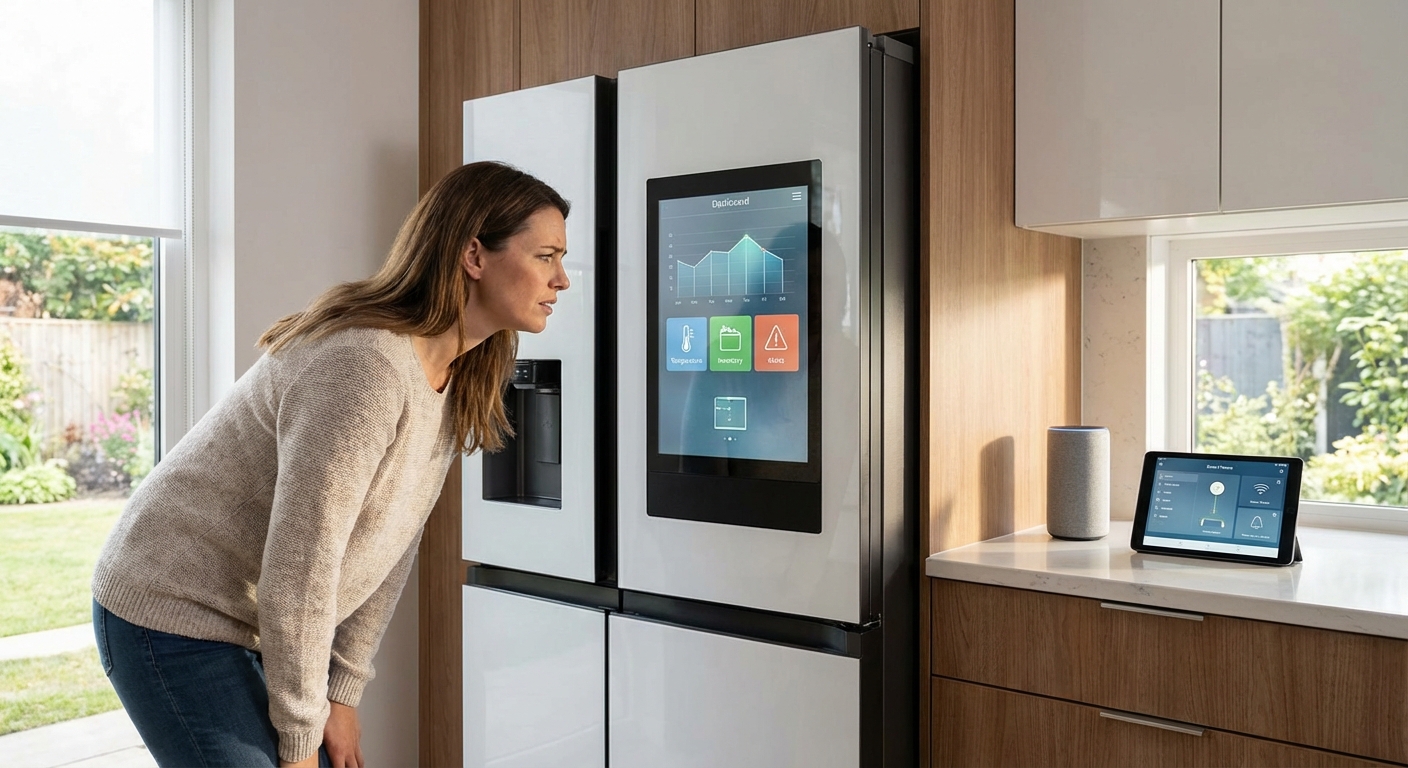
When a smart feature is built into a covered appliance like a Wi-Fi-enabled refrigerator, a smart oven with a touchscreen, or a connected washing machine, the appliance itself is typically covered under a standard appliance plan. However, coverage only extends to the mechanical and electrical components that enable the appliance's core function.
Smart Refrigerator Example:
The bottom line: your smart refrigerator's cooling system is covered. Its "smart" layer is not. A notable 2026 trend is that some providers are beginning to explicitly list smart and energy-efficient appliances as covered items, but only for mechanical or electrical wear-and-tear failures, not connectivity or app problems.
Standalone Smart Devices
These are devices that exist solely as smart technology. They have no traditional mechanical counterpart that a home warranty was designed to protect. Examples include:
- Smart video doorbells (Ring, Nest Doorbell)
- Smart locks and keypads
- Smart plugs and hubs
- Security cameras
- Voice assistants (Amazon Echo, Google Nest Hub)
These are almost universally excluded from standard home warranty coverage. They are not built-in appliances, they don't have the type of mechanical components home warranties are structured to cover, and they fall outside the wear-and-tear model entirely.
Device-by-Device Breakdown: Covered vs. Denied
Smart Thermostats (Nest, Ecobee)
A smart thermostat sits in a gray area. Traditional thermostats are often included as part of HVAC coverage, but in 2026 smart thermostats are frequently excluded from base plans even when the HVAC system itself is covered. Old Republic Home Protection, for example, will cover a Wi-Fi thermostat only if the failing part is a normally covered mechanical component (like a valve). Purely smart features such as Wi-Fi and app connectivity are not covered.
When it would be covered: If the smart thermostat is directly tied to a covered HVAC system and fails in a hardware or electrical way that affects heating and cooling, it may be replaced. Some premium plans or add-ons explicitly include smart thermostats.
When it would be denied: The thermostat loses Wi-Fi connectivity. The app stops communicating. A software update bricks the device. Most plans only guarantee replacement with a standard, non-smart thermostat, even if your existing unit is a $250 Nest or Ecobee. Upgrading back to a smart model can be at your own cost. See our full HVAC coverage guide for details on how thermostats fit into HVAC claims.
Smart Refrigerators
Smart refrigerators are one of the more favorable devices for home warranty holders. Because they are built-in appliances with robust mechanical systems, most major providers cover them up to plan limits. See our full refrigerator coverage guide for the fine print.
Coverage limits in 2026: American Home Shield's ShieldGold plan covers up to $2,000 per appliance, while ShieldPlatinum covers up to $4,000 per appliance, both under a $50,000 aggregate limit per contract term and a $5,000 per-system limit for HVAC. First American Home Warranty covers major mechanical components like the compressor, fans, and ice maker motors.
Denied scenarios: The internal display cracks. The Wi-Fi module stops connecting to your smart home app. Cosmetic shelving or lighting fails. The unit is a specialty appliance like a wine cooler or mini-fridge.
Smart Video Doorbells (Ring, Nest Doorbell)
This is one of the clearest denials in the home warranty world. Standard doorbells (buttons, chimes, wiring) are typically covered under most electrical coverage plans, but smart video doorbells are explicitly excluded by major providers, including American Home Shield, which treats them as consumer electronics rather than covered home systems.
Why? Smart video doorbells rely on cameras, cloud storage, and mobile apps, none of which fall under traditional home warranty coverage models. Even when your plan lists "doorbells" as covered, that language refers to the traditional wired doorbell button and chime, not a Ring or Nest smart device.
Electronics Add-Ons and Separate Smart Home Protection Plans
Home Warranty Electronics Add-Ons
Recognizing the coverage gap, some home warranty providers offer electronics protection add-ons. The most notable is American Home Shield's Whole Home Electronics Protection Plan (EPP), offered in partnership with Allstate Protection Plans.
What it covers in 2026:
- Televisions and home theater systems
- Laptops, desktops, tablets, and computer accessories
- Gaming consoles
- Home routers and select smart home products
- Wearables (like smartwatches)
- External hard drives, digital cameras, and printers
Coverage details: Up to $2,000 per claim and $5,000 total per contract term, with power surge protection included. The EPP covers an unlimited number of new and used electronics, but products without serial numbers, pre-existing conditions, and theft or loss are excluded. AHS base ShieldSilver, ShieldGold, and ShieldPlatinum plans run about $50 to $77 per month in 2026, and the EPP is layered on top as an optional add-on.
Liberty Home Guard also offers a broad menu of more than 40 optional add-ons, including an Electronics Protection add-on priced at about $19.99 per month (roughly $200 per year). Liberty's electronics add-on is a fixed bundle covering two televisions, one PC or laptop, one printer, one home theater system, and one smart home system. Per-item caps typically follow Liberty's standard $2,000 ceiling, though some optional-item categories are limited to $500 after the first 90 days, so read your sample contract carefully.
Standalone Smart Home Protection Plans
Asurion Home+ remains the most popular standalone smart home and electronics protection plan in 2026, priced at $34.99/month plus tax. It covers an unlimited number of eligible devices, including smart speakers, smart thermostats, smart locks, smart video doorbells, smart cameras, smart smoke and CO detectors, TVs, laptops, tablets, wearables, and game consoles. Coverage extends to mechanical and electrical breakdowns plus accidental damage from handling on portable devices. Note that Asurion Home+ does not cover mobile phones.
| Plan Type | Monthly Cost | Per-Claim Limit | Annual Limit | Best For |
|---|---|---|---|---|
| Home Warranty Base Plan | $50-$77 | Varies by item | $50,000 (AHS) | Appliances & home systems |
| AHS Electronics Add-On (EPP) | Add-on pricing | $2,000 | $5,000 | TVs, laptops, smart devices |
| Asurion Home+ | $34.99 | $2,000 | $5,000 (rolling 12 mo) | Smart devices, gadgets |
| Liberty Home Guard Electronics | ~$19.99 | ~$500-$2,000 | Varies | TVs, PC, printer, smart hub |
Service fees on Asurion Home+ in 2026: Service fees vary by device and claim type, ranging from $0 to $129 plus tax per approved claim. A commonly cited pattern is around $49 per approved claim for smart locks, smart cameras, smart thermostats, smart video doorbells, audio headsets, and fitness bands, and $99 per approved claim for PCs, printers, TVs, gaming systems, home theater systems, VR headsets, and smart watches. Tech support starts immediately upon enrollment, but protection coverage begins on Day 31.
Is a separate smart home protection plan worth it? For most homeowners, the answer is "it depends." If you have a heavily automated home with high-value smart devices (mesh Wi-Fi systems, premium outdoor cameras, smart hubs over $300), a dedicated plan may offer meaningful protection. For the average household, self-insuring or using alternatives like setting aside $20 to $30 per month in a repair fund often delivers better financial outcomes given the low failure rates of most smart devices in the first few years.
When comparing your options, it helps to understand the difference between a home warranty and an extended warranty, especially for high-value smart appliances where both might apply. Reviewing common appliance coverage exclusions is also a smart move before signing any contract.
Frequently Asked Questions
Does a home warranty cover smart home devices?
Standard home warranties do not cover standalone smart home devices such as video doorbells, smart speakers, security cameras, or smart locks. Coverage is focused on the mechanical and electrical components of major built-in appliances and home systems. Some providers like American Home Shield and Liberty Home Guard offer electronics protection add-ons that can extend coverage to certain smart devices, but these must be purchased separately and typically have their own claim limits.
Will my home warranty cover a smart thermostat like a Nest or Ecobee?
Most standard home warranty plans in 2026 exclude smart thermostats as "smart components," even when the HVAC system they control is covered. Coverage is more likely if the thermostat is bundled into an HVAC-related mechanical claim or if you have a premium plan or electronics add-on that explicitly includes the device. Even when covered, replacement is often limited to a basic non-smart thermostat, so lean on the manufacturer warranty (Nest offers 2 years standard with up to 5 years Pro Warranty; Ecobee now offers 3 years standard with up to 5 years Pro Warranty) as your primary protection.
What part of a smart refrigerator is covered by a home warranty?
The mechanical and electrical components of a smart refrigerator (compressor, fans, thermostat, ice maker motor, and core circuit boards) are typically covered under appliance plans. The smart features, including the touchscreen, Wi-Fi module, app connectivity, and firmware, are excluded. American Home Shield's ShieldGold plan covers up to $2,000 per appliance in 2026, while ShieldPlatinum covers up to $4,000 per appliance, all under a $50,000 aggregate contract limit.
Does a home warranty cover Ring or Nest doorbell cameras?
No. Smart video doorbells like Ring and Nest are classified as standalone smart consumer electronics and are explicitly excluded from standard home warranty coverage, even by providers that cover traditional doorbell wiring and chimes. For this type of device, look into your manufacturer's warranty (Nest Doorbell offers 1 year standard and up to 3 years with a Pro Warranty), a retailer protection plan, or an electronics add-on offered by your warranty provider or Asurion Home+.
What is the best way to protect smart home devices in 2026?
The most cost-effective approach is layered coverage: rely on your home warranty for covered appliances, use manufacturer warranties for new smart devices (and register them immediately), consider an electronics protection add-on from AHS or Liberty Home Guard for higher-value tech, and check whether your homeowners insurance offers smart device discounts. Many carriers now offer 5% to 20% off for monitored security systems, water leak detectors, and connected smart home devices. For a heavily automated home with thousands of dollars in connected gear, Asurion Home+ at $34.99 per month may be worth evaluating.