

Compare Home Warranty Options in Ohio
See what plans you qualify for in less than 2 minutes
Industry Claim Approval Rates: What the 2026 Numbers Say
Industry data on home warranty claim approval rates varies significantly depending on the source. A 2026 This Old House survey of 2,000 homeowners found that about 90% of policyholders said their most recent claim was approved, with nearly half seeing repairs resolved in a week or less. Complaint-based industry roundups tell a different story: one 2026 industry benchmarking report puts the average claims approval rate at 75% to 85%, with top performers hitting 88% to 93% and legacy operators falling to 65% to 75%. A separate consumer analysis found that 44% of policyholders have had a claim denied or only partially paid.
The most granular 2026 figures come from BBB filings and third-party audits. The weighted industry average across the top six providers sits at roughly 74%, with American Home Shield leading at 85% and Select Home Warranty trailing at 64%. State-regulator complaint data suggests denial rates typically fall in the 30% to 50% range on a claim-by-claim basis, so your individual experience depends heavily on your provider and your documentation.
Provider Approval Rates Compared (2026 BBB Data)
| Provider | 2026 Approval Rate | Annual Claim Volume | BBB Rating |
|---|---|---|---|
| American Home Shield | 85% | ~1.2M | B |
| Cinch Home Services | 80% | ~400,000 | B+ |
| First American Home Warranty | 76% | ~280,000 | A- |
| Choice Home Warranty | 72% | 15,000+ monthly | B- |
| Liberty Home Guard | 68% | 8,000+ monthly | A+ |
| Select Home Warranty | 64% | 6,500+ monthly | B |
American Home Shield leads the field at 85%, while Liberty Home Guard holds an A+ BBB rating despite a more modest 68% approval rate, showing that approval rate and customer satisfaction don't always align. For a full breakdown of top providers, see our guide to the best home warranty companies of 2026 or our deep dive on home warranty industry statistics.
American Home Shield publishes a $50,000 total limit per agreement term across all plans, with $5,000 per covered HVAC system, $2,000 per appliance on ShieldGold, $4,000 per appliance on ShieldPlatinum, and additional sub-limits like $1,500 for geothermal AC. Choice Home Warranty, by contrast, caps most covered items at $3,000 (with just $3,000 combined for heating and cooling), plus a $400 additional repair limit and a $150 refrigerant cap. Learn more in our American Home Shield review for the full plan breakdown.
Why Home Warranty Claims Get Denied
Understanding why claims are denied is the most powerful step you can take toward protecting yourself. Denials are rarely random. They follow predictable patterns, and 2026 consumer complaint data shows the same handful of triggers appearing across every major provider.
The Most Common Denial Reasons
The most common reasons claims are denied include pre-existing conditions, lack of maintenance, improper installation, code violations, unauthorized repairs completed before approval, coverage limits being exceeded, damage caused by accidents or external events, and items specifically listed under exclusions.
| Denial Reason | Share of Denied Claims |
|---|---|
| Pre-existing condition | ~29-32% |
| Coverage exclusion (item or part not covered) | ~29% |
| Repair cost exceeds coverage limit | ~20% |
| Lack of proper maintenance | ~13-24% |
| Improper installation / code violation | ~9-18% |
1. Pre-Existing Conditions If a system or appliance was already malfunctioning before your policy started, most providers will not cover it. This is especially common with older homes, where technicians often find corroded fittings, scorched contactors, or calcified heat exchangers on the first visit. Learn more about how pre-existing conditions affect coverage before you file.
2. Lack of Maintenance Providers can deny claims if a failure resulted from neglected upkeep, such as a dirty HVAC filter causing a compressor failure, or a water heater that was never flushed. If a system hasn't been serviced for years and eventually fails, the technician may note signs of neglect during inspection, and the provider may request maintenance records before proceeding. A 2026 industry report noted that failing to produce a receipt for a professional tune-up within the last 12 months is increasingly being used to deny high-dollar claims.
3. Contract Exclusions Even "comprehensive" plans have exclusions. Cosmetic damage, secondary damage (such as water damage from a leaking dishwasher), code upgrades, and structural components are frequently excluded. Reading the fine print before you buy is the single best way to avoid a surprise denial. See our full breakdown of home warranty exclusions for a category-by-category look.
4. Unauthorized Repairs Using a contractor outside the provider's approved network, or attempting a DIY fix before filing, can void coverage entirely for that item.
How to Maximize Your Claim Approval Chances
Approval rates aren't just about luck. They're largely driven by how prepared you are before a problem occurs.
Documentation Is Your Best Defense
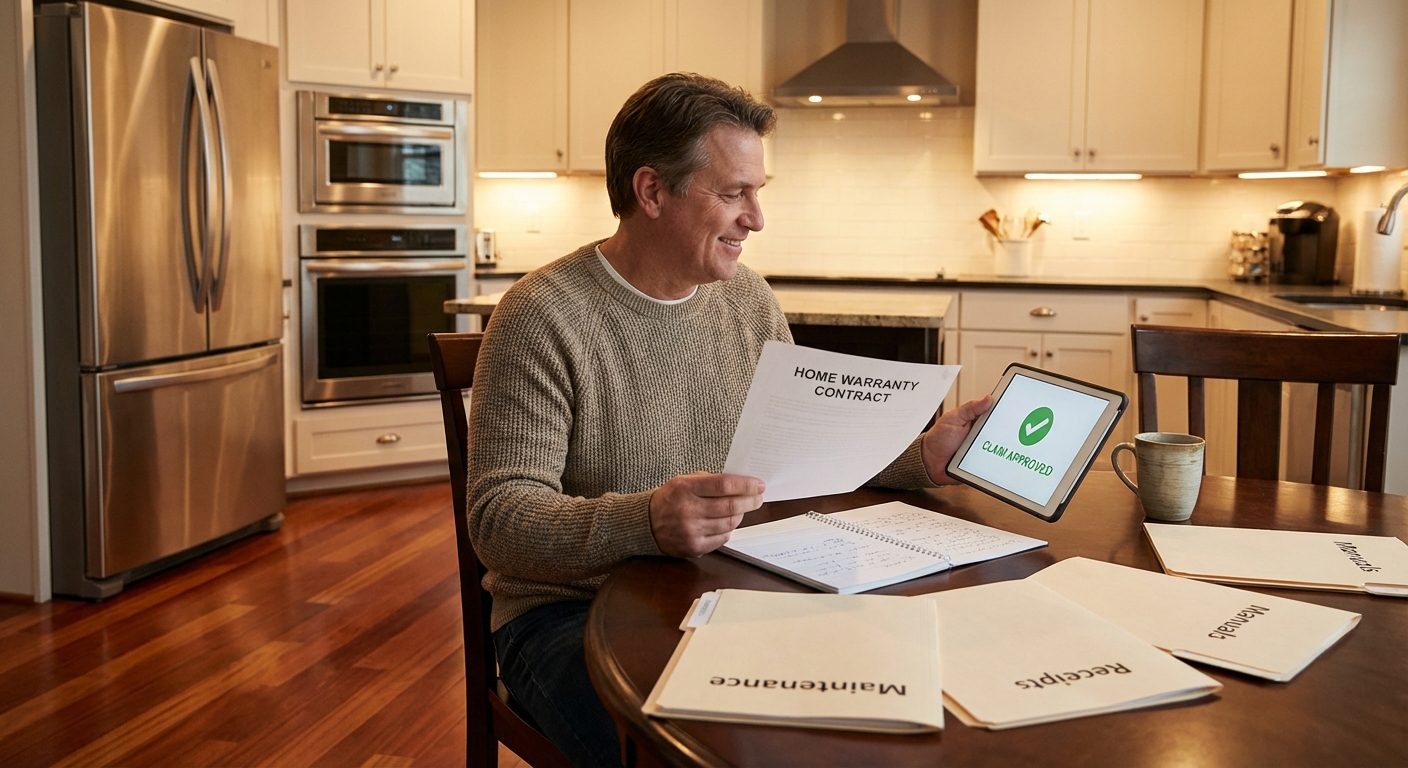
Keeping organized records is the single most impactful thing you can do to support a successful claim. Here's what to maintain:
- Service and maintenance logs: date, description, and technician name for every visit
- Receipts and invoices: for professional repairs, filter replacements, HVAC tune-ups
- Installation documentation: permits, contractor licenses, and model/serial numbers
- Photos and videos: document the condition of major systems at policy start
- Manufacturer manuals: proof of recommended maintenance schedules
Smart Filing Strategies
- File immediately when a problem occurs. Delayed filings get scrutinized harder because adjusters assume you tried home repairs first that may have worsened the damage.
- Never attempt unauthorized repairs before submitting a claim. Even a minor fix can disqualify coverage.
- Be specific in the claim description. Specificity signals you know your system, which signals lower fraud risk to the adjuster.
- Use the provider's approved contractor network unless specifically authorized to use your own.
Understanding how to file a home warranty claim the right way from the start significantly reduces your risk of denial. For a deeper look at typical service timelines, see our guide to home warranty response times.
Know Your Coverage Limits in Advance
Many homeowners are surprised to find that coverage caps fall short of actual repair costs. For example, if your HVAC system requires a $13,000 replacement but your plan caps HVAC coverage at $3,000, you'll be responsible for the difference. Knowing these limits ahead of time helps you decide whether to buy extended coverage or supplement with savings. For homeowners filing multiple claims in one year, see our breakdown of annual claim limits and aggregate caps.
Disputing a Denied Claim: Your Step-by-Step Options
If your claim is denied, don't assume it's final. Based on BBB and state insurance commissioner data, 40 to 60% of formal appeals end up reversed or partially paid, yet fewer than 15% of denied claimants actually file appeals.
The Appeal Process
Step 1: Review your contract Identify the exact clause used to deny your claim. Request a PDF copy from your provider and search for relevant keywords. Our guide to reading a home warranty contract walks through every clause worth scrutinizing.
Step 2: Request the inspection report Ask for the denial in writing along with the specific contract provision cited, the inspection report, photos, and the name of the decision maker. Vague denials like "pre-existing condition" without a supporting clause are the easiest to overturn.
Step 3: Gather counter-evidence Compile maintenance records, photos, invoices, and any prior service history for the affected item. A well-documented history of proper upkeep can directly refute a "lack of maintenance" denial.
Step 4: Get a second opinion Hire an independent licensed contractor to provide their own written diagnosis. At $150 to $300, it's money well spent and a powerful piece of appeal evidence.
Step 5: File a formal appeal Most warranty companies require a formal written appeal within 30 days of the denial letter. Send it by both certified mail and email so you have proof it was received, and escalate to a supervisor or executive review if the first appeal fails. Allow up to 30 days for a response.
For a deeper walkthrough, see our guide on how to appeal a denied home warranty claim.
Escalation Options
If your appeal is denied, you still have options:
- File a BBB complaint: companies are motivated to resolve complaints to protect their ratings
- Contact your state Attorney General: 2026 has seen major enforcement actions, including the $11.8 million Arizona consent judgment against Choice Home Warranty entered January 23, 2026 (restitution claim deadline closed August 1, 2026)
- Small claims court: available for most warranty disputes. Learn the full process in our guide to suing a home warranty company
- Mediation or arbitration: many contracts require this before litigation
If you believe your provider has engaged in deceptive denial practices, review our list of home warranty companies to avoid to spot the red flags that signal a bad actor. For homeowners who paid for repairs out of pocket, our guide to home warranty reimbursement explains how to recover those costs, and our breakdown of repair vs replace decisions covers how providers choose between fixing and replacing your equipment.
Frequently Asked Questions
What is the average home warranty claim approval rate in 2026?
It depends on the source. A 2026 This Old House homeowner survey found that about 90% of policyholders said their claim was approved, while an industry benchmarking report puts the average closer to 75% to 85%. BBB-based compilations of the top six providers put the weighted average around 74%, with American Home Shield leading at 85% and Select Home Warranty at 64%. Most homeowners with good documentation see approval rates above 90% regardless of provider.
Which home warranty company approves the most claims?
According to 2026 BBB filings and third-party audits, American Home Shield leads with an 85% approval rate, followed by Cinch Home Services at 80% and First American Home Warranty at 76%. AHS also offers the highest coverage limits, including $5,000 per HVAC system and a $50,000 aggregate cap per agreement term across all plans. Liberty Home Guard has a lower 68% approval rate but earns the highest BBB consumer rating (A+) among major providers.
What are the most common reasons a home warranty claim is denied?
The top reasons are pre-existing conditions (roughly 29% to 32% of denials) and coverage exclusions where the item or part simply isn't covered (about 29%). Repair costs exceeding the plan's coverage cap account for around 20% of denials, and lack of proper maintenance documentation accounts for 13% to 24% depending on the survey. Unauthorized repairs, improper installation, and code violations make up most of the remaining cases.
Can I appeal a denied home warranty claim?
Yes, and 2026 data shows it's worth doing. Based on BBB and state insurance commissioner data, 40 to 60% of formal appeals end up reversed or partially paid when supported by proper documentation. Start by reviewing your contract and requesting the technician's inspection report in writing, then gather maintenance records and an independent contractor's written opinion before submitting a written appeal within 30 days that cites specific contract language.
How do I prevent my home warranty claim from being denied?
The best prevention strategy is proactive documentation. Get an HVAC tune-up within 30 days of coverage starting, keep service logs and receipts for all covered systems, and save installation permits. File claims the same day a failure occurs since delays invite scrutiny, always use the provider's approved contractor network, avoid DIY repairs before filing, and read your contract thoroughly to understand your exact coverage limits and exclusions before you ever need to use it.