

Compare Home Warranty Options in Ohio
See what plans you qualify for in less than 2 minutes
Maintenance Requirements by System and Appliance
Home warranty contracts don't just sit in your drawer and automatically pay for repairs. They come with maintenance obligations that you, the homeowner, are expected to fulfill. These requirements are written into your service contract and mirror manufacturer recommendations. In 2026, providers have become noticeably more aggressive about demanding proof of professional maintenance before approving high-dollar claims, and many mid-tier plans now explicitly tie wear-and-tear coverage to receipts showing you followed the manufacturer's service schedule.
Here's a breakdown of what's typically expected for each major system and appliance category:
| System / Appliance | Key Maintenance Tasks | Frequency |
|---|---|---|
| HVAC (Heating & Cooling) | Professional tune-up, coil cleaning, refrigerant check, filter replacement | Annually (many providers prefer spring + fall) plus filters every 1-3 months |
| Plumbing | Inspect for leaks, flush water heater, clean drains, prevent freezing | Every 6-12 months |
| Electrical | Panel inspection by licensed electrician, no DIY rewiring | Every 3-5 years (more often in older homes) |
| Refrigerator | Clean condenser coils, check door seals, defrost if needed | Every 6-12 months |
| Washer / Dryer | Clean lint trap and dryer vent duct, inspect hoses | Every 1-3 months |
| Dishwasher | Clean filter, inspect spray arms, check door seal | Monthly |
| Oven / Range | Clean per manufacturer guidelines, avoid excessive self-clean cycle use | As needed |
| Water Heater | Flush sediment, inspect anode rod, test pressure relief valve | Annually |
Most warranties assume these tasks are being performed as a baseline condition of coverage. If your contract mentions that coverage applies to breakdowns from "normal wear and tear," the fine print typically assumes that proper care was applied. Learn more about what a home warranty covers before assuming a repair will be approved, especially for HVAC where 2026 refrigerant policy updates and per-system caps of $1,000 to $5,000 shape what gets paid.
How Lack of Maintenance Can Void Your Coverage
When you file a claim, a warranty company technician is dispatched to your home. Their job isn't just to diagnose the problem. It's also to determine why it happened. If they identify evidence of neglect, your claim can be denied on the spot.
Critically, a denied claim is not the same as a voided warranty. A maintenance-related denial means your coverage stays intact for other claims, but the specific repair tied to the neglected item won't be paid out. Full policy voiding typically only occurs for things like non-payment of premiums or major contract violations.
In 2026, denial data from major industry surveys consistently identifies a "denial trinity" that dominates rejected claims: pre-existing conditions (roughly 29% of denials), items not covered under the plan (29%), and repair costs exceeding coverage limits (20%), followed by lack of maintenance at about 13% in the This Old House survey. Some provider-level analyses push that number as high as 24% or more, since it's one of the easiest reasons to justify when a technician spots dirty filters, scale buildup, or worn belts. Industry-wide, claim denial rates now range from roughly 18% (Liberty Home Guard) to 35% (Choice Home Warranty) depending on the provider. For a deeper look, see our guide on the most common claim denial reasons.
Most Common Maintenance-Based Claim Denials
Understanding how the claims process works before you need to file is one of the smartest moves a homeowner can make. Knowing exactly how to file a home warranty claim with proper documentation from day one dramatically improves your approval odds.
Documentation: What to Keep and How to Prove Maintenance
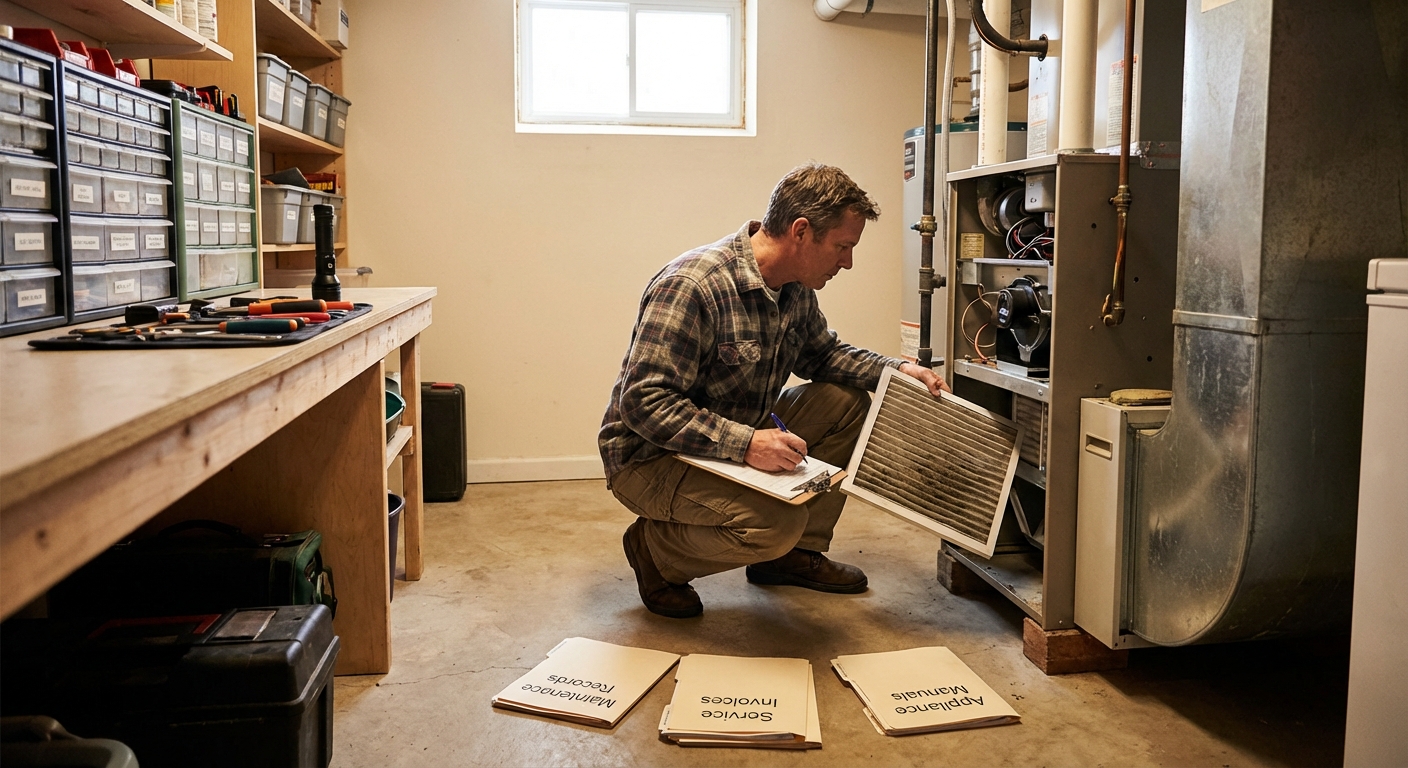
Your maintenance records are your proof of compliance. Without them, the burden of proof falls entirely on you, and that's a fight you'll likely lose. In 2026, digital claims portals routinely prompt you to upload service records at the time of filing, and consumer-law attorneys report that missing HVAC tune-up receipts within the past 12 months is now one of the most common triggers for a "neglect" denial. Start a dedicated folder (physical or digital) with the following:
Essential Records to Maintain
- Service invoices and receipts with date, technician name, license number, company, tasks performed, and property address
- Dated photographs (before/after shots of filter replacements, coil cleanings, duct work, etc.)
- Maintenance log (a simple spreadsheet or notebook tracking what was done, when, and by whom)
- Appliance manuals (keep originals or digital copies with model and serial numbers noted)
- Warranty contract (your full service agreement including all exclusions and maintenance clauses)
- Correspondence records (emails, letters, or call notes from your warranty company)
- Receipts for supplies like filters and water heater flush kits to corroborate DIY tasks
- Bank or credit card records showing payments to service companies (useful if original receipts are lost)
Routine Maintenance vs. Covered Repairs: Know the Difference
This distinction is one of the most misunderstood aspects of home warranties.
If your dryer vent was never cleaned and the heating element burns out, the warranty company can classify that as a maintenance failure, not a covered repair. The boundary is determined by the technician's assessment and your contract language. Reviewing common home warranty exclusions helps clarify which failures fall outside coverage before you file.
Are Inspections Required to Keep Coverage Valid?
Formal home inspections are not typically required on an ongoing basis to keep your home warranty active. However, there are three important exceptions:
- At enrollment. Some providers require or encourage an inspection when you first purchase coverage to identify pre-existing conditions that won't be covered. See our full guide on home warranty inspection requirements for provider-by-provider details.
- During a claim. The warranty company sends its own technician to assess the situation. This is functionally an inspection, and their findings determine whether the claim is approved.
- State and regulatory changes. Florida's HB 623 (effective July 1, 2025) now requires builders of newly constructed single-family homes, duplexes, triplexes, and quadruplexes to provide a transferable one-year warranty covering material Florida Building Code violations. These state-by-state shifts can affect inspection standards, transferability rules, and claim handling timelines.
Most providers also impose a 30-day waiting period after enrollment before coverage becomes active. During this time, any breakdowns are typically not covered, so staying on top of maintenance from day one matters even more. Learn how pre-existing conditions are used to deny claims during and after that waiting period.
Tips for Staying Compliant With Your Home Warranty Terms
Keeping your coverage valid isn't complicated, but it does require consistency. With home warranty premiums averaging roughly $60 to $73 per month in 2026 (about $720 to $876 per year) plus $75 to $125 per service call (averaging about $108), protecting your ability to actually use that coverage matters. Follow these best practices to make sure you never give your warranty company a reason to deny a legitimate claim.
Read your contract in full. Every provider has different language. What qualifies as adequate maintenance for one may not be enough for another. Pay close attention to the exclusions section and any clause referring to "manufacturer's specifications."
Use licensed professionals for annual servicing. DIY maintenance rarely satisfies home warranty compliance requirements for complex mechanical systems, especially HVAC and boilers. Always get an itemized receipt from a licensed technician that includes their license number and detailed task list.
Set calendar reminders. Replace air filters, schedule tune-ups, and flush your water heater on a regular schedule. Treat it like paying a bill.
Never authorize repairs without contacting your warranty company first. Hiring your own contractor without prior authorization is one of the fastest ways to void a covered repair. Always call your provider and use one of their approved vendors. See our guide on home warranty reimbursement for the narrow exceptions.
Store records digitally and physically. A cloud folder with photos, invoices, and your warranty contract means you'll never scramble during a claim. Many 2026 providers now allow uploads directly to their claims portal at the time of filing.
Keep track of appliance ages. Coverage limits often reduce for appliances over 10 years old. If you own an older property, our guide on home warranties for older homes explains how age affects eligibility and payouts.
Demand written denial explanations. If a claim is denied, ask for the specific contract paragraph and page the denial cites. This creates a record you can use to appeal.
Before renewing, it's worth revisiting how to read a home warranty contract so you know exactly what maintenance language you're agreeing to, and reviewing appliance coverage details to understand which items are subject to the strictest maintenance rules.
Frequently Asked Questions
What maintenance is required for a home warranty?
Most home warranty contracts in 2026 require homeowners to perform routine upkeep on all covered systems and appliances in line with manufacturer recommendations. This typically includes annual professional HVAC servicing (with some providers preferring spring and fall tune-ups), regular filter replacements every 1 to 3 months, annual water heater flushing, appliance cleaning per manufacturer guidelines, and periodic inspection of plumbing and electrical systems. The exact requirements vary by provider, so always review your specific contract for language referencing "proper maintenance" or "manufacturer's specifications."
Can a home warranty company deny a claim for lack of maintenance?
Yes. Lack of maintenance accounts for roughly 13% of denials in the 2026 This Old House survey, and provider-level data pushes that number as high as 24%. When a technician is dispatched, they assess not just what failed but why. If they determine the failure was caused by neglect or improper upkeep, the warranty company has grounds to deny the claim under the contract's maintenance exclusion. The denial is typically specific to that item and doesn't void your entire policy, but you will pay out of pocket for that repair.
What documentation should I keep for my home warranty?
Keep dated invoices from all professional service visits (including the technician's license number), a maintenance log showing what was done and when, appliance manuals with model and serial numbers, dated photographs of maintenance work, your full warranty contract, and all written correspondence with your provider. Store records both digitally and physically, and upload them to your provider's claims portal if available. Because 2026 providers increasingly request maintenance history going back 1 to 3 years for HVAC and other major systems, retain records indefinitely.
What is the difference between routine maintenance and a covered repair under a home warranty?
Routine maintenance is preventive care that is entirely the homeowner's responsibility, such as changing filters, cleaning coils, and scheduling professional tune-ups. A covered repair, by contrast, is an unexpected breakdown of a covered component due to normal wear and tear, which the warranty company pays for after your service fee (averaging about $108 per visit in 2026). The critical distinction is causation: if a breakdown is traced back to a maintenance failure, the warranty company can reclassify what would otherwise be a covered repair as a denied claim.
Do I need a home inspection to keep my home warranty valid?
Ongoing formal home inspections are generally not required to maintain your home warranty coverage. However, some providers conduct or encourage an inspection at enrollment to document pre-existing conditions, and the technician dispatched during a claim functions as an informal inspection. Most plans also have a 30-day waiting period after enrollment before coverage activates. The most important "inspection" requirement in practice is simply demonstrating that you've consistently maintained covered systems through professional service records.