
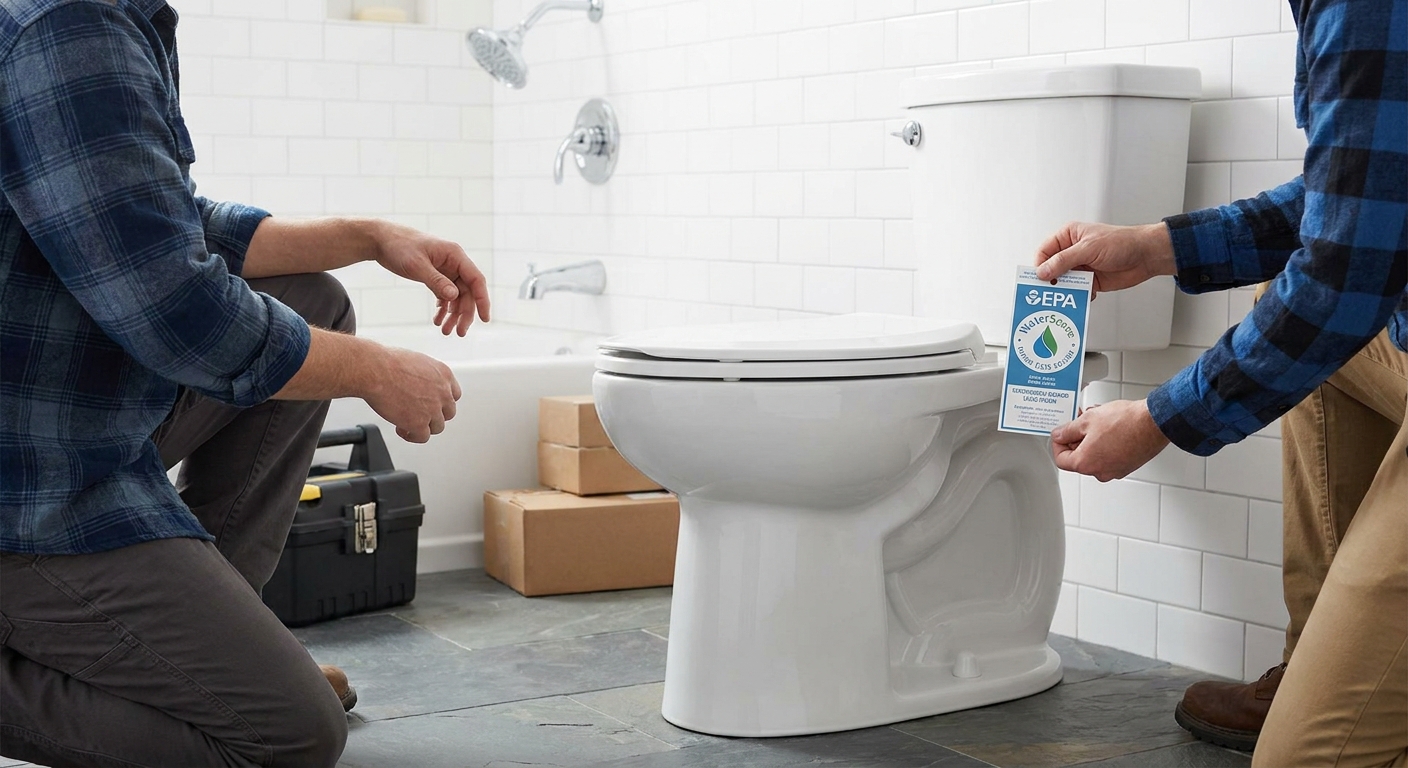
What Does WaterSense Certification Actually Mean?
The EPA's WaterSense program is a voluntary labeling initiative that identifies plumbing fixtures independently certified to be at least 20% more water-efficient than the federal baseline — without sacrificing performance. Think of it as the Energy Star equivalent for water-using products.
To earn the label, a fixture must:
- Meet the EPA's WaterSense specification for its product category
- Be tested and certified by an accredited, independent, third-party lab
- Pass performance requirements (not just efficiency tests)
- Be subject to annual audits on roughly 15% of certified products
This matters because WaterSense isn't just about lower flow — it guarantees the product actually works well. A toilet still has to flush effectively. A showerhead still has to deliver solid spray coverage. The certification ensures both boxes are checked.
2026 Flow Standards by Fixture
| Fixture | Federal Standard | WaterSense Max | Savings vs. Federal |
|---|---|---|---|
| Toilet | 1.6 gpf | 1.28 gpf | ~20% |
| Showerhead | 2.5 gpm | 2.0 gpm | ~20% |
| Bathroom Faucet | 2.2 gpm | 1.5 gpm | ~32% |
| Urinal | 1.0 gpf | 0.5 gpf | ~50% |
Note: As of July 1, 2025, dual-flush WaterSense toilets must have a full flush of ≤ 1.28 gpf — not just a weighted average. Any new WaterSense toilet you buy in 2026 already meets this updated standard.

Find Trusted & Licensed Plumbers in Ohio
Get matched with companies for your specific needs
How Much Can You Actually Save?
Let's get into the numbers most homeowners actually care about: water saved and dollars kept in your pocket.
Toilet Savings
The toilet is the single biggest water user inside a home, accounting for nearly 30% of indoor water use. Replacing an old 3.5 gpf toilet with a WaterSense 1.28 gpf model can save roughly 13,000 gallons per year for a family of four, according to EPA estimates. Even upgrading from a newer 1.6 gpf toilet saves around 2,000–3,000 gallons per toilet annually.
EPA estimated annual savings from WaterSense toilets:
- ~$170/year on water costs per household
- ~$3,400 over the life of the fixtures
Showerhead Savings
Switching from a 2.5 gpm showerhead to a WaterSense 2.0 gpm model saves 5 gallons per 10-minute shower. For a household averaging two showers daily, that's roughly 3,650 gallons/year. Factor in hot water heating costs and you're looking at an additional $15–$50+ per year in energy savings.
Faucet Savings
WaterSense bathroom faucets max out at 1.5 gpm vs. the standard 2.2 gpm — a 32% reduction. For a home using faucets about 10 minutes a day, that's roughly 2,500+ gallons/year saved. The savings per fixture are modest, but at near-zero cost (a WaterSense aerator can be less than $5), the return is immediate.
Combined Household Impact
For a deeper dive into how these upgrades fit into a full home water strategy, see our guide to water conservation plumbing upgrades.
Best WaterSense Certified Products in 2026
Top WaterSense Toilets
| Product | Type | Flush Volume | Best For |
|---|---|---|---|
| TOTO Drake 1.28 gpf | Single-flush | 1.28 gpf | Reliability & long-term value |
| TOTO Aquia IV | Dual-flush | 0.8 / 1.28 gpf | Maximum water savings |
| Niagara Stealth Phantom | Dual-flush | 0.8 / 1.28 gpf | Quiet operation |
| Swiss Madison Sublime II | Dual-flush | 0.8 / 1.28 gpf | Budget buyers, 1000g MaP score |
| Kohler Highline 1.28 gpf | Single-flush | 1.28 gpf | Mainstream availability |
What is a MaP score? Maximum Performance (MaP) testing measures how effectively a toilet flushes solid waste. A score of 500g+ is considered "good"; 800g+ is "excellent." Modern WaterSense toilets routinely score 800–1000g — meaning they often outperform older 1.6 gpf models that relied on sheer water volume.
Top WaterSense Faucets & Showerheads
Faucets — Delta, Moen, Kohler, and American Standard all offer WaterSense-labeled bathroom faucets in the 1.2–1.5 gpm range. In real-world use, most people cannot feel a difference between a 1.2 gpm aerated faucet and a 2.2 gpm model during handwashing or brushing teeth. The easiest upgrade? A WaterSense aerator — a $5–$15 swap that takes five minutes and immediately drops your faucet flow by 30–45%.
Showerheads — Delta's H2Okinetic technology, Moen's multi-spray WaterSense heads, and Kohler's 2.0 gpm systems are all rated for strong spray coverage despite lower flow. Well-designed 1.75–2.0 gpm WaterSense showerheads are virtually indistinguishable from a 2.5 gpm head in homes with typical water pressure.
For a broader look at how modern water-saving products stack up alongside smart and touchless options, check out our plumbing fixture upgrade guide.
WaterSense Rebates, Payback Periods & Is It Worth It?
How to Find WaterSense Rebates in 2026
Most rebates come from local water utilities and city programs, not the federal government. Here's how to find them:
- EPA WaterSense Rebate Finder — Visit epa.gov/watersense and use the "Find Rebates" tool with your ZIP code and product type
- Your water utility's website — Search "[your city] water rebate WaterSense toilet"
- Plumbing Manufacturers International — safeplumbing.org has a rebate finder linking to regional programs
Typical 2026 Rebates by Fixture
| Fixture | Typical Rebate Range | Example Program |
|---|---|---|
| WaterSense Toilet | $50–$150 per unit | Melbourne, FL: $50; Derby, KS: up to $100 |
| WaterSense Showerhead | $10–$30 per unit | Many CA, AZ, FL utilities |
| Smart Irrigation Controller | $50–$250 per unit | Denver Water, SoCalWaterSmart |
| Bathroom Faucet Aerator | Often free or $5–$15 | Utility giveaway programs |
States where WaterSense is required by code (meaning rebate programs are especially active):
- Georgia — Water Stewardship Act mandates WaterSense fixtures for all installations
- New York City — NYC Green Code requires WaterSense toilets and faucets
- California & Texas — Both have strict flow standards, with many utilities offering extra rebates for exceeding code
Payback Period Analysis
| Fixture | Typical Cost Premium | Annual Savings | Payback (No Rebate) | Payback (With Rebate) |
|---|---|---|---|---|
| WaterSense Toilet | $30–$80 more | $30–$90/year | 1–3 years | Under 1 year |
| WaterSense Showerhead | $10–$40 more | $20–$70/year | Under 1 year | Months |
| WaterSense Faucet Aerator | $5–$15 | $10–$30/year | Months | Immediate |
Real-world example: A family of four in a Florida city with standard water rates replaces two old 3.5 gpf toilets, two 2.5 gpm showerheads, and three bathroom faucet aerators:
- Total fixture cost: ~$900 (two mid-range WaterSense toilets + showerheads + aerators)
- Available utility rebates: $100 (2 × $50 toilet rebates)
- Net out-of-pocket: ~$800
- Annual savings: ~$240 (water + some energy)
- Payback period: ~3.3 years → then saving $240/year for the next 15+ years
Over 20 years, that's roughly $4,800 in total savings on a ~$800 investment. That's a 500%+ return.
Are WaterSense Fixtures Worth It?
If your water or energy rates are above average — common in California, Hawaii, the Northeast, and parts of Florida — payback periods shrink to under two years, sometimes under one. If you're also considering sensor-based or touchless plumbing fixtures, many of those also carry WaterSense certification and stack additional savings.
Installation: What You Need to Know
Most WaterSense fixtures install identically to standard versions — no special tools or licensed plumber required for basic swaps:
- Showerheads: Very DIY-friendly. Simple ½" threaded connection. Takes 10 minutes.
- Faucet aerators: Extremely easy. Screw off the old, screw on the new.
- Full faucets: Good DIY project if shutoff valves work and connections aren't corroded.
- Toilets: Intermediate DIY. Confirm your rough-in distance (standard is 12"), use a new wax ring, and check the floor flange before you start.
Hire a plumber if: Your shutoff valves are corroded, the toilet flange is damaged, or you have older galvanized pipes with existing drainage issues.
Frequently Asked Questions
What is the difference between WaterSense certified and standard plumbing fixtures?
WaterSense certified fixtures must be at least 20% more water-efficient than the federal minimum standard and pass independent third-party performance testing. Standard fixtures only need to meet minimum federal flow requirements — there's no performance test, and they can use significantly more water. WaterSense products display the EPA's blue label and are listed in a searchable federal database, making them easy to verify before purchase.
Are WaterSense toilets as powerful as regular toilets?
Yes — modern WaterSense toilets routinely match or outperform standard 1.6 gpf models thanks to improvements in bowl geometry, trapway design, and flushing technology. The early reputation for clogging from 1990s low-flow toilets no longer applies to WaterSense-certified products. Look for models with a MaP score of 800g or higher (like the TOTO Drake or Swiss Madison Sublime II) for excellent waste-clearing performance at 1.28 gpf.
How do I find WaterSense rebates in my state?
Start with the EPA's WaterSense Rebate Finder at epa.gov/watersense, enter your ZIP code and fixture type, and review the list of local utility and city programs. You should also search your water utility's website directly for "water efficiency rebate" or "WaterSense toilet rebate." Rebates vary widely — from $10 for a showerhead to $150 for a toilet — and some utilities offer free aerators. Always confirm eligibility and deadlines before purchasing.
How long does it take for WaterSense fixtures to pay for themselves?
The payback period depends on which fixtures you upgrade, your local water and energy rates, and whether you qualify for rebates. Showerheads and faucet aerators typically pay back within months. WaterSense toilets generally pay back within 1–3 years without rebates, and often under one year when rebates are applied. In high water-rate areas like California and Hawaii, payback on all fixture types can be under a year.
Can I install WaterSense fixtures myself?
Showerheads and faucet aerators are among the easiest home improvement projects possible — both are simple threaded connections requiring only basic tools. Full faucet replacements are good intermediate DIY projects. Toilet replacement is manageable for most homeowners, but you should check the floor flange condition, verify your rough-in distance, and make sure your shutoff valve works before starting. Call a licensed plumber if valves are corroded, the flange is damaged, or you suspect drainage issues.