
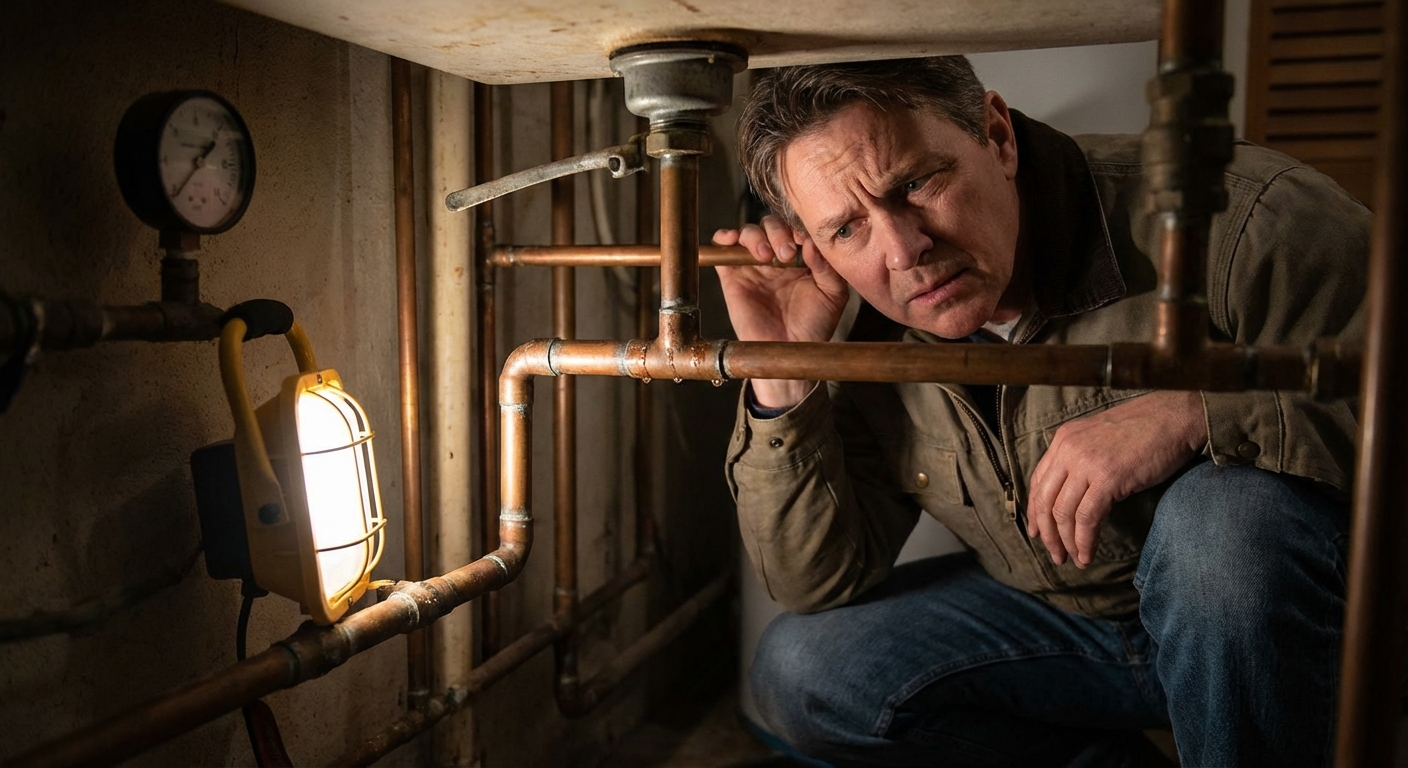
What Is Water Hammer?
Water hammer, also called hydraulic shock, is a sudden, high-pressure shockwave that travels through your pipes when fast-moving water is abruptly stopped or forced to change direction. The result is a loud banging, thudding, or rattling noise that you've probably heard right after shutting off a faucet, flushing a toilet, or when your washing machine finishes filling.
The physics behind it are straightforward: water in motion carries momentum. When a valve snaps shut, that momentum has nowhere to go, so it creates a pressure surge that slams back through the pipe like a shockwave. Sudden valve closures can add a spike of 10 to 15 PSI (or more) on top of your static line pressure, enough to crack pipes, loosen joints, and destroy fixtures over time.
What Causes Water Hammer in Pipes?
Several different culprits can trigger water hammer. Understanding which one applies to your home is the first step toward fixing it.
| Cause | What's Happening | Common Location |
|---|---|---|
| Fast-closing valves | Solenoid valves shut instantly, cutting off flow with zero slowdown | Washing machines, dishwashers, toilets |
| High water pressure | Pressure above 70-80 PSI amplifies every shockwave throughout the system | Whole house |
| Worn washers/seals | Degraded seals allow valve components to rattle violently under shock | Faucets, stopcocks |
| Loose pipes | Unsecured pipes bang against walls, joists, or framing when a wave hits | Behind walls, under floors |
| Waterlogged air chambers | Air cushion absorbers lose their air over time and stop working | Near appliances |
High water pressure is one of the biggest hidden contributors. The EPA's WaterSense program recommends incoming service pressure between 45 and 60 PSI for the best balance of flow and equipment protection, and both the International Plumbing Code and International Residential Code require a pressure-reducing valve when static pressure exceeds 80 PSI. When pressure creeps into that 80 to 100 PSI zone, even a routine valve closure can send a violent shockwave through your entire system. Learn more about diagnosing pressure problems if you suspect this is the culprit.

Find Trusted & Licensed Plumbers in Ohio
Get matched with companies for your specific needs
How to Diagnose Water Hammer in Your Home
Locating the source of water hammer is simpler than most homeowners expect. If you're already dealing with other mysterious plumbing sounds, our guide on common plumbing noises is a great companion resource.
Step-by-Step Diagnosis
Note exactly when it happens. Does the bang occur right after you flush the toilet, when the washing machine stops filling, or when you quickly turn off the kitchen faucet? The trigger almost always points directly to the source.
Listen and trace the sound. Walk through your home and listen near appliances, under sinks, and in the basement or crawl space. The sound travels through pipes but is loudest closest to its origin.
Check water pressure. Attach a pressure gauge to a hose bib and read your PSI. Anything over 70 PSI is a red flag, and anything over 80 PSI requires immediate action per current plumbing code.
Look for loose pipes. In exposed areas like basements or utility rooms, gently shake accessible pipes while someone runs water. If they move freely, they're not properly secured and will amplify hammer shocks.
Rule out other causes. Random knocking without any connection to water shutoff may indicate a different issue like pipe expansion or water heater vibration, not water hammer.
DIY Fixes vs. Professional Solutions
Once you've identified the cause, you have a range of options, from simple weekend DIY fixes to professional installations.
DIY Solutions You Can Do This Weekend
Securing Loose Pipes: Purchase pipe straps or clips (under $10) and fasten exposed pipes to joists or framing every 12 inches. Use copper clips for copper pipes and plastic clips for PEX or PVC. Do not use galvanized steel on copper, as the metal-on-metal contact can cause corrosion.
Replacing Worn Washers: For faucet-related hammer, turn off the water supply, disassemble the handle, and swap out the worn rubber washer. Upgrading to ceramic disc spindles eliminates the abrupt shutoff that standard washers create.
Draining Air Chambers: If you have older air-chamber style arrestors, they can become waterlogged. Turn off the main water supply, open all faucets from highest to lowest floor, let the system drain for 20 to 30 minutes, then close faucets and restore pressure to reintroduce the air cushion.
Adjusting Your Pressure Regulator: Your pressure-reducing valve (PRV) is usually found near the main shutoff, shaped like a bell. Turn the adjustment screw counter-clockwise in small quarter-turns to reduce pressure. Target 50 to 60 PSI for the ideal balance of flow and protection.
Professional Solutions Worth the Investment
For chronic or whole-house water hammer, professional-grade solutions deliver lasting results. Skipping the repair now often means paying much more later. Burst pipe repairs typically run $400 to $2,000 for the plumbing work alone, and full water damage restoration averages $3,867 in 2026, with typical ranges from $1,384 to $6,387.
Water Hammer Arrestors
A water hammer arrestor is a sealed device with an internal spring and pressurized air bladder that absorbs shockwaves the moment a valve closes. Unlike air chambers, they never need recharging and are designed to last the life of your plumbing. Modern arrestors should conform to the ASSE 1010 standard, which is the specification referenced by the 2021 IRC (Section P2903.5), the IPC (Section 604.9), and most state plumbing codes. They should be installed as close as possible to the fast-closing valve, typically at the washing machine hose connections, under sinks, or at the dishwasher supply line.
- DIY arrestor unit cost (2026): $15 to $50 each, with small screw-on units for washing machines starting around $10 to $30
- Professional installation (labor + parts): $75 to $150 per arrestor for straightforward, accessible installs
Pressure Reducing Valves (PRV)
If your incoming municipal water pressure is consistently above 80 PSI, a PRV installed on your main supply line is the single most effective whole-house fix.
- PRV unit cost (2026): $75 to $200 at big-box retailers for a standard residential direct-acting valve
- Professional installation (labor + parts): $300 to $650 in most markets, with $400 to $600 being the most common total. Difficult access (buried outdoor meter box) can push totals to $1,000 or more.
Preventing Water Hammer in New Plumbing Installations
If you're building a new home or completing a major renovation, it's far cheaper to design water hammer prevention in from the start than to fix it later. Under the 2021 International Residential Code (Section P2903.5) and IPC Section 604.9, water hammer arrestors are required wherever quick-closing valves are used, so proper planning also keeps you on the right side of the inspector. Several states (including Florida) are reviewing expanded 2025 code proposals that would mandate ASSE 1010 arrestors in all new construction and major renovations involving quick-closing valves.
Best Practices for New Construction
1. Specify PEX Piping
PEX (cross-linked polyethylene) piping is flexible and naturally absorbs some pressure surges by expanding slightly under shock. It significantly reduces water hammer transmission compared to rigid copper or galvanized steel. Make sure your plumber creates sections where PEX can move freely to flex during surges.
2. Install ASSE 1010 Arrestors at Every Quick-Closing Valve
Include water hammer arrestors in the design blueprint for every appliance connection: washing machine, dishwasher, refrigerator ice maker, and all toilet supply lines. For branch lines longer than 20 feet, current placement guidance recommends installing two arrestors, one at the end of the line and another at the midway point. Manual shower valves and standard faucets typically do not require arrestors under code.
3. Set the PRV to 50-60 PSI From Day One
Have a pressure-reducing valve installed on the main supply line during construction and pre-set it to 50 to 60 PSI, in line with EPA WaterSense guidance. This prevents high municipal pressure from ever becoming a problem. A little annual plumbing maintenance each year will keep it accurate.
4. Secure All Pipes Per Code
Ensure every pipe run is supported with appropriate straps and hangers at code-required intervals. Properly secured pipes have nowhere to bang even if a minor shockwave occurs. This is one of the most common plumbing mistakes homeowners make during DIY renovations.
5. Add Air-Relief Valves at High Points
Place air-relief valves at high points throughout the system, especially around pumps and at elevation changes, so trapped air can escape rather than being compressed into a hammer trigger. Combined with regular preventive maintenance, this keeps the whole system running quietly for decades.
Frequently Asked Questions
Is water hammer dangerous?
Yes, if left untreated, water hammer is genuinely damaging to your plumbing. Repeated pressure surges can crack pipe walls, loosen fittings and joints, wear out valves and appliance components, and cause leaks inside walls that lead to mold and structural damage. Homes with older galvanized or copper pipes are especially vulnerable, and knowing what to do in a plumbing emergency can save thousands if a joint eventually fails.
Why do my pipes bang only when I flush the toilet?
Toilet fill valves use a float mechanism that shuts off water flow quickly once the tank is full, and that rapid shutoff creates a shockwave. This is one of the most common triggers of water hammer noise. Installing an ASSE 1010 water hammer arrestor on the toilet supply line, or replacing the fill valve with a slow-close model, will typically eliminate the noise.
Do I really need a water hammer arrestor, or can I fix this myself?
It depends on the cause. If the problem is loose pipes or a worn washer, DIY fixes are often enough. However, if the hammer is triggered by appliances with fast-closing solenoid valves (washing machines, dishwashers, ice makers), a water hammer arrestor is the most reliable and permanent fix, and current 2021 IRC and IPC codes require one on those lines. Installing one yourself costs as little as $15 to $50 with basic plumbing skills.
Why is water hammer worse in hot water pipes?
Hot water pipes expand and contract more than cold water lines due to temperature changes, which loosens pipe supports over time and creates more movement when a shockwave hits. Water heaters can also contribute to pressure fluctuations, especially if the thermal expansion tank has failed. This is why water hammer in hot water pipes is often louder and more noticeable than in cold water lines.
How much does it cost to fix water hammer professionally in 2026?
Professional repairs vary based on the solution needed. Installing a water hammer arrestor typically runs $75 to $150 per location including labor and parts. A pressure-reducing valve on the main supply line costs $300 to $650 installed in 2026, with $400 to $600 being the most common total. Most jobs take one to three hours for a licensed plumber, and getting multiple quotes is always a smart move to avoid overpaying.