
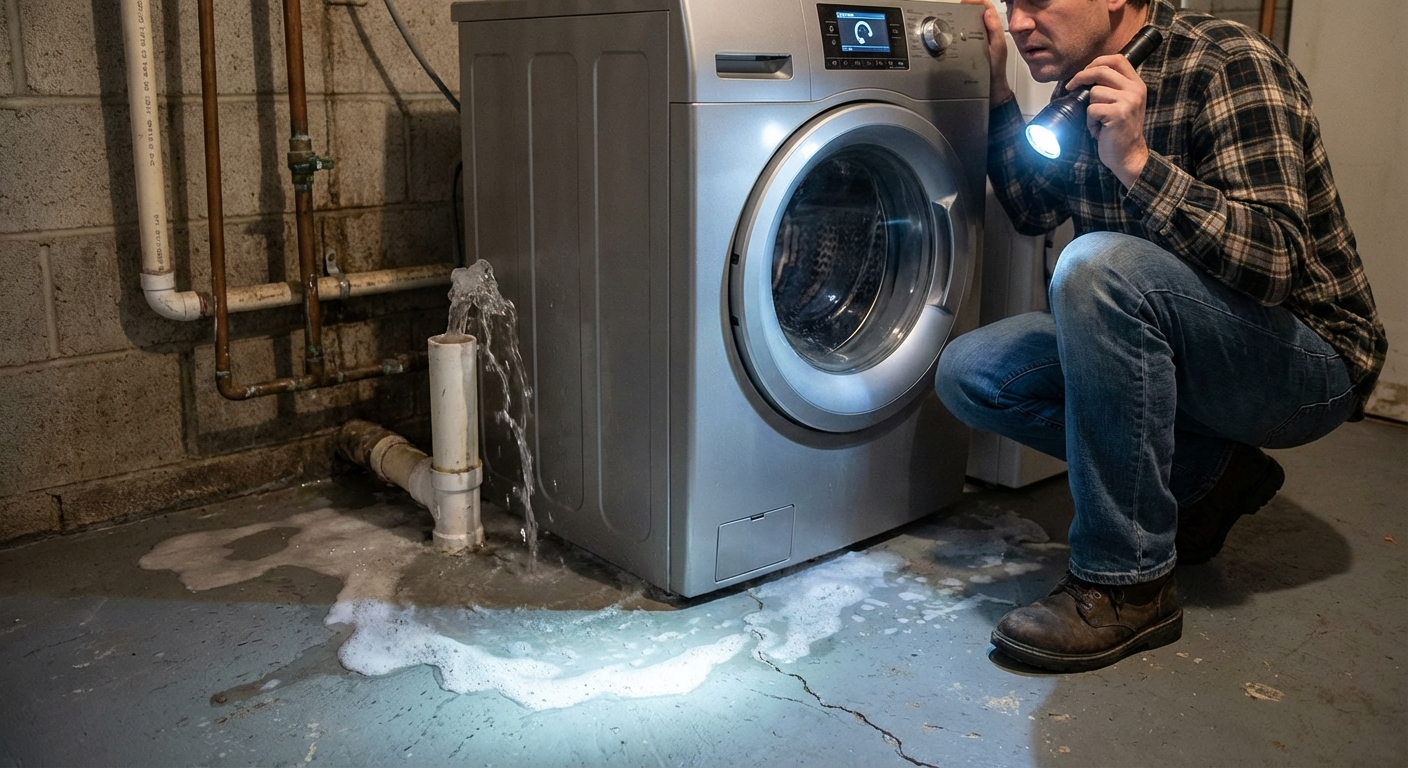
How Washing Machine Drainage Works
Before you can fix a washing machine drain overflow, it helps to understand what's happening behind the scenes. Your washing machine's drain pump forces water out through the drain hose during the rinse and spin cycles. That hose loops up high on the back of the machine (creating a siphon break), then drops down into a standpipe, which is a vertical 2-inch PVC or ABS pipe secured to the wall. The standpipe connects to a P-trap, which in turn connects to your home's main drain line. A separate vent pipe allows air into the system, enabling smooth gravity drainage without gurgling or siphoning.
Modern washers move water quickly. Top-load HE washers can pump water out at roughly 15 gallons per minute, while front-load washers typically discharge around 10 gallons per minute, and manufacturers note that flow drops by about 1 GPM for every additional foot of drain height. Larger, high-speed pump models can push 17 GPM or more, which is why current code requires that the 2-inch washer drain transition into a 3-inch line downstream. When any part of the drain chain is compromised, water backs up fast.
Key Drain Components at a Glance
| Component | Purpose | 2026 Spec to Know |
|---|---|---|
| Standpipe | Receives drain hose discharge | 2" diameter, 18" min height above trap |
| P-Trap | Blocks sewer gases from entering home | Roughed in 6" to 18" above floor |
| Vent Pipe | Allows air in for gravity-assisted drainage | Required by plumbing code |
| Drain Hose | Carries water from pump to standpipe | Inserted no more than 5" (top-load) or 7" (front-load) into standpipe |
| Downstream Drain | Carries suds-laden discharge to main line | Should transition from 2" to 3" per IPC guidance |

Find Trusted & Licensed Plumbers in Ohio
Get matched with companies for your specific needs
Common Causes of Washing Machine Drain Overflow
Understanding what's causing the problem is the fastest way to fix it. Most washing machine drain overflows trace back to one of the following culprits.
1. Clogged Standpipe or Drain Line
This is the #1 cause. During every wash cycle, lint, fabric fibers, soap scum, and debris travel through the drain hose. Over time, this material accumulates inside the standpipe, the P-trap, or further down the main drain line, gradually narrowing the pipe until water can no longer pass through fast enough.
Signs of a clog:
- Water rises in the standpipe and spills over the top
- Slow drainage from nearby sinks or floor drains
- Gurgling sounds from other drains when the washer runs
2. Incorrect Standpipe Height or Diameter
Standpipes that are too short can't contain the rush of water during a drain cycle. Under the Uniform Plumbing Code (UPC), the standpipe should be no less than 18 inches and no more than 30 inches above the trap, with the trap itself roughed in 6 to 18 inches above the floor. Jurisdictions using the International Plumbing Code (IPC) commonly allow up to 42 inches above the trap, meaning the top of the standpipe can be as high as 42 inches from the floor.
Diameter matters even more with modern washers. The current standard is a 2-inch standpipe and trap, though some older homes still have 1½-inch pipes. A 1.5-inch drain line typically handles only about 9 gallons per minute, while newer HE washers can push out 13 to 15 GPM. That mismatch alone causes chronic overflows in older homes. Just as important, the 2-inch trap arm should tie into a 3-inch downstream line to handle the suds and volume produced by modern washers. Learn more about broader washing machine drain problems and solutions if your setup uses undersized pipe.
3. Insufficient Venting
Every drain system needs a vent pipe to allow air into the line. Without proper venting, negative pressure builds as water rushes through, creating a partial vacuum that slows drainage significantly. The result: water backs up into the standpipe or the nearest fixture. If you suspect a venting issue, our guide on plumbing vent problems and how to fix them walks through the symptoms and repairs in detail.
In jurisdictions that permit them, an air admittance valve (AAV) can supplement venting, but it does not replace a traditional roof vent for the whole home. AAV legality varies by state and municipality in 2026, and some cities specifically prohibit AAVs on pumped fixtures like clothes washers. Always confirm with your local building department before installing one, and see our detailed breakdown of the plumbing venting system and AAV rules for state-by-state guidance.
4. Shared or Partially Blocked Main Sewer Line
Many homes have the washing machine drain tied into the same line as the kitchen sink or bathroom. If that shared line is partially blocked by grease, tree roots, or accumulated debris, running the washer can push water backwards into connected fixtures like a nearby sink or floor drain.
5. Excess Detergent & Sudsing
Using regular detergent in a high-efficiency (HE) washer, or simply using too much of any detergent, generates excessive suds. This thick foam slows drainage dramatically and can overflow the standpipe even when the pipe itself is completely clear. Detergent experts recommend dosing at roughly half the amount printed on the label for most HE loads, then adjusting based on the suds you see 5 to 10 minutes into the wash.
DIY Troubleshooting & Clearing Clogs Safely
Many washing machine drain overflows can be resolved without a service call. In 2026, a plumber's flat-rate visit to snake a laundry drain typically runs $150 to $250, with a national average around $195 to $216. Work through these steps before reaching for the phone. For a broader look at pricing across drain types, see our updated guide on drain cleaning service costs and methods.
Step 1: Inspect the Drain Hose First
Unplug the washer and pull it away from the wall. Check the drain hose for kinks, sharp bends, or visible damage. Make sure it's inserted only 5 inches (top-load) or 7 inches (front-load) into the standpipe. Inserting it too far removes the air gap needed for proper drainage and can trigger siphoning.
Step 2: Test the Standpipe Drainage Speed
Pour a bucket of water (about 1 gallon) directly into the standpipe. If it drains immediately with no backup, the clog is likely in the washer's internal pump or drain hose, not the plumbing. If it backs up within a few seconds, the blockage is near the top of the standpipe. If it takes 30 seconds or more to drain, the clog is deep in the main line.
Step 3: Clear a Surface Standpipe Clog
For clogs near the top:
- Remove the drain hose from the standpipe
- Use a hand drain snake (drain auger), feeding it 2 to 3 feet into the standpipe
- Rotate and pull back slowly to break up or retrieve the clog
- Flush with hot water to clear debris
Do not use chemical drain cleaners in a standpipe. They can damage PVC fittings and the P-trap, and they rarely work on lint-based clogs. This is one of the most common plumbing mistakes homeowners make.
Step 4: Check the Washer's Internal Filter
Many modern front-load and HE washers have a coin trap or pump filter accessible at the lower front of the machine. A clogged filter restricts pump flow and mimics a drain line overflow. Consult your owner's manual and clean it every 1 to 3 months.
Preventing Future Overflows & Upgrading for HE Washers
Once you've fixed the immediate problem, a little maintenance goes a long way. More importantly, if you've recently upgraded to a high-efficiency washer, your existing drain system may need updates to keep up. Building good habits also fits neatly into a broader preventive plumbing maintenance routine that pays for itself many times over.
Ongoing Prevention Tips
- Use HE detergent only and dose at about half the label amount for a normal load
- Install a mesh lint trap on the drain hose to catch fibers before they enter the standpipe
- Use garment bags for delicate items to reduce lint shedding
- Flush the standpipe monthly with hot water to dissolve soap scum buildup
- Inspect the drain hose every 3 months for kinks, buildup, or wear
- Place a drain pan under the washer to catch minor leakage and protect flooring, especially on upper floors where most codes now require one
When Your Drain System Needs Upgrading
Modern HE washers pump water out significantly faster than older machines, and older homes often have drain systems that weren't designed for this. Consider a professional upgrade if:
| Situation | Recommended Upgrade |
|---|---|
| Standpipe is 1.5" diameter | Replace with 2" standpipe (current standard) |
| Standpipe is shorter than 18" above trap | Extend to at least 18" to 30" above trap |
| 2" line ties directly into another 2" branch | Reconfigure to transition into a 3" downstream drain |
| No vent pipe on washer drain | Add an air admittance valve (if allowed locally) or dedicated vent |
| Frequent main line backups | Professional hydro jetting or camera inspection |
If you're seeing recurring clogs despite regular maintenance, it may be time to consult a plumber about re-plumbing the washer drain entirely. This is especially true in homes built before 1980, where drain pipe sizing standards were different. A full main line hydro jetting job in 2026 averages $475 nationally, with residential sewer lines running $300 to $800 in most cases and reaching $1,000 to $1,500 for severe blockages or difficult access. A basement laundry setup that relies on a pump may also require checking the sewage ejector pump as part of any overflow diagnosis.
Frequently Asked Questions
Why does my washing machine drain overflow but my other drains work fine?
If only the washing machine drain is overflowing while other drains function normally, the problem is isolated to the standpipe or the drain line directly connected to it. The most likely cause is a lint or soap scum clog in the standpipe or a drain hose that's inserted too far without an air gap. Start by pulling the hose out slightly and testing drainage directly into the standpipe with a bucket of water.
How tall should a washing machine standpipe be in 2026?
Under the UPC, a standpipe should be at least 18 inches and no more than 30 inches above the trap, with the trap itself 6 to 18 inches above the floor. IPC jurisdictions commonly allow the top of the standpipe up to 42 inches above the trap. A standpipe that's too short can't contain the surge of water released during the drain cycle, and one that's too tall can siphon the P-trap dry.
Can too much detergent really cause a drain overflow?
Yes, absolutely. Excess suds, especially from using non-HE detergent in a high-efficiency washer, can create dense foam that moves far more slowly through drain pipes than liquid water. This effectively reduces the drain pipe's capacity and can cause water to back up and overflow the standpipe. Switching to the correct HE detergent and dosing at about half the label recommendation resolves this quickly.
When should I call a plumber instead of fixing it myself?
Call a plumber if the standpipe takes more than 30 seconds to drain when tested with a bucket of water (deep main line clog), multiple drains back up simultaneously, you discover the drain pipe is 1.5" diameter or smaller, or there is no vent pipe connected to the washer drain. Expect to pay $150 to $250 for a routine laundry drain snake in 2026, and $300 to $800 or more for main sewer line hydro jetting.
Will upgrading to a high-efficiency washer require plumbing changes?
It depends on your existing setup. If your home already has a 2-inch standpipe at the correct height with adequate venting and a 3-inch downstream drain, an HE washer typically won't require any plumbing changes. However, if your current drain system uses 1.5-inch pipes, lacks a vent, or has the washer sharing a small drain line with another fixture, an upgrade is highly recommended. HE washers can push out 13 to 15 GPM, well beyond what a 1.5-inch line rated for about 9 GPM can handle.