
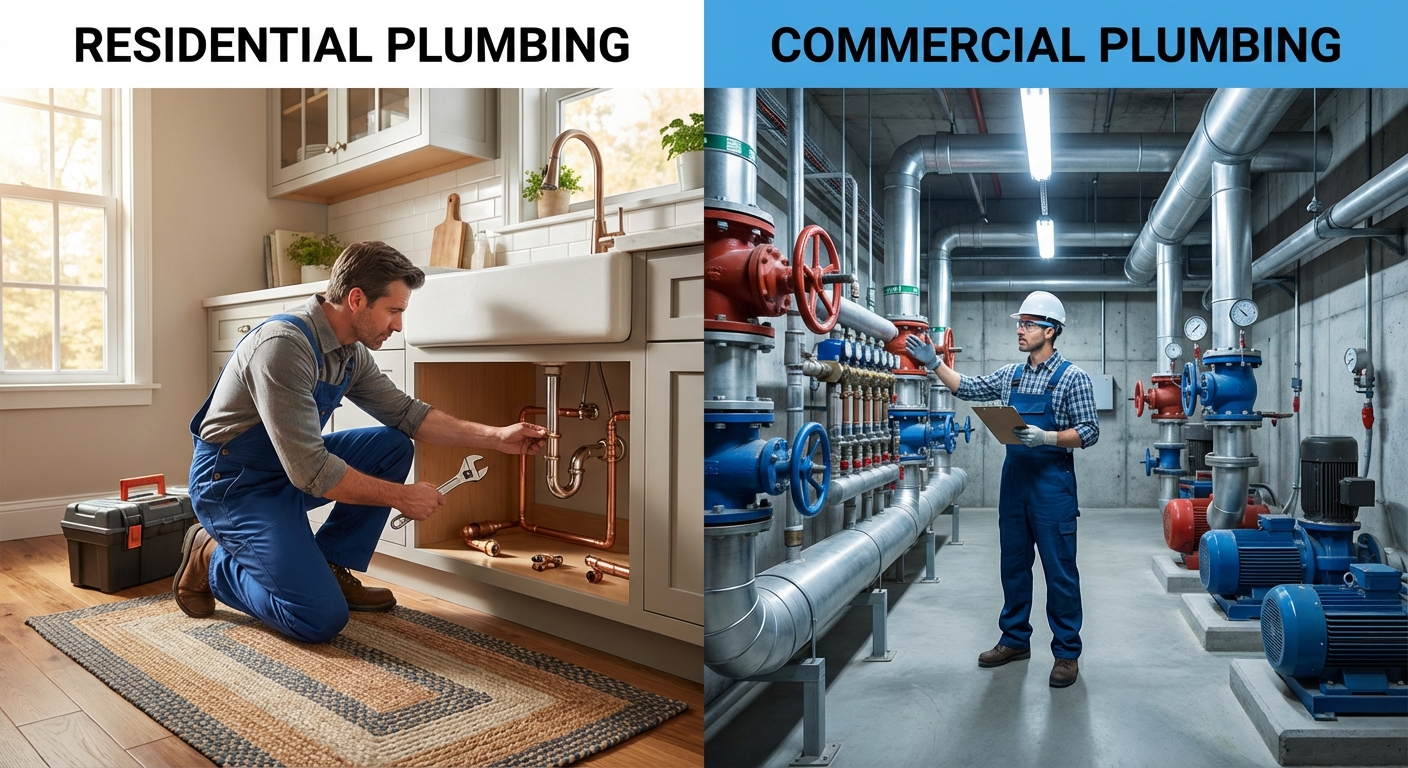
System Complexity & Design: A World Apart
The most fundamental difference between residential and commercial plumbing is scale and complexity. A residential plumbing system is designed for a single household with predictable usage, a handful of fixtures, and straightforward pipe routing through walls and under floors. Commercial systems, by contrast, must serve dozens, hundreds, or even thousands of users simultaneously, often across multiple floors and building wings.
Residential Plumbing Systems
Residential plumbing systems feature standardized layouts that are relatively easy to troubleshoot and repair. Pipes are typically made from PEX, copper, or PVC, and water pressure remains stable because demand is low and consistent. Access points like basements and crawl spaces make most repairs manageable for a single skilled plumber. The latest 2024 Uniform Plumbing Code (UPC) also introduced a Peak Water Demand Calculator that simplifies sizing for modern homes, something the IPC does not provide in the same way.
Commercial Plumbing Systems
Commercial systems are a different animal entirely. They involve intricate pipe networks with multiple supply lines, booster pumps, pressure regulators, and redundancy features to prevent total shutdowns, which is critical in settings like hospitals or restaurants. Large-diameter pipes handle high-volume water demand, and the system must maintain consistent pressure throughout the building regardless of simultaneous usage. The 2024 UPC also added new fixture-count provisions for all-gender facilities, indoor horticultural facilities, and onsite stormwater treatment systems, all of which primarily affect commercial buildings.

Find Trusted & Licensed Plumbers in Ohio
Get matched with companies for your specific needs
Code Requirements, Licensing & Insurance in 2026
Plumbing Codes
Both residential and commercial plumbing must comply with plumbing codes, typically the 2024 Uniform Plumbing Code (UPC) or the International Plumbing Code (IPC), depending on your state. The next UPC/IPC code cycle is expected in 2027, with code change proposals already covering topics like temperature limits, backflow, drinking water treatment systems, Legionella risk, and sewer rehabilitation. Commercial projects face far stricter interpretations of these codes, particularly around backflow prevention, grease trap installation, ADA-compliant fixture counts, and fire suppression integration. Learn what to watch for in our plumbing code compliance guide.
Licensing Differences
Most U.S. states do not issue separate "residential" and "commercial" personal plumber licenses. Instead, they license plumbers by level (apprentice, journeyman, master) and then define residential vs. commercial scope at the contractor or permit level. For example, Florida and Texas use a single set of journeyman and master licenses that cover both residential and commercial settings, while Arizona, California, Kentucky, Delaware, and Idaho explicitly recognize separate residential and commercial contractor classifications when granting reciprocity.
The general path to any plumbing license typically requires 4+ years of documented experience (often around 6,800 to 8,000 hours), passing a trade exam, and proof of insurance and bonding. Some states require contractors to log documented hours in both commercial and residential plumbing (for example, 3,850 hours of each) before issuing a full plumbing contractor license. Learn more in our guide to licensed plumber requirements.
Insurance & Bonding Requirements
Commercial plumbing contractors carry significantly higher insurance limits than residential plumbers because the financial risk of a mistake in a commercial building is far greater. In 2026, typical commercial contracts require $1 million per occurrence / $2 million aggregate in general liability, with large projects often requiring $2 to $5 million in total limits via an umbrella policy. Many commercial clients also require professional liability (E&O) at $1M/$2M, pollution liability at $1 to $2 million for sewer or septic work, and performance and payment bonds equal to 50% to 100% of contract value.
Residential plumbers typically need far less coverage. State license bonds for plumbers commonly range from $5,000 to $25,000 (for example, $15,000 in California, $20,000 in Illinois, $25,000 in Minnesota). Always verify that your contractor carries adequate insurance for your project type before work begins.
2026 Pricing: How Much More Does Commercial Plumbing Cost?
Commercial plumbing typically costs noticeably more than equivalent residential work, often 1.3 to 2 times more per labor hour, with total project costs running 3 to 5 times higher once materials, permits, and crew size are factored in. Here's a 2026 breakdown:
| Cost Factor | Residential (2026) | Commercial (2026) |
|---|---|---|
| Standard hourly labor rate | $75 – $150/hr | $100 – $180/hr |
| Practical national average | ~$90 – $100/hr | ~$120 – $150/hr |
| Service call / trip fee | $75 – $150 | Often higher or embedded in contract |
| Emergency / after-hours | $150 – $400+/hr | Often $200+/hr effective |
| Full system installation | $4,000 – $15,000 | $5,000 – $50,000+ |
| Fixture repair/replacement | $100 – $250 | Higher (code-compliant fixtures) |
Several factors drive these higher costs in commercial settings:
- Specialized materials: 1/2" PEX runs about $0.45 to $0.80 per foot in 2026, while 3/4" Type L copper now runs $3 to $4+ per foot, and larger commercial copper or steel can exceed $5 to $10 per foot.
- Labor intensity: Commercial jobs often require multiple technicians and longer timelines, and are usually billed on a time-and-materials or bid-contract basis rather than flat-rate.
- Code compliance: Additional permits, inspections, backflow testing, and specialized components add to the bill.
- Off-hours scheduling: Work often must happen outside business hours, pushing emergency rates 1.5 to 2 times higher than standard.
Learn more about protecting your property with the right coverage in our guide to commercial plumbing services. For homeowners, our flat rate vs hourly plumbing pricing breakdown helps you pick the right model.
Common Problems, Equipment & When to Hire Which Contractor
Typical Problems by Property Type
Residential and commercial plumbing failures share some overlap but differ greatly in frequency and severity. Across 2025-2026 industry data, clogged drains and toilets remain the single most common commercial issue, driven by high foot traffic, paper towels, wipes, and grease misuse in restrooms and commercial kitchens.
| Problem | Residential Homes | Commercial Buildings |
|---|---|---|
| Clogged drains & toilets | Common, minor | #1 issue across all sources |
| Leaky pipes & faucets | Occasional drips | Hidden corrosion, costly bursts |
| Low water pressure | Rare, isolated | Systemic across floors/zones |
| Sewer backups | Uncommon | Frequent in high-traffic facilities |
| Backflow / cross-connection | Very rare | Regular compliance requirement |
| Water heater/boiler failure | Disruptive at home | Shuts down operations |
| Running toilets / silent leaks | Minor water waste | Can waste 3,000+ gallons/yr per fixture |
Special Equipment & Skills for Commercial Work
Commercial plumbing demands tools and expertise that go well beyond what a typical residential plumber carries:
Commercial plumbers must also understand OSHA jobsite safety standards, ADA fixture requirements, and mandatory backflow testing schedules. This level of specialized knowledge is exactly why a residential plumber, even a highly experienced one, may not be the right fit for a commercial job. If you're unsure whether you even need a licensed pro, our plumber vs handyman comparison walks through the line between the two.
When to Hire a Commercial vs. Residential Plumbing Contractor
Hire a residential plumber when:
- You need repairs or installation in a single-family home, condo, or apartment
- Work involves standard fixtures (sinks, toilets, showers, water heaters)
- The system serves a small number of people under consistent, low-volume conditions
Hire a commercial plumber when:
- You own or manage an office building, restaurant, retail space, or multi-unit property
- The project involves industrial-grade fixtures, grease traps, or fire suppression plumbing
- You need code-compliant installations that require commercial permit inspections
- A plumbing failure would disrupt business operations or impact public health
For business owners wondering whether their space qualifies, our in-depth guide on commercial plumbing services can help you determine exactly what type of contractor your property requires. Before signing anything, also review our plumbing quote vs estimate guide.
Frequently Asked Questions
Can a residential plumber do commercial work?
In most states, a journeyman or master plumbing license legally covers both residential and commercial work, but that doesn't mean every residential plumber has the skills for commercial jobs. Commercial plumbing involves complex system design, industrial fixtures, and strict code compliance that requires specialized experience. If you're a business owner, always ask a plumber about their commercial project history and verify their contractor classification covers commercial work in your state.
What is the main difference between residential and commercial plumbing?
The primary differences are scale, complexity, and regulatory requirements. Residential plumbing serves a small number of users with simple, standardized pipe layouts, while commercial systems handle dozens to hundreds of users, require pressure-boosting equipment, grease traps, backflow prevention, and must meet stricter health and safety codes under the 2024 UPC. This complexity makes commercial plumbing significantly more expensive and harder to repair.
Is commercial plumbing more expensive than residential?
Yes. In 2026, commercial labor typically runs $120 to $180 per hour vs. $75 to $150 for residential, and total project costs often reach 3 to 5 times residential equivalents. Higher labor rates, industrial-grade materials, specialized equipment, permitting, inspections, and after-hours scheduling all add up. Preventive maintenance contracts can help business owners manage these expenses over time.
Do I need a special license to do commercial plumbing?
It depends on the state. Most states issue a single plumbing license that covers both residential and commercial settings, while states like Arizona, California, Kentucky, Delaware, and Idaho explicitly recognize separate residential and commercial contractor classifications. Business owners should always confirm their contractor holds the appropriate license classification and adequate insurance for their state and project type.
What are the most common plumbing problems in commercial buildings?
Clogged drains and toilets are by far the most common commercial plumbing issue, driven by high daily foot traffic, wipes, paper towels, and grease in restrooms and kitchens. Other frequent problems include hidden pipe leaks and corrosion, low or inconsistent water pressure across floors, sewer line backups, water heater or boiler failures, and backflow compliance failures. Even a single running toilet or dripping faucet can waste over 3,000 gallons per year, so prompt service and preventive maintenance are essential.