
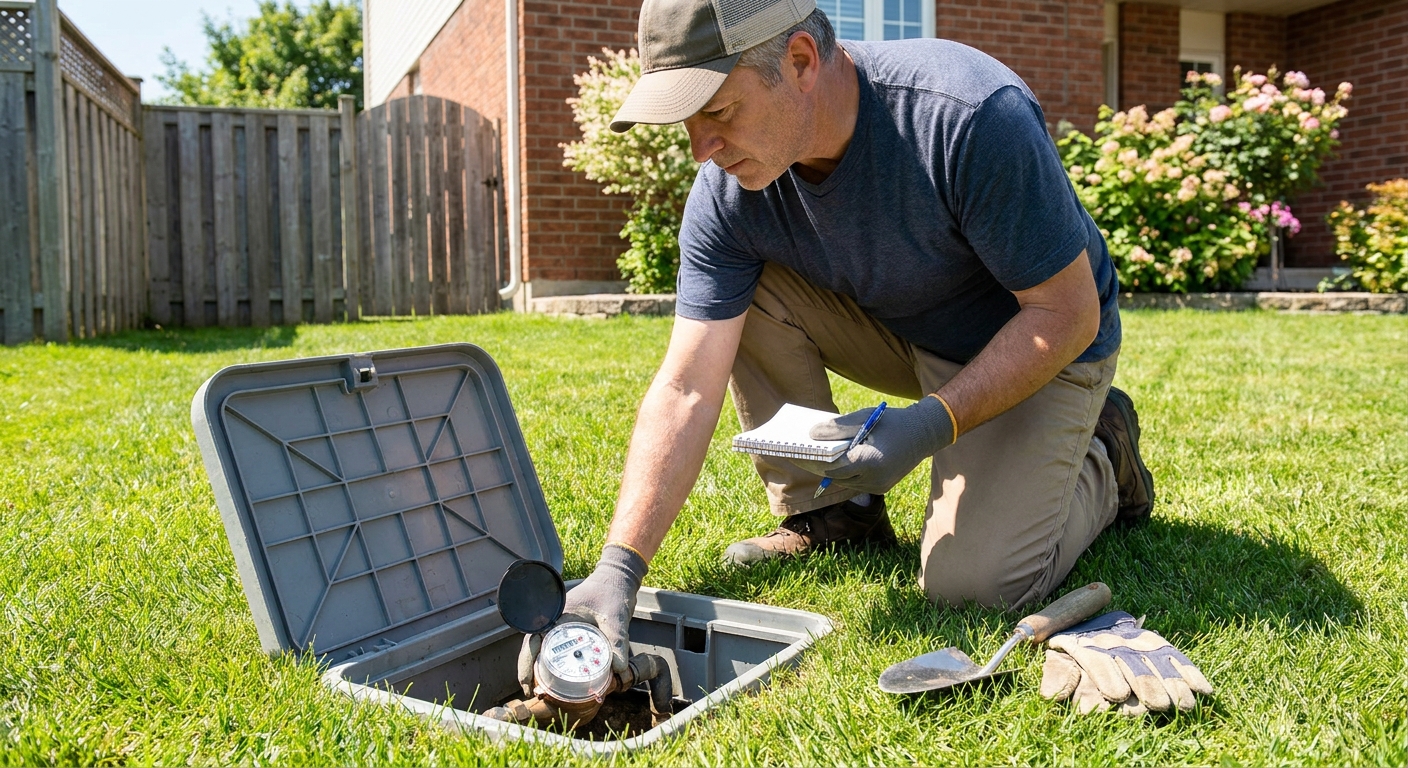
How to Check Your Water Meter for Leaks
The water meter is your first and most reliable diagnostic tool when your water bill jumps unexpectedly. Before calling a plumber, you can perform a simple meter test that takes less than two hours.
Here's how to do it step by step:
- Shut off all water. Turn off every faucet, appliance, irrigation zone, ice maker, and HVAC humidifier in and around your home.
- Locate your water meter. It's typically in a ground-level box near the curb, or inside your basement or utility room.
- Note the reading. Write down the current numbers shown on the meter dial or digital display. Take a photo for reference.
- Wait 1 to 2 hours. Do not use any water during this period. Overnight is even better for accuracy.
- Recheck the reading. If the numbers changed, you have a leak somewhere in your system.
- Isolate the location. Shut off your home's main valve and re-check the meter. If it stops moving, the leak is inside your home. If it keeps moving, the leak is underground between the meter and your house.
Most meters also have a leak indicator, a small triangle, star, or spinning dial that moves even with very low flow rates. If it's spinning with everything turned off, that's a red flag.

Find Trusted & Licensed Plumbers in Ohio
Get matched with companies for your specific needs
Common Causes of a Sudden High Water Bill
Understanding why your bill spiked is half the battle. The causes range from silent toilet leaks to billing errors, and some are surprisingly easy to fix yourself. In 2026, the average U.S. combined water and sewer bill runs about $100 to $130 per month for a typical household, clustering around $115 monthly. Households in the Northeast average closer to $147 per month, and unexplained spikes above your baseline are worth investigating quickly.
Running Toilets and Dripping Faucets
These two culprits are responsible for the majority of residential water waste. What makes them especially frustrating is how invisible they can be. According to the EPA's latest WaterSense figures, household leaks waste an average of about 9,400 gallons per year per family (roughly 180 gallons per week), and nationwide leaks now total nearly 1 trillion gallons annually.
| Leak Type | Daily Waste | Monthly Waste | Annual Waste |
|---|---|---|---|
| Worn flapper (small leak) | ~30 gallons | ~900 gallons | ~11,000 gallons |
| Typical running toilet (EPA) | ~200 gallons | ~6,000 gallons | ~73,000 gallons |
| Running toilet at 0.5 gpm | ~720 gallons | ~21,600 gallons | ~260,000 gallons |
| Stuck fill valve (severe) | Up to 4,300 gal | Up to 120,000+ gal | Massive |
| Faucet (1 drip/second) | ~8 gallons | ~250 gallons | 3,000+ gallons |
A running toilet is the single most common cause of inflated water bills. The EPA's 2026 "Know Your Flow" fact sheet notes that a stuck fill valve can waste up to 4,300 gallons per day, translating to roughly $1,400 in water costs per month at high-cost utility rates. It usually happens when the flapper valve wears out and no longer creates a proper seal, allowing water to silently drain from the tank into the bowl 24/7. To test yours, add a few drops of food coloring to the toilet tank. If color appears in the bowl within 30 minutes without flushing, you've found your leak. Our guide on running toilet repair walks through step-by-step DIY fixes that usually cost under $60 in parts.
Dripping faucets are similarly deceptive. A single faucet dripping at just one drip per second wastes more than 3,000 gallons per year, according to the EPA. That's money pouring literally down your drain.
Hidden Leaks: Underground Pipes and Irrigation Systems
Not all leaks are indoors. Underground supply line leaks and faulty irrigation systems can hemorrhage thousands of gallons before you ever notice. A poorly maintained automatic irrigation system alone can waste up to 25,000 gallons per year, and a single drip irrigation malfunction leaking at 1 gallon per minute can cost about $5,700 annually per the EPA.
Signs you may have a hidden underground leak:
- Unexplained soggy or unusually green patches in your yard, even during dry weather
- Low water pressure throughout the home
- The sound of running water when nothing is turned on
- Cracks appearing in your driveway, walkway, or foundation
- Musty odors or soft spots on interior floors and walls
For irrigation systems specifically, check each zone individually by running it while walking the yard. Look for broken heads, geyser-like spraying, or pooling water near lines. Even a single cracked irrigation line can waste hundreds of gallons per cycle.
Learn more about water line leak detection methods professionals use to pinpoint underground leaks without digging up your entire yard. If the leak sits under your foundation, a slab leak repair guide can help you understand your options.
Seasonal Usage Spikes and Billing Errors
Sometimes a high bill isn't caused by a leak at all. Common non-leak explanations include:
Water and sewer rates have been rising faster than inflation, with a 5.1% jump in 2025 and wastewater rates projected to rise about 6.0% in 2026. Since 2000, water and sewer prices have climbed roughly 207% versus 93% for overall inflation. If you suspect a billing error, contact your water utility and request a meter re-read. Ask for your usage history going back 12 months, as a legitimate spike will stand out clearly against your baseline. Rate increases are sometimes applied mid-year without much fanfare, so it's worth reviewing any notices from your utility provider. Learning to spot plumbing red flags also helps you avoid inheriting expensive water waste from a previous owner.
DIY Troubleshooting Steps to Find the Problem
Before spending money on a plumber, work through this systematic checklist. Most common leaks can be identified and even fixed with basic tools. Reviewing this annual plumbing maintenance guide can also help you catch problems before they show up on the water bill.
Step-by-Step DIY Leak Check
- Perform the water meter test (described above) to confirm a leak exists.
- Test every toilet using the food coloring method. Replace the flapper if color bleeds into the bowl. Flappers cost as little as $5 to $10 at any hardware store.
- Inspect all faucets and showerheads for dripping. Tighten connections or replace worn washers and O-rings.
- Check under sinks and around appliances, looking for puddles, mineral stains, or warped cabinetry that suggests a slow drip.
- Inspect your water heater for pooling water around the base or signs of corrosion at connection points. If you spot moisture, our guide to a leaking water heater explains next steps.
- Walk your yard looking for soggy patches, pooling water, or unusually lush grass during dry periods.
- Run each irrigation zone one at a time and visually inspect heads, lines, and valves for breaks or misdirected spray.
- Check your washing machine hoses and outdoor faucet connections, since rubber hoses crack over time and can drip slowly.
Avoiding these and other common plumbing mistakes can save you thousands over the life of your home, and a solid preventive plumbing maintenance routine is one of the best long-term defenses against surprise bills.
When to Call a Plumber & Water Conservation Strategies
When to Call a Professional for Leak Detection
DIY methods have their limits. Call a licensed plumber if:
- Your meter test confirms a leak but you cannot find the source inside or outside your home
- You hear running water sounds inside walls or under your slab but see no visible leak
- Your yard has wet patches that persist through dry weather despite no irrigation running
- Water pressure has dropped noticeably throughout the house (learn more about water pressure problems)
- You've ruled out all visible sources and the bill remains elevated
In 2026, most homeowners pay $175 to $400 for a standard residential leak detection service visit, with the full range spanning $75 for easy-access leaks to $2,000+ for complex jobs (slab leaks, underground service lines, or whole-house multi-method surveys). Slab leak detection specifically averages about $280 nationally, with a typical range of $150 to $400 and up to $600 to $900 in high-cost metros. Professional plumbers use acoustic listening devices, thermal imaging cameras, moisture meters, tracer gas, and video pipe inspection cameras to locate hidden leaks with pinpoint accuracy, without tearing open walls or excavating your yard. If the failure ends up being on the service line itself, our main water line repair guide explains who pays for what. For emergency situations, our plumbing emergency guide walks through what to do before help arrives.
Smart Leak Detectors: The Newer 2026 Option
Whole-home smart plumbing systems have become one of the fastest-growing categories in residential water tech. Devices like Moen Flo, Phyn Plus, and Flume 2 monitor flow and pressure on your main line 24/7, use machine learning to flag abnormal patterns, and can automatically shut off water when a serious leak is detected. In 2026, Flume 2 starts around $159 to $229 (self-install), Phyn Plus 2nd Gen runs about $580, and Moen Flo lists at $500 to $650 plus an optional $5.99/month FloProtect subscription. With professional installation, complete auto-shutoff systems typically total $1,000 to $1,500, and some insurers (including Liberty Mutual, Hippo, State Farm, and USAA) offer 5% to 15% premium discounts on the water-damage portion of your policy for installing a recognized device.
Water Conservation Strategies to Lower Your Bills Long-Term
Once you've addressed any leaks, these habits and upgrades can keep your bill low going forward. According to the EPA, an average family spends about $1,300 per year on water and can save around $500 per year by retrofitting with WaterSense-labeled fixtures and ENERGY STAR appliances.
- Install WaterSense-certified fixtures. WaterSense toilets, faucets, and showerheads use at least 20% less water than standard models. Replacing older toilets alone saves the average family about 13,000 gallons and $130 to $170 per year.
- Swap in a WaterSense showerhead, which can save the average family more than 2,700 gallons of water and about $70 in water and electricity costs per year.
- Upgrade to WaterSense faucet aerators, which are about 30% more efficient and can save around 700 gallons of water per year for just a few dollars.
- Use drip irrigation or soaker hoses instead of sprinklers to deliver water directly to roots and reduce evaporation.
- Install a WaterSense weather-based irrigation controller, which can save up to 15,000 gallons annually per home.
- Fix leaks immediately. Even a slow toilet or dripping faucet adds up to hundreds of dollars over a year.
- Run dishwashers and washing machines only when full to maximize efficiency per cycle.
- Consider xeriscaping in drought-prone areas, replacing water-hungry grass with drought-tolerant plants and mulch.
For a deeper dive into the highest-ROI upgrades, see our full guide to water conservation plumbing and the latest WaterSense fixture options for 2026.
Frequently Asked Questions
Why did my water bill suddenly go up with no obvious leak?
A sudden spike without a visible leak is often caused by a silent toilet leak, a cracked underground supply line, or a faulty irrigation system. These leaks can waste thousands of gallons without making any sound or showing obvious signs indoors. Perform the water meter test and the toilet food coloring test as your first two steps. If both check out, walk your yard for soggy patches and inspect all irrigation zones.
How do I know if my water meter is being read correctly?
You can verify your meter reading yourself at any time by lifting the meter box lid and recording the numbers displayed. Compare your self-read to the number on your bill, and if they don't align, contact your utility company and request a re-read. Meters can occasionally be misread or have mechanical issues, and utilities will typically investigate and adjust your bill if an error is confirmed.
How much water does a running toilet actually waste?
A running toilet is one of the most wasteful household leaks. According to the EPA, a typical running toilet wastes around 200 gallons per day, while a stuck fill valve can waste up to 4,300 gallons per day and roughly $1,400 in water costs per month. Even a small worn flapper leak of 30 gallons per day adds up to nearly 11,000 gallons a year, easily doubling a normal water bill.
What are signs of an underground water pipe leak on my property?
Key signs include unexplained wet or soggy patches in your yard, unusually lush and green grass during dry weather, a noticeable drop in household water pressure, cracks appearing in your driveway or sidewalk, and the sound of running water when all fixtures are off. If your water meter keeps moving after you've shut off your main home valve, the leak is almost certainly underground between the meter and the house, a situation that requires professional repair.
Can I lower my water bill without finding a leak?
Yes. Even without an active leak, there are meaningful ways to reduce consumption. Installing WaterSense showerheads, fixing dripping faucets, running appliances only when full, switching to drip irrigation, and planting drought-tolerant landscaping can collectively cut household water usage by 20% or more. The EPA estimates the average family can save around $500 per year with a full WaterSense and ENERGY STAR retrofit.