
Ohio Life Insurance - Save up to 70% Off
See what plans you qualify for in just a few minutes
Why the Paramedical Lab Panel Matters
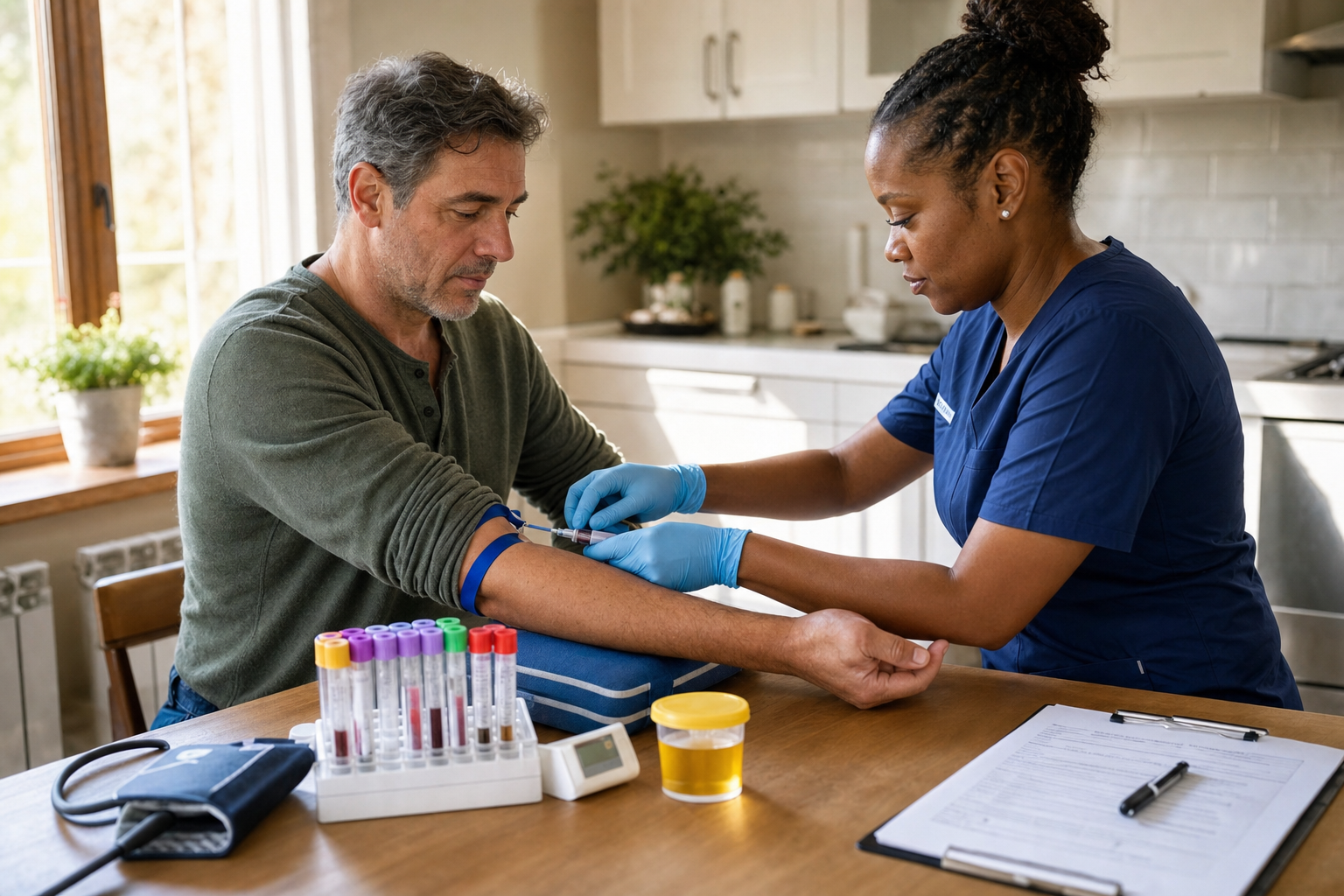
The blood and urine samples collected during your paramedical exam are the single largest factor in placing you into an underwriting rate class. A licensed examiner draws blood and collects a urine sample, ships the specimens to a contracted lab (ExamOne, APPS, or Superior Mobile Medics are the largest), and results are typically transmitted to the insurer's underwriting team within about a week of the exam. The lab is not a rubber stamp. Four exam findings drive most reclassifications: blood pressure, A1c/glucose, cholesterol ratio, and cotinine (nicotine). Biomarkers from blood and urine also allow underwriters to identify subclinical conditions tied to increased mortality, including cardiovascular disease, kidney and liver disease, substance use, and infectious diseases.
In 2026 those lab numbers are also cross-checked against your prescription history and electronic health records. Milliman IntelliScript and Clareto announced a collaboration to deliver electronic health record (EHR) data to life, long-term care, and disability insurers via the IntelliScript user platform. Milliman IntelliScript aggregates and interprets real-time prescription, medical claims, credit and EHR data, then converts it into an Irix mortality risk score that insurers plug directly into automated underwriting workflows. IntelliScript now lets underwriters see the applicant's full longitudinal health record alongside other data they already decision on, including Risk Score, Prescription Data, Medical Data, and Criminal Data. A clean lab paired with a clean prescription history is the fastest path to a top rate class. For a full breakdown of how carriers use this data, see our guide on the accelerated underwriting process.

Ohio Life Insurance - Save up to 70% Off
See what plans you qualify for in just a few minutes
The Standard Blood Panel: Marker by Marker
Every major US life insurer runs a similar core panel on the blood specimen. Here is what each test measures and the typical threshold for top rate classes. For a full breakdown of each rate tier, review our guide on life insurance health classifications.
Lipid profile (cholesterol)
Life insurance blood tests screen for cholesterol levels, blood glucose and HbA1c, liver enzymes (ALT, AST), kidney function markers (creatinine, eGFR) and cotinine (a nicotine metabolite). The lipid panel reports total cholesterol, HDL ("good"), LDL ("bad"), triglycerides, and the cholesterol/HDL ratio. Underwriters care most about the ratio because it correlates most strongly with cardiovascular mortality. For Preferred Plus consideration in 2026, most carriers want total cholesterol at or below roughly 220 mg/dL with a cholesterol/HDL ratio of 4.5 or lower, though more flexible carriers allow up to 250 to 300 mg/dL as long as the ratio stays under 4.0 to 4.5. Triglycerides above 400 mg/dL will typically drop you at least one rate class on their own.
Blood glucose and A1c
Fasting glucose captures a snapshot of your blood sugar the morning of the draw, while Hemoglobin A1c reflects your average blood sugar over the previous 90 days. A1c is far more reliable and cannot be gamed by a one-day fast. Underwriting guidelines align with clinical thresholds: A1c below 5.7% is normal, 5.7 to 6.4% is prediabetic, and 6.5% or higher is diabetic range. Well-controlled diabetes with an A1c under 7.0% is often still insurable at Preferred or Standard Plus rates depending on the carrier. Learn more about life insurance for diabetics if your A1c is elevated.
Liver enzymes
AST, ALT, and GGT are the three enzymes screened. Elevations can indicate fatty liver, alcohol overuse, hepatitis, medication side effects, or muscle breakdown from recent intense exercise. GGT specifically is sensitive to alcohol consumption, which is why one of the strongest prep tips is avoiding drinking for at least 48 to 72 hours before your exam.
Kidney function
The panel checks creatinine, BUN (blood urea nitrogen), and calculates eGFR (estimated glomerular filtration rate). Urine is also tested for protein and microalbumin, both early indicators of kidney disease. An eGFR above 90 is ideal. Anything below 60 sustained over three months meets the definition of chronic kidney disease and will usually trigger a Table rating or decline. Our guide to life insurance with kidney disease covers the full CKD staging process.
PSA (men age 50+)
Men age 50 and older, and sometimes men 45+ with a family history of prostate cancer, receive a prostate-specific antigen (PSA) test. A PSA under 4.0 ng/mL is generally considered normal for insurance purposes. Elevated PSA rarely causes an outright decline but often triggers a request for an Attending Physician Statement (APS) from your urologist.
Complete blood count and protein markers
The CBC counts red cells, white cells, and platelets, flagging anemia, infection, or blood disorders. Total protein, albumin, and globulin help assess overall nutritional status, chronic inflammation, and liver synthetic function.
What the Urine Test Actually Detects
The urine cup does far more work than most applicants realize. Beyond confirming the sample belongs to you (via creatinine concentration and temperature), it screens for a wide range of substances and conditions.
| Marker Tested | What It Detects | Impact on Rate |
|---|---|---|
| Glucose in urine | Undiagnosed or poorly controlled diabetes | Standard to Table B+ |
| Protein/microalbumin | Early kidney disease | Standard to Table |
| Blood in urine | Kidney stones, infection, tumor | APS request, possible postpone |
| Cotinine | Nicotine use (any source) | Smoker rates (2-3x premium) |
| Cocaine metabolites | Recreational cocaine use | Usually decline |
| THC-COOH | Marijuana use | Rates vary by carrier |
| Amphetamines, opiates | Illicit or undisclosed use | Decline or heavy rating |
| HIV antibodies | HIV infection | Rating, sometimes decline |
| Hepatitis B/C surface antigens | Active or chronic hepatitis | Rating or postpone |
Testing positive for illegal drugs will likely result in automatic disqualification from traditional life insurance. Undisclosed prescription medications, especially controlled substances like benzodiazepines, opioids, or stimulants that were not listed on your application, can be treated as material misrepresentation and cause the insurer to withdraw the offer.
Cotinine, Nicotine, and Marijuana: The Details That Trip Up Applicants
Marijuana underwriting has continued to loosen in 2026. Because THC itself does not produce cotinine, a cannabis user who is otherwise tobacco-free can still test cotinine-negative and qualify for non-smoker treatment on that axis. Nationwide may qualify you for a preferred plus nontobacco rate if your recreational use is two times or less per week, you disclose this on your application, and you have no history of alcohol abuse, drug abuse, or DUIs. At Prudential, applicants can use cannabis as often as three times a week and still qualify for nonsmoking rates. At MetLife, anyone who smokes marijuana less than once a week is considered a nonsmoker. Corebridge Financial, Lincoln Financial, and Mutual of Omaha now offer similarly flexible non-smoker rates to occasional users. Smoked or vaped THC is still treated more strictly than edibles or tinctures, and daily heavy use will usually still trigger smoker classification or a table rating. THC metabolites can be detected in urine for 3 to 5 days after occasional use and 30 to 45+ days for chronic daily users. For carrier-by-carrier detail on cannabis pricing, see our guide on life insurance for marijuana users.
How to Prepare: A Timeline That Actually Works
You cannot fake a good exam, but you can absolutely avoid unnecessarily bad numbers. Most poor results in otherwise healthy applicants come from dehydration, a late-night meal, a hard workout, or a couple of drinks the evening before.
7 days out
- Cut back on saturated fat, salt, and sugar
- Increase water intake to keep urine light yellow
- Skip alcohol if possible
- Sleep 7 to 8 hours nightly (chronic sleep loss raises blood pressure)
48 to 72 hours out
- No intense workouts. Heavy lifting or long runs elevate ALT, AST, and creatinine
- No alcohol. GGT and liver enzymes can spike for 2 to 3 days
- Continue drinking water steadily
The night before
- Begin your fast (aim for 8 to 12 hours)
- Water is fine and encouraged; nothing with calories
- Eat a light, low-fat dinner
- Sleep well
Morning of the exam
- Drink a full glass of water an hour before
- No coffee, tea, energy drinks, or nicotine
- No exercise beyond a light walk
- Have your medication list, doctor contacts, and ID ready
Turnaround Times and What Happens After
Specimens usually reach the lab within 24 hours of the draw and are processed within 48 to 72 hours, though most carrier-facing lab results are transmitted to underwriting within 7 to 14 days. Underwriting then reviews the full file, including your MIB report, MVR, Milliman IntelliScript prescription and medical claims data, and any APS requests. For fully underwritten policies the final decision typically arrives 2 to 6 weeks after your exam, though accelerated underwriting programs can now return decisions in minutes when the lab and prescription data support automatic approval. Our life insurance underwriting process guide breaks down each stage in detail.
If HIV, hepatitis B, or hepatitis C is detected, most reputable insurers handle disclosure through your primary physician rather than by mail, and they do not automatically decline. Well-controlled HIV with an undetectable viral load is now insurable at several major carriers. Guardian qualifies HIV-positive applicants who are ages 20 to 65, have been on highly active antiretroviral therapy for at least two years with an undetectable viral load, have a CD4 count above 350 and never below 200, no AIDS-defining illness, no hepatitis B history, and no recent IV drug use. Guardian offers $100,000 to $10 million of term life insurance for qualifying HIV-positive applicants. John Hancock and Prudential also underwrite HIV-positive applicants who meet strict viral load, CD4, and treatment-duration criteria. For a deeper dive, see our guide on life insurance for HIV-positive individuals.
What Abnormal Results Mean for Your Rate Class
Rate classes translate directly into premium dollars. The table below shows how common abnormal findings typically shift an applicant's classification. Actual outcomes depend on severity, control, and combinations with other risks.
| Finding | Typical Rate Class Impact |
|---|---|
| Total cholesterol 240-300, ratio 4.5-6 | Preferred Plus to Preferred or Standard |
| A1c 5.7-6.4% (prediabetes) | Preferred to Standard |
| A1c 6.5-7.5%, well controlled | Standard, occasionally Table B |
| Mild ALT/AST elevation, isolated | Additional labs, then Standard likely |
| eGFR 60-89 with proteinuria | Standard to Table B |
| Cotinine positive | Automatic smoker rates (2-3x) |
| Cocaine or opiate positive | Decline |
| Undisclosed prescription meds | Rate adjustment or withdrawal |
If you know your health is borderline, it is often worth exploring options that skip the paramedical entirely. Accelerated underwriting programs have expanded dramatically in 2026. Penn Mutual has the highest no-exam coverage limit at $10 million, while Banner Life has the next highest at $4 million. Symetra's accelerated underwriting caps at $3 million for ages 18 to 50 and $2 million for ages 51 to 60. Nationwide's Intelligent Underwriting reaches $1.5 million for qualifying applicants. Our overview of the life insurance medical exam process covers those programs in detail. Applicants with existing hypertension should also review our guide on life insurance with high blood pressure, since blood pressure readings taken at the exam interact directly with your lab results. Smokers who want to reclassify should read our life insurance for smokers breakdown.
Frequently Asked Questions
Can the life insurance blood test detect STDs?
The standard panel specifically screens for HIV and hepatitis B and C. It does not routinely test for other sexually transmitted infections like syphilis, gonorrhea, chlamydia, or herpes. A positive HIV or hepatitis result does not automatically disqualify you today, but it will typically move you into a rated (higher premium) class or trigger further underwriting review with your treating physician.
Do I really need to fast, and for how long?
Yes, if the insurer or paramedical company instructs you to. Most carriers ask for an 8 to 12 hour fast to get accurate fasting glucose and triglyceride readings. Water is not only allowed, it is encouraged because dehydration can artificially elevate creatinine and make the blood draw harder. Scheduling your exam for early morning is the simplest way to complete the fast overnight.
How long does marijuana stay detectable in the urine test?
For occasional users (a few times a month), THC metabolites are typically detectable for 3 to 5 days. For daily heavy users, THC-COOH can remain in urine for 30 to 45 days or more. Blood detection is shorter, usually 1 to 3 days for occasional use and up to 7 days for chronic users. If you use marijuana regularly, disclose it on the application rather than hoping it clears, since many carriers now offer non-smoker rates to occasional cannabis users.
Will the insurer see prescription drugs I did not disclose?
Almost certainly. Beyond the urine screen, insurers pull your prescription history through Milliman IntelliScript, which aggregates real-time prescription fills, medical claims, credit data, and (through its Clareto integration) electronic health records covering up to seven years. If your labs show drug metabolites or your prescription history contradicts your application, most carriers treat it as material misrepresentation, which can void the offer or, if discovered later, the policy itself.
Can I retake the blood test if my results come back bad?
Sometimes. If a specific value looks abnormal because of a temporary cause (recent illness, intense workout, a medication that was recently discontinued), underwriters may allow a retest 4 to 12 weeks later. For chronic issues like elevated A1c or persistent kidney markers, retesting will not help unless you have made real lifestyle or treatment changes in between. Ask your agent about a "reconsideration" request before accepting a downgraded offer.