
Compare Home Insurance Plans in Ohio
Find your best options in less than 2 minutes



How Much Home Insurance Costs in New Jersey
New Jersey is actually one of the more affordable states for homeowners coverage, despite its high cost of living. Estimates for 2026 put the average annual premium roughly between $1,480 and $1,780 per year, depending on the data source and coverage level. That works out to about $123 to $148 a month, well below the national average of around $2,543 per year for $300,000 in dwelling and liability coverage with a $1,000 deductible.
Why is NJ relatively cheap? The state has strong building codes, lower wildfire and tornado exposure than much of the country, and a competitive carrier market. That said, premiums vary widely between the Pine Barrens, the urban Gold Coast, and the barrier islands.
Average NJ home insurance by county
| County | Avg. Annual Premium | Avg. Monthly |
|---|---|---|
| Bergen | ~$2,183 | ~$182 |
| Burlington | ~$2,112 | ~$176 |
| Camden | ~$1,988 | ~$166 |
| Newark (city) | ~$2,050 | ~$171 |
| Jersey City | ~$1,980 | ~$165 |
| Coastal Shore towns | $2,000 to $4,700+ | $167 to $390+ |
Rates have been climbing hard statewide. New Jersey home insurance rates rose 7.5% in 2025 compared to 3.6% general inflation, and cumulative increases now sit at roughly 32% over the past five years. In 2025, more than 80 insurance companies filed rate hike requests, and over 50 were approved, with the largest going to Founders Insurance (approved at about 23.9%), Farmers Property & Casualty (approved at 21.6%), and St. Paul Protective (Travelers) (approved at 19.5%). Reinsurance costs, rebuild inflation, and climate-related storm losses are the main drivers. Insurify projects NJ premiums will rise another 2% in 2026 to about $1,797, though individual carriers may still push double-digit filings.

Compare Home Insurance Plans in Ohio
Find your best options in less than 2 minutes
Best Home Insurance Companies in New Jersey
The top-rated carriers in New Jersey for 2026 combine strong financial ratings with competitive premiums and decent claims service. Here are the standouts based on the latest independent rankings.
NJM (New Jersey Manufacturers) is the homegrown favorite. NJM is the best value choice with an average annual rate of $1,570, compared to a state average of $2,030 per year in NerdWallet's 2026 analysis. Insurance.com ranked NJM as the best homeowners insurance company in New Jersey with an overall rating of 4.89, and it also offers the cheapest home insurance in the state at $966 per year for $300,000 dwelling coverage and $300,000 liability with a $1,000 deductible. NJM's standard policy includes guaranteed replacement cost coverage, which means the insurer will pay what it actually takes to rebuild your home even if construction costs exceed your dwelling limit.
Chubb is the go-to for high-value homes. MoneyGeek's 2026 research found Chubb offers the highest-quality homeowners insurance in New Jersey with the lowest average annual premium at $953, plus cash-settlement options and a white-glove claims process.
Selective Insurance is the affordability leader in several 2026 rankings. CNBC Select named Selective best for affordability in New Jersey, with an average rate of $531 a year in its sample analysis, while Insurify pegs Selective at about $67 per month ($804 per year) for $300,000 dwelling coverage.
Cumberland Mutual now ranks as the cheapest overall in LendingTree's 2026 comparison, edging out even NJM on base rates for standard homes. Travelers remains one of the cheapest national carriers in NJ, and USAA is still the top choice for military families and veterans, though eligibility is restricted.
Other carriers writing in NJ include Plymouth Rock, Allstate, Liberty Mutual, Nationwide, Progressive, and State Farm. If you're shopping around, our guide to the best home insurance companies is a useful starting point for comparing national names, and our breakdown of how to compare home insurance walks through the six factors that matter most beyond price.

Protect your home with State Farm
Average Rate:
Homeowners who bundle and save with State Farm save an average of $1,000 per year!

You're in Good Hands® with Allstate
Average Rate:
Get comprehensive home coverage with flexible policy options.

Customize your home coverage
Average Rate:
Only pay for the coverage you need with personalized home insurance.

Smart coverage for your home
Average Rate:
Protect what matters most with award-winning home insurance.
Coastal Coverage and the Jersey Shore Challenge
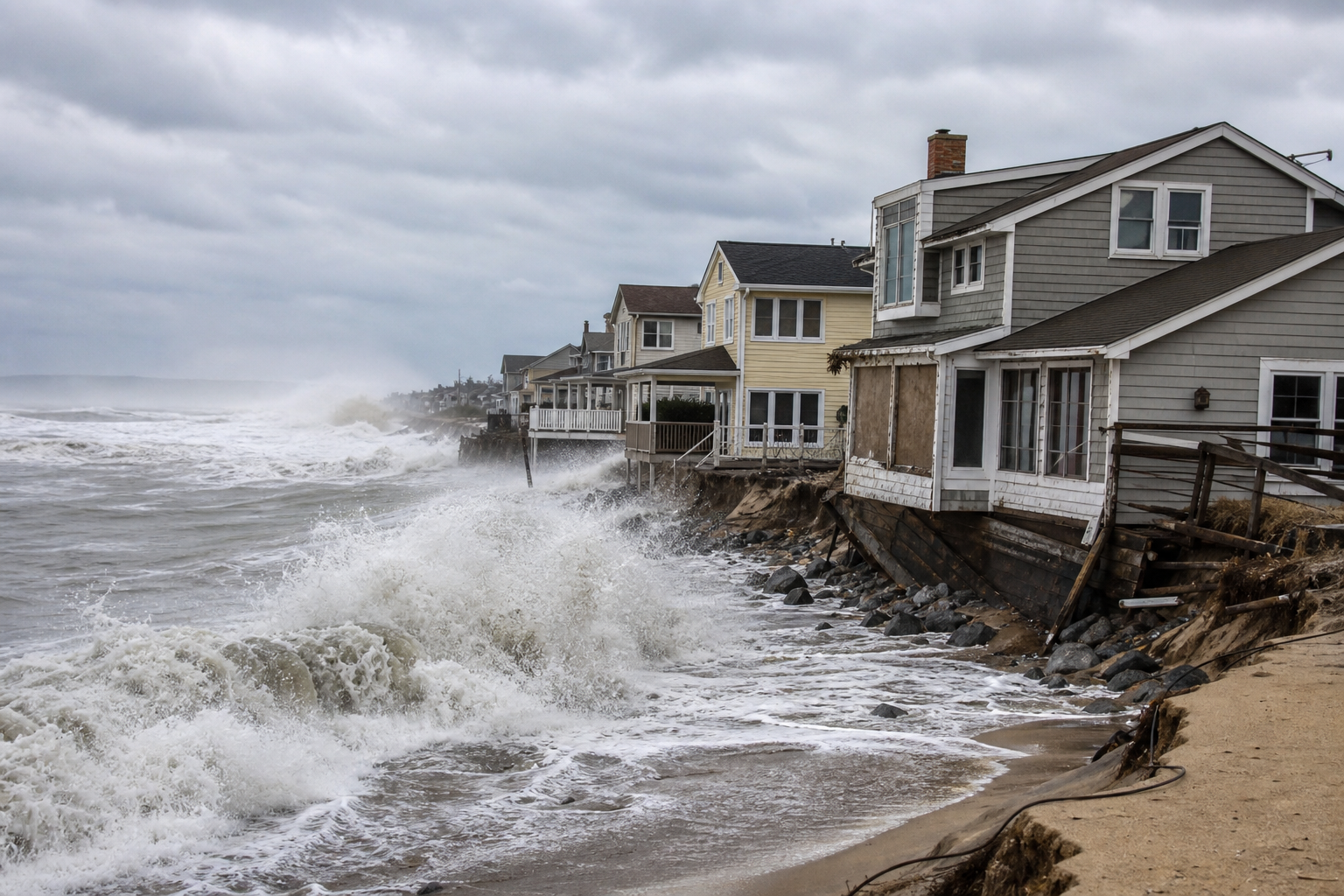
The Jersey Shore is gorgeous, but insuring a home in Cape May, Ocean City, Long Beach Island, or Asbury Park is a different game than insuring a Cape Cod in Morristown.
Wind and hurricane deductibles
Rather than a flat dollar-value deductible, hurricane, windstorm, or named storm deductibles are calculated as a percentage of a home's insured value. Under NJ regulation, insurers and the FAIR Plan may file to use mandatory hurricane deductibles of up to 5% in designated coastal ZIP codes, with optional deductibles up to 10%. The New Jersey Insurance Underwriting Association (NJIUA) applies its mandatory hurricane deductible to properties in 116 designated coastal ZIP codes, using this tiered structure:
- 3% hurricane deductible with a $500 all-peril deductible for properties in a coastal group 1 ZIP code more than 2 miles from the ocean or bay
- 3% hurricane deductible with a $1,000 all-peril deductible if the property is in a coastal group 1 ZIP code and 1 to 2 miles from the ocean or bay
- 4% hurricane deductible with a $1,000 all-peril deductible if within 1 mile or less of the ocean or bay
- 5% hurricane deductible with a $1,500 all-peril deductible in a coastal group 2 ZIP code
Example: If you insure your home for $400,000, a 3% wind deductible works out to $12,000, which is much higher than normal deductibles that typically range from $500 to $2,000. On a $600,000 Long Beach Island home with a 5% hurricane deductible, that's $30,000 out of pocket before the insurer covers anything.
Nor'easter and hurricane risk
Hurricane Sandy (2012) reshaped the NJ shore insurance market. Carriers tightened underwriting, raised deductibles, and several pulled back from writing new policies within a set distance of the water. Cape May, Atlantic, and Hudson counties now rank in the top 100 nationwide for the biggest jump in insurance non-renewal rates between 2018 and 2023. Nor'easters, which can produce hurricane-force winds and major coastal flooding outside the traditional June to November hurricane season, are also a real underwriting concern.
Many shore-focused carriers will only write a policy if your home is more than a set distance (often 1,000 to 2,500 feet) from the coastline. For homes closer than that, you may need a specialty coastal carrier or a package policy that bundles home and flood. Learn more about coastal home insurance and how it differs from a standard policy.
Flood Insurance in NJ Coastal Counties
This is the single biggest gap homeowners miss. Standard NJ home insurance does not cover flood damage, no matter how the water got there. Storm surge, tidal flooding, heavy rain runoff, and riverine overflow are all excluded.
When flood insurance is required
You'll be required to carry flood insurance if both of these are true:
- Your property is in a FEMA Special Flood Hazard Area (any zone starting with A or V), and
- You have a federally backed or federally regulated mortgage (FHA, VA, USDA, or a conventional loan from most banks).
Many coastal NJ properties in Ocean, Monmouth, Atlantic, and Cape May counties fall into A or V zones because of storm surge exposure. Our flood insurance guide walks through how NFIP pricing works and what private carriers like Neptune, Palomar, and Kin offer outside of NFIP.
Risk Rating 2.0 and what NJ coastal owners face in 2026
New Jersey has about 210,000 to 228,000 active NFIP flood policies (the state ranks 4th in the nation), with average current premiums around $1,040 to $1,100 per year under FEMA's Risk Rating 2.0 methodology. The methodology no longer uses flood zones alone to calculate rates, instead considering the building's foundation type, structural system, elevation, distance from a body of water, and the area's historic flood frequency. That shift generally raises premiums for barrier island and bayfront homes, and NJ's full risk-based average is projected around $2,100 per year once all phase-ins complete.
Under Risk Rating 2.0, existing policyholders transition gradually to full-risk rates, subject to an 18% per year cap on most residential policies, so many coastal owners are mid-climb toward their true actuarial premium. Real-world 2026 ranges tell the story:
- Elevated Long Beach Island homes: $1,200 to $1,500/year
- Oceanfront V-zone properties on LBI: $4,700+/year
- Bayside A-zone LBI homes: $1,200 to $1,300/year
- Raritan River floodplain homes: $800 to $1,600/year
For more on hurricane-specific coverage gaps, see our guide to hurricane insurance coverage.
Urban vs Suburban: Newark, Jersey City, and the Suburbs
Premiums in NJ's two biggest cities tell an interesting story.
Newark now averages roughly $2,050 per year for a $300,000 dwelling policy in CoverForge's 2026 data, about 15% above the state average because of higher theft and vandalism claim frequency plus rebuild costs. Within Newark, ZIPs like 07114, 07105, and 07102 tend to run cheapest, while 07104, 07106, and 07108 sit slightly higher.
Jersey City averages about $1,980 per year, roughly 11% above the state average, especially near the Hudson waterfront where rebuild costs and condo conversion values are elevated.
Affluent inner-ring suburbs in Bergen County (Ridgewood, Tenafly, Englewood Cliffs) often run more expensive than either city because the homes are larger and rebuild costs are higher. Bergen County averages roughly $2,183 per year in Plymouth Rock's 2026 data.
Inland suburbs and exurbs (Hunterdon, Sussex, Warren counties) often come in below Bergen or Camden levels, particularly for newer construction. See how NJ stacks up against nearby markets in our Pennsylvania home insurance guide and New York home insurance breakdown.
What drives the urban-suburban gap
- Rebuild cost (square footage, finish quality, local labor)
- Theft and vandalism claim frequency (higher in dense urban areas)
- Fire department response distance
- Liability exposure (sidewalk slip-and-fall claims more common in cities)
- Coastal proximity (the single biggest premium driver in NJ)
If you're shopping in a high-cost suburb, our overview of top home insurance companies can help you compare value carriers like NJM against national names. For a broader look at how states stack up, see our cheapest and most expensive states for home insurance ranking.
Frequently Asked Questions
How much is home insurance in New Jersey on average?
The average homeowners insurance premium in New Jersey is about $1,500 to $1,800 per year in 2026, depending on the data source. That's well below the U.S. average of roughly $2,543 annually for a $300,000 policy. Premiums vary significantly by county, with coastal shore towns often paying $2,000 to $4,700 or more and inland suburbs often paying less than $1,500.
Is NJM the cheapest home insurance in New Jersey?
NJM is consistently the best-value carrier in NJ, often coming in among the cheapest while bundling guaranteed replacement cost coverage as standard. Independent 2026 comparisons put NJM's average annual premium between $966 and $1,570, well below state averages of $2,000+ with other top-rated insurers. Selective, Cumberland Mutual, and Travelers sometimes quote even lower base rates, but usually with less robust standard coverage.
Do I need flood insurance on the Jersey Shore?
If your home is in a FEMA Special Flood Hazard Area (any A or V zone) and you have a federally backed mortgage, flood insurance is required. Even outside SFHAs, it's strongly recommended in Ocean, Monmouth, Atlantic, and Cape May counties because standard home insurance never covers flood damage. NFIP policies (averaging about $1,040 to $1,100 per year statewide in 2026) and private flood carriers like Neptune are widely available in NJ.
What is a hurricane deductible on a NJ home policy?
A hurricane deductible is a separate, percentage-based deductible that only applies when a covered hurricane causes damage. In NJ, mandatory hurricane deductibles range from 3% to 5% of your dwelling coverage depending on your ZIP code and distance from the ocean or bay. On a $500,000 home with a 4% deductible, you'd pay $20,000 out of pocket before the insurer pays anything, and the deductible only activates when NWS records sustained winds of 74 mph anywhere in the state.
Why are NJ home insurance rates rising so fast?
New Jersey home insurance rates rose 7.5% in 2025 and are up about 32% cumulatively over the past five years, driven by higher reinsurance costs, rebuild inflation, and more frequent severe weather. Over 80 NJ insurers filed rate hike requests in 2025, and more than 50 were approved, with the largest hitting 23.9% (Founders Insurance). Shopping every renewal, raising your all-peril deductible, and bundling home and auto are the most reliable ways to offset the increases.