
Compare Home Insurance Plans in Ohio
Find your best options in less than 2 minutes



What Is Lead Paint and Why Does It Still Matter?
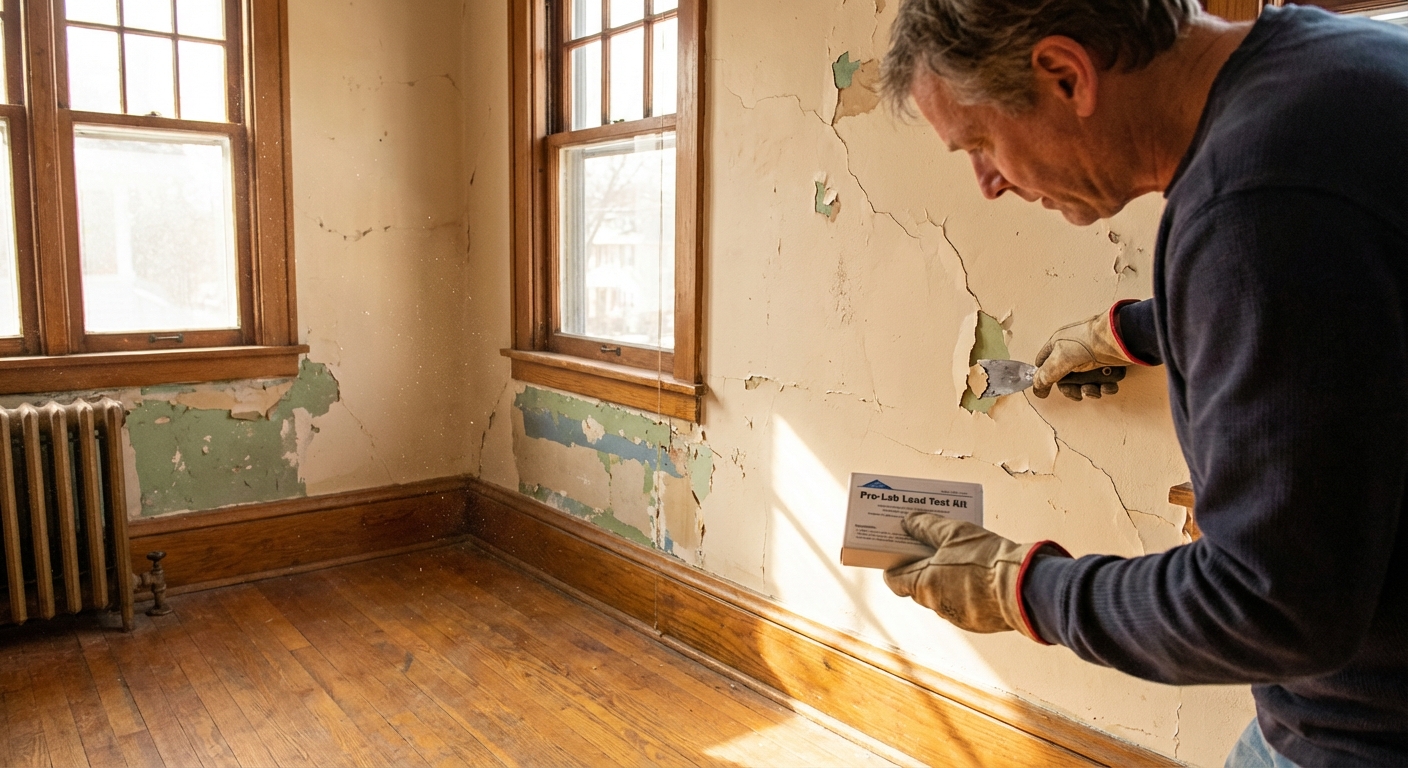
Lead-based paint was used in American homes for decades, valued for its durability, fast drying time, and moisture resistance. In 1978, the U.S. Consumer Product Safety Commission banned lead-based paint for residential use, but the damage was already done. Today, about half of U.S. homes built before 1978 still contain some lead-based paint, and roughly 29 million housing units have active lead-based paint hazards (deteriorated paint or lead-contaminated dust), including about 2.6 million where young children live.
The likelihood of finding lead paint climbs sharply with the age of the home. According to EPA figures, homes built from 1960 to 1977 have a 24% chance of containing lead paint, homes built from 1940 to 1959 have a 69% chance, and homes built before 1940 have an 87% chance. Children under six are the most vulnerable population. Lead exposure can cause developmental delays, learning disabilities, and behavioral problems, while adults can suffer hypertension, kidney damage, and neurological effects. The critical point: intact lead paint poses little immediate risk. It's deteriorating or disturbed paint that creates dangerous exposure. If you own an older home built before 1978, understanding these risks is central to insuring the property responsibly.

Compare Home Insurance Plans in Ohio
Find your best options in less than 2 minutes
Does Home Insurance Cover Lead Paint? Understanding the Coverage Gaps
This is where many homeowners are caught off guard. Standard homeowners insurance policies do not cover lead paint removal or abatement costs. Insurers classify lead hazards as long-term maintenance issues rather than sudden, accidental damage, similar to replacing outdated wiring or dealing with asbestos in an older home. This is one reason insuring older homes can be more expensive and complicated than newer construction.
Why Insurers Exclude Lead Paint Coverage
Most policies exclude lead-related claims through two primary mechanisms:
- Pollution Exclusions: Almost all home insurance policies exclude coverage for pollutants, so asbestos and lead-paint removal likely will not be covered unless the material was disturbed or exposed by a covered peril, such as wind or fire damage. This is a contested legal area, but insurers frequently win on this basis.
- Stand-Alone Lead Exclusion Endorsements: Today, most commercial general liability (CGL) policies include explicit lead exclusion clauses, which bar coverage for injuries related to lead exposure. Similar language now appears in modern homeowners policies. This is one of many common exclusions buried in a standard home policy.
What Scenarios Might Have Limited Coverage?
| Scenario | Typically Covered? | Notes |
|---|---|---|
| Routine lead paint removal or abatement | ❌ No | Classified as maintenance or home improvement |
| Lead dust dispersal from a covered peril (fire, burst pipe, storm) | ⚠️ Possibly | Lead-safe repair work can be folded into the larger claim |
| Tenant lead poisoning liability claim | ⚠️ Limited | Often blocked by pollution or lead exclusions |
| State-mandated lead remediation | ❌ No | Not tied to a covered insured peril |
| Environmental hazard endorsement | ✅ Yes | Rare add-on, must be purchased separately |
A professional lead inspection in 2026 typically runs $300 to $700, while a full risk assessment costs $800 to $2,000, none of which is reimbursed by a standard policy. Lead paint removal generally costs $6 to $17 per square foot or $3,000 to $17,000 total, depending on the area size and method used, and full-home abatement can run $10,000 to $30,000 or more in extensive cases.

Protect your home with State Farm
Average Rate:
Homeowners who bundle and save with State Farm save an average of $1,000 per year!

You're in Good Hands® with Allstate
Average Rate:
Get comprehensive home coverage with flexible policy options.

Customize your home coverage
Average Rate:
Only pay for the coverage you need with personalized home insurance.

Smart coverage for your home
Average Rate:
Protect what matters most with award-winning home insurance.
Lead Paint Liability: What Homeowners and Landlords Are Really Risking
The liability exposure from lead paint is where the stakes get extremely high, especially for landlords and homeowners who rent out their properties or have young children in the home.
Your Legal Disclosure Obligations (Updated Forms)
Federal law requires sellers, landlords, real estate agents, and property managers to provide specific information about known lead-based paint and lead-based paint hazards before prospective renters and homebuyers sign a lease or contract. Specifically, you must:
- Disclose all known information about lead-based paint or lead hazards, including location and condition of painted surfaces
- Provide the EPA pamphlet "Protect Your Family from Lead in Your Home" before the contract is ratified
- Include a Lead Warning Statement in all sales contracts and leases, signed and dated by all parties
- For home sales only: allow buyers a 10-day window for a professional lead inspection or risk assessment
- Retain executed disclosures for at least three years from the sale or start of the lease
The 2026 version of the Protect Your Family from Lead in Your Home pamphlet is available in English and Spanish, and reflects the new dust-lead action levels (previously referred to as the dust-lead clearance levels) and dust-lead reportable levels (previously referred to as the dust-lead hazard standards) effective January 12, 2026. If you're still using outdated 2020-era forms and pamphlets in 2026, you're out of compliance. Violations are enforceable by EPA and HUD, and the annual inflation adjustment to civil penalties under the Federal Civil Penalties Inflation Adjustment Act raised the maximum daily penalty from $40,000 (2024 schedule) to $46,989 per violation per day effective January 12, 2026.
Can You Be Sued for Lead Poisoning?
Absolutely, and recent enforcement and court results show the numbers are enormous. In May 2026, a childhood lead poisoning lawsuit filed in New York State Supreme Court, Bronx County, was settled for $1.75 million, compensating two young sisters who suffered lead poisoning and resulting developmental delays after a landlord's alleged neglect. In September 2025, New York AG Letitia James announced a settlement with Buffalo landlord Farhad Raiszadeh and his associated companies (Raiszadeh Group) after suing him in March 2023 over dangerous lead paint conditions, requiring $70,000 for a tenant relief fund and $445,000 for lead hazard remediation plus oversight requirements.
Public housing verdicts have been even larger. In January 2025, a Cook County jury ruled that the Chicago Housing Authority must pay more than $24 million to two residents whose two children suffered lead paint poisoning in their Rogers Park apartment. And in Rhode Island, a plaintiff who obtained a default judgment in a lead paint suit was awarded $448,000 in late 2025, showing that smaller but still substantial landlord awards remain common.
Practitioners report that severe childhood lead poisoning suits regularly resolve in the mid-six to seven figures, with individual verdicts in Baltimore (a major epicenter of lead-paint litigation) reaching $8.7 million and higher. Because these cases usually settle confidentially, published national averages are hard to pin down, but attorneys agree the risk of a runaway verdict is what drives landlords to settle.
Landlords and homeowners face liability on multiple grounds:
- Failure to disclose known lead hazards
- Negligence in maintaining the property
- Breach of warranty of habitability
- Violation of consumer protection laws
If a plaintiff prevails, damages can include medical bills, pain and suffering, lost wages, long-term health monitoring costs, and in some cases, punitive damages. Courts may also order remediation and rent reductions until the home is deemed safe. Because judgments frequently exceed standard homeowners liability limits, reviewing your personal liability coverage and adding an umbrella policy is one of the most important steps a landlord or older-home owner can take.
How Lead Paint Affects Insurability and Steps to Protect Yourself
How It Affects Getting Home Insurance
Lead paint doesn't automatically disqualify you from homeowners insurance, but it does create complications:
- Older homes (especially pre-1960) face more scrutiny during underwriting since these homes have the highest lead concentrations
- Insurers may add lead-specific exclusion endorsements to your policy as a condition of coverage
- Landlord policies on older rental properties may face restrictive terms or higher premiums
- Some homeowners must turn to specialty or surplus lines carriers, or accept a modified HO8 policy for older homes, when standard insurers decline
- If you have a granny flat or in-law suite in a pre-1978 home, coverage gaps multiply
- Homes with multiple risk factors may qualify as hard-to-insure properties requiring E&S market or FAIR Plan coverage
Steps to Reduce Your Liability Exposure
- Get a professional lead inspection. A certified risk assessor will identify the location, condition, and severity of lead paint in your home.
- Choose abatement over encapsulation when possible. Full abatement provides permanent hazard elimination. Encapsulation is only a temporary fix.
- Hire only EPA-certified RRP firms. Any paid renovation disturbing more than 6 square feet of interior painted surface, 20 square feet of exterior surface, or any window replacement in a pre-1978 home must be done by an EPA-certified firm. Big-box retailers have been hit hard: on November 25, 2025, the Justice Department and EPA announced a proposed nationwide settlement with Lowe's Home Centers LLC (a subsidiary of Lowe's Companies Inc.) to resolve alleged violations of EPA's Lead Renovation, Repair and Painting rule, with a $12.5 million penalty. This followed Home Depot's $20.75 million settlement in 2021.
- Know the updated 2026 dust standards. As of January 12, 2026, EPA's new dust-lead action levels (previously the dust-lead clearance levels) and dust-lead reportable levels (previously the dust-lead hazard standards) took effect at more protective thresholds. After lead abatement or dust cleanup, clearance testing must show dust levels are below the new thresholds set by EPA.
- Document everything. Keep detailed records of inspections, disclosures, maintenance, and any abatement work.
- Review your insurance policy carefully. Ask directly about lead exclusions and explore an environmental liability endorsement or stand-alone lead paint contamination coverage. Understanding what home insurance won't cover is essential before a claim happens.
- Make all required disclosures using the updated 2026 EPA pamphlet and forms. Do not use outdated versions.
Frequently Asked Questions (FAQ)
Does homeowners insurance cover lead paint removal?
No. Standard homeowners insurance in 2026 does not cover lead paint removal or abatement because insurers treat these costs as maintenance rather than sudden, accidental damage. The only exception is when lead-containing materials are damaged by a covered peril like a fire or burst pipe, in which case lead-safe repair work can be folded into the larger claim. Otherwise you'll pay out of pocket or rely on federal, state, and county assistance programs.
Can my homeowners insurance be canceled because of lead paint?
Lead paint alone rarely triggers outright cancellation, but insurers may add lead-specific exclusions as a condition of renewal, particularly on pre-1960 homes. If your carrier declines to renew, a surplus lines or specialty insurer is usually your next option. Some carriers even offer small discounts for documented lead-safe homes, so it's worth asking after abatement.
What happens if a tenant or visitor claims lead poisoning in my home?
Your homeowners or landlord policy may initially defend the claim, but most modern policies include pollution or lead exclusions that can block coverage entirely. Recent settlements and verdicts have ranged from $448,000 in Rhode Island up to a $24 million CHA verdict in Chicago, and severe private childhood lead poisoning cases can reach seven or eight figures. Proactive inspection, disclosure, abatement, and an umbrella liability policy are your best defenses.
What is the difference between lead abatement and encapsulation?
Lead abatement involves the complete removal or permanent treatment of lead-based paint, such as stripping paint, replacing affected components, or enclosing surfaces with rigid coverings. Encapsulation simply covers lead paint with a special sealant to prevent deterioration. Abatement is the preferred long-term solution because encapsulation can fail if the underlying paint continues to deteriorate.
Am I required to disclose lead paint when selling my home?
Yes. Under Title X, Section 1018, sellers of homes built before 1978 must disclose all known lead-based paint information, provide the EPA's pamphlet, and include a Lead Warning Statement in the contract. As of 2026, the updated EPA pamphlet (reflecting the new January 12, 2026 dust-lead action and reportable levels) is the compliant version. Buyers must also receive a 10-day inspection opportunity, and disclosures must be retained for three years.