
Compare Home Insurance Plans in Ohio
Find your best options in less than 2 minutes



North Carolina Home Insurance Rates: Coastal vs. Inland
North Carolina's geography creates one of the most dramatic insurance pricing splits in the country. Homeowners within a few miles of the Atlantic coast can pay two to three times more for coverage than a comparable home in Raleigh or Charlotte, and in some beach communities standard policies barely exist at all. Understanding why rates diverge so sharply, what coverage you actually need, and which insurers are still writing policies in your area is the first step toward protecting your home and your wallet.
How Location Drives Your NC Home Insurance Cost
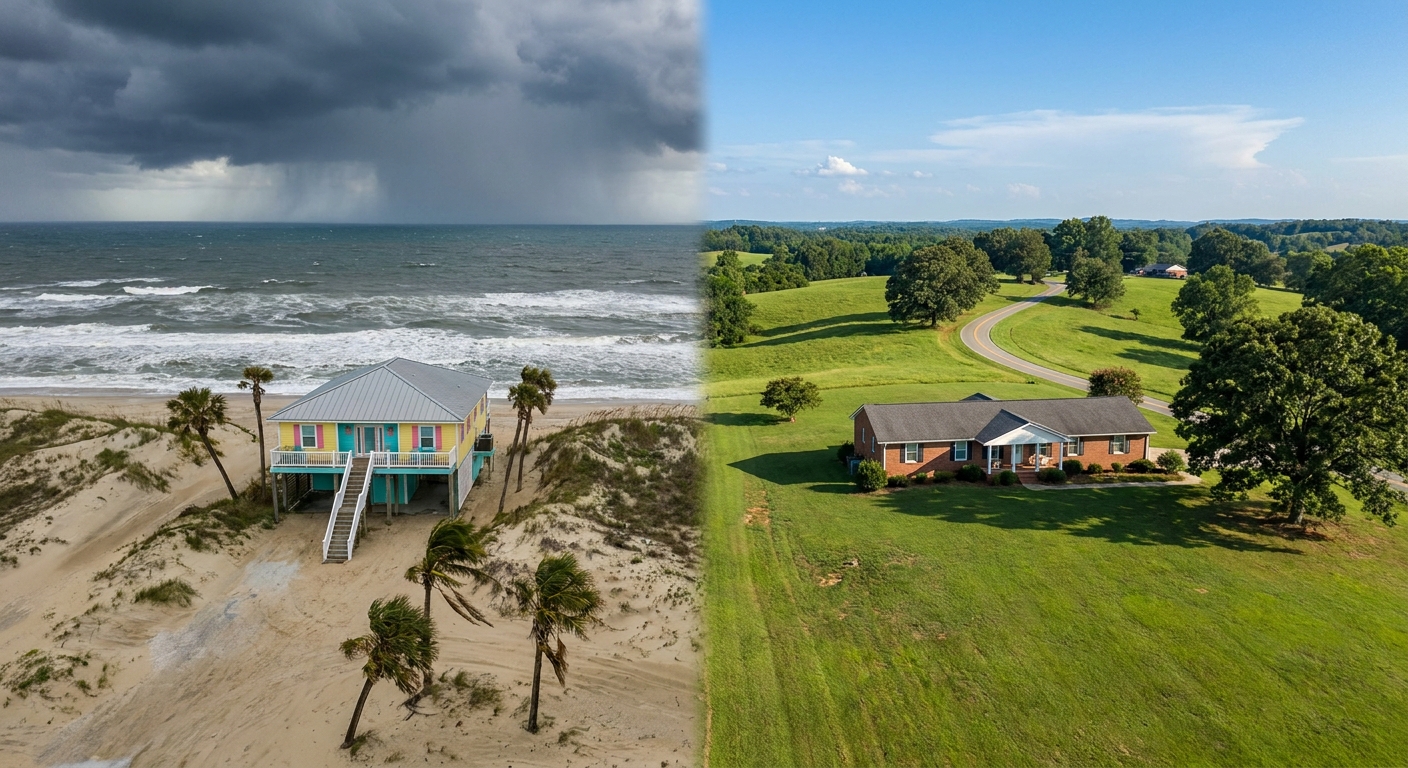
Where your home sits in North Carolina is the single biggest factor in what you'll pay for insurance. The state is effectively divided into two very different risk environments: the hurricane-exposed coastline and the comparatively calmer Piedmont and mountain regions. Statewide, the average cost of homeowners insurance in North Carolina is about $2,951 per year, or about $246 a month, for $300,000 in dwelling coverage, roughly 21% above the national average.
Average Annual Premiums by Region (2026)
| Region | Example Counties/Cities | Avg. Annual Premium |
|---|---|---|
| Mountains / High Country | Watauga, Ashe, Alleghany | ~$1,420 to $2,040 |
| Piedmont / Triad | Winston-Salem, Greensboro, High Point | ~$1,510 to $2,855 |
| Charlotte Metro | Charlotte, Mecklenburg | ~$2,050 to $3,050 |
| Triangle | Raleigh, Durham | ~$2,500 to $3,400 |
| Coastal Inland | Wilmington (inland ZIP) | ~$3,200 to $7,410 |
| Tier 1 Coastal / Beach | Outer Banks, Brunswick County | $8,000 to $25,500+ |
Note: Coastal premiums at the high end often reflect wind-only policies through the NC Beach Plan combined with a separate base policy. Flood insurance adds further cost. Bankrate data shows Wrightsville Beach ($25,536) and Southport ($25,440) top the state, running roughly 760%+ above the state average, while Wilmington-area combined premiums with wind and flood often land between $4,800 and $7,200 per year for full protection.
Following Hurricane Helene, North Carolina homeowners will soon see an average 7.5% increase in homeowners insurance rates statewide. The increase takes effect June 1 and comes after negotiations between Insurance Commissioner Mike Causey and the insurance industry. Insurers had originally requested an average 42% increase. If your North Carolina home insurance renewed on or after June 1, 2026, your premium reflects the second 7.5% increase, bringing the two-year cumulative hike to roughly 15%. The settlement bars the NCRB from seeking another statewide increase before June 1, 2027.
A separate dwelling (landlord) rate filing originally requested a 68.3% increase over two years. Insurance Commissioner Mike Causey today announced that the N.C. Department of Insurance has settled a dwelling rate case with North Carolina insurance companies. Commissioner Causey negotiated an average statewide increase of 5% per year over the next two years. The first 5% increase takes effect October 1, 2026, with the second on October 1, 2027, and the settlement also includes mitigation credits for fortified homes and roofs in certain eastern NC territories.

Compare Home Insurance Plans in Ohio
Find your best options in less than 2 minutes
Hurricane Risk, Wind & Hail Deductibles on the NC Coast
If you own a home in one of North Carolina's 18 eligible coastal counties, your coverage structure looks fundamentally different from an inland policy, and so does your out-of-pocket exposure when a storm hits.
How Wind & Hail Deductibles Work
Unlike a standard flat-dollar deductible, coastal wind and hail deductibles are percentage-based, calculated as a percentage of your home's total insured value, not the damage amount. North Carolina homeowners and Beach Plan policyholders face named-storm deductibles that apply when a named tropical system causes damage. These deductibles typically range from 1% to 5% of dwelling value depending on your policy and location, and some coastal carriers push all-wind deductibles as high as 10%.
Example: A 2% wind deductible on a $400,000 coastal home means you pay $8,000 out of pocket before your insurer covers a single dollar of wind damage. In high-hazard Tier 1 counties like New Hanover, Dare, and Brunswick, deductibles can reach 5% to 10%, meaning $20,000 to $40,000 on that same home.
Wind and hail deductibles typically apply to all wind events, not just named hurricanes. Thunderstorms, tornadoes, and tropical storms can all trigger the same deductible. In the designated beach territory (Outer Banks and coastal areas of the 8 coastal counties), most standard insurers exclude windstorm, meaning wind coverage must be purchased separately through the North Carolina Insurance Underwriting Association (NCIUA), also known as the Coastal Property Insurance Pool.

Protect your home with State Farm
Average Rate:
Homeowners who bundle and save with State Farm save an average of $1,000 per year!

You're in Good Hands® with Allstate
Average Rate:
Get comprehensive home coverage with flexible policy options.

Customize your home coverage
Average Rate:
Only pay for the coverage you need with personalized home insurance.

Smart coverage for your home
Average Rate:
Protect what matters most with award-winning home insurance.
The NC Beach Plan & Flood Insurance Requirements
When private insurers won't write policies in high-risk coastal areas, North Carolina homeowners have a safety net, but it comes at a price.
The North Carolina Beach Plan (Coastal Property Insurance Pool)
The Coastal Property Insurance Pool offers commercial, homeowner and dwelling windstorm coverage and homeowner coverage to any person having an insurable interest in property located in the 18 eligible coastal counties of North Carolina. It functions as the insurer of last resort for properties that cannot secure coverage in the standard private market. Non-coastal homeowners who cannot find coverage should look at the separate NCJUA (FAIR Plan) instead. Both plans are commonly used by owners of high-risk homes that standard carriers decline.
What You Need to Know About the NC Beach Plan (2026)
| Feature | Details |
|---|---|
| Who Qualifies | Property owners in 18 eligible coastal counties denied by private insurers |
| Coverage Offered | Windstorm, homeowners, dwelling fire, commercial fire, crime |
| Residential Building Limit | Up to $1,000,000 (personal property capped at 40% of that) |
| Commercial Building Limit | Up to $4 million per structure ($10M aggregate with firewall divisions) |
| Typical Named-Storm Deductible | 1% to 5% of dwelling value |
| Flood Coverage | NOT included, must be purchased separately |
| Requirement | Must attempt private market first |
The maximum residential limit of building coverage is $1,000,000, with a limit for personal property capped at 40% of the approved building coverage. The maximum commercial combined limit is $4 million; capped at a $10 million aggregate depending on fire wall divisions of the structure insured. To apply, work with a licensed NC insurance agent or contact the NCIUA directly.
Flood Insurance: When It's Required
Standard homeowners insurance, including the NC Beach Plan, does not cover flood damage. For NC homeowners, whether on the coast or in the mountains, flood insurance is a separate and critical policy. Hurricane Helene made this painfully clear: Less than 1% of people affected by Tropical Storm Helene in Western North Carolina had flood insurance. That means that most of the personal property and business property losses incurred as a result of the costliest disaster in North Carolina history will not be reimbursed by insurers.
Flood insurance is federally mandated if your home is located in a Special Flood Hazard Area (SFHA) and financed with a federally backed mortgage:
- Zones V and VE (coastal high-hazard: storm surge + wave action, e.g., Wrightsville Beach, Outer Banks): Required; premiums typically $3,000 to $5,000+/year
- Zones A and AE (100-year floodplain, e.g., Cape Fear or Neuse River areas): Required; typical premiums $800 to $1,300/year
- Zone X (500-year floodplain): Not required by lenders, but flooding is still possible and coverage is strongly recommended
NFIP policies through FEMA cover up to $250,000 for the building and $100,000 for contents. Private flood insurance is also available and may offer higher limits or faster claims. Under FEMA's Risk Rating 2.0, most policyholders now see higher (but capped) premiums.
Best Home Insurance Companies in NC & How Hurricanes Changed the Market
The NC home insurance market has shifted significantly following Hurricane Helene in 2024. Some insurers have retreated, rates have climbed, and availability in coastal areas has tightened. Here's where things stand in 2026.
Top Home Insurance Companies in North Carolina (2026)
| Company | Best For | Approx. Annual Premium* | Coastal Availability |
|---|---|---|---|
| State Farm | Cheapest overall rates | ~$1,274 | Yes (selective) |
| NC Farm Bureau | NC-specific expertise & coastal value | Competitive | Yes (strong) |
| USAA | Military families | ~$2,644 | Yes (military only) |
| Erie Insurance | Low complaints & claims handling | Moderate | Limited coastal |
| Nationwide | Bundling & coverage options | Moderate | Reduced coastal presence |
| Travelers | Customizable coverage | Moderate to High | Yes |
| Amica | Customer satisfaction | Moderate to High | Limited coastal |
| Chubb | High-value homes | Premium pricing | Yes |
*Premiums based on $300,000 dwelling coverage; coastal rates will be significantly higher.
Multiple 2026 industry analyses (MoneyGeek, Bankrate, and Insurance.com) rank State Farm, NC Farm Bureau, USAA, and Erie among the top NC insurers, with State Farm typically offering the lowest average annual premium near $1,274 and NC Farm Bureau frequently the cheapest option in coastal cities like Topsail Beach and Surf City.
How Hurricane Helene Changed Everything
After Hurricane Helene hit North Carolina, roughly 1 in 4 storm claims closed with no payout at all, largely because standard policies exclude flood damage. North Carolina homeowners are trapped in an insurance crisis where premiums have surged by 38% since 2019, major insurers are abandoning tens of thousands of policyholders, and more than 25% of Hurricane Helene claims were closed without any payment to devastated families.
Key market shifts include:
- Statewide homeowners rates rose 7.5% on June 1, 2025 and another 7.5% on June 1, 2026 (about 15% cumulative)
- Beach counties from Carteret to Brunswick are seeing rate hikes around 16% in 2025 and 15.9% in 2026, while Charlotte faces back-to-back increases of about 9%
- Mountain counties hit hardest by Helene received smaller hikes of roughly 4.4% in 2025 and 4.5% in 2026
- An analysis by Reuters reveals that merely 0.5% of residences in the Western North Carolina counties most severely impacted by Hurricane Helene were enrolled in the National Flood Insurance Program
- Only 2% of Hurricane Helene victims in North Carolina, South Carolina, and Georgia had flood insurance, highlighting a critical coverage gap
- The separate dwelling (landlord) policy filing (originally 68.3%) was negotiated down to about 5% per year effective October 2026 and 2027
The pattern is clear: insurers are pulling back from the highest-risk coastal areas, and those who remain are charging more. Shopping your policy annually and working with an independent agent who specializes in coastal home insurance has never been more important. For a broader look at the market forces at play, see how climate change is driving costs up nationwide, or compare NC to other states in our state-by-state cost guide.
Money-Saving Tips by Region
For Coastal NC Homeowners:
- Get a wind mitigation inspection. Storm shutters, reinforced roofs, and impact-resistant windows can earn meaningful discounts through the NCIUA
- Consider IBHS FORTIFIED construction upgrades to reduce wind exposure and unlock insurer discounts
- Shop private flood insurers alongside NFIP for potentially better rates
- Ask about a named-storm deductible vs. an all-wind deductible. It can mean a narrower trigger on your out-of-pocket costs
- Learn how hurricane coverage is actually assembled from multiple policies
For Piedmont & Mountain NC Homeowners:
- Bundle home and auto policies for 10-25% savings
- Install a monitored security/fire alarm system for discounts
- Raise your standard deductible from $1,000 to $2,500 to lower your premium
- Review replacement cost coverage annually. Construction costs have risen significantly since 2020
- Don't skip flood coverage. Helene proved flooding can devastate even non-coastal areas
Frequently Asked Questions
What is the average cost of home insurance in North Carolina?
Statewide, North Carolina homeowners pay an average of roughly $2,951 per year on a $300,000 policy, about 21% above the national average. Mountain and Piedmont areas tend to fall at the lower end (around $1,420 to $2,855 annually), while coastal areas can easily reach $8,000 to $25,500 or more when separate wind and flood policies are included. With approved rate hikes of 7.5% in both June 2025 and June 2026, costs have climbed roughly 15% cumulatively since Helene.
Do I need hurricane insurance in North Carolina?
There is no standalone "hurricane insurance" product. Hurricane protection is assembled from multiple policies. For coastal homeowners, this typically means a base homeowners policy (often excluding wind), a separate wind/hail policy through the NC Beach Plan or a private insurer, and a flood insurance policy through NFIP or a private carrier. Inland homeowners are usually covered for wind under their standard policy but still lack flood protection unless they purchase it separately.
What is the NC Beach Plan and who qualifies?
The NC Beach Plan (officially the Coastal Property Insurance Pool) is a state-created insurer of last resort for homeowners in North Carolina's 18 eligible coastal counties who cannot find coverage in the private market. As of 2026, it offers windstorm, homeowners, dwelling fire, and commercial fire coverage with residential building limits up to $1 million and commercial limits up to $4 million per structure (with a $10 million aggregate). To qualify, you must first attempt to get coverage from private insurers, then apply through a licensed NC insurance agent.
How do wind and hail deductibles work on the NC coast?
Coastal wind and hail deductibles are percentage-based rather than flat dollar amounts, typically ranging from 1% to 5% of your home's insured value for named storms, and up to 10% for all-wind events on some policies. These deductibles often apply to all wind events, not just named storms. On a $350,000 home with a 3% deductible, you would pay $10,500 out of pocket before insurance kicks in. In Tier 1 counties like Dare and New Hanover, wind coverage is often stripped from the base policy entirely and must be purchased through the NCIUA.
How has Hurricane Helene affected home insurance in NC?
Hurricane Helene's 2024 destruction accelerated rate increases and insurer retreats across North Carolina. Approved statewide rate hikes of 7.5% took effect in June 2025 and June 2026 (about 15% cumulative), with coastal counties seeing increases as high as 16%. About 1 in 4 Helene homeowners claims closed without payment, largely because standard policies excluded flood damage, and only around 0.5% of homes in the hardest-hit western NC counties had flood coverage through the NFIP. The NC Rate Bureau had originally requested a 42.2% increase before the commissioner negotiated it down, and no new homeowners increase can be filed before June 2027.