
Compare Home Insurance Plans in Ohio
Find your best options in less than 2 minutes



How Standard Home Insurance Covers Tornado Damage
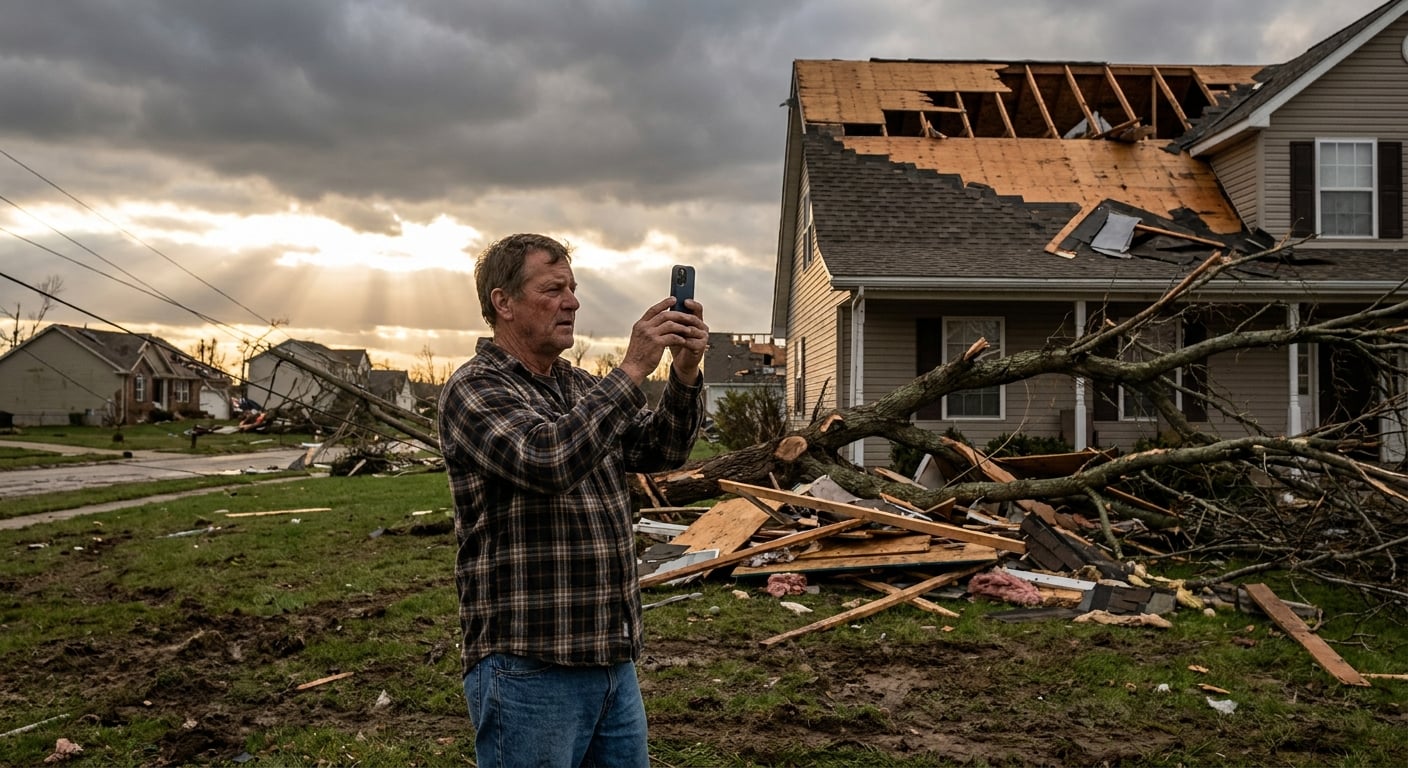
A standard HO-3 homeowners policy (the form most Americans carry) treats tornadoes as a covered "windstorm and hail" peril. That means damage from the funnel itself, flying debris, and structural collapse triggered by the storm are all paid out under your existing policy, with no special tornado rider required in most inland states.
Four parts of your policy spring into action after a tornado:
| Coverage | What It Pays For | Typical Limit |
|---|---|---|
| Dwelling (Coverage A) | Repairs or full rebuild of the home and attached structures | 100% of insured value |
| Other Structures (Coverage B) | Sheds, fences, detached garages, gazebos | 10% of Coverage A |
| Personal Property (Coverage C) | Furniture, electronics, clothing, appliances | 50-70% of Coverage A |
| Loss of Use / ALE (Coverage D) | Hotel, rent, meals while displaced | 20-30% of Coverage A |
Personal property can be reimbursed at either actual cash value (depreciated) or replacement cost (cost of a new equivalent item). Replacement cost coverage typically costs a bit more in premium but pays out significantly more after a major loss, so it is worth the upgrade in tornado-prone areas.

Compare Home Insurance Plans in Ohio
Find your best options in less than 2 minutes
What's Not Covered After a Tornado
This is where claims get denied. Even when wind damage is covered, several common tornado-related losses fall outside a standard policy.
Flooding from tornado rain or storm surge
Rising water is almost always excluded. If torrential rain accompanying the tornado floods your basement, or a swollen creek overflows into your living room, you need a separate flood insurance policy from the National Flood Insurance Program (NFIP) or a private flood carrier. There is one exception worth knowing: if wind first creates an opening (a blown-off roof or a broken window) and rain then enters through that opening, the resulting water damage is usually covered as part of the wind claim. See our full breakdown of water damage coverage for more on the wind-versus-flood distinction.
Vehicle damage
Your homeowners policy does not cover cars, trucks, motorcycles, or RVs, even if they were parked in your attached garage when the tornado hit. Vehicle damage falls under the comprehensive coverage portion of your auto insurance policy. If you only carry liability, there is no insurance protection for your vehicle.
Other common exclusions
- Cosmetic-only damage to siding or roofing under many current policies
- Pre-existing wear and tear or maintenance issues the adjuster attributes to age, not the storm
- Landscaping beyond modest tree-removal limits (usually $500-$1,000)
- Outbuildings used for business in many policies

Protect your home with State Farm
Average Rate:
Homeowners who bundle and save with State Farm save an average of $1,000 per year!

You're in Good Hands® with Allstate
Average Rate:
Get comprehensive home coverage with flexible policy options.

Customize your home coverage
Average Rate:
Only pay for the coverage you need with personalized home insurance.

Smart coverage for your home
Average Rate:
Protect what matters most with award-winning home insurance.
Wind and Hail Deductibles in Tornado Alley
If you live in Oklahoma, Kansas, Texas, Nebraska, Missouri, Arkansas, or anywhere across the central plains, expect a separate wind/hail deductible that's much higher than your standard "all other perils" deductible.
Unlike a flat $1,000 or $2,500 deductible, wind/hail deductibles are usually calculated as a percentage of your dwelling coverage, typically between 1% and 5%. In 2026, a 2% deductible has become the dominant standard across most Texas markets, with North Texas carriers moving to 3% in higher-risk zones and Oklahoma and Kansas commonly using 1% to 2% as their baseline. Notably, the Texas FAIR Plan Association eliminated its 1% wind/hail option effective July 1, 2026, automatically moving all existing 1% policies to 2% at renewal. Here's how that math plays out:
| Dwelling Coverage | 1% Deductible | 2% Deductible | 5% Deductible |
|---|---|---|---|
| $200,000 | $2,000 | $4,000 | $10,000 |
| $300,000 | $3,000 | $6,000 | $15,000 |
| $450,000 | $4,500 | $9,000 | $22,500 |
| $600,000 | $6,000 | $12,000 | $30,000 |
For a deeper breakdown, see our guide on wind and hail deductibles and how they now work state by state.
How to lower your out-of-pocket exposure
You have a few options if a 2% deductible feels too steep:
- Deductible buy-down endorsements that reduce a 2% deductible to a fixed $2,500 or $5,000 cap (typically 6-15% of the buydown amount)
- Supplemental wind/hail deductible policies that reimburse you up to $25,000 after a qualifying storm
- Lowering the percentage in exchange for higher premium (1% instead of 2%, where still available from carriers like The Hartford in North Texas)
- Impact-resistant roof discounts that can cut premiums 15-35% in many tornado alley states
Filing a Tornado Damage Insurance Claim
Acting quickly and documenting thoroughly are the two factors that separate a smooth claim from a frustrating one. This matters more than ever in 2026, since the five largest carriers now deny or short-pay over 44% of claims, and post-tornado data from major 2025 outbreaks shows average payouts leaving many homeowners short due to under-scoping and depreciation.
Step-by-step process
- Confirm it's safe to enter the property. Watch for live wires, gas leaks, and unstable walls. Wait for official all-clear notices before returning to a damaged area.
- Make emergency repairs only. Tarp the roof, board up broken windows, and remove standing water. Save every receipt. Do not start permanent repairs yet.
- Document everything before cleanup. Take wide-shot and close-up photos and video of every damaged area inside and out. Capture serial numbers on electronics and appliances.
- Call your insurer immediately. Most policies have notification time limits. Get a claim number, your adjuster's contact, and a list of deadlines.
- Build a room-by-room inventory. List each damaged item with description, brand, model, age, purchase price, and estimated replacement cost. Attach receipts, bank statements, or photos as proof.
- Meet with the adjuster on-site. Walk them through every damaged area. Provide your photos, video, and inventory list. Take notes on what they say.
- Get independent contractor estimates. Compare them against the adjuster's number before signing any settlement.
- Track ALE expenses. Save hotel, restaurant, fuel, and storage receipts while your home is uninhabitable.
Documentation that wins claims
How Total Losses Are Handled
When a tornado completely destroys a home, the claim becomes a "total loss" and the rules shift. Your insurer pays the dwelling limit on your declarations page, not necessarily the true rebuild cost. With construction and roofing prices climbing sharply through 2025 and 2026, dwelling limits need to keep pace or you will end up short.
If you carry extended replacement cost coverage (usually 25-50% above your dwelling limit), the insurer will pay above the base limit when rebuild costs exceed it. Guaranteed replacement cost policies, which are rarer but available from some carriers, pay whatever it actually costs to rebuild to original specifications.
Most total-loss settlements are paid in stages: an initial advance for immediate needs, an actual cash value payment for the structure, and a final replacement-cost holdback once you sign rebuild contracts. Mortgage lenders are usually named on the check, so expect coordination with your bank before funds release.
Average Tornado Insurance Payouts
Severe convective storms (which include tornadoes, hail, and straight-line winds) produced roughly $51 billion in U.S. insured losses in 2025, the third straight year above $50 billion. Through mid-June 2026, U.S. severe convective storm insured losses had already topped $22 billion, marking the 11th consecutive year above the $20 billion mark, and Aon's H1 2026 recap put the six-month total closer to $27 billion. Individual claim payouts vary enormously by damage severity, home value, and deductible:
- Minor wind damage (roof, siding, fence): $3,000-$8,000 typical repair cost
- Moderate damage (roof replacement, interior water intrusion, content losses): $15,000-$50,000
- Severe partial loss (significant structural damage): $75,000-$200,000+
- Total loss rebuild: equal to your dwelling limit, often $300,000-$700,000+
Wind and hail claims now average around $13,500 per incident (with tornado-specific claims typically running $15,000 to $25,000) and account for roughly 45% of all homeowners claims filed in a given year. Learn more about hail damage claims and how adjusters evaluate storm damage.
How Tornado Alley Affects Your Premiums
Living in a high-risk wind state costs real money on your premium. According to 2026 carrier data, the tornado belt dominates the top of national premium rankings:
| State | Average 2026 Premium | vs. National Average |
|---|---|---|
| Oklahoma | $5,300 - $7,700 | +75% to +150%+ |
| Nebraska | $5,640 - $6,015 | +85% to +97% |
| Kansas | $5,260 - $5,455 | +72% to +78% |
| Texas | $4,700 - $4,915 | +54% to +61% |
The national average homeowners premium in 2026 is roughly $3,057 per year, up 4% from 2025 after a double-digit jump the year before. Tornado alley homeowners in Oklahoma, Nebraska, and Kansas spend the highest percentage of their household income on home insurance in the country, with Oklahoma leading at roughly 6.84% of income. See our full Oklahoma home insurance guide for state-specific savings strategies.
Tornado vs Hurricane Insurance Coverage
Both are wind events, but insurers treat them very differently depending on geography. Learn more about how wind damage coverage applies in both scenarios, or compare against a full hurricane insurance breakdown.
Both perils share one major exclusion: flooding requires a separate flood policy. Storm surge from a hurricane and rain-driven flooding from a tornado are both handled by NFIP or private flood insurance, never homeowners. For broader storm exposure, our guide on severe convective storms covers the full spectrum of wind, hail, and tornado risk.
When FEMA Disaster Assistance Steps In
FEMA aid is a safety net, not a replacement for insurance. After a federal disaster declaration, FEMA's Individual Assistance program can help with:
- Temporary housing grants when ALE coverage runs out or you have none
- Basic safe-and-sanitary repairs to make the home habitable (not full rebuilds)
- Essential personal property like appliances and a primary vehicle
- Medical, dental, and funeral expenses tied to the disaster
- SBA disaster loans for uninsured repair costs above grant caps
For federal fiscal year 2026 (October 2025 through September 2026), FEMA's Individual Assistance caps sit at $43,600 for Housing Assistance and $43,600 for Other Needs Assistance, a combined maximum of $87,200 per household per disaster. These caps are adjusted every October 1 based on the Consumer Price Index, and typical actual awards average only $3,000 to $8,000.
Three critical limits to understand:
- FEMA will not duplicate any benefit your insurance pays. File your insurance claim first.
- FEMA does not pay deductibles or cover upgrades beyond minimum safety requirements.
- Most households receive well under the maximum. The caps are ceilings, not typical awards.
If you're uninsured or underinsured, FEMA can keep you housed and your family fed, but it won't make you whole the way a properly sized homeowners policy can. For broader coverage questions after major events, review our guide on tree damage and home insurance since fallen trees are one of the most common tornado secondary losses.
Frequently Asked Questions
Does homeowners insurance cover tornado damage to my roof?
Yes. A standard HO-3 policy treats tornado roof damage as a covered windstorm loss, including blown-off shingles, structural damage, and water intrusion through wind-created openings. Your wind/hail deductible applies, which in tornado alley states is often 1-2% of your dwelling limit. Watch for the March 2026 Fannie Mae and Freddie Mac rule allowing ACV roof coverage, which could significantly reduce your payout on an older roof.
Do I need separate tornado insurance?
In most cases, no. Tornadoes are covered under the windstorm peril in standard policies. The exception is coastal areas where wind has been excluded from the base policy and requires a separate windstorm endorsement or state wind-pool policy. Always confirm with your agent that wind/hail is listed as a covered peril before storm season.
Will my insurance pay if a tornado destroys my car in the driveway?
Not under your homeowners policy. Vehicle damage from any cause, including tornadoes, is handled by the comprehensive portion of your auto insurance. If you only carry liability coverage, there is no protection for your vehicle. Comprehensive is typically inexpensive and well worth adding if you live in a tornado-prone area.
How long do I have to file a tornado damage claim?
Most policies require "prompt" notification, which typically means within a few days to a week of the event. Many states extend deadlines after federally declared disasters, and Oklahoma's HB 3495 now gives homeowners 24 months to file hidden damage claims. Call your insurer the same day if possible, even without full damage information, just to get a claim number on the record.
What is a wind/hail deductible buy-down?
A buy-down is a supplemental endorsement or standalone policy that reduces the out-of-pocket cost of a percentage-based wind/hail deductible. For example, instead of paying a 2% deductible ($8,000 on a $400,000 home), a buy-down might cap your responsibility at $2,500 or $5,000. They typically cost 6-15% of the buydown amount and can be a smart purchase in Oklahoma, Kansas, and parts of Texas.