
Compare Car Insurance Rates in Ohio
See if you qualify for a lower rate in less than 2 minutes



What Does Auto Insurance Actually Cover for a Towed Trailer?
Before spending money on a separate policy, it helps to understand exactly what your existing auto insurance already covers and where it stops.
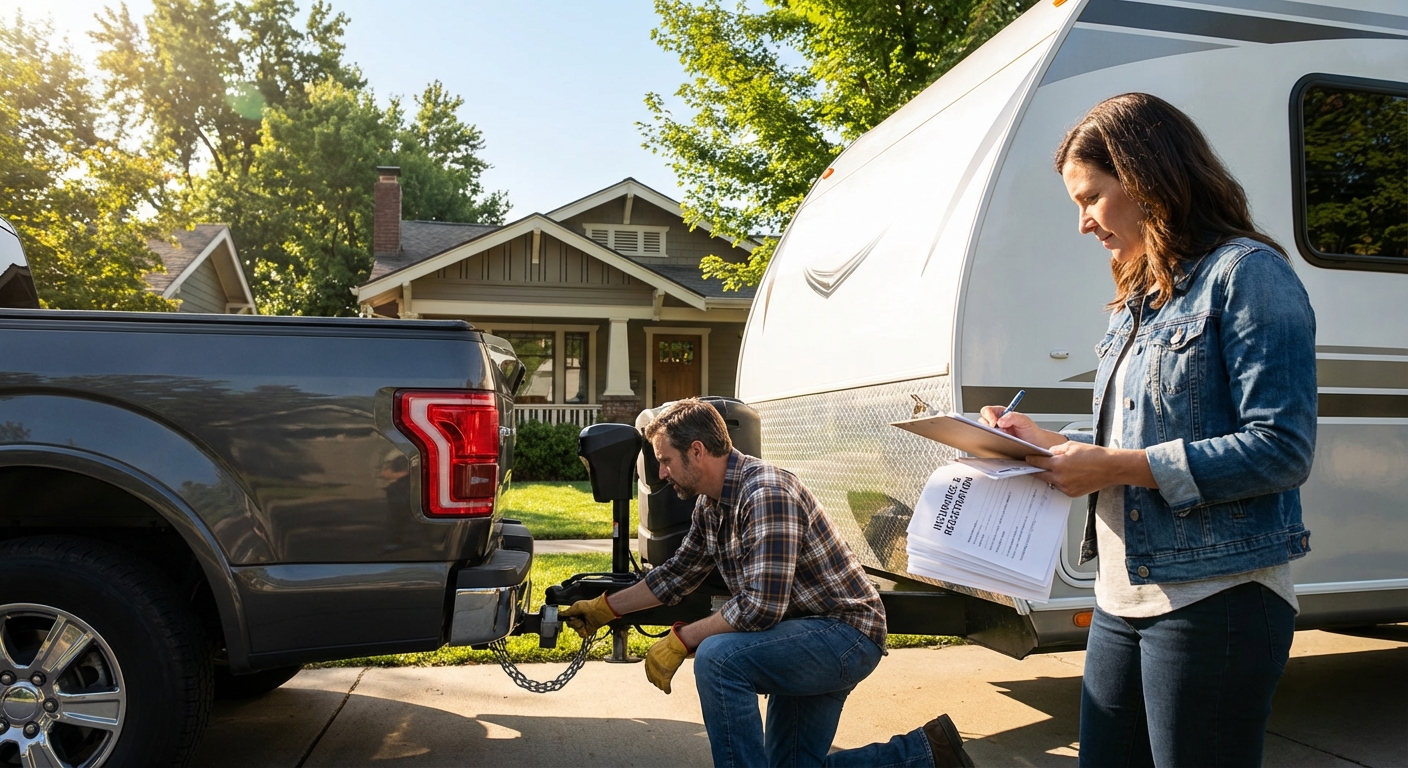
When your travel trailer is properly hitched to your tow vehicle, your auto policy's liability coverage does extend to the trailer. That means if you cause an accident while towing and injure someone or damage their property, your tow vehicle's bodily injury and property damage limits apply. However, that coverage is strictly for damage done to others. It does not protect the trailer itself.
Here's a clear breakdown of what a standard auto policy will and won't cover for a towed trailer:
| Coverage Type | Covered by Auto Policy? | Notes |
|---|---|---|
| Liability (bodily injury/property damage) | ✅ Yes | Applies only while actively towing |
| Collision damage to the trailer | ❌ No | Requires separate trailer policy |
| Comprehensive (theft, fire, weather) | ❌ No | Not included in auto policies |
| Personal belongings inside trailer | ❌ No | Needs personal property or contents coverage |
| Liability when parked/unhitched | ❌ No | Requires vacation or full-timer liability |
The bottom line: your auto insurance provides a thin layer of protection while the trailer is on the road, but it leaves massive gaps the moment the trailer is damaged, stolen, or parked at a campsite. Learn more about comprehensive car insurance coverage if you want a closer look at how comprehensive works on the auto side.

Compare Car Insurance Rates in Ohio
See if you qualify for a lower rate in less than 2 minutes
Understanding Travel Trailer Insurance Coverage Types
A standalone travel trailer policy, available from top-rated carriers like Progressive, Nationwide, Foremost, Good Sam, Roamly, and National General, fills those gaps with several coverage types designed specifically for towable campers. Progressive's most-cited countrywide average for a 12-month travel trailer policy is $594 per year, and Money's August 2026 review cites right around $600 per year for the same full coverage. Progressive is widely ranked best overall and best for affordability, Nationwide leads on stacked discounts, Good Sam is a favorite for part-time RVers and storage savings, National General shines for auto and RV bundles and full-timer coverage, Foremost specializes in full-timer and specialty rigs, and Roamly is built for owners who rent out their trailer on peer-to-peer platforms.
Comprehensive and Collision Coverage
These two coverages protect the physical structure of your trailer itself:
- Comprehensive covers non-collision events like theft, vandalism, fire, hail, wind damage, falling objects, and animal collisions.
- Collision covers damage to your trailer from accidents with other vehicles or objects, regardless of fault.
Both come with a deductible, typically ranging from $250 to $1,000. Raising your deductible is one of the easiest ways to lower your annual premium.
Personal Belongings / Contents Coverage
Everything you bring on a camping trip (laptops, clothing, bikes, camping gear) is not covered by your auto policy while stored in a travel trailer. A dedicated contents coverage rider protects personal effects inside the trailer. Most standard recreational RV policies only provide about $3,000 to $5,000 in contents coverage, while full-timer endorsements can push that limit up to $50,000 or more with replacement cost value.
Vacation Liability (Campsite Liability)
Once your trailer is parked and unhitched, your auto liability coverage disappears. Vacation liability, sometimes included automatically in camper policies, covers bodily injury or property damage that occurs at your campsite. If a guest trips and falls inside or around your trailer, this coverage applies.
Total Loss Replacement
For newer trailers (typically within the first 4 to 5 model years), this endorsement replaces a totaled trailer with a brand-new equivalent model rather than paying you the depreciated actual cash value. Progressive offers a diminishing deductible that reduces by 25% at each claim-free renewal and can eventually drop to $0 on qualifying policies. National General also features a diminishing deductible option, and Geico is frequently ranked best for total loss replacement in 2026.
Emergency Expense Coverage
If your trailer becomes uninhabitable due to a covered loss while you're on the road, emergency expense coverage pays for hotel stays and transportation until repairs are made. Recreational policies typically cap this benefit around $1,000, while full-time policies often extend it to $5,000 or more.
If you already own or are considering a motorhome instead of a towable, many of these same coverage types apply, though motorhomes have additional requirements since they're self-propelled vehicles.

Protect your car with Farmers
Average Rate:
Find coverage options that fit your budget.

The insurance savings you expect.
Average Rate:
Enjoy personalized policies, comprehensive coverage & more.

See how much you could save today!
Average Rate:
Drivers who switch their auto insurance and save with State Farm save $764 on average!

Safe Drivers Save with Allstate®
Average Rate:
Get rewarded with savings for having a clean driving record.
Full-Timer vs. Recreational Use Policies
How often you use your travel trailer dramatically affects what kind of policy you need and what you'll pay.
Recreational (Part-Time) Use
A seasonal or recreational RV policy is designed for owners who use their RV recreationally for a portion of the year, typically fewer than 150 days or under 5,000 miles annually, and maintain a permanent residence elsewhere. These policies are less expensive because they factor in reduced exposure time. Weekend campers using their trailer 30 to 50 days per year typically pay standard recreational rates.
Full-Timer Coverage
A full-timer policy is built for those who live in their RV as a primary residence or use it six months or more per year. Most insurers now classify you as a full-timer if you live in the trailer for 150 or more nights annually. It functions more like homeowners insurance on wheels, providing homeowner-style protections that standard recreational policies do not include. Full-timer policies typically add:
- Higher personal liability limits (typically $100,000 to $300,000 for injuries at your campsite, with some guides recommending $500,000 or more paired with umbrella coverage)
- Expanded personal belongings coverage ($25,000 to $50,000+ vs. $3,000 to $5,000 for recreational policies)
- Loss-of-use or additional living expenses if the trailer becomes uninhabitable
- Medical payments ($1,000 to $10,000+) and uninsured motorist coverage
- Optional loss assessment (for campground or HOA fees) and permanent attachments coverage
Full-time use can push premiums roughly 20% to 40% higher on the low end and 40% to 100% higher on the high end compared to a similar recreational policy, with 2026 full-timer policies typically ranging from $1,500 to $4,000 per year depending on trailer value, location, and coverage choices. After sharp premium spikes between 2021 and 2024, the recreational towable RV market is essentially flat heading into late 2026, though full-timers continue to see upward pressure driven by year-round exposure, rising repair costs, and severe weather losses. A standard recreational policy used for full-time living can result in claim denials, so accurate classification is critical.
If you're weighing full-time RV living against a small permanent structure, our tiny home insurance guide breaks down a related coverage path.
Fifth Wheels, Pop-Up Campers & Financed Trailers
Fifth Wheel Insurance
A fifth wheel is a large, high-value towable that connects to a special hitch in the bed of a pickup truck. While most U.S. states don't legally require insurance on a non-motorized fifth wheel, the trailer's high value and home-like features make a full coverage policy essential. Most fifth wheel owners need:
- Comprehensive and collision coverage
- Campsite/vacation liability
- Roadside assistance
- Personal property/contents coverage
- Full-timer endorsement if used as a primary residence
Annual premiums for a fifth wheel typically range from $500 to $1,500 for standard units, with luxury triple-slide models running $1,500 to $2,500 or more. Higher repair costs driven by the complexity of modern RV systems (including solar installations and smart technology) continue to push fifth wheel premiums toward the higher end of that range in 2026.
Pop-Up Camper Insurance
Pop-up campers (folding camping trailers) are smaller, lighter, and lower in value than fifth wheels or standard travel trailers. Basic liability coverage starts at around $125/year, while a fuller policy with comprehensive and collision coverage typically runs $200 to $350 annually, with high-end coverage rarely exceeding $500. The canvas sides of pop-ups make them especially vulnerable to weather and tearing, so comprehensive coverage is worth considering even on a budget unit.
Do Lenders Require Insurance on Financed Trailers?
Yes, virtually always. While most states don't legally require insurance on non-motorized trailers, lenders almost universally require comprehensive and collision coverage as a condition of financing. Many lenders also cap deductibles (a $1,000 maximum is common) and require the lender to be named as loss payee before releasing loan funds. If you allow your coverage to lapse, your lender may purchase force-placed insurance on your behalf at a much higher cost with limited protection for you, or may even declare your loan in default and pursue repossession. Some lenders also require or recommend gap coverage to bridge the difference between what you owe and the trailer's depreciated value if it's totaled early in the loan.
State-by-State Insurance Requirements
The legal landscape for trailer insurance varies more than most people realize. Most states require liability insurance and uninsured/underinsured motorist coverage for RVs that have a motor and are self-powered, with New Hampshire and Virginia being the notable exceptions. For non-motorized trailers hooked up to your car, most states rely on the tow vehicle's auto liability policy, which extends to the trailer while attached. Here's a snapshot of where things stand for 2026:
| State | Requirement |
|---|---|
| Michigan | Trailers with more than 2 wheels are treated as motor vehicles under MCL 500.3101 and require Michigan No-Fault (applies to most travel trailers and fifth wheels), including 50/100/10 liability, PIP, and PPI up to $1 million |
| California | Trailers with unladen weight of 750 lbs or more must be registered and endorsed to an auto policy |
| Texas | Trailers with GVWR of 4,500 lbs or more must be insured |
| New York | Liability insurance mandated for most trailers registered for road use |
| Ohio | Trailers with GVWR of 3,000 lbs or more require liability coverage |
| North Carolina | All registered trailers require liability insurance |
| Florida | Personal-use trailers not required; commercial and financed trailers require coverage |
| Most Other States | No separate trailer requirement (lender requirements still apply) |
How Much Does Travel Trailer Insurance Cost in 2026?
Annual premiums vary based on trailer type, value, your location, usage, and coverage levels. Progressive's most-cited countrywide average premium for a 12-month travel trailer policy is $594, while motorhome coverage averages $1,052. Allstate reports a 2026 monthly average of $52 for travel trailers and $73 for motorhomes. Here's a general cost overview for 2026:
| Trailer Type | Basic/Liability Coverage | Full Coverage |
|---|---|---|
| Pop-Up Camper | ~$125/year | $200-$350/year |
| Standard Travel Trailer | $180-$300/year | $300-$800/year |
| Fifth Wheel | $500-$800/year | $800-$2,500/year |
| Full-Timer (any type) | N/A | $1,500-$4,000/year |
Regional factors matter more than ever in 2026. Florida averages well above the national average due to hurricane risk and higher repair costs, California adds wildfire surcharges in high-risk ZIP codes, and hail-prone plains states are seeing carriers reclassify risk upward. You can offset these pressures through several proven strategies. Storing your trailer in secure, monitored facilities typically qualifies for 10% to 25% discounts compared to driveway or street parking, and some insurers (including Progressive and Good Sam) offer storage discounts as high as 53% for seasonal layup periods of 4+ months. Combined with bundling (10% to 25% savings), a claim-free driving record for the past 3 years, safety devices, an approved RV safety course, and paying in full, stacking multiple discounts can yield combined savings of 20% to 40%. For a deeper look at how bundling home and auto with an RV policy stacks up, our dedicated guide breaks down the math, and our full list of home insurance discounts shows how bundling stacks with other homeowner savings. If you want a broader look at whether bundling is really worth it, our bundling deep-dive walks through when it makes sense to keep policies separate.
If you're considering a self-propelled RV instead of a towable, see how motorhome insurance compares on cost and coverage. And if a storm damages both your tow vehicle and home at once, a common loss deductible can help you avoid paying two deductibles at the same time.
Frequently Asked Questions
Is travel trailer insurance legally required?
In most U.S. states, separate insurance is not legally required for non-motorized travel trailers because the towing vehicle's auto liability policy typically extends to the trailer while it's hitched. However, Michigan requires No-Fault insurance on trailers with more than two wheels (which includes most travel trailers and fifth wheels), and several other states like New York and North Carolina mandate liability coverage on registered trailers. If your trailer is financed, your lender will almost certainly require comprehensive and collision coverage as a loan condition. Even without legal mandates, going without coverage on a valuable trailer is a significant financial risk.
Does my auto insurance cover my travel trailer?
Your auto insurance extends liability coverage to a travel trailer while it's properly hitched and being towed, but only for damage you cause to other people or property. It does not cover damage to the trailer itself, theft, weather damage, or any personal belongings stored inside. Once the trailer is parked or unhitched, even that liability coverage disappears. A standalone travel trailer policy is the only way to close those gaps.
What's the difference between a full-timer and recreational travel trailer policy?
A recreational policy is designed for occasional use like weekends and vacations, and offers basic physical damage and limited personal property coverage (typically $3,000 to $5,000). A full-timer policy is built for those living in their trailer 150+ nights or 6+ months per year, offering homeowners-style protections including higher liability limits, expanded personal property coverage ($25,000 to $50,000+), medical payments, uninsured motorist protection, loss assessment, and loss-of-use benefits. Using a recreational policy while living full-time in your trailer can result in denied claims, so accurate classification is essential.
How much does travel trailer insurance cost per year?
Costs vary widely depending on trailer type, value, location, and coverage level. A basic pop-up camper policy can start around $125/year, while a standard travel trailer with full coverage typically runs $300 to $800/year, with Progressive's national average right around $594 to $600. A fifth wheel with comprehensive coverage can range from $800 to $2,500 annually for larger units, and full-time living policies range from $1,500 to $4,000 per year. Bundling with your existing auto or home policy (saving 10% to 25%) and using secure storage (up to 53% off during layup months) are the fastest ways to lower your premium.
Do I need separate insurance for a fifth wheel trailer?
No state universally requires separate insurance on a fifth wheel, but the tow vehicle must meet its state's auto liability minimums, and lenders who finance fifth wheels almost always require comprehensive and collision coverage. Michigan is a notable exception, requiring No-Fault insurance on most fifth wheels because they have more than two wheels. Given the high value of most fifth wheels and their home-like features, a comprehensive policy covering collision, theft, weather damage, campsite liability, and personal property is strongly recommended. Without it, a single storm, accident, or theft could leave you with a total loss and no financial recovery.