
Compare Car Insurance Rates in Ohio
See if you qualify for a lower rate in less than 2 minutes



What Is Property Damage Liability Coverage?
Property damage liability coverage is the portion of your auto insurance policy that pays to repair or replace another person's property when you are at fault in an accident. It is required by law in nearly every U.S. state and is one of the core components of a standard auto policy, alongside bodily injury liability.
Unlike some coverages that protect you and your vehicle, property damage liability is entirely focused on third-party losses. When you cause an accident, your insurer steps in to pay the other party's damages up to your policy's per-accident limit, and does so with no deductible applied on your end. To understand how this fits in the broader picture, see our overview of first-party vs. third-party coverage.
Think of it as the financial bridge between your mistake behind the wheel and the bills someone else is left with. Without it, you'd be personally responsible for every dollar of damage caused.

Compare Car Insurance Rates in Ohio
See if you qualify for a lower rate in less than 2 minutes
What Does Property Damage Liability Cover?
Property damage liability is broader than most drivers realize. It doesn't just cover fender-benders. It can pay for a wide range of third-party property losses stemming from an at-fault accident.
Types of Property Covered
| Property Type | Examples |
|---|---|
| Other vehicles | Cars, trucks, motorcycles, RVs, boats on trailers |
| Structures | Buildings, storefronts, garages, walls |
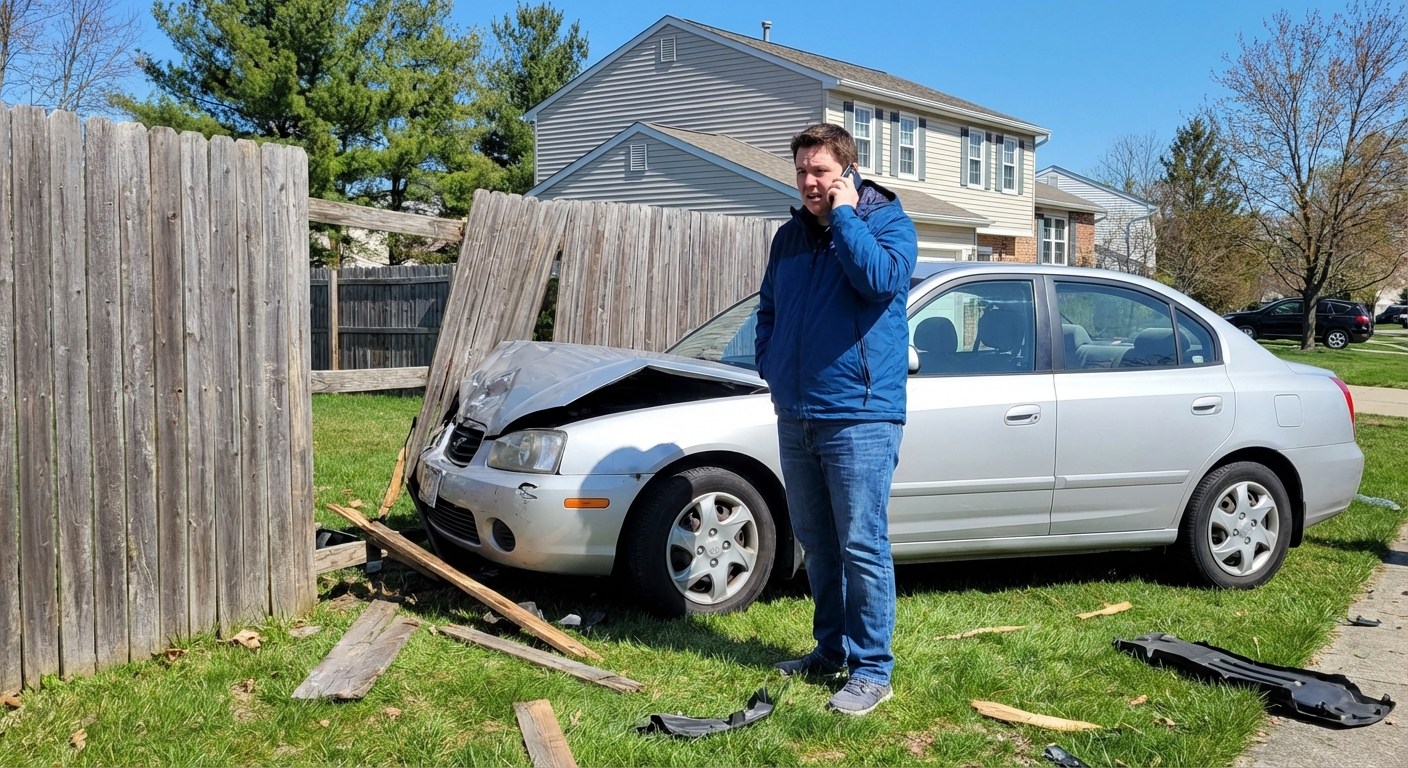
| Yard & outdoor features | Fences, gates, mailboxes, landscaping, trees |
| Roadway infrastructure | Utility poles, guardrails, traffic signs |
| Personal property | Items damaged inside the other party's vehicle |
| Related expenses | Towing costs, rental while vehicle is repaired, loss of use |
Beyond physical repairs, property damage liability also typically covers your legal defense costs if the other party sues you over the damage. That alone can be worth thousands in attorney fees. For a broader look at what auto policies actually pay for, see our guide on what car insurance covers.
What It Does NOT Cover
- ❌ Damage to your own vehicle (requires collision or comprehensive coverage)
- ❌ Injuries to other people (requires bodily injury liability)
- ❌ Your own medical bills after an accident (requires personal injury protection or MedPay)
- ❌ Damage from theft, weather, or vandalism (requires comprehensive coverage)
- ❌ Any damages exceeding your policy limit, meaning you pay the rest out of pocket

Protect your car with Farmers
Average Rate:
Find coverage options that fit your budget.

The insurance savings you expect.
Average Rate:
Enjoy personalized policies, comprehensive coverage & more.

See how much you could save today!
Average Rate:
Drivers who switch their auto insurance and save with State Farm save $764 on average!

Safe Drivers Save with Allstate®
Average Rate:
Get rewarded with savings for having a clean driving record.
Property Damage Liability vs. Collision Coverage
Property damage liability is one component of a broader liability policy that also includes bodily injury liability. Here's how it compares to collision coverage, the coverage drivers most often confuse it with:
The key distinction: property damage liability looks outward (protecting others from your mistakes), while collision coverage looks inward (protecting your own car). If you're financing or leasing your vehicle, your lender will almost certainly require both. See our liability vs. full coverage comparison to understand how the pieces fit together.
Understanding Coverage Limits & State Minimums
How Limits Work
Property damage liability limits appear as the third number in your policy's split-limit notation. For example, in a 25/50/25 policy:
- 25 = $25,000 bodily injury per person
- 50 = $50,000 bodily injury per accident
- 25 = $25,000 property damage per accident ← this is your PD limit
This is a per-accident cap, meaning it's the total your insurer will pay across all damaged property in a single incident, not per item or per vehicle. For a deeper dive on how split limits work, see our guide on per occurrence vs. aggregate limits.
State Minimum Property Damage Liability Requirements (2026)
Several states have raised their minimums over the past two years. Here's a current snapshot for 2026:
| State | Minimum PD Liability | Notes |
|---|---|---|
| California | $15,000 | 30/60/15 fully in effect for all 2026 renewals; locked through 2034 |
| Texas | $25,000 | 30/60/25 minimum |
| Utah | $15,000 | Raised in 2025 update (30/65/15) |
| Virginia | $20,000 | 30/60/20 minimum after 2025 update |
| North Carolina | $50,000 | Part of July 2025 increase to 50/100/50 |
| New Jersey | $25,000 | Standard Policy raised to 35/70/25 Jan 1, 2026 |
| Hawaii | $20,000 | Updated to 40/80/20 effective Jan 1, 2026 |
| Illinois | $20,000 | Standard 25/50/20 minimum |
| Maryland | $15,000 | 30/60/15 minimum |
| Pennsylvania | $5,000 | Unchanged for decades |
| Florida | $10,000 | Minimum PDL (at-fault system arrives Jan 1, 2027) |
| Michigan / New York | $10,000 | Among the lowest in the U.S. |
Always verify your state's current requirements. Minimums have been changing frequently, so a quick check with your state DMV or insurer before your next renewal is a smart move.
When State Minimums Fall Dangerously Short
State minimums are designed as a floor, not a recommendation. Here's why low limits are a real financial risk in 2026:
- Modern vehicle prices: The average new-vehicle transaction price reached $49,855 in July 2026 according to Kelley Blue Book, the highest level of 2026 and up 1.9% year over year. Totaling someone's new vehicle with a $15,000 or $25,000 limit leaves you personally on the hook for tens of thousands of dollars.
- Rising repair costs: BLS data shows motor vehicle maintenance and repair prices climbed 6.6% year over year in July 2026, running at roughly double the 3.4% all-items CPI-U rate over the same 12 months.
- Multi-vehicle accidents: Damaging two or three cars in one incident can push costs past $75,000 to $100,000.
- Structure damage: Driving into a commercial building can trigger substantial repair costs well beyond typical PD limits.
- Lawsuits: If damages exceed your limit, the other party can sue you personally, putting your savings, home, and wages at risk.
Experts recommend carrying at least $50,000 to $100,000 in property damage liability, with 100/300/100 being the widely accepted benchmark from Consumer Reports and the Insurance Information Institute. For higher-net-worth households, pairing your policy with an umbrella insurance policy can add $1 million or more in additional protection. In 2026, a $1 million personal umbrella policy commonly costs $150 to $300 per year for standard-risk households per Insurance Information Institute figures, though real carrier quotes often land closer to $300 to $400 per year on average, with high-cost states like Florida running as high as $875 to $975.
How to Choose the Right Property Damage Liability Limit
There's no universal answer, but these factors should guide your decision. If you're not sure whether your current limits are enough, check whether you're underinsured before something happens.
Step-by-Step: Choosing Your Limit
1. Consider the vehicles you might hit The average new vehicle transaction price hit $49,855 in July 2026, and full-size trucks and midsize SUVs routinely exceed $50,000 to $65,000. New electric vehicles alone averaged $56,126 in July 2026 per Cox Automotive. If you total someone's new vehicle with a $25,000 limit, you're already deep in the hole before attorney fees enter the picture.
2. Think about where you drive Dense urban environments, heavy traffic corridors, and areas with high-value commercial property increase the risk of expensive accidents. States like California, Hawaii, Maryland, New Jersey, and New York have among the highest average auto repair costs, meaning claims there tend to run higher.
3. Assess your personal assets The more you have to lose (home equity, retirement savings, investments), the more coverage you need. A lawsuit can target any of it.
4. Factor in your driving habits Longer commutes, frequent highway driving, or regularly driving in adverse weather conditions all increase your exposure and risk.
5. Check the cost difference Jumping from $25,000 to $100,000 in property damage liability typically adds only a few dollars to your monthly premium. It's one of the most cost-efficient upgrades in auto insurance. Keep in mind an at-fault claim causing at least $2,000 in property damage raises full-coverage premiums by an average of 45% (roughly $1,031 more per year, or about $3,093 over three years) per LendingTree's 2026 analysis. Other analyses put the impact even higher, with some carriers like Progressive reaching 67% and USAA as low as 25%. Those surcharges typically stick around for three to five years, so avoiding out-of-limit lawsuits also protects your future premiums. For a real-world example of how these surcharges hit, see how an at-fault accident affects rates in permissive-use scenarios.
Recommended Limits by Situation
| Driver Profile | Suggested PD Limit |
|---|---|
| Minimum-budget driver | $25,000 to $50,000 |
| Average household | $50,000 to $100,000 |
| High-net-worth individual | $100,000 + umbrella policy |
| Commercial/business driver | $100,000 to $300,000 |
Not sure where you stand? Take a fresh look at what full coverage actually includes and how it works alongside liability limits, or browse the full list of car insurance coverage types.
Frequently Asked Questions
Does property damage liability cover a rental car I damage?
Property damage liability generally does not cover damage to a rental car you are driving. That falls under your collision coverage or a damage waiver purchased from the rental company. However, if you damage another person's vehicle or property while driving a rental, your property damage liability typically does apply. Always confirm with your insurer before renting.
What happens if I'm in a parking lot accident and it's my fault?
If you're found at fault in a parking lot accident, your property damage liability coverage would pay for the other driver's vehicle repairs, up to your policy limit. Since fault in parking lots can be disputed or shared, documenting everything thoroughly is critical. Your insurer may cover a portion based on your percentage of fault in states with comparative negligence rules.
Will my property damage liability rates go up after I file a claim?
Filing an at-fault claim, including a property damage liability claim, can increase your premiums significantly. LendingTree's 2026 analysis found at-fault accidents that cause at least $2,000 in property damage raise full-coverage rates by an average of 45% nationwide, or roughly $1,031 more per year and about $3,093 over three years. Surcharges typically stay on your policy for three to five years depending on the insurer and state.
Does property damage liability cover damage to someone's fence, mailbox, or landscaping?
Yes. Property damage liability covers damage to a wide range of third-party property, including fences, mailboxes, utility poles, landscaping, trees, and even building structures, not just other vehicles. As long as you are at fault and the damage occurred in a covered incident, your insurer will pay up to your policy limit for these repairs.
Is property damage liability the same as uninsured motorist property damage coverage?
No, they are different coverages. Property damage liability pays for damage you cause to others. Uninsured motorist property damage coverage protects you when an uninsured or hit-and-run driver damages your vehicle. Both are valuable components of a well-rounded auto policy, but they serve opposite purposes. Check out our full breakdown of car insurance terminology to understand how each piece fits together.