
Compare Car Insurance Rates in Ohio
See if you qualify for a lower rate in less than 2 minutes



Why Insurers Care About Your Occupation
When you apply for car insurance, the questions go beyond your driving record and vehicle type. Insurers also ask what you do for a living, and it's not just small talk. Actuarial data shows a measurable correlation between profession and claim frequency. The logic is straightforward: your job shapes how often you drive, when you drive, how stressed you are behind the wheel, and how many miles you rack up annually.
Insurance companies use historical claims data to identify which occupational groups file more claims, make larger claims, or get into accidents more frequently. A delivery driver who logs 60,000 miles a year is statistically more exposed to accidents than a librarian who drives 8,000. A bartender driving home late at night faces different risks than an accountant with a predictable 9-to-5 schedule. These patterns are baked into the rating models most insurers use today.
Here's a breakdown of the key ways occupation feeds into your rate calculation:
| Factor | How Occupation Affects It |
|---|---|
| Annual Mileage | Work-related driving inflates total miles, increasing exposure |
| Driving Hours | Night or irregular shift workers face higher risk windows |
| Stress Levels | High-stress jobs statistically correlate with more at-fault accidents |
| Vehicle Use Class | Commute vs. business use changes your policy category |
| Claims History by Group | Insurers track claim rates by occupational category |
It's worth noting that occupation is far from the most heavily weighted factor. Your driving record, location, and annual mileage carry more weight. To understand the full picture of what affects your car insurance rates, including how credit score and zip code feed into your premium, see our complete breakdown. You can also learn more about how education level affects your premium, another non-driving factor insurers frequently consider.

Compare Car Insurance Rates in Ohio
See if you qualify for a lower rate in less than 2 minutes
Professions That Typically Pay Less for Car Insurance
Certain careers consistently earn lower base rates or direct occupation-based discounts. These professions tend to share common traits: predictable schedules, lower annual mileage, stable income, and statistically fewer claims.
Low-Risk Professions with the Best Rates
Teachers are among the most favored professions in the eyes of insurers. Full-time K-12 teachers often live close to work, drive during safe daytime hours, and benefit from summers off. That means fewer miles driven annually. Teachers, nurses, military personnel, engineers, and federal employees can save 5% to 25% on car insurance through occupation-based discounts, with GEICO partnering with over 500 professional groups and Liberty Mutual providing dedicated educator pricing. According to MoneyGeek's 2026 analysis, Allstate, Farmers, and Nationwide offer the largest car insurance discounts for teachers, averaging around 10% off premiums, while most other insurers offer discounts of 5% to 8%. Horace Mann and Meemic (educator-focused insurers) advertise meaningful savings, with Meemic offering up to 50% for certain retired teacher segments. COUNTRY Financial continues to advertise a 15% teacher discount, one of the largest in the market.
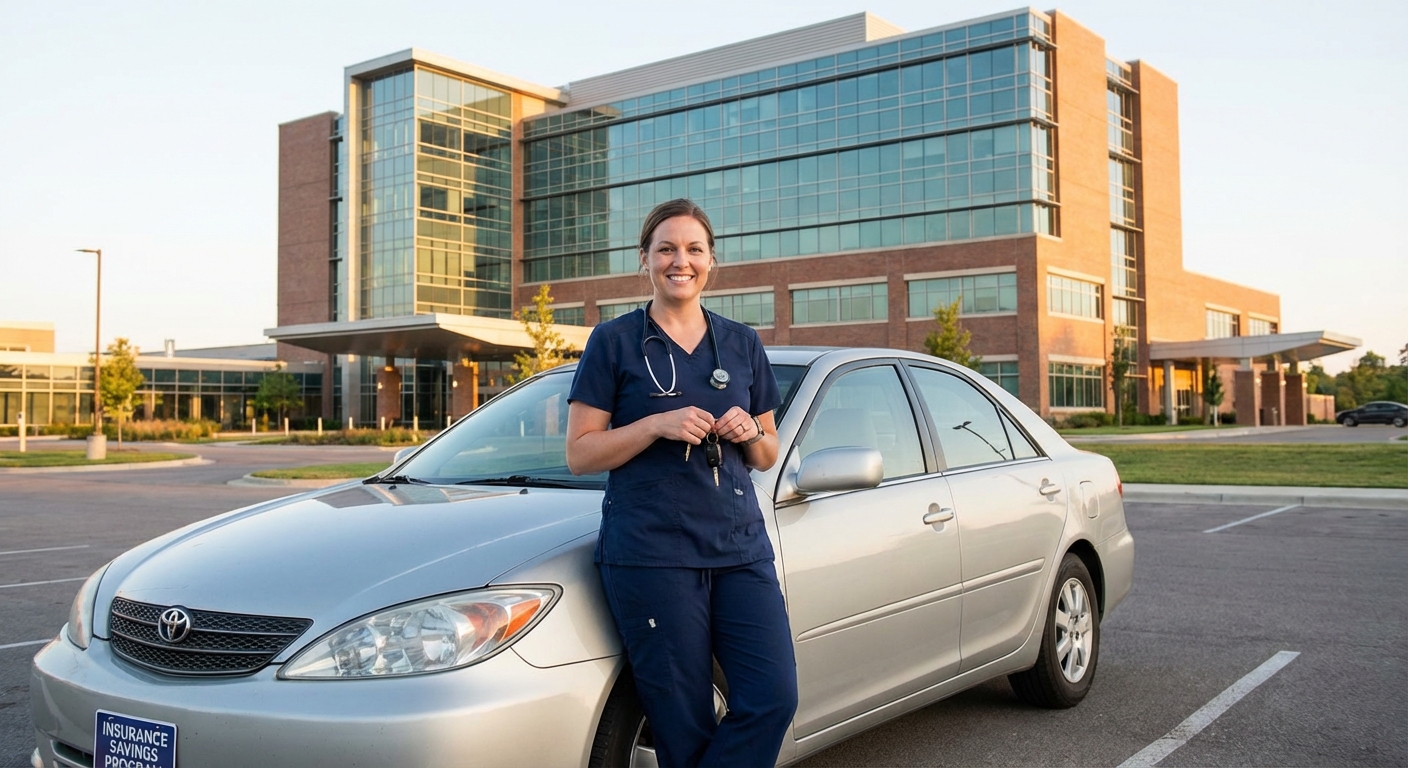
Nurses and Healthcare Professionals also qualify for profession-based discounts. Registered nurses, physical therapists, and occupational therapists are viewed as responsible, detail-oriented professionals. Nurses can save 3% to 15% on car insurance through occupation-based discounts, with insurers like GEICO offering affinity pricing through organizations such as the American Nurses Association, and major carriers including AAA, California Casualty, COUNTRY Financial, Farmers, Nationwide, and Plymouth Rock running occupation-based programs. For a deeper look at how nurses can maximize their savings, see our dedicated car insurance guide for nurses.
Engineers, Scientists, and CPAs round out the top tier. These roles are associated with analytical, risk-aware personalities, traits insurers believe translate into cautious driving behavior. General occupation tables show engineers and scientists typically save 5% to 8% with major carriers, and AAA in California offers engineers up to 7.4% off auto insurance. Farmers/Mid-Century Insurance in California offers 12% discounts to registered nurses, physical and occupational therapists, and chiropractors, and often extends similar treatment to engineering, math, and science degree holders. CPAs and accountants may also qualify for affinity group discounts through professional associations.

Protect your car with Farmers
Average Rate:
Find coverage options that fit your budget.

The insurance savings you expect.
Average Rate:
Enjoy personalized policies, comprehensive coverage & more.

See how much you could save today!
Average Rate:
Drivers who switch their auto insurance and save with State Farm save $764 on average!

Safe Drivers Save with Allstate®
Average Rate:
Get rewarded with savings for having a clean driving record.
High-Risk Occupations That Often Pay More
Not all professions enjoy a rate break. Some careers are consistently associated with elevated insurance premiums due to the nature of the driving involved or stress-related risk factors.
Occupations With Higher-Than-Average Premiums
Delivery and Gig Workers represent one of the highest-risk occupational categories. High mileage, time pressure, frequent stops, and urban driving all increase accident exposure. Standard personal auto policies typically exclude business delivery use entirely, meaning an insurer can deny a claim if you're delivering and haven't disclosed your work. A rideshare endorsement typically costs $15 to $30 per month on top of your personal policy, while a full commercial policy runs about $185 to $240 per month for DFW gig drivers according to 2026 market data. Learn more about when you need commercial auto coverage.
Sales Representatives and Real Estate Agents are also flagged as elevated-risk due to the heavy driving demands of client visits, property showings, and territory coverage. These professionals often drive tens of thousands of miles per year for work, all of which inflates their risk profile. See our guide on high mileage car insurance for strategies to manage these costs.
Food Service Workers, including bartenders, waiters, and chefs, face higher rates due to irregular and late-night hours. Statistically, driving late at night or after unconventional shifts increases accident risk.
Rate Differences by Profession: 2026 Data
According to ValuePenguin by LendingTree's State of Auto Insurance 2026 report, the average cost of full coverage car insurance in the U.S. is $208 per month, or about $2,496 per year. Other 2026 industry sources place full coverage anywhere from $2,158 (Insurify projection) to $2,924 (Experian) per year depending on methodology. Data shows meaningful variation in estimated average monthly premiums by occupation:
| Occupation | Est. Monthly Premium | vs. National Average |
|---|---|---|
| Homemaker / Retiree | ~$175 to $200 | Below average |
| Teacher / Office Worker | ~$185 to $210 | Below average |
| Doctor | ~$200 to $220 | Near average |
| Nurse | ~$200 to $220 | Near average |
| Sales / Manager | ~$210 to $230 | Near average |
| Student | ~$220 to $260+ | Above average |
| Delivery / Gig Worker | ~$260 to $350+ | Significantly above average |
| National Average (Full Coverage) | ~$208 | Baseline |
Note: Base rate figures reflect occupational risk profiles before occupation-specific discounts are applied. A military member, for example, may show a higher base rate but can access GEICO's military discount or USAA membership, which can bring their actual premium well below average. Understanding how car insurance premiums are calculated helps you better anticipate where occupation fits into your total rate.
Affinity Group Discounts and How to Claim Them
One of the most underutilized ways to save on car insurance is through affinity group discounts, reduced premiums offered to members of pre-approved organizations. This is separate from your base rate calculation and is often stackable with other discounts. See our complete guide to maximizing car insurance discounts for more ways to combine them.
What Qualifies as an Affinity Group?
Affinity discounts are triggered by your membership in recognized organizations such as:
- Professional associations (teachers' unions, nursing boards, engineering societies)
- Alumni associations from accredited colleges and universities
- Military and veterans' organizations
- Credit unions and employer groups
- Wholesale clubs (Costco, Sam's Club, BJ's)
- Civic or fraternal organizations
Typical affinity discounts range from 3% to 25%, with larger, more established organizations commanding the higher end. Here's how major carriers compare in 2026:
| Insurer | Max Affinity/Occupation Discount | Notable Groups |
|---|---|---|
| GEICO | Up to 15% military; +25% deployment | 500+ partner orgs; federal employees; alumni groups |
| Liberty Mutual | ~5 to 12% + teacher perks | Military, alumni, professional associations; $0 school-property vandalism deductible for teachers |
| Horace Mann | Educator-focused pricing | Teachers and school employees exclusively |
| Meemic | Up to 50% (retired teachers) | K-12 educators in IL, MI, WI, GA |
| Country Financial | Up to 15% for teachers | K-12 teachers, first responders |
| Farmers | ~5 to 10% affinity | Nurses, doctors, teachers (~10%), police, firefighters |
| Allstate | ~10% for educators | Employer and professional groups, NEA members |
| Nationwide | ~10% teacher discount | Actively employed teachers and other professions |
| The Hartford | ~10% | AARP members and affiliations |
| Costco (via CONNECT/AmFam) | Member discount in most states | Available in 42 states plus D.C. |
| USAA | Military-exclusive pricing | Active duty, veterans, and their families |
GEICO offers up to a 15% discount on car insurance as a military discount, plus an emergency deployment discount for members deployed to imminent danger pay areas. This can stack with membership discounts from organizations like the Association of the United States Army (AUSA) or Navy League.
How to Prove Your Occupation or Membership
Getting an occupation-based discount isn't automatic. You typically need to verify your status. Depending on the type of discount, insurers may ask for:
- Professional license or certification (required for nurses, doctors, pilots, CPAs)
- Pay stub or employer verification letter confirming full-time status
- Membership card or proof from a professional organization
- Work ID or business card as supplementary documentation
- DD Form 214 or military orders for military and veteran discounts
Life Changes That Affect Your Occupation and Rates
Changing Jobs
Switching careers can meaningfully impact your insurance premium in either direction. Moving from a high-mileage sales role to a remote office job can reduce your annual mileage significantly and may shift you into a lower-risk category. Conversely, taking on a delivery or gig economy role can trigger a rate increase, or worse, a coverage gap, if your insurer isn't notified.
Always notify your insurer when you change jobs, especially if it changes how you use your vehicle. Failing to report a shift to business or commercial use could void coverage in the event of an accident. Part-time gig drivers adding an endorsement can expect to pay roughly $15 to $30 more per month in 2026, with USAA members paying as little as $6/month in states where it's offered.
Retirement
Retirees can often benefit from lower car insurance rates, but it's not automatic. There's no universal "retiree rate" across the industry. What typically drives savings is the shift in driving behavior: no more commute, fewer total miles, and more flexible driving hours. If you retire and don't update your mileage and use classification with your insurer, you may be leaving money on the table.
Updating your occupation status to "retired" with your insurer is still worthwhile and can trigger:
- Low-mileage discounts, especially if you now drive under 7,500 to 10,000 miles/year
- Usage-based insurance savings of up to 30% to 50% with telematics programs like Nationwide SmartRide (up to 40% with no rate-hike risk)
- Mature driver safety course discounts of 5% to 15% that are widely available
Drivers in their late 50s and early 60s often pay the lowest premiums of their lives. However, premiums can rise again in your late 60s and beyond as age-related risk factors increase. For a full breakdown of rates and top insurers for older drivers, see our senior driver car insurance guide. GEICO, USAA, and The Hartford (via AARP) offer some of the most competitive rates for retirees and senior drivers.
Unemployment
Unemployment's effect on rates is nuanced. Some insurers in states that allow occupation as a rating factor may apply a slight increase to unemployed drivers, while others don't use employment status at all. However, reduced driving during unemployment often qualifies you for low-mileage discounts and usage-based insurance savings of 5% to 25%, which can more than offset any premium bump. For a full playbook on managing coverage between jobs, see our guide on car insurance when unemployed.
The bigger risk is a lapse in coverage during unemployment. Drivers with a coverage lapse of 30 days or less saw an 8% average car insurance rate increase, while those with a coverage lapse greater than 30 days saw an average rate increase of 35%. Notably, Louisiana's Act 476 (effective January 1, 2026) established that a first lapse of 90 days or less cannot by itself trigger a rate increase or surcharge, and any lapse after 5 consecutive years of continuous coverage resets as your "first." If you're struggling to afford premiums between jobs, contact your insurer about lowering coverage limits or switching to a usage-based insurance plan rather than canceling outright. Learn more about the consequences of a lapse in car insurance coverage.
Frequently Asked Questions
Does my occupation really affect my car insurance rates?
Yes, occupation is one of many factors insurers use when calculating premiums. Your job influences your perceived risk based on annual mileage, driving hours, stress levels, and historical claims data for your occupational group. While it's not the most heavily weighted factor (your driving record, location, and vehicle type carry more weight), it can produce meaningful differences in your premium when occupation-based discounts are available. Note that California, Massachusetts, Michigan, and New York ban or heavily restrict the use of occupation as a rating factor, with New York's 2026 auto insurance reform expanding those restrictions.
Which jobs get the cheapest car insurance rates?
Homemakers, retirees, teachers, engineers, CPAs, and licensed healthcare professionals like doctors and nurses typically see the most favorable base rates. Teachers have the best access to occupation-specific discounts from carriers like Horace Mann, Meemic (up to 50% for retired teachers), COUNTRY Financial (15%), Allstate, Farmers, and Nationwide (around 10%). Engineers frequently see 5% to 8% savings across major carriers, with AAA in California offering up to 7.4% off. For a detailed breakdown of how nurses specifically can save, check our dedicated guide.
What professions are considered high-risk by insurers?
Delivery drivers, rideshare drivers, sales representatives, real estate agents, and food service workers such as bartenders and chefs are among the most consistently flagged high-risk occupations. The common thread is either high annual mileage for work, irregular or late-night hours behind the wheel, or the need for commercial coverage that personal policies don't provide. Delivery drivers may find their personal policy voided during work-related accidents if they haven't disclosed their gig work, especially during Period 1 when the app is on but no order has been accepted.
How do I claim an occupation discount on my car insurance?
Start by asking your insurer directly whether they offer occupation or affinity group discounts. If they do, you'll likely need to provide proof such as a professional license, pay stub, employment verification letter, military orders, or proof of membership in a qualifying professional organization. Not all insurers offer these discounts, and availability varies by state, so shopping multiple carriers is worthwhile. You should also explore whether your alumni association, Costco membership, or professional group qualifies you for additional affinity discounts.
Should I update my occupation when I change jobs or retire?
Absolutely, and the impact can go in either direction. Updating your occupation ensures your policy reflects your actual risk profile and vehicle use. Switching to remote work or retiring may lower your rate through low-mileage discounts and usage-based insurance programs. If you move into a delivery or gig role, failing to update your occupation could leave you uninsured in the event of a claim. Always compare quotes after any major job change to make sure you're getting the best rate, as what affects your car insurance rates goes well beyond occupation alone.