
Compare Car Insurance Rates in Ohio
See if you qualify for a lower rate in less than 2 minutes



How Car Insurance Works for Drivers With Disabilities
Drivers with disabilities generally buy the same standard auto policies as everyone else. Under the Americans with Disabilities Act (ADA), insurance companies are prohibited from denying coverage or charging higher premiums solely because of a disability. That means a spinal cord injury, low vision that still meets your state's licensing standard, an amputation, or the use of a mobility aid cannot, by itself, drive up your rate.
However, insurers can still consider legitimate risk factors that happen to correlate with certain conditions, such as your actual driving record, annual mileage, the value of your vehicle, and the cost of any adaptive equipment installed on it. In practice, the policy structure looks identical to any other driver's:
- Bodily injury and property damage liability (required in almost every state)
- Collision and comprehensive for damage to your own vehicle
- Uninsured/underinsured motorist protection
- Medical payments (MedPay) or personal injury protection (PIP)
- Optional endorsements for adaptive equipment, roadside assistance, and rental reimbursement

Compare Car Insurance Rates in Ohio
See if you qualify for a lower rate in less than 2 minutes
Does a Standard Policy Cover Adaptive Equipment?
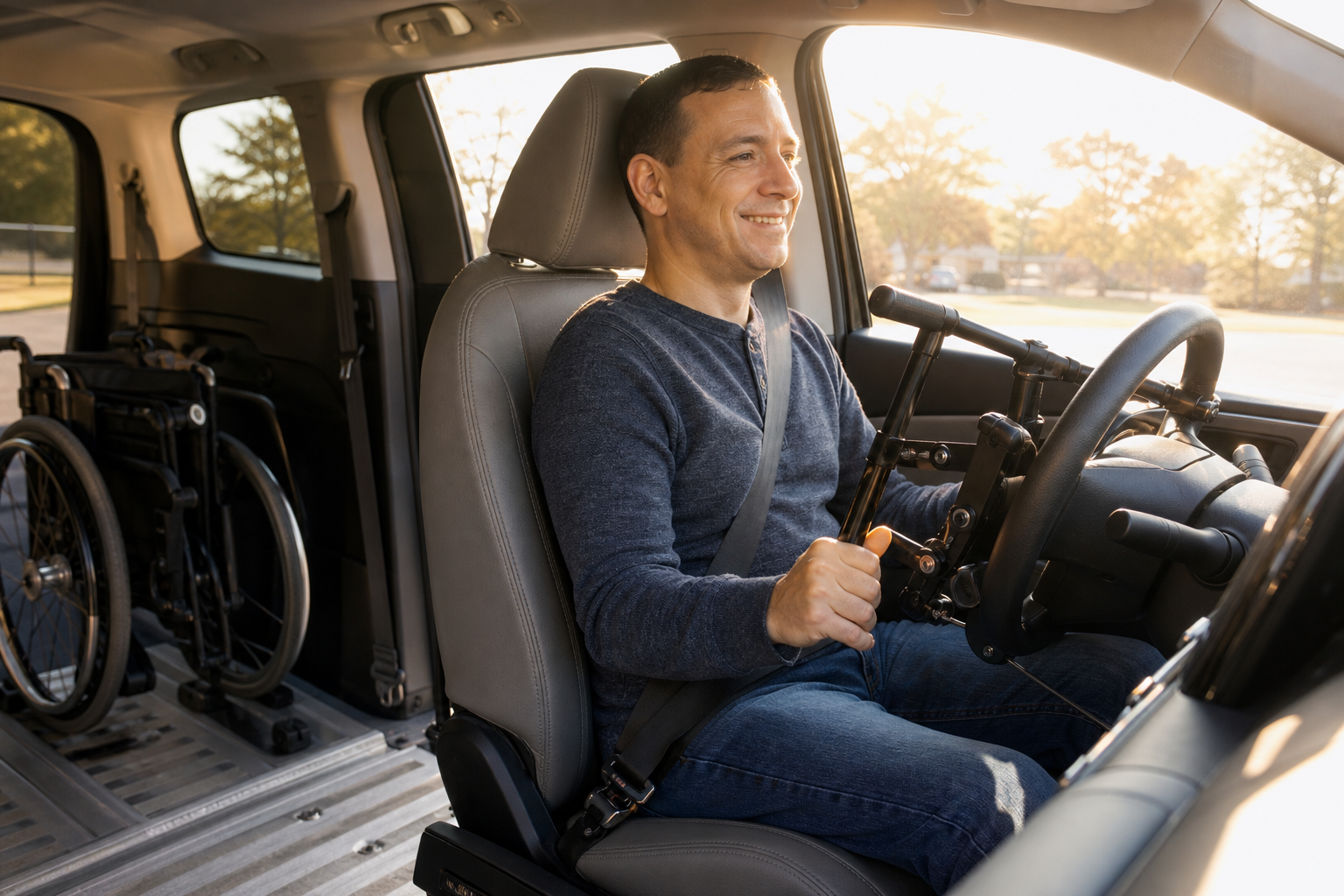
Almost always the answer is no, or only in a very limited way. A base auto policy insures the vehicle as it left the factory. Aftermarket additions like hand controls, left-foot accelerators, pedal extenders, wheelchair lifts, powered ramps, kneeling suspensions, transfer seats, and tie-down systems are typically classified as "custom parts and equipment" (CPE) and are subject to a much lower default cap or excluded entirely unless you disclose them and add the right endorsement.
Most standard policies include somewhere between $1,000 and $1,500 of built-in custom equipment coverage. That is not close to enough. A single set of high-tech electronic hand controls can run $2,500 to $6,000, and a full wheelchair-van conversion (lowered floor, powered ramp, kneeling system, tie-downs) commonly adds $25,000 to $35,000 to the vehicle's value.

Protect your car with Farmers
Average Rate:
Find coverage options that fit your budget.

The insurance savings you expect.
Average Rate:
Enjoy personalized policies, comprehensive coverage & more.

See how much you could save today!
Average Rate:
Drivers who switch their auto insurance and save with State Farm save $764 on average!

Safe Drivers Save with Allstate®
Average Rate:
Get rewarded with savings for having a clean driving record.
Custom Parts and Equipment Coverage: How It Works
Custom parts and equipment coverage is an add-on endorsement that pays to repair or replace permanently installed aftermarket parts after a covered loss (collision, theft, vandalism, fire, weather). It is the single most important coverage for anyone driving an adapted vehicle.
A few ground rules apply across most carriers:
- CPE only kicks in if you already carry both comprehensive and collision coverage.
- Claims are still subject to your normal deductible.
- You generally need to provide receipts or an appraisal documenting the value of the equipment.
- Limits are chosen by you, up to the carrier's maximum.
Typical CPE Limits by Carrier
| Insurer | Common CPE Limit Available | Notes |
|---|---|---|
| Progressive | Up to $5,000 standard, higher with endorsement | Well-known for adapted-vehicle experience |
| Allstate | Up to $20,000+ via endorsement | Requires appraisal for higher limits |
| Geico | Up to $5,000 baseline | Extra available in most states |
| State Farm | Varies by agent/state, often $5,000-$20,000 | Local agent can request specialty underwriting |
| Nationwide | Up to $10,000, negotiable higher | Ask about mobility-vehicle riders |
| USAA (eligible military) | Up to $20,000+ | Strong option for disabled veterans |
For a fully converted wheelchair van, most owners buy a limit in the $20,000 to $35,000 range so the endorsement matches the actual conversion cost.
How Much Does It Cost to Insure a Modified Van?
For a personal-use wheelchair-accessible van, expect to pay roughly 10-15% more than you would for the same base minivan without modifications. On a typical family vehicle, that translates to somewhere around $1,500-$2,500 per year in most states, depending on driving record, location, and coverage limits.
If the van is used commercially (non-emergency medical transport, paratransit, ride-share for wheelchair users), the pricing looks very different. Commercial wheelchair-accessible van policies in 2026 commonly run $6,800 to $14,000 per year per vehicle, because they carry $1 million liability limits plus lift, securement, and passenger-boarding endorsements.
The premium spread within the personal category comes mostly from the replacement value of the equipment, not the disability itself. A $70,000 converted van costs more to insure than a $40,000 unmodified minivan for the same reason a $70,000 luxury SUV costs more than a $40,000 sedan.
How Disability Status Affects Your Rate (Spoiler: It Shouldn't)
The ADA blocks insurers nationwide from using disability as a standalone rating factor. What they can consider:
- Your driving record (tickets, at-fault accidents)
- Annual mileage (often lower for disabled drivers, which helps)
- Vehicle value (including adaptive equipment)
- Coverage choices (limits, deductibles, endorsements)
- Location and garaging address
Many disabled drivers actually save money by qualifying for low-mileage discounts through telematics programs like Geico's DriveEasy, Progressive's Snapshot, Allstate's Drivewise, Nationwide's SmartMiles, and State Farm's Drive Safe & Save. If your disability means you drive fewer than 7,500 miles a year, pay-per-mile insurance can cut premiums significantly. You can compare options in our guide to pay-per-mile car insurance and see whether your annual mileage puts you in the savings zone.
Insurers With Disability-Friendly Programs
There is no such thing as a formal "disability discount" from major U.S. carriers, but several are known for handling adapted vehicles smoothly and offering discounts that disabled drivers frequently qualify for.
Why Medical Payments Coverage Matters More
Medical payments coverage (MedPay) pays medical bills for you and your passengers after a crash regardless of fault, and it is especially valuable for disabled drivers for three reasons:
- Existing conditions can complicate injury care. A crash-related injury on top of a spinal cord injury, brittle bones, or a neurological condition may need specialized (and expensive) treatment.
- It covers passengers too. If you regularly transport family members, aides, or other wheelchair users, MedPay protects everyone in the vehicle.
- It coordinates with health insurance. MedPay usually pays the deductibles, co-pays, and out-of-network costs your primary insurance leaves behind.
In no-fault states, personal injury protection (PIP) plays a similar role and is often required. Consider limits of at least $10,000, and $25,000-$50,000 if you have complex medical needs.
How to Declare Modifications Properly
Doing this correctly is the difference between a smooth claim and a denied one. Follow these steps every time you add or upgrade adaptive equipment:
- Notify your insurer in writing within 30 days of any modification (email is fine and creates a paper trail).
- Provide itemized receipts from the mobility dealer showing parts, labor, and installation date.
- Request that each item be listed on your declarations page (hand controls, lift, ramp, tie-downs, etc.).
- Get an appraisal for conversions over $10,000. Many carriers require it before writing higher CPE limits.
- Confirm the CPE limit in writing and re-check it every renewal, especially if you upgrade equipment.
- Keep photos of the equipment installed in the vehicle in case of a total-loss claim.
If you are shopping around, our overview of how to compare car insurance quotes walks through the exact questions to ask each carrier about adaptive equipment.
Frequently Asked Questions
Can an insurance company charge me more just because I have a disability?
No. The Americans with Disabilities Act prohibits insurers from raising your premium or denying coverage based solely on disability status. They can, however, factor in the additional value of adaptive equipment on your vehicle and any legitimate driving-related risk factors. If you believe you were rated unfairly, file a complaint with your state Department of Insurance.
Does regular car insurance cover my wheelchair lift or hand controls?
Usually not beyond a small default limit of around $1,000-$1,500. To fully protect adaptive equipment, you need to add custom parts and equipment (CPE) coverage with a limit high enough to match the actual cost of your modifications. Always disclose the equipment to your insurer and get it listed on your declarations page.
How much extra will I pay to insure a wheelchair-accessible van?
Personal-use adapted vans typically cost 10-15% more than an unmodified equivalent, often adding $200-$500 per year to a standard policy. The extra premium reflects the higher replacement value of the conversion, not the disability itself. Commercial wheelchair vans used for paid transport cost significantly more, often $6,800-$14,000 per year.
What is the best insurance company for drivers with adaptive vehicles?
There is no single best answer, but Progressive, State Farm, Nationwide, Allstate, and USAA (for eligible military) are commonly cited for handling adapted vehicles well. The best carrier for you is the one that offers the CPE limit your equipment requires at the most competitive rate. Get at least three quotes before committing.
Do I need special insurance if I have a modified van but do not personally drive it?
You still need standard auto insurance in your name if the vehicle is registered to you, plus a CPE endorsement covering the modifications. Anyone else who drives it regularly (a family member, aide, or caregiver) should be listed on the policy. If a paid caregiver uses the vehicle for transport, a commercial or hired-and-non-owned policy may be required.