
Compare Car Insurance Rates in Ohio
See if you qualify for a lower rate in less than 2 minutes



Suspending Liability vs. Keeping Comprehensive Coverage
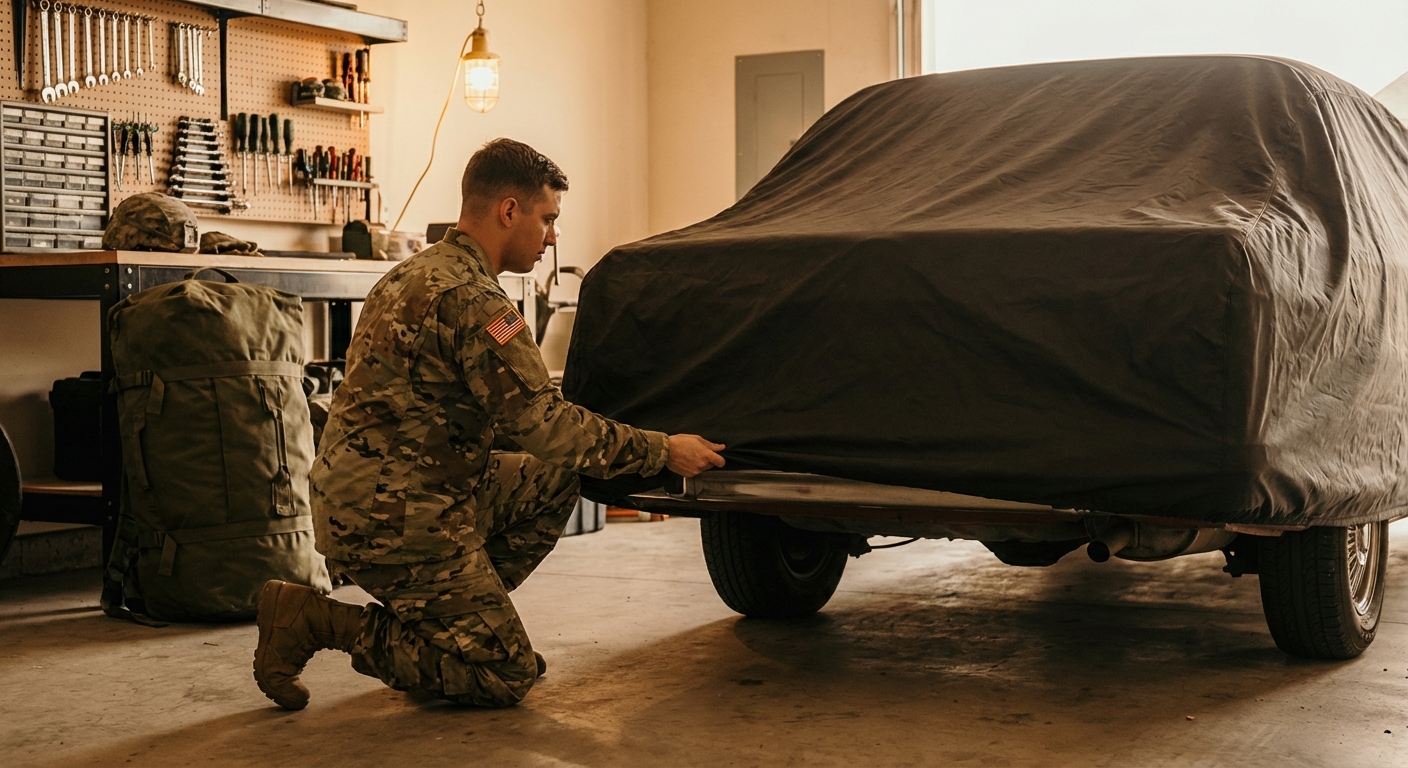
When you deploy, your car does not disappear, but your need to drive it does. The smart move for most service members is not to cancel their policy outright, but to reduce it. Specifically, that means suspending liability and collision coverage while keeping comprehensive-only coverage on your stored vehicle.
Here is why comprehensive-only (also called car storage insurance) makes sense during deployment:
- Liability coverage protects others when you are driving. If the car is not moving, you do not need it.
- Collision coverage pays for damage from crashes, irrelevant for a parked car.
- Comprehensive coverage protects against theft, vandalism, fire, flooding, hail, and falling objects, all real risks for a stored vehicle.
Most major insurers, including USAA and GEICO, allow active-duty members to drop to comprehensive-only after the vehicle has been in storage for at least 30 consecutive days. This can reduce your monthly premium dramatically. Learn more about car insurance for stored vehicles to understand all your coverage options.
If your car is financed or leased, your lender may still require you to carry both comprehensive and collision coverage regardless of your deployment status. Confirm with your lender before reducing coverage.

Compare Car Insurance Rates in Ohio
See if you qualify for a lower rate in less than 2 minutes
USAA, GEICO & Military-Specific Insurer Policies
Not all insurers treat military members the same. If you are not already with a military-friendly provider, deployment is a good time to reconsider your options.
USAA: The Gold Standard for Military Insurance
USAA is exclusively available to active-duty military, veterans, and their eligible family members. Its 2026 deployment benefits remain unmatched:
- Up to 60% discount on premiums for vehicles stored during deployment. Per USAA's official deployment guidance, this storage discount is generally not available in North Carolina or Virginia, and availability is limited in California and Hawaii. The vehicle must not be driven for at least 30 consecutive days and must be stored in a secure location.
- Up to 15% off comprehensive coverage for vehicles kept in a garage on a military base.
- SafePilot® telematics program offering up to 10 to 15% at enrollment and up to 30% off at renewal based on safe driving habits tracked via the USAA DriveSafe app. Each driver must log at least 325 miles and 16 hours per policy period to qualify for the full renewal discount. Poor driving scores will not increase your premiums. The program only rewards, never penalizes.
- SafePilot is available in most states but is commonly excluded in California, Delaware, and New Jersey.
- Seamless policy adjustment. Notify USAA of your deployment orders and provide proof such as deployment orders or military ID. USAA also offers a dedicated deployment line at 877-2-DEPLOY (877-233-7569).
- USAA's average annual full coverage rate ranges from approximately $1,533 to $1,670 per year for a military member with a clean record, according to 2026 analyses from NerdWallet, AutoInsurance.com, Insurance.com, and Insuremojo. That is roughly 29 to 35% below current 2026 national averages ranging from about $2,237 (Insurify H1 2026) to $2,356 (NerdWallet).
- USAA continues to return money to eligible members through 2026 rate reductions, including $250 million in savings from an average 14% auto rate cut across two filings between January and July 2026, plus a $500 million dividend for eligible Florida members.
Explore a full breakdown of USAA discounts and benefits or read our USAA car insurance review for more detail.
GEICO: Strong Military Discounts with Broad Availability
GEICO does not restrict membership to the military, but it does offer solid benefits:
- Up to 15% military discount for active-duty, retired, and National Guard/Reserve members.
- Emergency Deployment Discount of up to 25% for those deployed to imminent danger pay areas as defined by the Department of Defense and approved by Congress. Stacks with the standard military discount for eligible members who store their vehicle under an approved plan.
- Storage Protection Plan allows eligible service members whose duties require storing a vehicle for 30 days or more to suspend or reduce coverages while the vehicle is parked during deployment (typically keeping comprehensive-only, which can cut that vehicle's premium substantially while preventing a coverage lapse). Remember to notify GEICO when the vehicle is back in use.
- Contact GEICO's Military Center at 800-MILITARY (645-4827) to arrange storage plans and deployment discounts.
Insurer Rate Comparison for Military Members (2026)
| Insurer | Full Coverage (Annual) | Liability Only (Annual) | Deployment Storage Discount | Military Discount |
|---|---|---|---|---|
| USAA | ~$1,533 to $1,670 | ~$342 to $436 | Up to 60% | Up to 15% (on-base) |
| GEICO | ~$1,587 to $2,275 | ~$492 | Storage Protection Plan | Up to 15% + up to 25% deployment |
| Liberty Mutual | ~$2,472 to $3,000+ | ~$1,000+ | Varies | Up to 10 to 12% |
| Farmers | ~$3,085 to $4,529 | ~$1,176 | Varies | Up to 10% |
Rates sourced from 2026 industry analyses (NerdWallet, AutoInsurance.com, Insurance.com, MoneyGeek, Insurify). Actual rates vary by location, driving history, and vehicle.

Protect your car with Farmers
Average Rate:
Find coverage options that fit your budget.

The insurance savings you expect.
Average Rate:
Enjoy personalized policies, comprehensive coverage & more.

See how much you could save today!
Average Rate:
Drivers who switch their auto insurance and save with State Farm save $764 on average!

Safe Drivers Save with Allstate®
Average Rate:
Get rewarded with savings for having a clean driving record.
Deployment Insurance: State Requirements, SOFA & Overseas Coverage
State Requirements for Stored Vehicles
Car insurance rules for stored vehicles vary by state, and ignoring them can lead to fines, registration suspension, or worse. Here is what you need to know:
| Situation | Typical Requirement | Action to Take |
|---|---|---|
| Active registration, stored car | Many states require minimum liability | Check with your state DMV |
| Surrender/suspend registration | Most states allow insurance reduction | File an Affidavit of Non-Use or PNO |
| Financed/leased vehicle | Lender requires comprehensive + collision | Maintain both regardless of state rules |
| California residents | File PNO or Affidavit of Non-Use before insurance is canceled | Vehicle must be off public roadways |
| California SR-22 holders | SR-22 remains active until DMV releases it | Coordinate with DMV, do not lapse |
| Deployed CA residents | Registration late-fee waiver available | Renew within 60 days of return with orders |
| On-base vehicle storage | Proof of current insurance required | Maintain at least comprehensive |
The safest approach in most states is to file an Affidavit of Non-Use or Planned Non-Operation (PNO) filing (or your state's equivalent) with your DMV before deploying. This legally declares your vehicle is off the road, which in most states removes the liability insurance requirement. According to the National Association of Insurance Commissioners (NAIC), if your state mandates auto insurance and you plan to suspend coverage, you may need to file an affidavit of non-use with your state's DMV to avoid fines.
Be aware that on-base storage typically has stricter requirements than DMV rules. Naval Base San Diego, for example, requires military ID, current registration, current insurance, and a deployment letter even for stored vehicles. Contact your state's DMV or base legal assistance office to confirm requirements specific to your state, and reinstate insurance and DMV proof immediately upon return. You can also review winter storage insurance options for additional insight on how other drivers handle stored-vehicle situations.
SOFA: Insurance for Overseas Deployments
If you are deploying overseas and plan to drive a vehicle, the Status of Forces Agreement (SOFA) is critical. SOFAs are legal agreements between the U.S. and host nations that define the rights and responsibilities of stationed military personnel, including driving privileges.
Under most SOFA agreements and the U.S. Government Rental Car Program:
- U.S. service members are generally exempt from mandatory local liability insurance requirements for official use.
- The U.S. Government Rental Car Program (Agreement #5, with maximum rates effective through March 31, 2027) provides Loss Damage Waiver (LDW), Collision Damage Waiver (CDW), and liability coverage ($25,000 property damage; $100,000 per person; $300,000 per incident) for official government travel at no extra cost.
- 2026 standard CONUS maximum daily rates published by DTMO include Economy, Compact, Intermediate, and Standard at $55, Full-size at $60, EV Intermediate at $70, EV Full-size at $80, Compact/Intermediate/Standard SUV at $90, EV SUV Intermediate at $115, Full-size SUV at $120, Premium SUV at $125, and Passenger Vans from $100 to $140 depending on capacity. High-cost metro areas such as Baltimore, Boston, Chicago, Detroit, Los Angeles, New York City, Newark, Philadelphia, San Francisco, and Washington, D.C. have separate, higher maximum rates.
- For OCONUS locations, DTMO publishes one maximum daily rate per car class per country in local currency. Weekly rates cannot exceed 6x the daily maximum, and monthly rates cannot exceed 4x the weekly maximum.
- Agreement #5 eliminated the old $5/day Government Administrative Rate Supplement (GARS) that existed under Agreement #4, and there are no additional fees for authorized drivers age 21 and older, no blackout dates, and unlimited mileage (except for one-way rentals).
- Do not purchase additional coverage from rental companies unless required by foreign law. Those purchases are generally non-reimbursable under the FTR and JTR.
- Always book rentals via the Defense Travel System (DTS), ETS2, ConcurGov, or a Travel Management Company to ensure program coverage applies.
- USAA and other U.S. military insurers may extend personal vehicle coverage internationally under SOFA terms, but specifics vary by country.
- Countries like Japan and South Korea have their own separate SOFA agreements distinct from NATO terms.
Always verify the SOFA terms for your specific host nation with your JAG office or Military OneSource before assuming your U.S. policy is sufficient overseas.
The Servicemembers Civil Relief Act (SCRA): What It Does and Does Not Cover
The SCRA is a powerful federal law that protects service members financially during deployment, but it has a limited role in car insurance specifically:
What SCRA DOES protect (auto-related):
- Caps interest rates at 6% on pre-service auto loans and other debts incurred before active duty, including credit cards, personal loans, and mortgages. Per DOJ and CFPB guidance, any interest above that cap must be forgiven, not simply deferred, and the cap applies retroactively to the date of entering active duty. Note that the benefit is not automatic. You must request it from each lender no later than 180 days after your active-duty period ends.
- Allows early termination of auto leases without penalty if you receive orders for a 180+ day deployment or a permanent change of station outside the continental U.S. (unpaid rent is typically prorated through the termination date).
- Requires creditors to obtain a court order before repossessing a vehicle purchased or leased before active duty if you made a deposit or installment before service.
- Benefits are not automatic. You must submit a written request to your lender with a copy of your active-duty orders.
What SCRA does NOT do:
- It does not create a federal exemption from state minimum auto insurance requirements. Your registration state's limits still apply during a PCS move, and deployment does not automatically suspend the requirement.
- It does not force insurers to offer deployment discounts.
- It does not provide a right to suspend or reduce auto insurance. The SCRA's insurance-related protections are focused on life insurance and some professional liability insurance, not personal auto insurance. Bona fide insurance charges are specifically excluded from the 6% interest cap.
The good news: most military-friendly insurers voluntarily offer the protections and discounts that SCRA does not mandate. You can learn more about how veterans can maximize auto insurance savings regardless of SCRA limitations.
Reinstating Full Coverage Upon Return
Returning from deployment means getting back behind the wheel, but make sure your insurance is fully reinstated before you drive. Here is a step-by-step checklist for getting covered again quickly:
Reinstatement Steps
Step 1: Contact your insurer immediately upon return. Call or log into your insurer's portal and notify them you have returned from deployment. If your policy was suspended (not canceled), reinstatement is typically fast, often same-day or within 24 hours.
Step 2: Pay any outstanding premiums. Some insurers require a prorated premium payment covering the reinstatement period. Confirm the amount before you are back on the road.
Step 3: Restore all desired coverage types. Do not forget to reinstate coverages you suspended, such as liability, collision, uninsured motorist protection, and any roadside assistance add-ons.
Step 4: Verify DMV notification. Your insurer should electronically notify your state DMV of the reinstated coverage. In some states, failure to do this can trigger a registration suspension.
Step 5: Review your policy for updated discounts. Your driving profile may have changed. You may now qualify for low-mileage discounts, USAA's SafePilot telematics program (up to 10-15% at enrollment, up to 30% off at renewal with no rate penalty for poor scores), or other savings. USAA also offers SafePilot Miles in certain states, a usage-based product for drivers who travel fewer miles annually. Ask your agent to do a full policy review. Explore how military car insurance benefits differ across providers before committing.
Frequently Asked Questions
Can I completely cancel my car insurance during deployment?
Technically, yes, but it is rarely a good idea. Canceling creates a coverage lapse, which insurers view negatively when you go to reinstate or shop for a new policy. Recent 2026 rate data from MoneyGeek and ValuePenguin shows lapses of 30 days or fewer average an 8 to 11% rate hike, while gaps over 30 days can push increases to 22 to 35% or more. A better approach is to suspend liability and collision coverage while keeping comprehensive-only on your stored vehicle.
How much can I save on car insurance during deployment?
Savings vary by insurer and situation, but USAA offers a storage discount of up to 60% for deployed service members who store their vehicles securely, though this program is generally not available or is limited in California, Hawaii, North Carolina, and Virginia. USAA's SafePilot program also offers up to 10-15% off at enrollment and up to 30% at renewal for safe driving, provided each driver logs at least 325 miles and 16 hours per policy period. GEICO also offers a stackable Emergency Deployment Discount of up to 25% on top of its standard 15% military discount for qualifying members deployed to imminent danger pay areas whose vehicle is stored under an approved plan.
Does my US car insurance cover me while driving overseas during deployment?
It depends on your insurer, the host country, and whether you are driving a personal or government vehicle. Under the U.S. Government Rental Car Program (Agreement #5, with maximum rates effective through March 31, 2027) for official travel, Loss Damage Waiver, Collision Damage Waiver, and liability coverage of $25K/$100K/$300K are included at no extra cost. Do not purchase supplemental coverage from rental companies unless local law requires it. For personal vehicles overseas, insurers like USAA may extend coverage under SOFA terms, but specifics vary by country, so confirm with your insurer and your base JAG office before driving.
What happens to my car insurance if I have a financed vehicle during deployment?
If your vehicle has an active auto loan or lease, your lender will typically require you to maintain both comprehensive and collision coverage regardless of your deployment status or state law. While you can still benefit from military discounts, you likely will not be able to drop to comprehensive-only as you could with a vehicle you own outright. Review your loan agreement and contact your lender before making any coverage changes. The SCRA does cap your pre-service auto loan interest at 6%, and that excess interest must be forgiven, not deferred, which provides meaningful financial relief.
When should I reinstate full coverage after returning from deployment?
You should reinstate full coverage before you drive the vehicle, not after. Contact your insurer as soon as you return from deployment and confirm that all coverages are active. If your policy was suspended rather than canceled, reinstatement is usually quick, sometimes same-day. Driving without proper liability coverage, even for one trip, can expose you to serious legal and financial risk, including fines, SR-22 requirements, and rate increases that may last for years.