
Compare Car Insurance Rates in Ohio
See if you qualify for a lower rate in less than 2 minutes



What Is Stacked vs Unstacked Insurance?
When you purchase uninsured motorist coverage, your insurer will often ask whether you want stacked or unstacked coverage — and most drivers have no idea what that means. At its core, the choice determines how your UM/UIM (uninsured/underinsured motorist) limits are calculated when you need to file a claim.
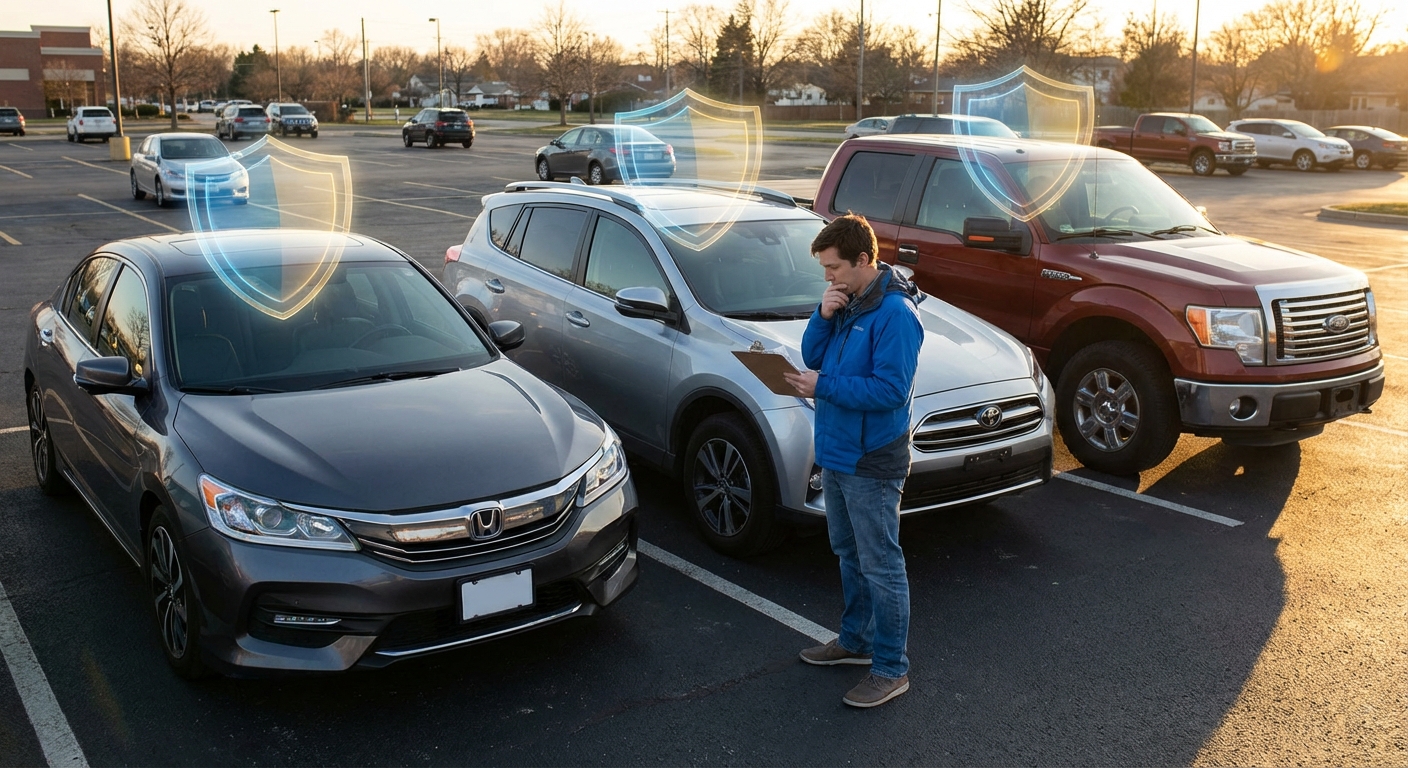
- Stacked coverage combines — or "stacks" — the UM/UIM bodily injury limits from multiple vehicles on your policy (or across multiple policies) to create a higher total coverage ceiling.
- Unstacked coverage keeps each vehicle's UM/UIM limit separate, capping your payout at the limit assigned to the one vehicle involved in the accident.
It's important to note that stacking only applies to bodily injury protection (medical bills, lost wages, pain and suffering). Property damage cannot be stacked.
| Feature | Stacked | Unstacked |
|---|---|---|
| Coverage Limit | Combined across vehicles | Per vehicle only |
| Premium Cost | Higher | Lower |
| Best For | Multi-vehicle households | Single-vehicle owners |
| Protection Level | Maximum | Standard |
| State Availability | ~32 states | All states |

Compare Car Insurance Rates in Ohio
See if you qualify for a lower rate in less than 2 minutes
How Stacked Coverage Works: Intra-Policy vs. Inter-Policy
There are two distinct types of stacking, and knowing the difference matters when choosing your policy.
Intra-Policy Stacking (Vertical Stacking)
This is the most common form. When you have multiple vehicles on a single policy, stacking multiplies your UM/UIM limit by the number of insured vehicles.
Example: You have 3 cars on one policy, each with a $100,000 UM/UIM bodily injury limit.
- Unstacked: You're hit by an uninsured driver → maximum payout = $100,000
- Stacked: Same accident → maximum payout = $300,000 ($100,000 × 3 vehicles)
That's a $200,000 difference in protection — from the exact same accident.
Inter-Policy Stacking (Horizontal Stacking)
This applies when you combine UM/UIM limits across separate insurance policies — for example, your personal policy and a spouse's policy — where both cover you as an insured driver.
Example:
- Your policy: $50,000 UM/UIM
- Spouse's separate policy: $50,000 UM/UIM
- Inter-policy stacked total: $100,000
Inter-policy stacking is permitted in fewer states and is more heavily regulated. Learn more about your UM/UIM coverage options to understand what protections are available to you.

Protect your car with Farmers
Average Rate:
Find coverage options that fit your budget.

The insurance savings you expect.
Average Rate:
Enjoy personalized policies, comprehensive coverage & more.

See how much you could save today!
Average Rate:
Drivers who switch their auto insurance and save with State Farm save $764 on average!

Safe Drivers Save with Allstate®
Average Rate:
Get rewarded with savings for having a clean driving record.
Stacked Insurance Cost & Who Benefits Most
How Much More Does Stacking Cost?
Stacked coverage typically costs 20–30% more than its unstacked equivalent, depending on your state, insurer, driving history, and number of vehicles. In dollar terms, that often translates to roughly $20–$40 more per month for a multi-vehicle household — a modest increase for a dramatically higher protection ceiling.
To put that in perspective:
| Vehicles on Policy | Unstacked UM Limit | Stacked UM Limit | Approx. Monthly Cost Increase |
|---|---|---|---|
| 2 vehicles | $100,000 | $200,000 | ~$15–$25 |
| 3 vehicles | $100,000 | $300,000 | ~$25–$40 |
| 4 vehicles | $100,000 | $400,000 | ~$35–$55 |
Estimates vary by insurer, state, and driver profile. Always get a personalized quote.
Who Benefits Most From Stacked Coverage?
Stacking is not for everyone, but it's a smart choice for:
- Multi-vehicle households — The more cars on your policy, the greater the stacking multiplier.
- Residents of high uninsured-driver states — States like Mississippi (28.2% uninsured), New Mexico (24.1%), Washington D.C. (25.2%), Michigan (19.6%), and Tennessee (20.9%) have alarming rates of uninsured motorists. In these areas, the odds of needing UM coverage are significantly higher.
- Drivers seeking maximum protection — Approximately 15.4% of all U.S. drivers were uninsured in 2023 (the most recent IRC data), and a combined 33.4% are either uninsured or underinsured. Standard limits may not be enough.
- Those with higher income or assets — If you have significant financial exposure, a larger UM/UIM limit protects more of what you've built.
Learn more about the uninsured motorist crisis and why the combined uninsured/underinsured rate has climbed to 33.4% — a 10-point jump since 2017.
Which States Allow Stacked Coverage?
Stacking availability is governed at the state level, and laws vary widely. Approximately 32 states permit some form of stacking as of 2026. Here's a breakdown:
States That Allow Stacking
Notable State-by-State Updates for 2025–2026
Florida is a frequently misunderstood state on this topic. Florida does allow UM stacking — and it's actually the default. Under Florida Statute § 627.727, stacking is automatically applied unless the policyholder explicitly opts out in writing using a state-approved form. Florida's § 627.4132 restricts stacking of liability coverage only, not UM/UIM. Florida has been actively debating a full repeal of its no-fault PIP system — which would replace it with mandatory bodily injury liability minimums of $25,000/$50,000 — with the most recent legislative effort targeting a July 1, 2026 effective date. Drivers should monitor updates from the Florida Office of Insurance Regulation, and ensuring your stacked UM election remains in place is more critical than ever given Florida's uninsured driver rate. Learn more about how Florida's potential PIP changes affect you in our guide on personal injury protection coverage.
North Carolina made significant updates effective July 1, 2025 via Senate Bill 452. The law introduced several important changes:
- UIM is now mandatory on all new or renewed NC policies
- New minimum coverage limits are now 50/100/50
- A new stack-and-compare rule applies specifically to UIM — meaning UIM payouts are now calculated by comparing your stacked inter-policy UIM limits against the at-fault driver's coverage (rather than subtracting it), increasing what you can actually recover
- Inter-policy UIM stacking (across separate policies) is now reaffirmed and permitted
However, intra-policy stacking — combining limits across multiple vehicles on the same policy — is still prohibited in North Carolina for both UM and UIM coverage. This is a critical distinction that the new law did not change.
Because laws and insurer rules vary so significantly, reviewing your complete uninsured motorist coverage guide and understanding why state minimums may not be enough before making any stacking decisions is essential.
How to Decide: Stacked vs Unstacked Insurance
Use these key factors to determine which option makes sense for your situation:
Step 1: Check If It's Available in Your State
If your state doesn't permit stacking, the decision is made for you. Contact your insurer or check with your state's department of insurance. Remember that some states, like North Carolina, may allow one type of stacking but not the other — and that the type allowed may apply only to UM or only to UIM.
Step 2: Count Your Vehicles
The math only works in your favor if you have two or more vehicles. One vehicle = no intra-policy stacking benefit, though inter-policy stacking across separate household policies may still be an option in eligible states.
Step 3: Evaluate Your State's Uninsured Driver Rate
If you live in a state where 1 in 4 drivers has no insurance — like Mississippi (28.2%), New Mexico (24.1%), Washington D.C. (25.2%), Tennessee (20.9%), or Michigan (19.6%) — stacking offers meaningful real-world protection. The combined rate of uninsured and underinsured drivers nationwide has risen to 33.4%, a 10-point increase since 2017. You can explore how UM/UIM protection works to better evaluate your exposure.
Step 4: Assess Your Risk Tolerance and Financial Situation
Ask yourself: If I'm seriously injured in an accident by an uninsured driver and face $250,000 in medical bills, could I absorb the difference between my coverage limit and that cost? If the answer is no — stacking is worth serious consideration. You can also explore our full breakdown of car insurance coverage recommendations to better understand how all your coverage layers work together.
Step 5: Compare Actual Quotes
Get side-by-side quotes from your insurer for both stacked and unstacked options. The price difference may surprise you — in either direction. You can also explore our guide on underinsured motorist coverage to better understand your full range of protection needs.
| Decision Factor | Choose Stacked | Choose Unstacked |
|---|---|---|
| Number of vehicles | 2 or more | 1 vehicle only |
| State uninsured rate | High (>15%) | Low (<8%) |
| Budget | Can absorb 20–30% UM premium increase | Prefer lowest premium |
| Risk tolerance | Low — want max protection | Moderate — comfortable with standard limits |
| State availability | Stacking permitted | Stacking prohibited |
If you currently carry separate policies across household members, our guide on multiple car insurance policies explains how this affects your inter-policy stacking eligibility and whether consolidating might save you money.
Frequently Asked Questions
What does "stacked" mean in car insurance?
Stacked car insurance means combining — or stacking — your uninsured/underinsured motorist (UM/UIM) bodily injury limits across multiple vehicles on your policy or across separate policies. For example, if you have three vehicles each with a $100,000 UM limit, a stacked policy gives you access to up to $300,000 in coverage per accident. Unstacked keeps each vehicle's limit separate, so you'd only access $100,000 regardless of how many cars are on the policy. Stacking is only available in states that permit it — approximately 32 states as of 2026 — and it only applies to bodily injury, not property damage.
Is stacked insurance worth the extra cost?
For multi-vehicle households in states with high uninsured driver rates, stacked coverage is generally worth the extra cost. The premium increase is typically 20–30% on your UM/UIM coverage — not your entire policy — which often amounts to $20–$40 per month. Given that 15.4% of U.S. drivers are uninsured and a combined 33.4% are either uninsured or underinsured (per the IRC's 2025 report), having a higher coverage ceiling can protect you from significant out-of-pocket expenses after a serious accident. The value depends heavily on your state, number of vehicles, and personal financial situation.
What is the difference between intra-policy and inter-policy stacking?
Intra-policy (or vertical) stacking applies when multiple vehicles are covered under one single insurance policy — your UM/UIM limits multiply by the number of vehicles insured. Inter-policy (or horizontal) stacking applies across two or more separate insurance policies, such as your policy and a spouse's policy, where you're a covered driver under both. Inter-policy stacking is permitted in fewer states and is more heavily regulated. Some states, like North Carolina after its July 2025 law change, allow only inter-policy stacking (for UIM specifically) while prohibiting intra-policy stacking across vehicles on the same policy.
Does Florida automatically give me stacked uninsured motorist coverage?
Yes — Florida's default is stacked UM coverage. Under Florida Statute § 627.727, stacking is automatically applied to your UM/UIM protection unless you explicitly opt out in writing using a state-approved Office of Insurance Regulation form. This is a common misconception: Florida's § 627.4132 only restricts the stacking of liability coverage, not UM/UIM. Florida's PIP no-fault system has been under active debate, with the most recent legislative effort proposing a July 1, 2026 repeal — making it especially important to confirm your stacked UM election is active and to stay informed on any changes. You can get a full picture of your options in our UM/UIM coverage explained guide.
Can I stack coverage if I only have one car?
No — intra-policy stacking requires at least two insured vehicles because the benefit comes from multiplying your UM/UIM limit by the number of cars covered. If you only have one vehicle, your coverage limit is fixed at whatever UM/UIM amount you selected. However, if you're a covered driver on another household member's separate policy, you may be able to explore inter-policy stacking in states that allow it. For single-vehicle owners, the best strategy is to choose the highest UM/UIM limit your budget allows — explore your options in our uninsured motorist coverage guide.