
Compare Car Insurance Rates in Ohio
See if you qualify for a lower rate in less than 2 minutes



What Is Insurance Bundling and How Does the Discount Work?
Insurance bundling means purchasing two or more policies (typically home and auto) from the same carrier. In exchange for your loyalty, that insurer applies a multi-policy discount to one or both premiums. On paper, it sounds like a no-brainer. In practice, the math deserves a much closer look.
Most major insurers advertise bundling discounts ranging from 5% to 25%, with a handful pushing as high as 40% for select customers. Here's a look at what some of the biggest names are currently offering in 2026:
| Insurer | Advertised Bundling Discount / Savings |
|---|---|
| Allstate | Up to 25% (10 to 15% typical real-world) |
| American Family | Up to 40% (highest advertised max) |
| Amica | Up to 30% |
| Erie | ~15% (avg. $608/yr) |
| Farmers | 17 to 19% |
| Liberty Mutual | Avg. ~$950/year in savings |
| Nationwide | 17% (avg. $320 to $460/yr) |
| Progressive | ~5 to 7% (avg. $223 to $291/yr) |
| State Farm | 22 to 25% (avg. $847 to $1,184/yr) |
| Travelers | ~11 to 14% |
| USAA | Up to 10% (members only) |
These figures are advertised maximums. Your actual discount depends on your location, claims history, coverage levels, and the insurer's base rates in your area. According to MoneyGeek's 2026 analysis of seven national carriers, bundling home and auto insurance saves drivers an average of $542 per year, with State Farm offering the largest bundle discount at 25% ($847 in annual savings) while Progressive averages just 6% ($223). Insurify puts the nationwide average closer to $646 per year. More recent 2026 syntheses put average bundle savings even higher, around $869 per year at the top end. Always request a personalized quote before assuming you'll hit those numbers.
Why Bundling Context Matters More Than Ever in 2026
The average U.S. household now spends roughly $5,000 to $5,400 per year combined on home and auto insurance. The national average annual homeowners insurance premium is projected to reach $3,057 in 2026, after jumping 12% in 2025 to $2,948, according to Insurify's Insuring the American Homeowner report. Add roughly $2,200 to $2,300 for full-coverage auto (NerdWallet pegs the 2026 average at $2,300, Insurify at $2,237) and the combined household total lands squarely in that range.
Home insurance costs have been climbing at a striking pace. Since 2021, average premiums have surged roughly 46%, adding about $900 per year for the typical homeowner. The 2026 increase of about 4% follows a 12% jump in 2025, indicating rates are still rising but at a moderating pace. Meanwhile, auto rates fell 6% nationally in 2025 before a small 1% projected rebound in 2026, giving bundlers a very different math problem than they had 24 months ago. A bundling discount that was meaningful two years ago may now barely offset your insurer's most recent rate hike.
In high-risk states like California, Florida, and Texas, carriers are still restricting or exiting the home insurance market. Seven of the top 12 property insurers in California have paused or restricted new business, including State Farm and Allstate, and State Farm stopped selling new policies in 2023 and began non-renewing existing policies in March 2024, pushing many homeowners toward the California FAIR Plan. By 2026, the FAIR Plan holds over 600,000 policies and roughly $650 billion in exposure, a record level reflecting how much business has shifted from the private market. In these zones, an insurer may write auto statewide but refuse to write home in your ZIP code, forcing you into an Excess and Surplus (E&S) carrier, Florida's Citizens Property Insurance, or the Texas FAIR Plan, none of which typically bundle with auto for a discount.

Compare Car Insurance Rates in Ohio
See if you qualify for a lower rate in less than 2 minutes
The Real Pros and Cons of Bundling Insurance
Before deciding whether to bundle, it's essential to weigh both sides honestly. The discount is the headline, but it's far from the whole story.
Advantages of Bundling
The Convenience Factor
Beyond the discount, bundling genuinely simplifies your financial life. You manage one account, receive one renewal notice, and call one customer service line when something goes wrong. If a hailstorm damages both your roof and your car, some bundled policies allow you to pay only one deductible instead of two, a benefit that could save you hundreds or even thousands in a single claim event. Learn more about how this works in our guide to the common loss deductible.
Bundled customers may also receive enhanced loyalty perks such as roadside assistance, identity theft protection, or better claim priority. These are benefits not typically offered on standalone policies.
Watch Out for "Sticker Discount" Traps
One of the most common bundling pitfalls is focusing on the discount percentage rather than the final dollar total. Some insurers set higher base premiums, then offer a "generous" bundle discount that brings the total back down to (or only slightly below) what a competitor charges with no discount at all. If your bundled quote is still higher than separate quotes from two other carriers, the discount percentage means nothing.

Protect your car with Farmers
Average Rate:
Find coverage options that fit your budget.

The insurance savings you expect.
Average Rate:
Enjoy personalized policies, comprehensive coverage & more.

See how much you could save today!
Average Rate:
Drivers who switch their auto insurance and save with State Farm save $764 on average!

Safe Drivers Save with Allstate®
Average Rate:
Get rewarded with savings for having a clean driving record.
When Bundling Makes Sense vs. When to Keep Policies Separate
Not every household benefits equally from bundling. The right answer depends on your risk profile, your insurer's competitiveness in your area, and whether convenience is worth a potential cost premium. According to a 2026 Kin survey, 61% of homeowners bundle home and auto insurance, with most citing cheaper prices (70% of bundlers) and convenience (69%) as reasons for doing so. Notably, J.D. Power research shows the share of auto insurance consumers who own homes and opted for a bundled policy fell to 58% by 2024, down from 71% in 2016, a long-term decline that suggests more households are questioning whether bundling still pays off.
High-risk drivers are often better served by a specialty auto insurer rather than dragging that risk into a home/auto bundle, which can raise both premiums. Similarly, homes in flood-prone or wildfire-risk areas may require niche or E&S coverage that standard bundlers don't offer competitively. In those cases, your best move is to get the strongest coverage for the riskier policy first, then shop the other separately. Reviewing your joint car insurance policy options is also smart if one spouse has a poor driving record that could poison a bundled rate.
Households with multiple vehicles should also consider stacking a multi-car insurance discount on top of a bundle deal. Combining both can significantly amplify total savings.
How to Accurately Compare Bundled vs. Unbundled Pricing
This is where most consumers go wrong. They see a 20% bundle discount and assume they're saving money without ever checking whether that insurer's base rates are competitive in the first place. A 20% discount on an inflated base rate can still cost more than a competitor's undiscounted price.
The Step-by-Step Comparison Method
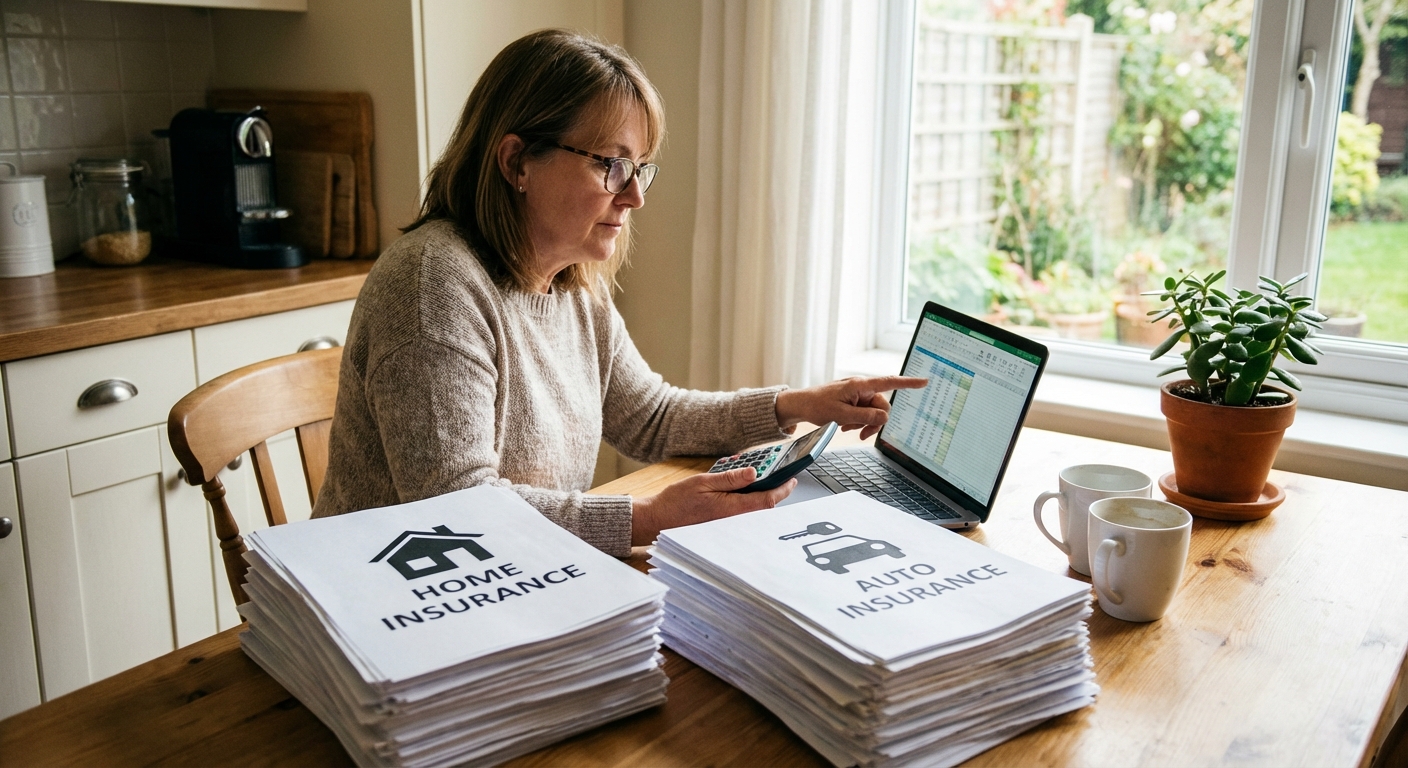
Step 1: Get bundled quotes Request a combined home + auto quote from at least 3 insurers that offer bundling. Note the pre-discount base premium and the final bundled total for each.
Step 2: Get standalone quotes Separately price your auto insurance with auto-focused carriers and your home insurance with home-focused carriers. Look for the lowest individual rates with identical coverage levels. Our guide on comparing quotes apples-to-apples walks you through how to standardize the numbers.
Step 3: Build a comparison table
| Scenario | Annual Auto Premium | Annual Home Premium | Total Annual Cost |
|---|---|---|---|
| Bundle, Insurer A | $2,200 | $2,900 | $5,100 |
| Bundle, Insurer B | $2,300 | $3,050 | $5,350 |
| Separate (best auto + best home) | $2,050 | $2,750 | $4,800 |
In this example, keeping policies separate saves $300/year despite no bundling discount. The key takeaway: the largest advertised discount percentage doesn't always equal the lowest total cost.
Step 4: Account for non-price factors Factor in claims service quality, deductible terms, and whether a shared deductible benefit applies in your bundled option. Sometimes paying slightly more for a bundle is worth the simplified management, particularly when one event could impact both your home and your car.
For a broader look at all the ways you can reduce what you pay, check out our complete list of car insurance discounts to make sure you're not leaving savings on the table.
Knowing how often to revisit your insurance is just as important as finding the right deal initially. Even if you've bundled, you shouldn't feel locked in. Running an annual car insurance policy review helps you catch rate creep before it costs you hundreds. If a better rate appears outside your renewal window, having multiple insurance policies in the same household is a legitimate option worth exploring. And if you're not sure your current premium is competitive, our how to lower car insurance guide covers 15 additional tactics beyond bundling.
Frequently Asked Questions
How much can I realistically save by bundling home and auto insurance in 2026?
Most consumers save between 10% and 25% on their combined premiums when they bundle, with the average landing around $542 to $869 per year based on 2026 analyses from MoneyGeek, Insurify, and other national studies. State Farm customers see some of the largest average savings at roughly $847 to $1,184 per year, while Progressive bundlers save closer to $223. Your specific savings depend on your location, coverage levels, claims history, and the insurer's base rates, so always verify with a real quote.
Is bundling always cheaper than having separate policies?
No, bundling is not always the cheapest option. Some insurers set higher base premiums before applying the discount, meaning the bundled total can still exceed the combined cost of two separately-shopped policies. In fact, 22% of homeowners in the 2026 Kin survey said they tried bundling and it did not save them money. The only reliable way to know is to run a side-by-side comparison using identical coverage levels across multiple carriers before committing.
Does bundling affect how claims are handled?
It can work in your favor. When both policies are under one roof, a single insurer manages all claims, streamlining communication and reducing friction. In cases where one event like a severe storm damages both your home and vehicle, some bundled policies include a common loss deductible feature, allowing you to pay just one deductible instead of two, potentially saving you hundreds out of pocket.
Should I bundle if I have a poor driving record?
Probably not. High-risk drivers typically get better auto rates from specialty carriers that focus on non-standard policies. Pairing a poor driving record with a home policy at the same insurer can raise both premiums, negating any discount benefit. In this scenario, keeping your auto and home insurance with separate companies is usually the smarter financial move.
How often should I re-evaluate whether my bundle is still saving me money?
At least once a year, ideally 30 to 60 days before your renewal date. Bundling discounts can shrink over time as insurers raise base premiums, and with 2026 home rates still projected to climb about 4% nationally on top of a 46% cumulative jump since 2021, annual re-shopping is essential. Doing so ensures you catch any rate creep early and stay ahead of market changes, especially in high-volatility states like California, Florida, and Texas.