

Compare Home Warranty Options in Ohio
See what plans you qualify for in less than 2 minutes
What Home Warranties Actually Cover (And What They Don't)
Standard home warranties are service contracts designed to cover the mechanical and electrical components of your home's core systems and built-in appliances when they break down from normal wear and tear. But in 2026, most American homes contain dozens of connected devices, and the gap between what you own and what your warranty covers can be surprisingly wide.
The golden rule is straightforward: home warranties cover the mechanics, not the technology. A compressor, motor, or heating element qualifies. A Wi-Fi chip, touchscreen display, or app-based feature does not.
The Core Coverage Rule for Smart Appliances
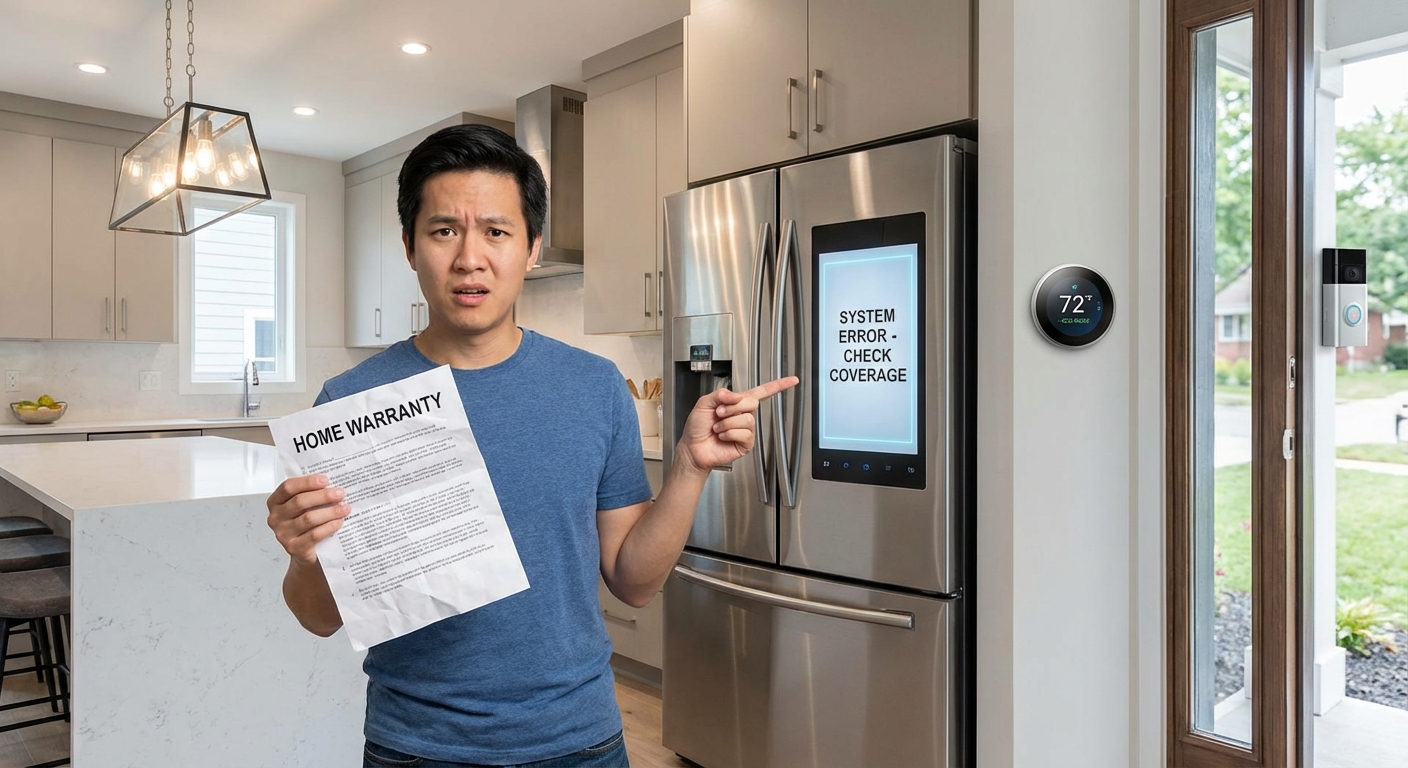
When a smart feature is embedded in an otherwise covered appliance, the home warranty may still pay for the mechanical failure, but it will not cover the smart component itself if that's the source of the breakdown. American Home Shield states this explicitly in its 2026 coverage guidance: a refrigerator breakdown is covered, but the embedded smart display or app connectivity is not. Industry data confirms the pattern across the market. Standard home warranties do not cover standalone smart devices like video doorbells, smart locks, or security cameras, and smart thermostats are often excluded as "smart" components even when the HVAC system itself is a covered item.
| Component Type | Covered? | Examples |
|---|---|---|
| Mechanical parts (compressor, motor, blower) | ✅ Yes | Refrigerator compressor, HVAC blower motor |
| Electrical components (wiring, heating element) | ✅ Yes | Oven heating element, basic control board |
| Smart display / touchscreen | ❌ No | Smart fridge display panel |
| Wi-Fi / connectivity module | ❌ No | Wi-Fi chip in any appliance |
| App or software functions | ❌ No | Remote control app, firmware updates |
| Standalone smart devices | ❌ No | Smart speakers, smart plugs, hubs |
Understanding this distinction is essential before you file a claim. For a deeper look at what's generally included in a plan, see our complete home warranty guide or review the full list of home warranty exclusions that commonly trigger denied claims.
Smart Thermostat, Refrigerator & Doorbell: Covered or Denied?
These three devices are the most common sources of confusion for smart homeowners. Here's the 2026 breakdown for each.
Smart Thermostats (Nest, Ecobee, Honeywell)
A standard home warranty typically covers traditional thermostats as part of your HVAC system coverage. AHS lists thermostats among the heating and air conditioning components included across all three of its 2026 plans (ShieldSilver, ShieldGold, and ShieldPlatinum). However, smart thermostats like the Nest Learning Thermostat or Ecobee SmartThermostat are treated differently.
The key variable is how your smart thermostat is integrated. If it controls your HVAC system as the wired control unit and fails due to an electrical fault, some providers may cover the repair. But if the smart software, scheduling feature, or connectivity module is the cause of failure, expect a denial. Industry reports note that some 2026 providers are beginning to expand coverage for smart and energy-efficient appliances, but standalone smart device coverage remains the exception, not the rule.
Smart Refrigerators
For smart refrigerators, the split between what's covered and what's not is crystal clear. The refrigeration system itself (compressor, condenser, evaporator coil, and ice maker motor) falls under standard appliance coverage. The smart features (the built-in touchscreen, internal camera, app connectivity, or voice assistant integration) are excluded.
So if your Samsung Family Hub refrigerator stops cooling, your home warranty will likely pay for a technician to diagnose and repair the compressor. But if the 21-inch display shorts out, that repair bill is entirely yours, and it's significant. 2026 repair pricing guides put the Family Hub touchscreen module in the $485 to $685 range in many markets, with premium Bespoke RF22A and RF23A models running as high as $685 to $985 for the full display panel and harness. The display is proprietary and generally cannot be sourced as a cheap aftermarket part, which is why even a starting-at-$400 part often turns into a $600 to $900 total once labor is added. One tip from repair technicians: not every blank-screen issue is a dead panel. A corrupted firmware update can mimic hardware failure, and a software fix through the service menu is often under $200 once diagnosed.
For more on how appliance coverage limits and replacement decisions work, review your plan's cap amounts. Most 2026 plans cap appliance coverage between $2,000 (AHS ShieldGold and Choice) and $4,000 (AHS ShieldPlatinum), with First American Premium going up to $7,000. Smart refrigerators often retail well above standard models, which means the cap can be hit fast on a total-loss claim. See our full refrigerator coverage guide for a deeper breakdown.
Smart Doorbells (Ring, Nest Hello)
Smart video doorbells are classified as standalone smart devices by virtually every major home warranty provider. American Home Shield, for example, covers traditional doorbell wiring, buttons, and chime components across all three of its 2026 plans, but explicitly states that video doorbells and other standalone smart gadgets are not typically covered.
The core reason: video doorbells are not a core home system. They are add-on smart gadgets that happen to replace a doorbell button. Because their primary function depends on cameras, Wi-Fi, motion sensors, and cloud connectivity, they fall outside mechanical and electrical coverage definitions.
Electronics Protection Add-Ons: Are They Worth It?
Recognizing the coverage gap, several home warranty companies and third-party providers now offer electronics protection add-ons designed to extend coverage to connected devices. Here's a comparison of what's available in 2026:
| Provider | Plan Name | What It Covers | Est. Cost | Claim Limit |
|---|---|---|---|---|
| American Home Shield | Allstate Electronics Protection | TVs, laptops, tablets, smart home products, routers | ~$14/mo add-on | $2,000/claim; $5,000 annual |
| Home Warranty Inc. | Smart Home Protection | Doorbells, locks, thermostats, cameras, hubs | Varies by plan | Varies |
| ARW Home | Electronics Protection Plan | TVs, routers, modems, audio, hubs | Add-on fee | Varies |
| Asurion Home+ | Whole-Home Tech Protection | Unlimited eligible devices (TVs, laptops, smart home) | $34.99/mo + tax | $2,000/claim; $5,000 annual |
| AT&T HomeTech Protection | Device Protection | Home electronics, smart devices, game consoles | $25/mo + tax | $2,000/claim; $5,000 annual |
AHS's Allstate Electronics Protection covers failures from normal use, power surge, and defects in workmanship, with coverage extending to TVs, desktop and laptop computers, tablets, gaming systems, printers, home routers, and select smart home products. It must be added within the first 60 days of membership or at renewal, and AHS's own site notes that add-on pricing across its lineup generally ranges from about $5 to $25 per month. Third-party 2026 reviews list the electronics add-on itself at about $14 per month. Most electronics add-ons still do not cover software failures, pre-existing damage, connectivity issues, cell phones, theft, or cosmetic damage. They focus on mechanical and electrical breakdowns of the devices themselves.
AT&T HomeTech Protection is the cheapest headline monthly price at $25 plus taxes and fees, but it requires an existing AT&T Wireless or AT&T Internet subscription, has a 30-day waiting period before coverage kicks in, and applies service fees of $0, $49, or $99 per approved claim depending on the device category. Routers, modems, and keyboards are $0 service fee, while TVs, laptops, and desktops fall into the $99 tier. Asurion Home+ has no carrier requirement, sells direct to consumers at $34.99 a month plus tax, covers unlimited eligible home devices with a $2,000 per-claim and $5,000 annual limit, and includes 24/7 tech support.
For a broader look at add-on coverages and options worth adding, it helps to compare per-month costs against your device inventory.
Should You Pursue Separate Smart Home Coverage?
If you have a heavily connected home (multiple smart TVs, a video doorbell, a smart thermostat, a connected refrigerator, and smart locks), a dedicated smart home protection plan may be worth evaluating. But for most homeowners, a few targeted moves deliver better value:
- Whole-home surge protection installed at your panel shields all connected devices from power spikes, which are among the most common causes of smart device failure. HomeAdvisor's 2026 data puts the national average project cost at about $300, with the typical installed range of $70 to $700, and most professional jobs landing between $200 and $500.
- Credit card extended warranties because many premium cards automatically extend manufacturer warranties at no cost. See our home warranty alternatives guide for more on these.
- Electronics add-ons from your home warranty provider like AHS's roughly $14 per month plan if your devices are high-value.
- Manufacturer warranties because Honeywell, Nest, and Ecobee thermostats carry 1 to 5 year warranties depending on whether they're retail or professionally installed models.
A dedicated plan like Asurion Home+ runs about $420 per year ($34.99 monthly plus tax), while AT&T HomeTech Protection runs about $300 per year plus tax and fees. By comparison, a one-time surge protector installation averaging $300 can protect every device in your home for a decade or more. If you're unsure whether a home warranty vs. extended warranty makes more sense for your specific devices, that distinction is worth understanding before spending money on either.
Frequently Asked Questions
Does a home warranty cover smart home devices?
Standard home warranties do not cover smart home devices in 2026. Coverage applies to the mechanical and electrical components of built-in home systems and appliances, not the smart features, Wi-Fi connectivity, software, or standalone smart gadgets layered on top of them. Some providers like American Home Shield and ARW Home offer optional electronics add-on plans that extend partial coverage, but these still exclude software and connectivity failures. Always read your contract carefully to understand what is and isn't included.
Will my home warranty pay to replace a broken Nest thermostat?
Most standard home warranty plans will not replace a Nest or Ecobee smart thermostat because they classify these devices as standalone smart gadgets rather than core HVAC components. In some cases, if the device is wired in as the primary HVAC control and fails due to an electrical fault, a provider may cover the mechanical repair, but this depends entirely on your specific plan. In 2026, a base Nest Thermostat retails at $129.99 and the Nest Learning Thermostat (4th gen) at $279.99 on the Google Store, so check our energy-efficient appliance coverage guide before assuming coverage exists.
What happens if the smart display on my refrigerator breaks?
If the smart display or touchscreen on your refrigerator fails, your home warranty will almost certainly deny the claim. Home warranties cover the mechanical refrigeration system (compressor, evaporator, ice maker motor) but not embedded digital components like screens, cameras, or app-based features. In 2026, Samsung Family Hub touchscreen module repairs commonly run $485 to $685, and premium Bespoke display panels can reach $685 to $985 all-in. Learn more about appliance coverage exclusions before a claim arises.
Does a home warranty cover a Ring or Nest video doorbell?
No. Ring, Nest Hello, and other video doorbells are classified as standalone smart devices and are excluded from standard home warranty plans. American Home Shield, for example, covers traditional doorbell buttons, wiring, and chimes, but excludes smart video doorbells. For video doorbell protection, your best options are the manufacturer's warranty, a retailer plan, or a dedicated electronics protection plan such as Asurion Home+ at $34.99 per month or AHS's Allstate Electronics Protection at about $14 per month. Learn more about electrical coverage rules to avoid costly claim denials.
Is a separate smart home protection plan worth the cost?
For most homeowners, a dedicated smart home protection plan is not the most cost-effective option unless you have a large number of high-value connected devices. At $25 to $35 per month, dedicated plans like Asurion Home+ or AT&T HomeTech Protection add up to $300 to $420 annually. Better value often comes from a $300 whole-home surge protector installation, leveraging credit card extended warranty benefits, and adding a low-cost electronics rider (like AHS's roughly $14 per month plan) to your existing home warranty. If you're weighing your overall home warranty plan options for 2026, factor in whether an electronics add-on is available before committing to a separate policy.