
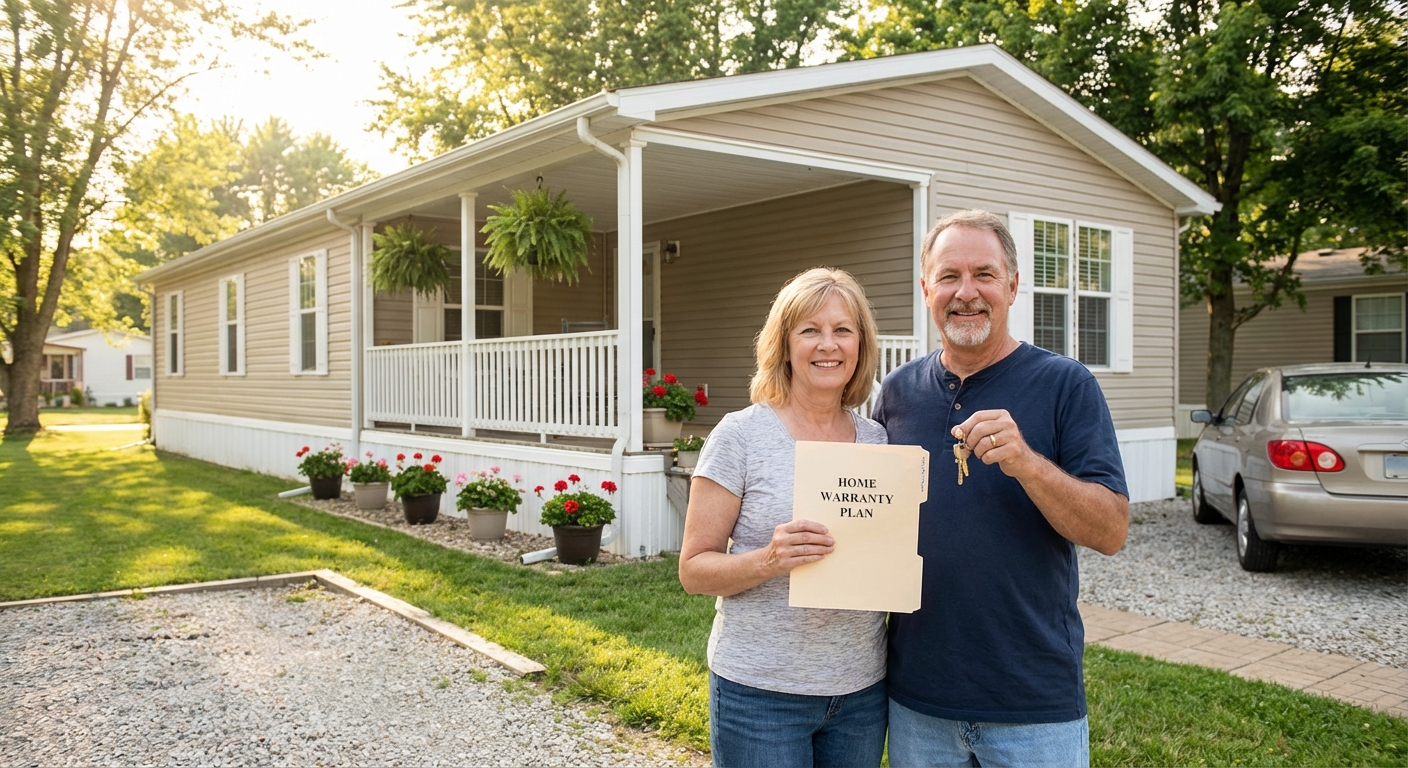

Compare Home Warranty Options in Ohio
See what plans you qualify for in less than 2 minutes
Mobile Home, Manufactured Home, or Modular Home: Does It Matter?
Before shopping for a home warranty, it's important to understand how warranty companies categorize your home. These three terms are often used interchangeably, but they carry very different legal and practical meanings.
| Home Type | Built To | Foundation | Key Trait |
|---|---|---|---|
| Mobile Home | Pre-June 15, 1976 local codes | Non-permanent; movable | Pre-dates HUD standards |
| Manufactured Home | Federal HUD Code (post-1976) | Permanent or pier-based | Red HUD seal on each section |
| Modular Home | State/local building codes | Permanent foundation | Treated like site-built homes |
Mobile homes were built before June 15, 1976 on a steel chassis with wheels, and predate federal safety standards. Manufactured homes are essentially the modern evolution, built in a factory after 1976 to strict HUD Code standards and affixed with a red HUD seal. Modular homes are factory-built in sections but assembled on a permanent foundation, subject to the same local building codes as a site-built home.
Why does this matter for warranties? Because modular homes are typically treated by warranty companies the same as traditional homes, giving owners the widest access to standard plans. Manufactured homes have moderate options, while true pre-1976 mobile homes face the most restrictions due to outdated construction standards. Some providers like Cinch Home Services explicitly require the home to be anchored to a permanent foundation and treated as a single-family residence to qualify for coverage.
What Does a Mobile Home Warranty Actually Cover?
A home warranty for mobile homes functions as a service contract that covers repair or replacement of major systems and appliances when they break down due to normal wear and tear. Coverage is similar in concept to a standard home warranty, but the specifics differ.
Typically Covered Systems & Appliances
Most mobile home warranty plans cover the following:
- Heating systems (central furnaces, heat pumps)
- Electrical systems (wiring, panels, outlets)
- Plumbing systems (pipes, fittings, stoppages)
- Water heater and ductwork
- Air conditioning systems (central; window units usually excluded)
- Refrigerator
- Oven, range, and cooktop
- Dishwasher
- Clothes washer and dryer
- Built-in microwave
- Garbage disposal
- Ceiling and exhaust fans
- Garage door opener (if applicable)
Common Exclusions Specific to Mobile Homes
This is where mobile home warranties diverge significantly from standard policies. Beyond the usual exclusions (pre-existing conditions, cosmetic damage, and natural disasters), mobile home plans typically exclude structural and transport components:
Understanding what a home warranty covers in general is a great foundation, but for mobile homeowners, reading the fine print for home-specific exclusions is non-negotiable. Learn more about common denial pitfalls, since pre-existing conditions and non-covered items each drive roughly 29% of claim denials.
Which Home Warranty Companies Cover Mobile Homes in 2026?
Not all major home warranty providers extend coverage to mobile or manufactured homes. Here's a breakdown of the most notable companies that do offer coverage as of 2026, with updated pricing pulled from ConsumerAffairs, Forbes, This Old House, and NerdWallet:
| Company | Mobile/Manufactured Coverage | Notable Feature | Est. Monthly Cost (2026) |
|---|---|---|---|
| American Home Shield | ✅ Yes | ShieldSilver, Gold, Platinum tiers; $5,000 HVAC and $4,000 appliance caps on Platinum; $50,000 aggregate | $30 to $100+ |
| First American Home Warranty | ✅ Yes | Starter, Essential, Premium plans; strong real estate channel | $37 to $72 |
| Liberty Home Guard | ✅ Yes | Appliance, Systems, Total Home Guard plans; 365-day workmanship warranty | $49.99 to $59.99 |
| Choice Home Warranty | ✅ Yes | Budget-friendly comprehensive plans; ~$85 service fee | $45 to $60 |
| Cinch Home Services | ✅ Yes | Requires permanent foundation; no shared systems | Varies |
| AFC Home Club | ✅ Yes | Flexibility to use your own licensed technician | Varies |
| Select Home Warranty | ⚠️ Limited | Confirm eligibility; often lowest premiums | $35 to $48 |
| 2-10 Home Buyers Warranty | ✅ Structural | 10-year structural warranty for new manufactured/modular homes | One-time fee |
According to 2026 industry data from ConsumerAffairs and This Old House, the typical mobile home warranty plan runs about $40 to $70 per month (roughly $480 to $840 per year), with service fees generally landing between $65 and $125 per visit. Forbes' 2026 analysis places the average mobile home warranty premium closer to $57 per month, with a broader range of $27 to $100 depending on plan and provider. For comparison, NerdWallet's 2026 research puts the national average for a standard home warranty at $73 per month, so mobile home coverage typically sits at the lower to middle end of the market. See how total warranty costs stack up across plan tiers for a broader view.
It's also worth noting that manufacturer structural warranties (like those from 2-10 Home Buyers Warranty) offer 10-year insurance-backed coverage against qualifying structural defects in load-bearing components on new manufactured and modular homes. The manufactured home version covers structural defects "from the frame up," while modular home coverage runs "from the sill plate up." These are separate from third-party service contracts, are typically paid by the builder, and don't cover systems or appliances, making a consumer home warranty a smart complementary investment. See our full roundup of the best home warranty companies of 2026 for a broader comparison.
Special Considerations for Older Mobile Homes
If your home was built before 1976, getting comprehensive warranty coverage becomes significantly more challenging, but not impossible.
The Pre-1976 Challenge
Older mobile homes were built before HUD standardized manufactured housing safety codes. Without a HUD seal, many warranty providers and lenders treat these homes as high-risk. Challenges include:
- Limited provider pool: fewer companies will accept pre-HUD homes
- Higher premiums: 2026 specialty carriers charge roughly 40% to 100% more for pre-1976 units versus post-HUD homes
- Possible inspection requirements: some providers require a professional inspection before coverage begins
- Reduced coverage limits: replacement cost coverage may be capped or unavailable
- Insurance gaps: mainline carriers like State Farm decline pre-1976 mobile homes; in 2026, four carriers (Foremost, Assurant, American Modern, and Progressive) control roughly 75% of the mobile home insurance market, with Foremost and American Modern being the go-to specialty options for older units
Much like the challenges outlined in our guide on home warranties for older homes, age introduces real risks around pre-existing conditions and outdated components that many providers will flag.
Tips for Older Mobile Home Owners
- Document everything: maintain records of all system maintenance and repairs
- Get a pre-warranty inspection: identify and fix known issues before applying
- Pair warranty with specialty insurance: Foremost explicitly accepts homes of any age, model, make and value, while American Modern is often the top choice for pre-HUD homes and other tough placements that mainstream carriers refuse
- Consider appliance-only plans: if your structure is older, a plan focused on appliances may be easier to qualify for and more cost-effective
- Expect ACV coverage: pre-1976 homes typically qualify only for actual cash value (ACV) policies that pay depreciated value, not full replacement cost
Mobile Home Warranty Costs & What to Look For
How Much Does It Cost in 2026?
Typical monthly premiums for mobile home warranties now range from $40 to $70 per month, with the average landing around $57 per month according to Forbes' 2026 research. Service fees per claim generally run $65 to $125, and optional add-ons like septic, sump pump, or roof leak coverage add roughly $5 to $12 per month per item. By comparison, standard site-built home warranties average about $73 per month in 2026 per NerdWallet, so mobile home coverage tends to be priced at the lower end of the market.
| Plan Type | Mobile Home (Monthly) | Site-Built Home (Monthly) |
|---|---|---|
| Basic (Systems or Appliances) | $30 to $48 | $30 to $50 |
| Comprehensive (Combo) | $50 to $70 | $57 to $85 |
| With Add-Ons | $60 to $85+ | $90 to $140+ |
| Service Fee Per Claim | $65 to $125 | $75 to $150 |
It's worth knowing that a home warranty is a fundamentally different product from homeowners insurance. If you're unsure about the distinction, our breakdown of home warranty vs. home insurance explains both in plain language. You can also compare the three main plan types side by side to see which mix of systems and appliance coverage fits your budget.
What to Look For in a Mobile Home Warranty Policy
Before signing any contract, run through this checklist:
- ✅ Explicit mobile/manufactured home eligibility: verify your home type qualifies
- ✅ Coverage for HVAC, plumbing, and electrical: these are your highest-cost systems
- ✅ Appliance coverage: refrigerator, washer/dryer, oven, dishwasher
- ✅ Mobile-specific add-ons: septic system, well pump, sump pump (note: roof leak coverage often excludes mobile home roofs)
- ✅ High per-item limits: AHS ShieldPlatinum offers up to $5,000 per HVAC system and $4,000 per appliance with a $50,000 aggregate cap
- ✅ Workmanship guarantee: 30 to 365 days depending on carrier (Liberty Home Guard leads at 365 days)
- ✅ Waiting period: most carriers impose a 30-day waiting period before claims can be filed
- ✅ Technician flexibility: ability to use your own licensed contractor if needed (AFC Home Club allows this)
- ✅ Clear exclusion list: confirm what mobile home components are explicitly excluded
Understanding the differences between home warranties and extended warranties is also useful when planning long-term protection, especially after a manufacturer's structural warranty expires. For first-time buyers, our millennial home warranty guide walks through additional cost-benefit scenarios.
Frequently Asked Questions
Do standard home warranties cover mobile homes?
Not automatically. Many traditional home warranty companies exclude mobile homes or require a mobile home addendum to their standard plan. Coverage depends entirely on the provider. Companies like American Home Shield, First American, Choice Home Warranty, Liberty Home Guard, Cinch Home Services, and AFC Home Club explicitly offer coverage for mobile and manufactured homes in 2026, but you should always confirm eligibility before purchasing.
What is the difference between a mobile home and a manufactured home for warranty purposes?
The key distinction is the build date. Mobile homes were built before June 15, 1976, and predate federal HUD safety standards, making them harder to cover. Manufactured homes were built after that date to HUD Code and typically qualify for more warranty options. For warranty purposes, manufactured homes are the preferred classification, while pre-1976 mobile homes often face more restrictions, age-related exclusions, and a smaller provider pool.
Are chassis, axles, and the tongue covered by a mobile home warranty?
No. These structural and transport components are universally excluded from home warranty coverage. The chassis (steel frame), axles, wheels, and tongue (tow hitch) are considered transport infrastructure, not home systems. Even structural warranties from companies like 2-10 HBW only cover qualifying structural defects in designated load-bearing elements, not the transport gear below. If these components fail, you would need to seek repair through a mobile home structural specialist or a separate insurance policy.
How much does a home warranty for a mobile home cost per month in 2026?
Most mobile home warranty plans cost between $40 and $70 per month in 2026, with Forbes citing an average of about $57 per month across providers. Service call fees typically range from $65 to $125 per claim, and add-ons like septic or well pump coverage tack on another $5 to $12 monthly. Basic appliance-only or systems-only plans land at the lower end, while comprehensive combination plans with add-ons can push costs higher. These rates are generally slightly less than warranties for traditional site-built homes, which now average closer to $73 per month.
Can I get a warranty on an older mobile home built before 1976?
Yes, but it is more difficult. Pre-1976 mobile homes face greater scrutiny because they do not carry a HUD seal and were not built to modern safety codes. Some providers will still offer coverage but may require a home inspection, impose higher premiums (often 40% to 100% more), or limit coverage to appliances only. Pairing a home warranty with a specialty insurer like Foremost (which accepts homes of any age) or American Modern (often the leading option for pre-HUD homes and the toughest risks) gives older mobile homeowners the most complete protection.