

Compare Home Warranty Options in Ohio
See what plans you qualify for in less than 2 minutes
Does a Home Warranty Cover Code Upgrades?
The short answer: usually not. Most standard home warranty plans do not cover the cost of bringing your home's systems up to current building codes, and permit and code upgrade costs are excluded from virtually all home warranty contracts. Code upgrade exclusions are among the most common, and most misunderstood, limitations buried in home warranty contracts.
When a covered system fails (say your furnace dies or a plumbing line bursts), your warranty company will typically pay to repair or replace that component on a like-for-like basis. But if a local inspector mandates that the replacement must meet updated code standards, requiring a larger electrical panel, a new venting configuration, or a high-efficiency unit using the newer R-454B refrigerant, that extra work generally falls on you.
Standard contract language from major warranty companies continues to treat code compliance as a limited add-on, not a core benefit. A handful of premium-tier plans now include a code upgrade allowance, typically between $250 and $2,000 per term, but only when the code issue is directly tied to a covered repair. Reviewing home warranty exclusions before you buy is the single best defense against surprise costs.
Why Are Code Upgrades Typically Excluded?
Home warranty companies exclude code compliance costs for several well-documented reasons:
- Unpredictable costs: Code upgrade work can range from a few hundred dollars to tens of thousands depending on the system, the municipality, and the age of your home.
- Legal responsibility lies with the homeowner: Code compliance is the property owner's legal obligation, and permits exist to ensure public safety and regulatory compliance.
- "Betterment" doctrine: Warranty plans are built around restoring what failed, not improving or modernizing it. Code upgrades almost always result in a net improvement over what was there before, which most contracts explicitly exclude as "betterment."
- Cost containment: By excluding these costs, companies keep monthly premiums more affordable.
As a result, standard plans will pay only for the least-cost repair that restores basic operation, not the full code-compliant rebuild that a licensed contractor may legally be required to perform. Learn more about how repair vs replace decisions get made.
Common Code Upgrade Scenarios (and What They Cost in 2026)
Code upgrades come up most frequently in three areas: electrical, HVAC, and plumbing. Understanding what these scenarios look like in the real world helps you anticipate costs that your home warranty may not address.
Electrical Panel Upgrades
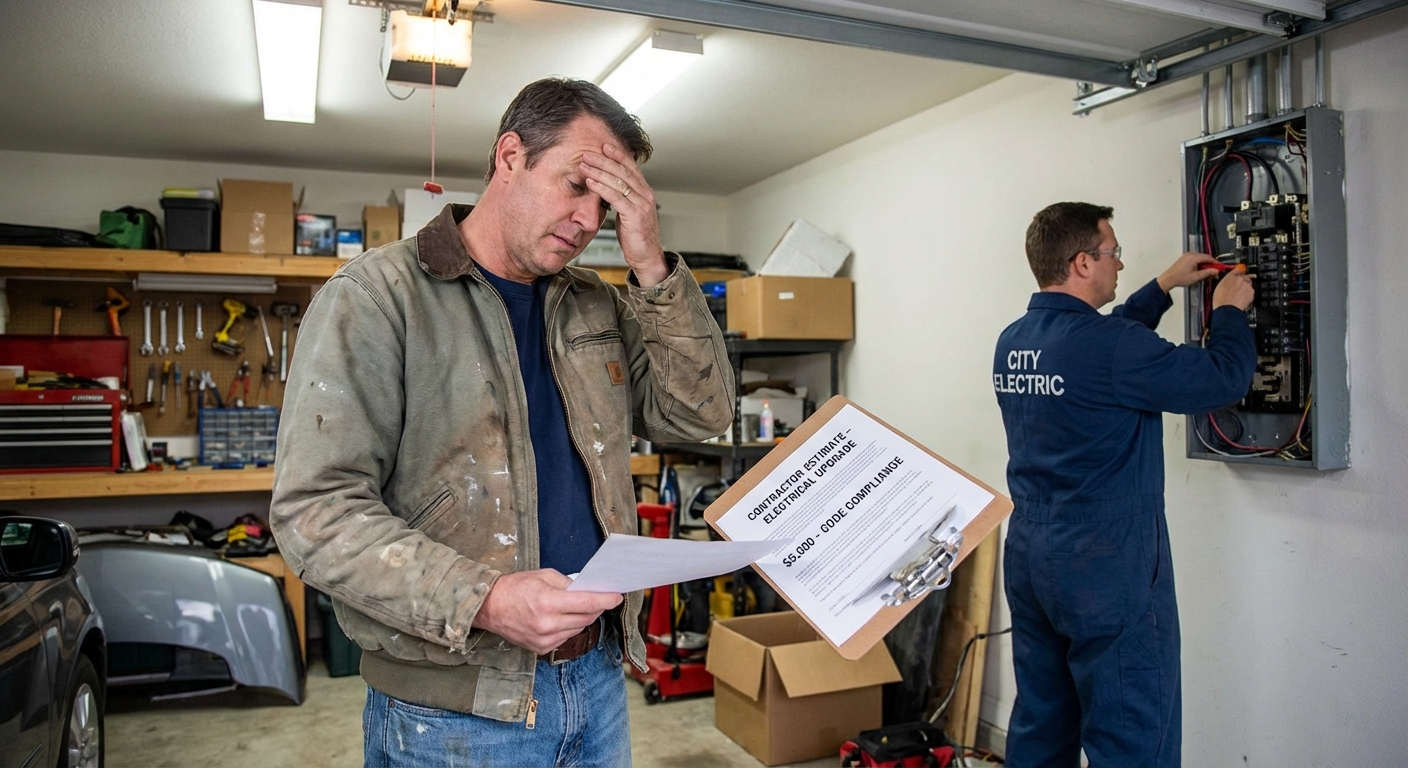
When an electrician replaces a breaker, wiring run, or sub-panel, local codes may require upgrading the entire electrical panel to current amperage standards, adding GFCI/AFCI breakers, or rerouting wiring. In 2026, most homeowners pay between $1,300 and $3,000 for a standard 100-amp to 200-amp panel upgrade, with the national average sitting around $2,000 to $2,500 when you include labor, a new panel, and the permit. When the meter base, service mast, and service-entrance conductors also have to be replaced, the all-in cost commonly climbs to $4,000 to $8,000, and some markets are reporting complete code-compliant upgrades in the $5,350 to $7,800 range including permitting and grounding work. Learn more about what electrical coverage typically includes (and excludes) before assuming your panel upgrade is covered.
HVAC Permits, SEER2 and the R-454B Refrigerant Transition
This is the biggest code shift homeowners face in 2026. Two federal changes are now in full effect:
- SEER2 efficiency minimums: The federal minimum for split-system central AC under 65,000 BTU/hr is 13.4 SEER2 in the North, 14.3 SEER2 for systems under 45,000 BTU/hr in the Southeast and Southwest, and 13.8 SEER2 for larger systems in those southern regions. The Southwest also carries additional EER2 requirements for peak-day performance.
- R-410A phase-out and 2026 sell-through rule: As of January 1, 2025, manufacturers can no longer produce new residential HVAC equipment using R-410A. The EPA later issued a final rule (effective July 27, 2026) that removed the installation compliance date for pre-2025 R-410A residential and light commercial equipment, allowing existing inventory to be installed as a "sell-through" while all newly manufactured splits use R-454B or R-32.
Manufacturers like Carrier have stated that R-454B units cost roughly 10 percent more than equivalent R-410A equipment because of redesigned components, A2L safety features, and leak-detection requirements. Real-world installations typically run $400 to $1,500 more per system than the previous R-410A generation, and some markets are quoting 15 to 30 percent higher totals when tariffs, Honeywell's 42 percent R-454B surcharge, and labor pressures are factored in. That "betterment" gap is rarely covered by standard warranty plans. See our full HVAC coverage guide and the latest on air conditioner coverage for how these refrigerant rules affect claims.
Plumbing Venting Code Updates
Updated plumbing codes govern pipe materials, venting configurations, and water supply standards. When a plumber makes a repair that triggers a code review, they may be legally required to update the venting layout or swap out older pipe materials.
| System | Common Code Requirement | Typical 2026 Added Cost |
|---|---|---|
| Electrical Panel | Upgrade to 200-amp service, add AFCI/GFCI breakers | $1,300 – $4,500 |
| HVAC System | SEER2 compliance, R-454B refrigerant unit, permit | $400 – $1,500+ |
| Plumbing | Venting reconfiguration, pipe material update | $300 – $2,000 |
| Water Heater | Seismic strapping, new shutoff valves, permit | $150 – $600 |
| Furnace | Flue rerouting, combustion air, permit | $400 – $1,500 |
Code-related add-ons can increase the total cost of a repair by 20 to 30% or more on top of standard repair costs, expenses that fall entirely on the homeowner if their warranty plan lacks code upgrade coverage. For furnace coverage specifically, code-required flue and combustion air work is a common denial point.
Which Home Warranty Companies Offer Code Upgrade Coverage?
A handful of companies provide some level of code upgrade or permit coverage, but the details vary widely. Here's how the major players compare in 2026:
American Home Shield (AHS)
AHS's ShieldPlatinum plan is one of the few tiers that explicitly names code violations, permits, and modifications as covered items. According to AHS's own plan page and contract language, ShieldPlatinum includes a $250 per agreement term Modifications limit covering duct, plenum, electrical, and plumbing modifications, plus permits, testing, inspections, and correction of existing code violations required by law for an approved repair. The plan also carries a $50,000 total limit per agreement term, a $5,000 per HVAC system cap, $4,000 per covered appliance, roof leak coverage, and unlimited AC refrigerant. The lower ShieldGold and ShieldSilver tiers do not include a code upgrade allowance. See our American Home Shield reviews for a full plan breakdown.
Choice Home Warranty
Choice's Basic and Total plans continue to run in the mid-$40s to mid-$50s per month with a service fee per claim, and both plans explicitly exclude code upgrades, including those triggered by federal efficiency or refrigerant changes. Most direct-to-consumer buyers will not receive any code-related benefits and should budget accordingly.
First American Home Warranty
First American's 2026 plan documents show that the First American Advantage upgrade adds coverage for code violations, permits, crane fees, refrigerant disposal, and mismatched or improperly installed systems, with a combined coverage cap of $500 on the Essential Plan and $1,500 on the Premium Plan. Older brochure language for the "Codes, Mods, and More" enhancement raises the code violation allowance to $1,250 in some contract versions. See our full First American Home Warranty reviews for current pricing and cap details.
Cinch Home Services
Cinch's Complete Home plan does not include code violations or permits by default, but its optional Premier Upgrade Package provides up to $2,000 per year (two claims of up to $1,000) for charges normally excluded, such as permits, code upgrades, and removal and disposal costs. Coverage limits vary by state, so ask specifically for the modification and permit dollar amount on your quote before signing.
Old Republic Home Protection
Old Republic's Platinum tier (particularly Platinum with the Total Care upgrade) lists code upgrades, permits, haul-away, cranes, refrigerant recapture, mismatched systems, and modifications as included benefits, and it's one of the few providers whose plan materials specifically call out A2L refrigerant conversion coverage. Because Old Republic uses per-system rather than aggregate caps (up to $6,500 heating plus $6,500 A/C in most states), it remains a strong option for homes with older systems where code exposure is likely.
When shopping, always ask specifically: Does this plan cover bringing a failed system up to current building code, and what is the dollar limit? Get the answer in writing. Our plans comparison breaks down provider differences side by side.
How to Handle Code-Related Repair Costs
Even with the best plan, code upgrades will likely generate some out-of-pocket expense. Here are proven strategies for managing those costs and negotiating effectively with your warranty company.
1. Know Your Contract Before a Crisis Hits
Review your contract's exclusions thoroughly before a repair ever comes up. Understand exactly what your plan's "code upgrade" cap is, or confirm that there isn't one, and check the coverage limits that apply to your specific systems.
2. Appeal Denied Claims in Writing
If your warranty company denies a code-related cost, file a formal written appeal. Nearly all providers have an appeal process. Gather maintenance records, photos, contractor estimates, and the technician's inspection report. Being thorough and persistent significantly improves outcomes, and following preventive maintenance requirements strengthens your position.
3. Get an Independent Contractor Assessment
If the warranty company's technician says code upgrades aren't necessary but your contractor says they are legally required (especially under 2026 SEER2 or A2L refrigerant rules), get a written second opinion from a licensed independent contractor. Use that document to support your appeal.
4. Escalate to State Regulators
If your appeal is denied and you believe the warranty company is misinterpreting your contract, file a complaint with your state's Department of Insurance or Attorney General's office. Many companies reconsider positions once a regulatory complaint is filed.
5. Request Itemized Invoices
Ask contractors to separately line-item the base covered repair from the code upgrade work. This makes it easier to submit the covered portion to your warranty company and clearly identify the amount you're responsible for, avoiding disputes over bundled invoices.
6. Evaluate Whether to Upgrade Your Plan
If your home has older systems, consider upgrading to a premium plan tier that includes code coverage. Review payout limits across providers to determine whether the added cost is worth it.
If you own an older home, check out our guide on warranties for old homes. Code upgrade exposure is especially high when systems were installed under decades-old standards.
Frequently Asked Questions
Does my home warranty cover electrical panel upgrades to meet current code?
In most cases, no. Standard home warranty plans cover the repair or replacement of a failed electrical component but not the cost of upgrading the panel to meet current building codes. Some premium plans like AHS ShieldPlatinum include a $250 modifications allowance, and First American's Advantage upgrade raises modification coverage to $500 or $1,500 depending on your plan tier, but neither covers a full panel upgrade, which typically runs $1,300 to $8,000 in 2026.
Will a home warranty pay for HVAC permit fees and R-454B refrigerant upgrades?
Permit fees are typically excluded from standard plans. AHS ShieldPlatinum covers modifications, code requirements, and permits tied to a covered repair up to a $250 term limit, plus unlimited AC refrigerant, which is increasingly valuable as R-454B becomes the residential standard. Choice Home Warranty's plans specifically exclude upgrades caused by refrigerant or efficiency changes, while Old Republic Platinum explicitly names A2L refrigerant conversion in its plan materials. Confirm permit and refrigerant coverage in writing before assuming your plan includes it.
Can I negotiate with my home warranty company to cover code compliance costs?
Yes, and it's worth trying. Start by filing a formal written appeal with supporting documentation including contractor estimates, maintenance records, and any local code documentation showing the upgrade is legally required. If the upgrade is directly tied to a covered repair, you have the strongest case. Companies sometimes agree to partial reimbursements rather than full denials, especially if you escalate through a state regulator complaint process.
Why does my home warranty exclude code violations?
Home warranty companies exclude code compliance because it falls outside the core purpose of a warranty, which is to repair or replace what failed due to normal wear and tear. Code upgrades represent a betterment beyond the original system, an unpredictable liability, and a legal obligation that belongs to the property owner. Covering all code-related work would significantly increase plan costs and create open-ended financial exposure.
What's the best way to protect myself from unexpected code upgrade costs?
The most effective strategies are: (1) purchase a premium plan tier that includes a code upgrade allowance, such as AHS ShieldPlatinum, First American with the First American Advantage upgrade, Cinch's Premier Upgrade Package, or Old Republic Platinum, (2) set aside a home repair emergency fund of $1,500 to $4,000 specifically for code-related out-of-pocket costs, and (3) ask your contractor to provide itemized quotes that separate covered repairs from code-required modifications. Reviewing your home warranty options before a claim is your best defense.