
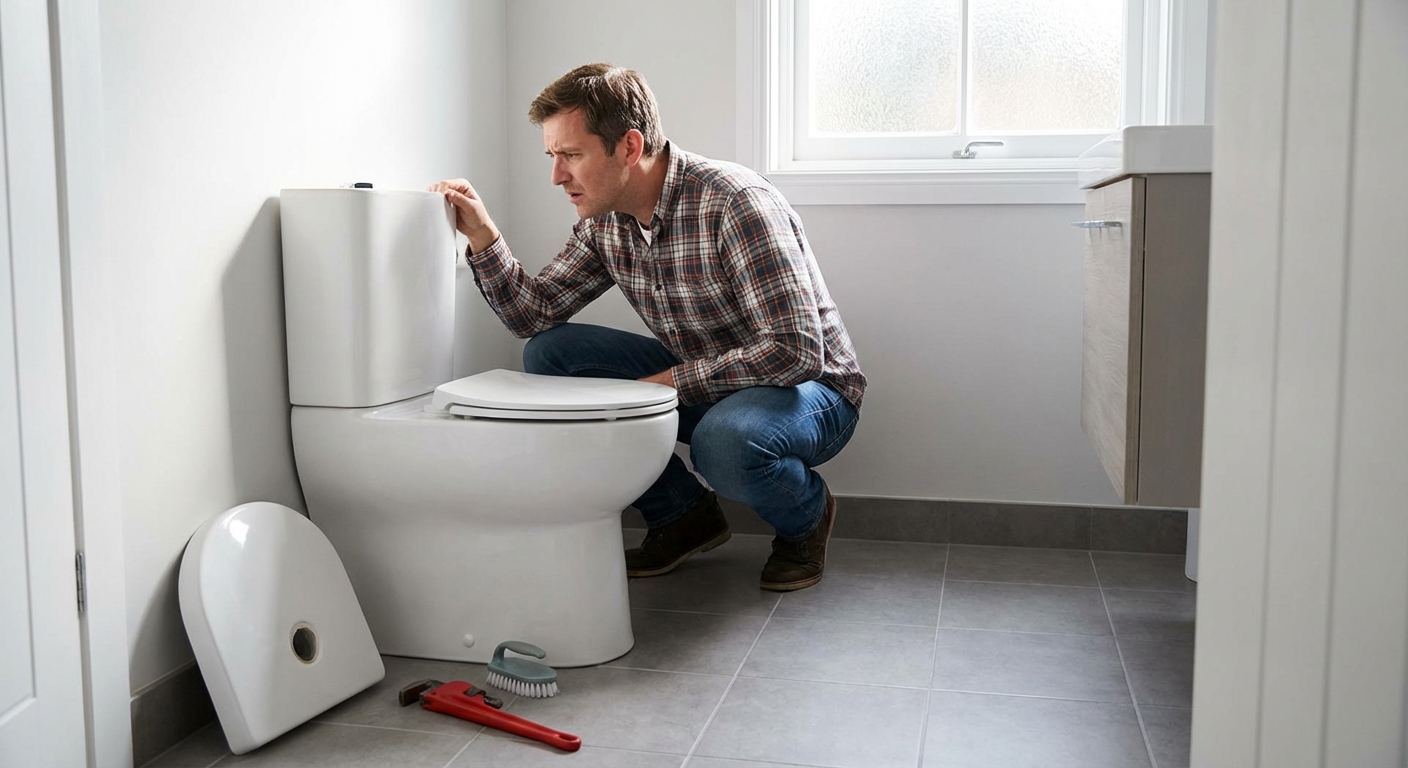
What's Actually Wrong With Your Low Flow Toilet
Low flow toilets use significantly less water per flush, typically 1.28 gallons or less compared to the 3.5 to 7 gallons consumed by older models. That's a meaningful conservation win, but it also means less force pushing waste through your plumbing. When something goes wrong with the mechanics, even that limited force becomes compromised.
Here are the four most common low flow toilet problems homeowners face and the technical reasons they happen:
| Problem | Root Cause |
|---|---|
| Weak flush | Low tank water level, clogged rim jets, or low water pressure |
| Frequent clogging | Smaller trapway passages plus reduced flush volume can't move solid waste |
| Multiple flushes needed | Inadequate water force fails to fully clear the bowl siphon |
| Incomplete bowl clearing | Mineral-blocked jet holes reduce water distribution under the rim |
The most frustrating irony? Double-flushing to compensate can use more water than a standard toilet, completely defeating the purpose of a water-saving model. If you're also dealing with weak pressure throughout the house, our guide to low water pressure fixes can help you rule that out first.

Find Trusted & Licensed Plumbers in Ohio
Get matched with companies for your specific needs
Older vs. Newer Low Flow Models: A Big Difference
Not all low flow toilets are created equal. If you're dealing with constant problems, your toilet's age may be the real culprit.
When the U.S. Energy Policy Act mandated a 1.6 GPF limit in 1992, manufacturers rushed to comply, often by simply reducing the water volume in existing tank designs without redesigning the trapway, bowl, or jet system. The result? Early low flow toilets were widely criticized for requiring multiple flushes and clogging regularly. According to industry plumbers, some brands "didn't re-engineer the necks and interior plumbing of the toilets, just put smaller tanks on," while the better brands redesigned everything.
Modern high-efficiency toilets (HETs) are a completely different story.
The EPA's WaterSense program certifies toilets using 1.28 GPF or less that still deliver equal or superior performance. In May 2024, the EPA released Version 2.0 of the WaterSense Specification for tank-type toilets, which eliminated the previous averaging calculation for dual-flush toilets and requires the full-flush mode to meet the same 1.28 GPF limit. Version 2.0 has been paused, so Version 1.2 remains in effect for now, but the direction is clear: modern low flow toilets no longer force you to sacrifice flush power to save water. Learn more about WaterSense certified fixtures and how they perform in independent testing.
How to Fix Low Flow Toilet Problems: Step-by-Step
Before calling a plumber, try these DIY troubleshooting steps in order. Most low flow toilet flush problems can be resolved with simple adjustments or inexpensive parts.
Step 1: Adjust the Tank Water Level
A low water level in the tank is the #1 cause of a weak flush. The water should sit at the manufacturer's fill line, or about ½ to 1 inch below the top of the overflow tube.
- Remove the tank lid and locate the fill valve and float
- For a cup-style float: twist or slide it upward to raise the water level
- For an older ball float: gently bend the arm upward
- Restore water supply and let it refill, then test the flush
Step 2: Clean the Rim Jets
Mineral deposits from hard water are notorious for blocking the small holes under the toilet rim that distribute flushing water. When these jets get clogged, the flush loses pressure and the bowl doesn't clear completely.
- Turn off the water supply valve
- Pour 1 to 2 cups of white vinegar or a lime-dissolving cleaner into the overflow tube inside the tank
- Let it sit for at least 30 minutes (overnight for heavy buildup)
- Use a small wire, mirror, and toothbrush to manually clear each rim hole
- Flush several times to rinse
Step 3: Inspect and Fix the Flapper
A worn or improperly adjusted flapper is one of the most common causes of an incomplete flush. If the flapper doesn't open fully or seals before all water exits the tank, your flush is cut short. This same issue can also cause a running toilet if the flapper doesn't reseal properly.
- Check the chain: it should have 1 to 2 links of slack, not too tight, not too loose
- Inspect the rubber flapper for cracks or warping
- Replace a worn flapper (universal Fluidmaster or Korky kits cost under $15 at any hardware store)
Step 4: Plunge or Snake for Clogs
If the bowl drains slowly or waste isn't clearing, there's likely a partial clog in the trapway.
- Use a flange plunger (not a flat-cup plunger) for a proper seal
- Plunge vigorously 10 to 15 times
- For stubborn clogs, use a toilet auger to break up blockages further in the drain
- Avoid chemical drain cleaners, which can damage toilet components over time
Best Low Flow Toilets That Won't Clog and When to Upgrade
If you've gone through every troubleshooting step and your toilet still underperforms, it may be time to upgrade, especially if your model is more than 15 years old. Independent testing from Consumer Reports, Good Housekeeping, and Wirecutter in 2026 has confirmed that modern 1.28 GPF toilets can outperform older 1.6 GPF models. Here are the top-performing low flow toilets that consistently avoid the problems covered above:
| Brand & Model | Flush Volume | Key Technology | Best For |
|---|---|---|---|
| TOTO Drake (1.28 GPF) | 1.28 GPF | Tornado/Cyclonic Flush | Best overall, independent test winner |
| Niagara Stealth 0.8 | 0.8 GPF | Pressure-assisted | Max water efficiency |
| Gerber Viper | 1.28 GPF | Wide trapway gravity flush | Best value, clog resistance |
| Kohler Cimarron | 1.28 GPF | AquaPiston canister | Solid build, big brand support |
| American Standard Champion 4 | 1.28 GPF | 4-inch flush valve & trapway | Max clog resistance |
| Glacier Bay One-Piece | 1.28 GPF | Siphonic gravity flush | Budget-friendly value |
What Does a Replacement Cost in 2026?
Total cost to install or replace a low flow toilet in 2026 typically runs $300 to $600, with most homeowners paying around $450 including the toilet and labor. Budget models start near $150 for the toilet alone, mid-range WaterSense units run $200 to $400, and plumber labor for a straightforward swap adds $150 to $400. Expect to pay more if the flange or subfloor needs repair. Learn more about broken toilet flange repair if you spot rocking or leaks at the base.
When Should You Replace Instead of Repair?
Consumer Reports testing in 2026 confirms that modern water-efficient toilets require no sacrifice in performance and can save homeowners money over the life of the unit. For broader upgrade strategies, see our full water conservation plumbing guide, and if your bill keeps climbing without an obvious cause, our high water bill troubleshooting guide can help you find the culprit.
Frequently Asked Questions
Do low flow toilets clog more than regular toilets?
Older low flow models (especially those from the 1990s) do clog more frequently because they used less water without redesigning the trapway or flush system. Modern high-efficiency toilets, however, have wide glazed 3 to 4-inch trapways and powerful flush technologies that match or exceed standard toilets in clog resistance. The key is the design quality and trapway size, not just the water volume.
Why does my low flow toilet require multiple flushes?
This is usually caused by one of three things: the water level in the tank is set too low, the rim jets are clogged with mineral deposits, or the flapper isn't staying open long enough to release a full flush. Start by checking the tank water level, which should be about 1 inch below the overflow tube, then work through the troubleshooting steps above. If the problem persists on a toilet older than 15 years, replacement is often more cost-effective than continued repairs.
How do I know if my low flow toilet flapper needs replacing?
Put a few drops of food coloring in the tank and wait 15 minutes without flushing. If color appears in the bowl, your flapper isn't sealing properly and needs to be replaced. A running toilet is another telltale sign, and the fix costs under $15 for a Fluidmaster or Korky replacement kit.
What is the best low flow toilet that doesn't clog?
The TOTO Drake at 1.28 GPF is widely rated as the best overall low flow toilet in 2026 testing by Good Housekeeping and Wirecutter, thanks to its cyclonic flush technology. The Gerber Viper and American Standard Champion 4 are also top choices for clog resistance, both handling more than a dozen golf balls in a single flush during independent testing. All three carry the WaterSense label.
Is it worth replacing a low flow toilet with a newer model?
If your toilet is more than 15 years old, constantly needs double-flushing, or clogs regularly, replacing it is almost certainly worth it. A modern 1.28 GPF toilet can save the average family nearly 13,000 gallons of water per year and over $170 annually on water bills. Combined with local rebates of up to $200, the upfront cost is often recovered within 2 to 3 years.