
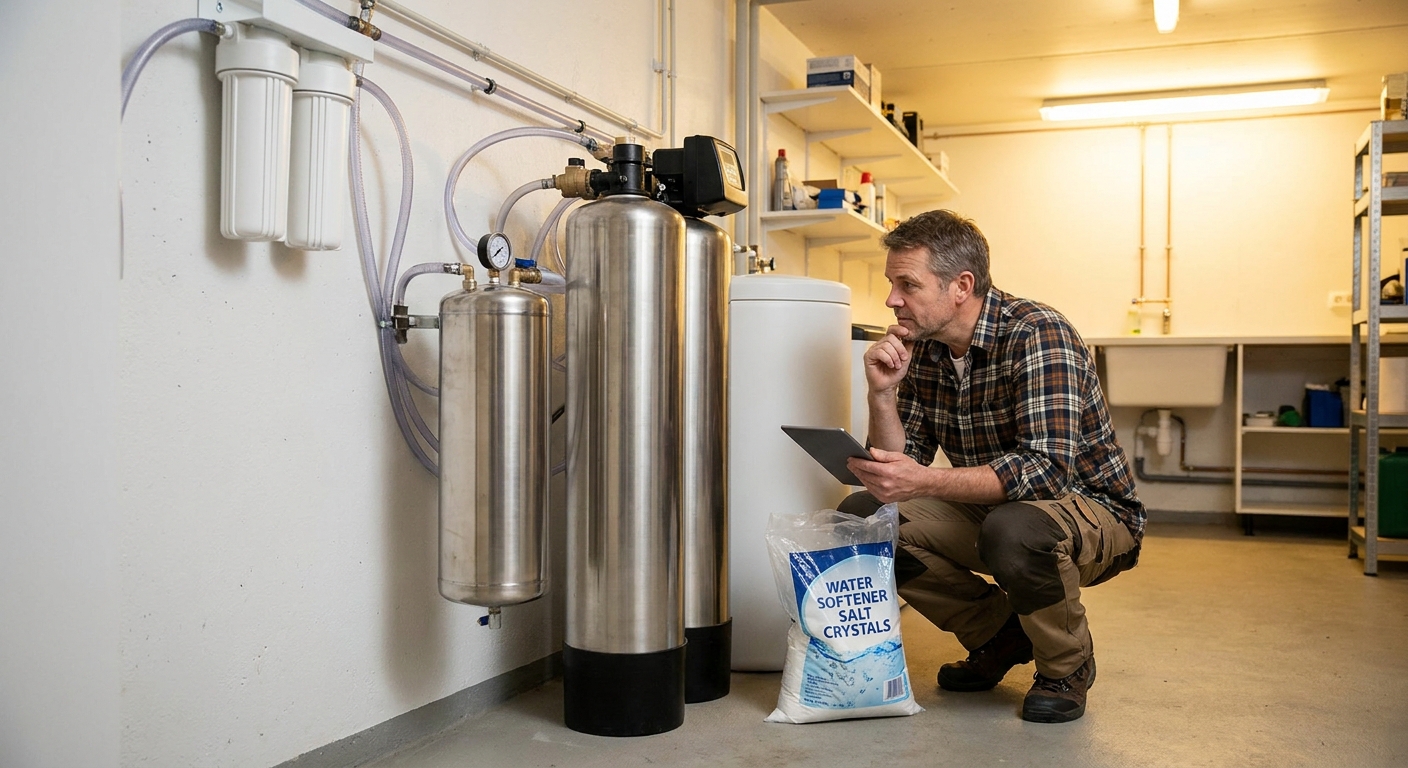
What Is Hard Water and Why Should You Care?
Hard water is water that contains elevated concentrations of dissolved calcium and magnesium minerals picked up as water moves through rock and soil. It's measured in grains per gallon (GPG), with one grain equaling roughly 17.1 parts per million (ppm). The higher the GPG, the harder your water and the more damage it quietly causes behind the scenes.
Hard Water Classification Scale
| Hardness Level | GPG Range | PPM Range |
|---|---|---|
| Soft | Less than 1.0 | Less than 17.1 |
| Slightly Hard | 1.0 to 3.5 | 17.1 to 60 |
| Moderately Hard | 3.5 to 7.0 | 60 to 120 |
| Hard | 7.0 to 10.5 | 120 to 180 |
| Very Hard | 10.5+ | 180+ |
Hard water is a nationwide issue. Roughly 85% of U.S. homes deal with it to some degree, according to 2026 USGS-based data. The hardest-water states most frequently cited in current rankings include Indiana, Arizona, Texas, New Mexico, Utah, Nevada, and Kansas, with Indiana averaging around 298 ppm and Arizona around 280 ppm. Cities like Las Vegas and Phoenix consistently exceed 250 ppm, and Indianapolis can reach up to 20 GPG.
The Real Cost of Ignoring Hard Water in 2026
Hard water isn't just a nuisance, it's a budget drain. The latest AWWA and Water Quality Research Foundation data show the average hard-water household loses $800 to $1,200 per year in appliance wear, energy waste, cleaning products, and plumbing repairs. Here's where that money goes:
- Water heaters can lose 24 to 48% efficiency at high hardness, with even a thin layer of scale increasing energy use significantly (per WQA research)
- Every 5 GPG of hardness causes roughly a 4% loss in gas water heater efficiency, per the widely cited Battelle Memorial Institute study
- Water heater lifespan can be cut from 12 to 15 years down to 6 to 8 years in hard-water homes
- Plumbing repairs from mineral buildup can average several hundred dollars per year per household
- Cumulative appliance repair and replacement costs can reach $6,000 or more over time in untreated hard-water homes
- Faucets and showerheads require ongoing maintenance to fight limescale

Find Trusted & Licensed Plumbers in Ohio
Get matched with companies for your specific needs
Comparing All Major Hard Water Treatment Options
There's no one-size-fits-all fix. The best hard water solution depends on your GPG level, household size, budget, and how much maintenance you're willing to do. Below is a breakdown of each option with 2026 pricing.
1. Salt-Based Water Softeners
The traditional gold standard. Salt-based systems use ion exchange, where hard water flows through a resin tank and calcium and magnesium ions are swapped out for sodium or potassium ions. When the resin beads become saturated, a regeneration cycle uses a saltwater brine to flush minerals down the drain and recharge the system.
Best for: Households with hard to very hard water (7 to 20+ GPG) who want the most complete solution.
2026 Cost Snapshot:
- Upfront: $1,000 to $3,000 installed (national average around $1,500 to $2,000, with a broader range of $200 to $6,000 per Angi 2026 data)
- Dealer-installed premium brands (Culligan, RainSoft, EcoWater): $2,500 to $8,000+
- Annual salt: $50 to $150/year (roughly $8 to $10/month for a family of four)
- Annual maintenance: $100 to $300/year
Before committing to a system, learn more about water softener installation, because proper sizing matters more than most people realize.
2. Salt-Free Water Conditioners
Salt-free conditioners don't actually remove hardness minerals. Instead, they use Template-Assisted Crystallization (TAC) or Nucleation-Assisted Crystallization (NAC) to convert calcium and magnesium into microscopic crystals that can't adhere to pipes or surfaces. Independent testing under the German DVGW W512 standard has found TAC media to be up to 99.6% effective at preventing hard-water mineral buildup, while retaining beneficial minerals.
Best for: Households with moderate hardness (3.5 to 25 GPG), renters, eco-conscious households, or areas where salt discharge is restricted (like parts of California).
2026 Cost Snapshot:
- Upfront: $500 to $4,000 (top-rated systems like SpringWell FutureSoft/SS1 run around $1,700 to $1,900; Pelican NaturSoft around $1,900)
- Budget carbon+TAC combos: around $299 to $1,899
- Annual maintenance: Low, media replacement typically needed only every several years
- No salt or electricity costs
3. Electronic Descalers
Electronic descalers are plug-in devices that wrap wire coils around your existing pipes and emit electromagnetic frequencies to alter the crystalline structure of minerals, reducing their ability to stick to surfaces. Real-world reviews of popular units like the iSpring ED2000 report noticeable scale reduction over 2 to 12 weeks, though results vary significantly by home size, pipe length, and water chemistry. Most units are rated to work best within about 50 feet of pipe from the device and for hardness up to roughly 25 GPG.
Best for: Renters, apartment dwellers, or homeowners who want a low-commitment, no-plumbing solution for mild to moderate hardness.
2026 Cost Snapshot:
- Upfront: $129 to $800 (popular options like iSpring ED2000 start around $129)
- Annual maintenance: Minimal, electricity only at pennies per day
4. Reverse Osmosis (RO) Systems
Reverse osmosis pushes pressurized water through a semi-permeable membrane that filters out 95 to 99% of dissolved minerals, contaminants, heavy metals, and hardness-causing calcium and magnesium. Most RO systems also include pre-filters (sediment and carbon) to protect the membrane.
Best for: Point-of-use drinking water purification, or as part of a combined system for very hard water with contaminant concerns.
2026 Cost Snapshot:
- Under-sink RO: $200 to $950 installed; $50 to $150/year for filters and membrane
- Whole-house RO: $4,500 to $15,000+ installed for typical setups, and $8,000 to $25,000+ for complex well-water systems with heavy pre-treatment; $500 to $2,000/year in maintenance
5. Whole-House Water Filters
Whole-house filters (also called point-of-entry filters) treat all the water entering your home. They're effective at removing sediment, chlorine, and certain contaminants, but standard carbon filters don't remove hardness minerals. For hard water, you'll need a filter system specifically designed with scale-inhibiting media or a combined softener-filter unit.
Best for: Households concerned about both water quality and hardness, as part of a multi-stage treatment approach.
2026 Cost Snapshot:
- Upfront: $300 to $1,500 (filter only); higher for combination units
- Annual maintenance: $100 to $400 (filter replacements)
6. Emerging Option: Capacitive Deionization (CDI)
New for 2026, several manufacturers (notably Karofi, which debuted a whole-house CDI system at CES 2026) are bringing Capacitive Deionization to residential markets. CDI uses electrically charged electrodes to attract and remove dissolved ions, eliminating the need for salt or brine discharge while still reducing actual hardness. Current 2026 reviews position CDI as an emerging premium option, not yet a mainstream low-cost choice, but it's worth watching if you're planning a system in the next couple of years.
Which Hard Water Treatment Is Right for You?
Use this comparison to match your situation to the best solution:
Quick Recommendation Guide by Hardness Level
| GPG Level | Best Primary Solution | Optional Add-On |
|---|---|---|
| Under 3.5 GPG | Electronic descaler or whole-house filter | Under-sink RO for drinking water |
| 3.5 to 7 GPG | Salt-free TAC conditioner | Carbon whole-house filter |
| 7 to 10.5 GPG | Salt-based water softener | Under-sink RO for drinking |
| 10.5+ GPG (Very Hard) | Salt-based softener + RO pre-treatment | Whole-house RO for full purification |
If you're unsure where to start, reviewing water softener installation options can help you understand sizing, types, and costs.
Frequently Asked Questions
What is the most effective hard water treatment available in 2026?
Salt-based ion exchange water softeners are still widely considered the most effective hard water treatment, with independent 2026 data showing 85 to 95% scale reduction. They fully remove calcium and magnesium from your water supply, protecting plumbing and appliances. For households with very hard water above 10.5 GPG, a salt-based softener combined with an under-sink RO unit for drinking water delivers the most comprehensive results.
Can I treat hard water without a salt-based softener?
Yes, several salt-free options exist. TAC (Template-Assisted Crystallization) conditioners like SpringWell FutureSoft prevent scale from adhering to surfaces without adding chemicals or removing minerals, and independent DVGW testing shows up to 99.6% scale prevention. Electronic descalers offer a low-cost alternative for mild to moderate hardness. These alternatives work best for water under 25 GPG and for households that prefer a low-maintenance or eco-friendly approach.
Is hard water dangerous to drink?
Hard water is not considered dangerous to drink. The calcium and magnesium it contains are actually beneficial minerals. The main concerns are with your plumbing, appliances, and fixtures rather than your health. However, softened water from salt-based systems does add sodium to your water, which may be a concern for individuals on a low-sodium diet.
How much does it cost to treat hard water in 2026?
Costs vary widely by treatment type. Electronic descalers start as low as $129 to $800 with minimal ongoing costs. Salt-free conditioners run $500 to $4,000 upfront. Salt-based softeners cost $1,000 to $3,000 installed on average (higher for dealer brands), plus $50 to $150/year in salt. Under-sink RO systems run $200 to $950, while whole-house RO systems can cost $4,500 to $15,000+. For most households, a salt-based softener or salt-free conditioner offers the best balance of cost and effectiveness.
How do I know how hard my water is?
The easiest way is to use a water hardness test kit, available at hardware stores or online for $10 to $15. You can also contact your local water utility, since most publish annual water quality reports (CCRs) that include hardness levels. If you're on well water, a professional water test is recommended, as hardness and other contaminants can vary significantly. Any reading above 7 GPG warrants action to protect your home.