
How Earthquakes Destroy Plumbing Systems
Most homeowners don't think about their plumbing until something goes wrong — and after an earthquake, a lot can go wrong very quickly. Earthquakes impose sudden, violent lateral forces on a building's structure and everything attached to it. Rigid pipes, heavy appliances, and threaded joints are highly vulnerable because they simply can't flex with the movement.
The Most Common Types of Earthquake Plumbing Damage
Here's how seismic activity typically damages a home's plumbing:
| Damage Type | Cause | Immediate Risk |
|---|---|---|
| Broken interior water lines | Pipes snap at rigid joints or threaded elbows | Flooding — hundreds of gallons per minute |
| Gas line ruptures | Rigid black iron pipe shears at fittings or meter connections | Fire, explosion, asphyxiation |
| Water heater tip-over | Unsecured tank rocks and falls | Combined gas + water line failure |
| Sewer lateral cracks | Ground shifts crack or offset clay/cast-iron pipes | Sewage backup, health hazard |
| Slab leaks | Under-slab pipes crack from ground deformation | Hidden structural water damage |
| Service line separation | Underground supply line pulls apart at fittings | Loss of water supply |
Gas Line Failures: The Most Dangerous Risk
Gas lines are the highest-stakes plumbing component in any earthquake. Rigid black iron pipe can shear or crack at threaded joints. Appliance connections snap as the building moves relative to the appliance. Even if your pipes don't immediately rupture, delayed stress from a shifted structure can cause leaks days later. Post-earthquake fires are frequently caused by undetected gas leaks — which is exactly why seismic gas shut-off valves exist.
Water Heaters: A Two-Hazard Problem
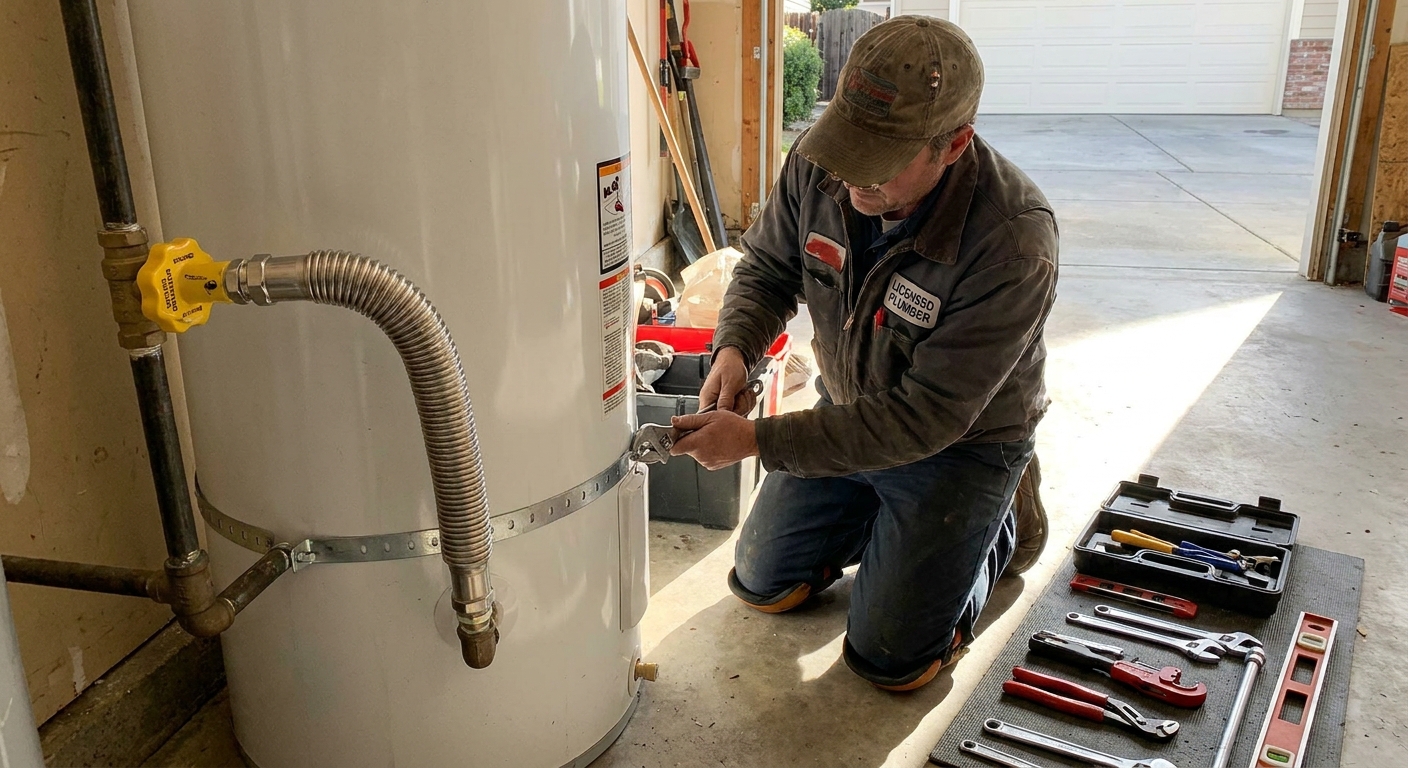
An unsecured water heater is both a flooding risk and a fire risk. When a tall, heavy tank tips over, it can simultaneously tear off the cold water supply line and rupture the gas flex connector — creating a water-and-gas emergency at the same time. This is why water heater strapping is one of the most universally enforced seismic plumbing requirements across all high-risk states.

Find Trusted & Licensed Plumbers in Ohio
Get matched with companies for your specific needs
Seismic Plumbing Code Requirements by State
Seismic plumbing rules are primarily governed at the state and local level, layered on top of model codes like the Uniform Plumbing Code (UPC) and the International Plumbing Code (IPC). Requirements vary significantly depending on building type, seismic design category, and whether the project is new construction, a remodel, or a retrofit.
California — The Most Comprehensive Seismic Plumbing Standards
California operates under the California Plumbing Code (CPC), the California Building Code (CBC), and Title 24 requirements. The 2025 editions are effective for most permits filed on or after January 1, 2026, and represent the strictest residential seismic plumbing standards in the nation.
Mandatory under California code:
- Water heaters must be anchored with two straps (upper and lower third of tank) secured to structural framing
- All gas piping and appliance connections must comply with seismic safety provisions
- Suspended piping runs must be braced for lateral movement
- New construction and substantial remodels must use flexible connectors at all appliance hookups
- Many local jurisdictions (Los Angeles, San Francisco, Oakland, Berkeley) require automatic seismic gas shut-off valves for new construction, major remodels, and sometimes as a point-of-sale requirement
Recommended best practices in California:
- Extra seismic bracing for long horizontal pipe runs
- Flexible supply lines at all fixtures, not just appliances
- Automatic water shut-off or leak-detection systems
Washington — Code-Based with Local Enforcement
Washington applies seismic plumbing requirements through the Washington State Building Code and Washington State Plumbing Code, largely based on adopted UPC and IPC editions with state amendments.
Mandatory in Washington:
- Water heater anchorage and bracing
- Flexible connections where building drift or movement could damage rigid piping
- Seismic restraint of piping where required by structural code provisions
Western Washington — particularly the Seattle metro area — sits atop the Cascadia Subduction Zone, one of the most dangerous fault systems in North America. Local jurisdictions here frequently go beyond minimum state requirements.
Alaska — High Risk, Engineering-Driven Compliance
Alaska has some of the highest seismic risk in the U.S., especially in the Anchorage region and south-central areas. The state operates under adopted building and plumbing codes plus local amendments.
Mandatory in Alaska:
- Anchoring and bracing of water heaters and major plumbing equipment
- Seismic restraint of piping in high-risk zones
- Flexible connections where structural movement is anticipated
Because of Alaska's extreme seismic exposure, licensed engineers and plumbers routinely apply conservative bracing even beyond what the prescriptive code text specifies.
State-by-State Comparison
Essential Seismic Plumbing Upgrades Explained
Understanding what each upgrade does — and whether it's mandatory or simply smart — helps you prioritize where to spend your money.
1. Earthquake Gas Shut-Off Valves
An earthquake gas shut-off valve (also called a seismic gas shut-off valve) automatically cuts the gas supply to your home when shaking exceeds a set threshold — typically equivalent to a magnitude 5.1–5.4 event at your location. Inside the valve, a metal ball sits in a cradle. When shaking dislodges it, the ball drops into a port and blocks gas flow. The valve must be manually reset by a qualified person after verifying there's no damage.
These are installed on the house side of the gas meter, downstream from the utility connection.
Are they required? At the statewide level in California, they are not universally mandated — but many cities (Los Angeles, San Francisco, and others) require them for new construction, major remodels, and sometimes at point of sale. In Washington and Alaska, they are recommended but rarely universally required. Always check with your local building department.
2. Water Heater Seismic Strapping
This is one of the few seismic plumbing upgrades that is broadly mandatory. California law and the California Plumbing Code require all tank-style water heaters to be secured with two heavy-duty straps — one in the upper third and one in the lower third of the tank — anchored directly into wall studs or solid structural backing (not just drywall).
During a home sale in California, lenders and home inspectors will flag an improperly strapped water heater and may require correction before closing.
3. Flexible Gas Connectors
Flexible corrugated metal connectors replace rigid gas piping at appliance connections — water heaters, ranges, dryers, and furnaces. When the building shifts during a quake, a flex connector can absorb movement that would shear a rigid threaded connection. California and most seismic-zone codes require approved flexible connectors for all gas appliance hookups.
Important: Old corrugated stainless steel tubing (CSST) or uncoated connectors may need replacement. Modern connectors are listed and approved per ANSI Z21.24.
4. Flexible Water Supply Lines
Just as with gas, flexible braided stainless steel or corrugated copper supply lines at fixtures and appliances dramatically reduce the chance of supply line failures during ground movement. These should be used at:
- Water heater (hot and cold inlets)
- Toilet supply lines
- Sink faucet connections
- Dishwasher and washing machine hose connections
5. Seismic Pipe Restraints and Bracing
For larger pipe runs — especially overhead or suspended piping in crawlspaces, basements, and garages — seismic bracing systems use rigid strut channels, pipe clamps, and wall/ceiling anchors to prevent pipes from swinging, racking, or pulling apart during lateral movement. California's CBC seismic bracing requirements cover all MEP (mechanical, electrical, plumbing) systems in commercial and multifamily buildings, and the principles apply to residential upgrades as well.
Retrofit Requirements, Costs & Insurance Considerations
Retrofit Requirements for Older Homes
Homes built before 1985 are especially vulnerable — they were typically designed without modern seismic plumbing standards. Whether a retrofit is mandatory or recommended depends on:
- Your local jurisdiction's ordinances
- Whether you're pulling permits for a remodel
- Whether you're buying or selling the home
In California, water heater strapping is required regardless of when the home was built and is typically enforced at every permit inspection and real estate transaction. Beyond that, full seismic plumbing retrofits (pipe bracing, flexible connectors, gas shut-off valves) are generally triggered by:
- Major remodels that alter 50%+ of a structural system
- Adding a new gas appliance or service
- Local point-of-sale ordinances in high-risk cities
In Portland, Oregon, older homes — especially those built before 1960 — often have no foundation bolting at all, making full system bracing urgent. Seattle's building department has its own residential seismic strengthening guidance for older wood-frame homes.
Mandatory vs. Recommended Upgrades
Cost of Seismic Plumbing Upgrades (2025–2026)
| Upgrade | DIY Materials | Professional Install |
|---|---|---|
| Water heater seismic strapping | $20–$60 | $250–$400 |
| Flexible gas connectors (per appliance) | $15–$40 | $75–$200 |
| Earthquake gas shut-off valve | $100–$250 | $200–$500 |
| Flexible water supply lines (whole home) | $50–$150 | $200–$600 |
| Seismic pipe restraints/bracing (residential) | $50–$200 (hardware) | $300–$2,500+ |
| Full basic seismic plumbing package | — | $1,150–$3,000+ |
For broader seismic structural retrofits (foundation bolting, cripple wall bracing), costs typically range from $3,500 to $10,000 for a standard single-family home, with the average around $6,000–$7,000.
Insurance Considerations
Seismic plumbing upgrades primarily benefit earthquake insurance policyholders. The California Earthquake Authority (CEA) offers up to 25% off earthquake premiums for qualifying brace-and-bolt foundation retrofits — and when your documented retrofit includes water heater strapping, flexible connectors, and gas shut-off valves, it strengthens your eligibility for those credits.
For standard homeowners insurance, modern flexible plumbing connections and automatic water shut-off systems can reduce water damage claims risk, which some insurers reward with modest premium credits. Always document all upgrades with permits, photos, invoices, and contractor certifications before contacting your insurer.
Frequently Asked Questions
Is earthquake-proof plumbing required in California?
California has the most comprehensive seismic plumbing rules in the country, but "required" varies by upgrade type. Water heater strapping and flexible gas connectors are broadly mandatory under the California Plumbing Code. Full pipe bracing and seismic gas shut-off valves may be required in specific cities or triggered by major remodels. Check with your local building department for the exact requirements that apply to your home and project scope.
How does a seismic gas shut-off valve work?
A seismic gas shut-off valve installs on your gas line just inside the building, downstream of the utility meter. It contains a metal ball that sits in a cradle under normal conditions, allowing gas to flow freely. When earthquake shaking exceeds the valve's trigger threshold — typically equivalent to a strong 5.1–5.4 magnitude event — the ball dislodges and blocks gas flow. The valve must be manually reset by a qualified person after confirming there is no gas damage.
How much does it cost to earthquake-proof plumbing in a typical home?
A complete basic seismic plumbing package — including water heater strapping, a seismic gas shut-off valve, flexible gas connectors for all appliances, flexible water supply lines, and targeted pipe bracing — typically costs between $1,150 and $3,000 installed by a licensed plumber. Individual upgrades like water heater strapping alone can be as low as $250–$400. Costs vary significantly by region, home size, and how accessible the plumbing is.
Does homeowners insurance cover earthquake plumbing damage?
Standard homeowners insurance policies typically do not cover earthquake damage, including plumbing failures caused by seismic activity. You need a separate earthquake insurance policy for that coverage. However, if broken pipes cause water damage independent of the seismic event, some standard policies may cover that portion. Review your policy carefully and consider the California Earthquake Authority (CEA) or a private earthquake insurer if you live in a high-risk zone.
What are the most important seismic plumbing upgrades for older homes?
For homes built before 1985, the highest-priority seismic plumbing upgrades are: (1) water heater strapping with two properly anchored straps, (2) replacing any rigid gas appliance connectors with approved flexible connectors, (3) installing a seismic gas shut-off valve at the meter, and (4) upgrading to flexible braided supply lines at toilets, sinks, and water heater connections. These four upgrades can be completed for $1,000–$2,000 and dramatically reduce the risk of gas leaks, flooding, and fire after a major earthquake.