


Lower Your Cost of Owning a Home
Compare home insurance quotes from insurers in Ohio
Pending home sales hit a record low
The Pending Home Sales Index tracks contracts signed on existing homes. It's an early signal for the housing market, because most of those contracts turn into closed sales within one or two months. An index of 100 equals the average level of contract activity in 2001.
In September, that index fell to 66.0. That's 7.3% below August and 11.3% below September 2025, and every region of the country declined on both measures.
| Measure | September 2026 | Change |
|---|---|---|
| Pending Home Sales Index (U.S.) | 66.0 | -7.3% month over month |
| Year-over-year change | -11.3% | |
| 30-year fixed mortgage rate (Oct. 15) | 7.40% | Up from 6.27% a year earlier |
| Median existing-home price | $417,500 | +1.3% year over year |
| Existing-home sales (annual pace) | 3.99 million | -2.2% year over year |
Sources: NAR Pending Home Sales (Oct. 20, 2026) and Existing-Home Sales (Oct. 13, 2026) reports; Freddie Mac Primary Mortgage Market Survey (Oct. 15, 2026).
"Market conditions weakened in September due to fast-rising mortgage rates," said NAR Chief Economist Lawrence Yun. "Although job growth and income gains can support home purchases, housing affordability is more affected by changes in mortgage rates."

Fewer buyers are signing contracts, even as homes stay on the market a little longer.
Why mortgage rates jumped so quickly
Earlier this year, borrowers caught a break. Freddie Mac's weekly average for a 30-year fixed loan bottomed at 5.98% on Feb. 26, 2026. Since then, rates have climbed almost without pause. They rose seven weeks in a row through Oct. 8 and held at 7.40% on Oct. 15.
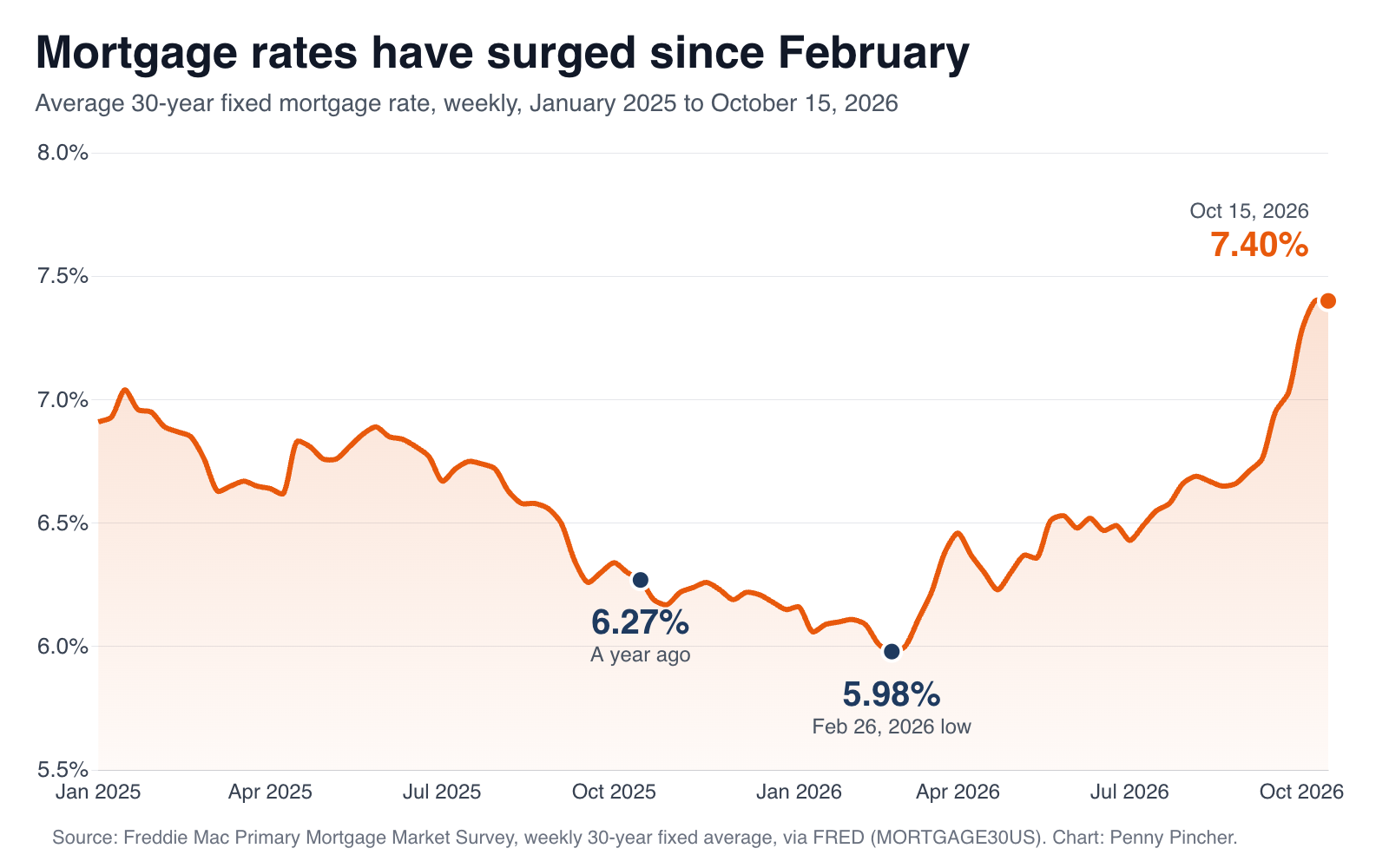
Mortgage rates tend to follow long-term Treasury yields. Reuters reported that higher borrowing costs have tracked those yields as the U.S.-Israeli war with Iran fuels inflation.
Yun noted that mortgage rates "have already risen much more than the Federal Reserve's short-term interest rate hikes" and said they "could be topping out." He cautioned that rising energy prices and the inflation pressure they create remain highly uncertain.
What the jump means for a monthly payment
A rise of a point or more can sound abstract. Here's what it looks like on a real home.
Take the September median existing-home price of $417,500, put 20% down, and finance the remaining $334,000 with a 30-year fixed loan:
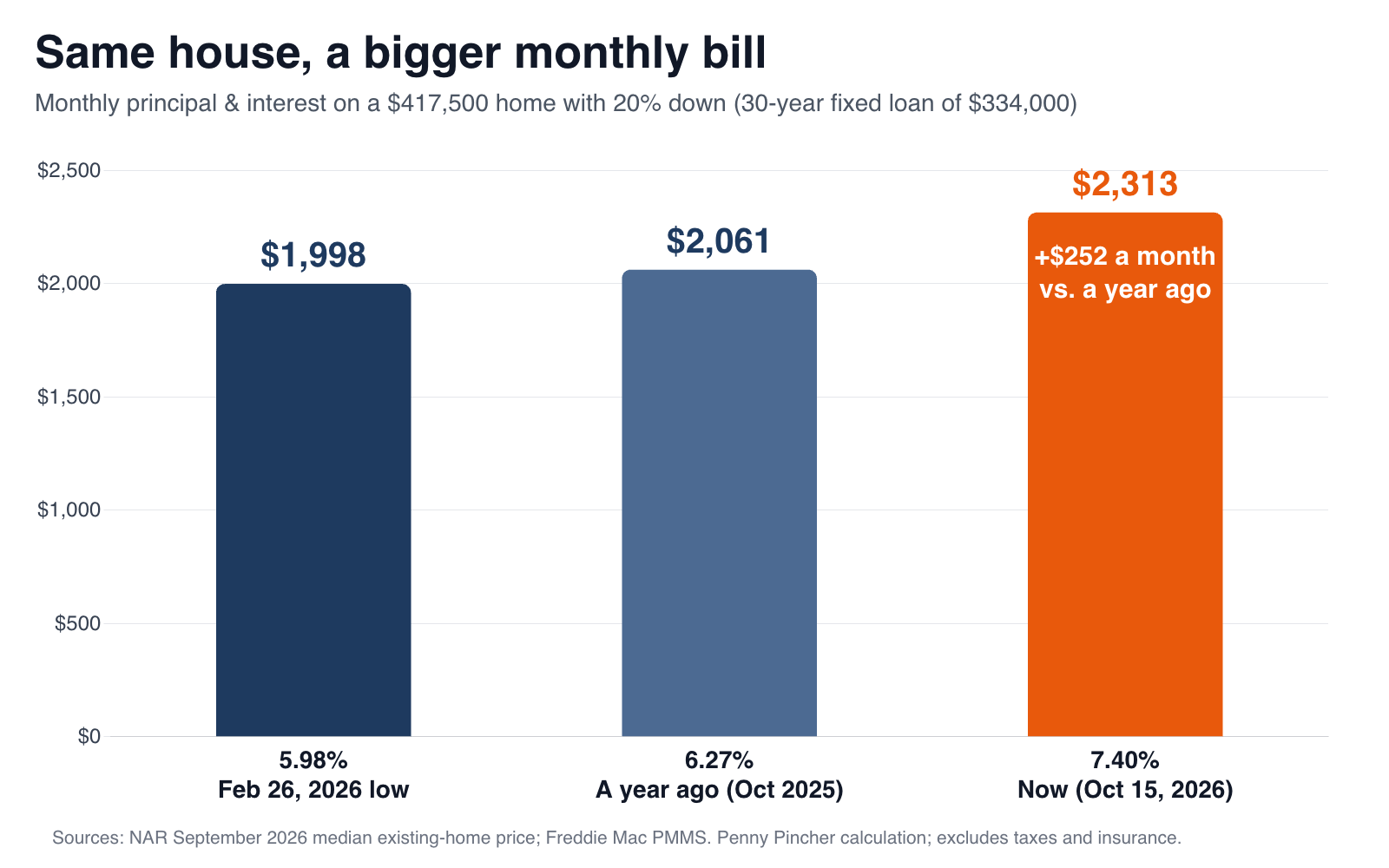
| Rate | When | Monthly principal & interest | Total interest over 30 years |
|---|---|---|---|
| 5.98% | Feb. 26, 2026 low | $1,998 | about $385,000 |
| 6.27% | October 2025 | $2,061 | about $408,000 |
| 7.40% | Oct. 15, 2026 | $2,313 | about $499,000 |
That's about $252 more per month than a year ago, or roughly $3,000 a year, for the same house. Compared with February's low, the difference is about $315 a month. These figures cover principal and interest only; property taxes, homeowners insurance and any mortgage insurance would add to the bill.

For many buyers, a one-point jump in rates is the difference between qualifying and waiting.
Where the slowdown hit hardest
Every region posted declines in September, but the West was hit hardest. Pending sales there fell 9.2% from August and 15.0% from a year earlier, and the region's index sits at just 49.3.
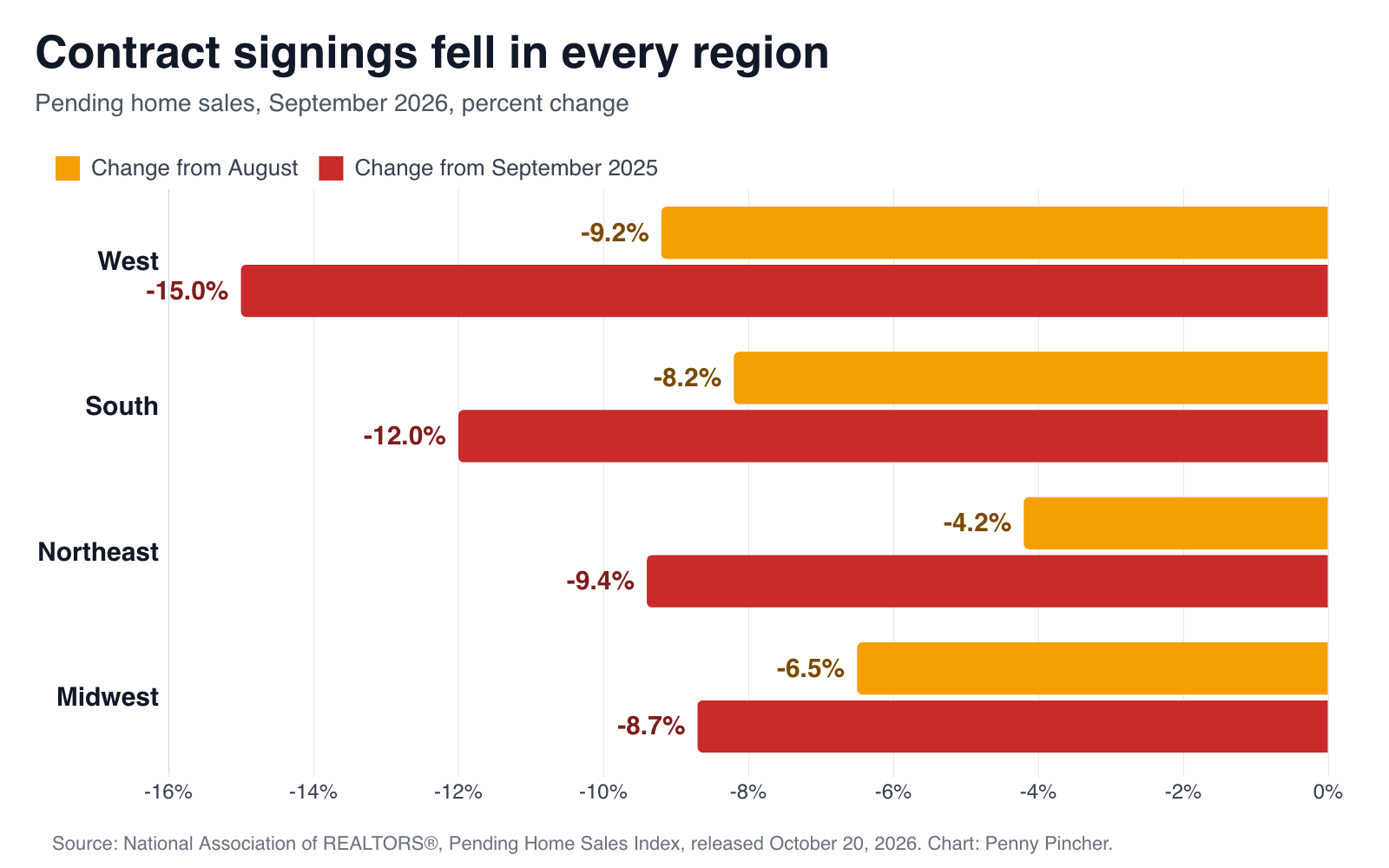
| Region | Index (Sept. 2026) | Change from August | Change from a year ago |
|---|---|---|---|
| South | 79.2 | -8.2% | -12.0% |
| Midwest | 67.3 | -6.5% | -8.7% |
| Northeast | 59.0 | -4.2% | -9.4% |
| West | 49.3 | -9.2% | -15.0% |
Even the strongest metro markets lost ground. Among the 50 largest metros, the smallest annual declines were in Nashville (-2.0%), Hartford (-2.1%) and San Francisco (-3.5%), according to Realtor.com® Economics data cited by NAR.
Prices are holding steady for now
Fewer buyers doesn't automatically mean falling prices. In September, NAR reported:
- Median existing-home price: $417,500, up 1.3% from a year earlier
- Inventory: 1.60 million homes for sale, up 4.6% from a year earlier
- Months' supply: 4.8 months, up from 4.5 a year earlier
- Median time on market: 33 days
"Despite the difficulty of obtaining a mortgage, the limited number of distressed properties is ensuring steady home prices," Yun said. "Buyers and sellers may simply be holding back until mortgage rates move favorably."
Because pending sales usually close within one to two months, September's drop in contracts suggests closed sales could soften in the months ahead.

More listings and longer days on market can shift some negotiating power toward buyers.
What it means for you
If you're buying: "Higher inventory and lengthening days on market give buyers improved negotiating power," Yun said last week. Get preapproved so you know what you can truly afford at today's rates, compare offers from several lenders, and ask sellers about concessions that could lower your costs.
If you're selling: With homes sitting a bit longer, pricing realistically from day one matters more than it did a year ago.
If you already own: You don't need to do anything differently. This is a good moment to make sure your other big housing costs, like homeowners insurance and property taxes, still make sense.
Frequently asked questions
What are pending home sales?
Pending home sales count contracts signed on existing homes that haven't closed yet. NAR's index is based on a large sample of multiple listing service data and is considered a leading indicator, because contract activity tends to show up in closed sales one to two months later.
How low is 66.0?
An index of 100 equals the average contract activity in 2001. September's reading of 66.0 is the lowest since the series began.
Will mortgage rates come down?
No one knows for sure. NAR's Lawrence Yun said rates "could be topping out," but noted that energy prices and inflation are highly uncertain.
How much does a higher rate really cost?
On a $334,000 30-year fixed loan, moving from 6.27% to 7.40% raises the monthly principal and interest payment from about $2,061 to about $2,313, roughly $3,000 more per year.
Sources
- National Association of REALTORS®: Pending Home Sales Decreased 7.3% in September (Oct. 20, 2026)
- National Association of REALTORS®: Pending Home Sales Snapshot, September 2026
- National Association of REALTORS®: Existing-Home Sales Increased 1.5% in September (Oct. 13, 2026)
- Freddie Mac: Mortgage Rates Hold Steady at 7.40% (Oct. 15, 2026)
- Federal Reserve Bank of St. Louis (FRED): 30-Year Fixed Rate Mortgage Average (MORTGAGE30US)
- Reuters via Investing.com: US pending home sales tumble to record low in September
Payment figures are Penny Pincher calculations for illustration only, using the NAR September 2026 median existing-home price, 20% down and Freddie Mac average rates. Your rate and payment will depend on your credit, loan type, down payment and lender.